
A Long Walk to Water cover
Garden Heights

A Long Walk to Water

This workbook is for Garden Heights members. Sign in to continue.

Sign in with Google →
New here? Just sign up with Google — your account includes Matilda, our gift book, forever.
A Long Walk to Water · Garden Heights

Part 8

for A Long Walk to Water · Part 8 · Chapters 17–18
8 Parts40 min
What Happens in Part 8

Salva reunites with his father, founds a well-drilling nonprofit, and brings clean water — and his name — to Nya's village.

Father and SonWord reaches Salva in America that his father is alive — sick, but being treated at a clinic in southern Sudan. Salva makes the long journey back and finds Mawien Dut in a bed at the small UN clinic. His father does not recognize the tall stranger at first; when he understands this is the son he believed dead, the two hold each other and weep.

A Dangerous HomecomingThe illness carries the book's whole argument: years of drinking dirty water have filled his father with waterborne disease, and he needs surgery before going home. Salva's mother is alive in the village, with sisters and a surviving brother, but his father warns him not to go — the fighting is too close, and a returning young man could be seized for a soldier. They part promising to meet again when it is safe.

Wells for SudanOn the flight back to New York, grief and hope press into a single idea: Sudan's people need clean water, and Salva — who knows exactly what its absence costs — could bring it. With American friends he founds a nonprofit to drill wells in southern Sudan's villages. Terrified before his first public talk, he remembers his uncle's advice about one step at a time, and speech by speech — schools, churches, clubs — the money slowly comes.

The Same WellIn Nya's village the borehole is finished, a pump is set, and clean water rises from dry land; her father says a school will be built, for girls and boys alike. Nya is astonished that the workers' leader is Dinka — a people her own Nuer have long fought — and crosses the clearing to thank him. He asks her name, glad the water is hers. His name is Salva, and the book's two long walks end at the same well.

What We Will Learn
SectionWhat you will practice
VocabularyIllness, giving, and thanks: contaminated, surgery, nonprofit, donation, gratitude
Literary ElementsParallel narratives that finally converge, dramatic irony held until the last page, and a resolution built on one spoken name
Cross-CurricularWater engineering — how a borehole reaches the water table, why deep groundwater is safe when pond water is not, and what one well lets a village build
Chapter Summary
Ch.What happens
Chapter 17A Father Found, a Plan Born — Salva travels back to Sudan and finds his father at a small clinic, sick from years of drinking dirty water. His mother is alive, but the village is too dangerous to visit. Flying home, Salva conceives his plan: drill wells. With friends’ help he founds a nonprofit and raises money speech by speech. In Nya’s village, her father announces that a school — for boys and girls alike — will follow the well.
Chapter 18Water Rises, a Name Is Spoken — The drilling crew finishes the well, and clean water flows in Nya’s village at last. Nya is astonished to learn the crew’s leader is Dinka — a man from the people her own people have fought — yet he has brought water to a Nuer village. She thanks him; he asks her name and wishes her well. His name is Salva, and the novel’s two storylines close around one working pump.
Part 1
Vocabulary
Study 10 key words from Chapters 17–18, then answer each question.
📚Knowledge Bank · Words for Giving Back
Vocabulary · Part 8Part 8 speaks two languages at once. The first is the language of damage and repair: a father made ill by contaminated water, a clinic, a surgery he must survive before he can walk home. The second is the language of organized giving, and it is worth learning precisely, because these are the words adults use when they turn sympathy into action. A nonprofit is an organization built to help rather than to earn; a donation is what people hand it; to persevere is what keeps it alive through years of slow work. Two of these words carry their history inside them: donation descends from the Latin donare — to give — while persevere joins per-, thoroughly, to severus, strict: to hold strictly on until a thing is finished. Notice that every one of these words is practical, not sentimental. The novel ends not with tears but with a working pump — and with the one word Nya carries across the clearing herself: gratitude.
reunionn.Ch.17
A meeting of people who have been apart for a long time
“The reunion at the clinic came after almost nineteen years apart.”
contaminatedadj.Ch.17
Made dirty or unsafe by harmful substances
“Years of contaminated water had made Salva’s father ill.”
surgeryn.Ch.17
Medical treatment in which doctors operate on the body
“His father needed surgery before he could return to the village.”
nonprofitn.Ch.17
An organization that exists to help people, not to make money
“Salva and his friends set up a nonprofit to drill wells in Sudan.”
donationn.Ch.17
Money or goods given to support a cause
“Each talk Salva gave brought another donation toward a well.”
perseverev.Ch.17
To keep working toward a goal in spite of difficulty
“Salva persevered through speech after speech, one step at a time.”
gushv.Ch.18
To flow out suddenly and in large amounts
“Clear water gushed from the pump while the villagers cheered.”
astonishedadj.Ch.18
Greatly surprised; amazed
“Nya was astonished that a Dinka man had brought water to her Nuer village.”
rivaln.Ch.18
A person or group that competes or struggles against another
“Dinka and Nuer had long been rivals, yet the well served everyone.”
gratituden.Ch.18
A feeling of thankfulness toward someone who has helped
“Nya crossed the clearing to offer the leader her gratitude.”

ⓘ The vocabulary words in this list are selected to help you understand and complete this workbook. Some may not appear verbatim in the original novel.
🧠Knowledge Bank question
1According to the Knowledge Bank, the word persevere carries its own history inside it because it ___.Ch.17
2‘Surgery’ is medical treatment in which doctors operate on the body.Ch.17
3Water that is ‘contaminated’ has been ___.Ch.17
4A ‘nonprofit’ is an organization that exists to ___.Ch.17
5Fill in each blank with the correct word.Ch.17–18
Word choices:gratitudedonationreunionrival- some words will not be used
Nya crossed the clearing to offer the leader her .
Each talk Salva gave brought another toward a well.
6To ‘persevere’ means to ___.Ch.17
7Someone who is ‘astonished’ is greatly surprised.Ch.18
8A ‘rival’ is a person or group that ___.Ch.18
9Fill in each blank with the correct word.Ch.17–18
Word choices:gushperseveresurgeryastonished- some words will not be used
Clear water began to from the new pump.
His uncle’s advice taught Salva to , one step at a time.
10A ‘donation’ is a payment that must be paid back like a loan.Ch.17
Part 2
Comprehension
Show you understood what happens in Chapters 17–18.
🔍Knowledge Bank · Two Stories, One Clearing
Content · What Happens in Part 8Follow what finally happens: word reaches Salva that his father is alive, and a son who once crossed deserts walks into a clinic to find a man made sick by the very thing this part is about — dirty water. From that hospital bed comes an idea, from the idea a nonprofit, from the nonprofit speech after speech, and from those speeches a drilling rig parked in a village in southern Sudan. On the other side of the book, Nya watches strangers coax clean water out of dry ground, hears that a school will follow, and at last learns the leader’s name. The chain kept running past the last page: the real organization Salva Dut founded has gone on drilling, village by village, and its handful of early wells has grown into hundreds across South Sudan. Track how every event here is a consequence: nothing in Part 8 happens by luck, and each gift travels a traceable road from suffering into action.
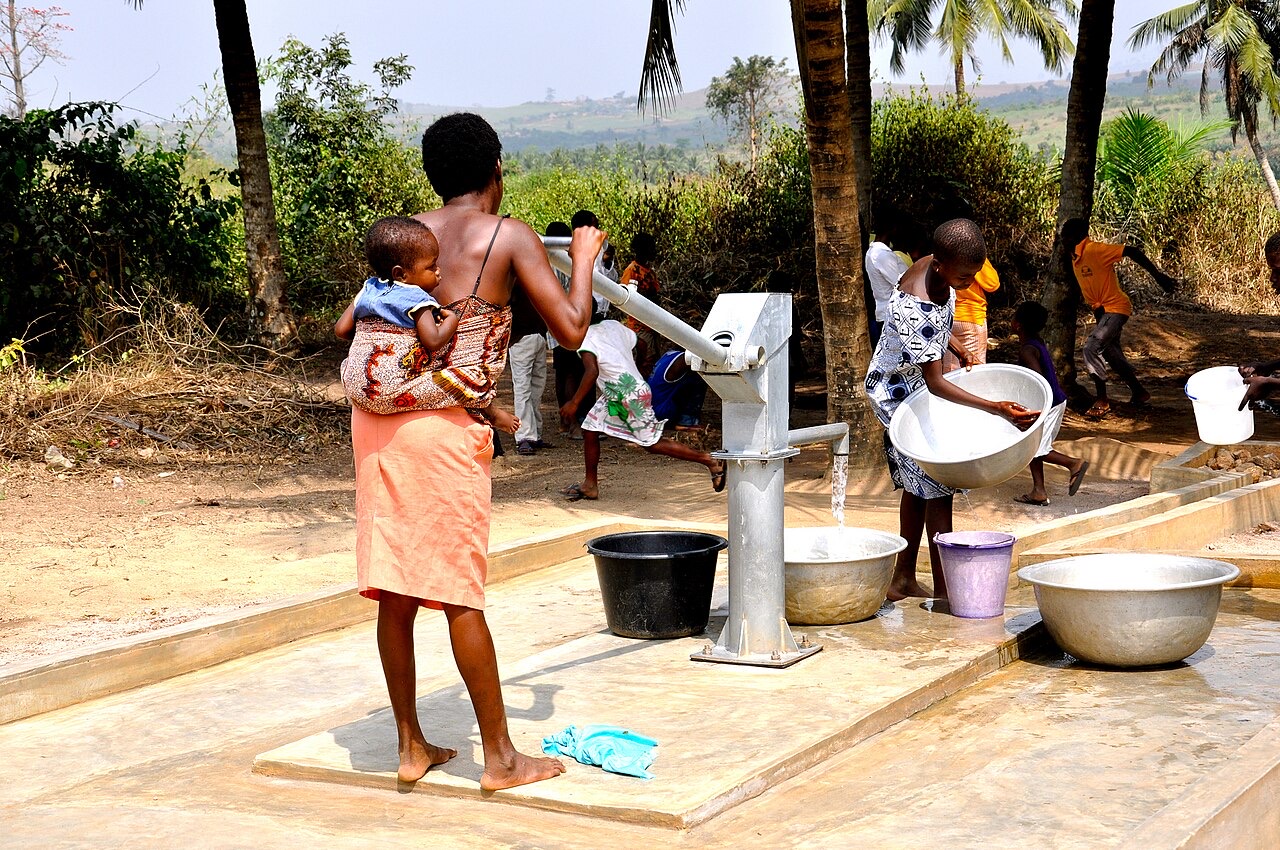
Visual AidA working pump
A woman with a baby on her back works the long handle of a hand pump on a concrete apron while water pours into a metal basin and children wait with buckets
Photograph of a hand pump at work: a woman drives the handle, clean water pours from the spout, and children queue with basins — the end of the chain of consequences the Knowledge Bank follows from a hospital bed to a drilling rig. The pump stands on a sealed concrete apron so that spilled water and dirt cannot run back down the shaft. The photograph was taken by the aid agency USAID elsewhere in Africa, not in Nya’s village, which is Linda Sue Park (author)’s composite; what it shows truly is the object itself. Notice the clock this picture replaces — every basin here once cost someone a day’s walking.
A woman pumps clean water at a USAID-provided station; USAID Africa Bureau photograph by Kasia McCormick, 2012. Source: Wikimedia Commons, File:Flickr - usaid.africa - Water pump.jpg, public domain.
🧠Knowledge Bank question
1The Knowledge Bank explains that the real organization Salva Dut founded has ___.Ch.17
2Why does Salva’s father warn him not to visit his mother?Ch.17
3Salva decides to stay in Sudan with his father instead of returning to America.Ch.17
4What plan takes shape as Salva travels back to America?Ch.17
5Write the numbers 1–5 in the boxes to show the correct order of events. Number 1 = what happens first.Chapters 17–18
  • Salva founds a nonprofit and gives talks to raise money.
  • Salva finds his father at a clinic in southern Sudan.
  • The finished well brings clean water to Nya’s village.
  • On the flight back to America, an idea about water takes shape.
  • Nya thanks the leader and learns that his name is Salva.
6How does Salva raise money for the wells?Ch.17
7Salva’s father tells him that his mother is still alive.Ch.17
8What does Nya’s father say the village will build next?Ch.17
9What astonishes Nya about the man who leads the workers?Ch.18
10At the end, Nya learns that the leader of the well workers is Salva.Ch.18
Part 3
Literary Elements
Understanding HOW and WHY Linda Sue Park tells the story across Chapters 17–18.
🎭Knowledge Bank · The Payoff of Patience
Literary Elements · Part 8Linda Sue Park (author) has run two stories side by side for seventeen chapters, and Part 8 is where the structure pays its debt. The moment the drilling leader appears, readers stand where Nya cannot: we know him, and she does not. That gap is dramatic irony, and she lets it stretch across the final pages so that Nya’s simple thank-you lands with double weight. The device is ancient equipment — Greek audiences knew who Oedipus was long before he did — but tragedy uses the gap to build dread, and this book reverses the machine, letting the reader’s secret knowledge build toward joy. The meeting itself is convergence — two parallel narratives, separated by more than twenty years, touching at last in one clearing. And because thirst opened this book and a well closes it, the resolution does more than settle a plot; it quietly argues that old dividing lines can be redrawn by a single act of kindness.
Parallel Narrative
Two stories — Salva’s, beginning in 1985, and Nya’s, in 2008–2009 — run in alternating strands until Part 8 finally lets them meet.
Dramatic Irony
Readers recognize the drilling leader long before Nya does, so her simple thank-you carries a weight she cannot yet feel.
Resolution
The conflicts of thirst, distance, and old enmity settle into one image: a working well, a promised school, and a spoken name.
🧠Knowledge Bank question
1According to the Knowledge Bank, this book reverses the ancient machinery of dramatic irony by ___.Ch.17–18
2Readers learn the leader’s identity before Nya does. This gap is called ___.Ch.18
3Dramatic irony happens when readers know something a character does not.Ch.18
4The ‘resolution’ of a story is the part where ___.Ch.18
5The resolution of a story is where brand-new conflicts are introduced.Ch.18
6Fill in each blank with the correct literary term.Ch.18
Word choices:resolutionironysuspensesymbol- some words will not be used
Both storylines settle at the well in the story’s .
Knowing the leader’s name before Nya does is dramatic .
7Salva recalling his uncle’s advice about single steps reinforces the theme of ___.Ch.17
8In this novel, water works as a symbol of life and hope.Ch.18
9For most of the book, what separates Salva’s chapters from Nya’s?Ch.17–18
10Fill in each blank with the correct literary term.Ch.17–18
Word choices:symbolthemesettingnarrator- some words will not be used
Water stands for life itself as the book’s central .
The lesson that persistence carries people through is a .
Part 4
Think Deeper
Four deeper challenges — no single-word recall. Read, weigh the evidence, and reason it out.
💡Knowledge Bank · What One Well Changes
Engineering · Drilling a Village WellThe well that rises in Nya’s village is a borehole — a narrow shaft drilled straight down to an aquifer, a buried layer of rock or sand whose pores hold water. Across much of South Sudan that water lies a hundred feet or more beneath the surface, far past the reach of any hand-dug hole, so a rig must hammer through dry earth for days before the drill comes up wet. Crews then line the shaft with pipe, fit a hand pump at the top, and seal the opening so that surface dirt can never trickle down into the clean supply. What changes next is counted in hours. The walk that once consumed a girl’s day shrinks to minutes, and those returned hours are precisely the raw material a school requires. Health shifts along the same line, because most of the illnesses that crowd the region’s clinics — guinea worm among them, a parasite swallowed in standing pond water — travel by the old source and die with it. One working pump quietly redraws a village’s whole future.
Visual AidStraight down to clean water
Straight down to clean waterA cut-away section. A dashed line marks ground level. Above it stands a hand pump with a handle and a spout dripping three drops; directly beneath the pump a sealed collar keeps surface dirt from trickling down, and a narrow pipe-lined shaft runs straight down through dry earth, about a hundred feet or more, to a wide band labelled aquifer, buried rock and sand whose pores hold water. A teal arrow beside the shaft shows water rising inside the pipe. Notes say a rig hammers for days before the drill comes up wet, and that one working pump quietly redraws a village's whole future.SECTION THROUGH A BOREHOLE WELLground levelHAND PUMPseal — surface dirt cannot trickle downa narrow shaft,lined with pipeDRY EARTHpast any hand-dug hole’s reachwater rises inside the pipeabout a hundred feetor more of dry earthAQUIFER — buried rock and sand whose pores hold waterthe drill must come up wet before the pipe goes ina rig hammers through dry earth for days — then the walk for water shrinks to minutesone working pump quietly redraws a village’s whole future
Structure diagram of the borehole the Knowledge Bank describes: a narrow shaft drilled straight down past the reach of any hand-dug hole, lined with pipe, sealed at the surface, and finished with a hand pump over an aquifer whose pores hold water. Nothing is to scale — a real shaft is far narrower against a hundred feet of earth than any drawing can show — and the rig that does the hammering is left out. The drawing shows how any village borehole works; it is not a plan of the well in Nya’s village. Notice the seal: clean water stays clean only because the surface is locked out.
Borehole and hand-pump construction as described in rural water-supply engineering guides (WHO and UNICEF technical notes). Drawn for Garden Heights Academy.

Picture a man who has not seen his father in almost nineteen years standing in the doorway of a small clinic in southern Sudan. The patient inside is thin and worn, made sick by the very water he has had to drink all his life — and for a long moment he does not know his own son, because the boy who ran from a schoolhouse at eleven is now a grown man from New York. Out of that reunion comes an idea so large Salva can hardly hold it, and so simple it fits in one word: water. Part 8 crosses the last distances in this book — between a hospital bed and a drilling rig, between a nervous speech in a borrowed room and a pump handle in a dry village, and finally between two people standing in one clearing: a girl who has walked for water all her life, and the stranger who came to end the walking.

Original passage written for Garden Heights — not a quotation from the novel.
1Claim: “Part 8 shows that one well changes a village’s whole future, not just its water supply.” — choose the two details that best prove it.Claim & Evidence
2Steps that built the project, or Changes the well brings? Tap each detail to send it left or right.Sort into two
◄ Steps that built the projectChanges the well brings ►
3Match each cause to its result. For each cause, pick its result.Cause & Effect
Word reaches Salva that his father is alive
Years of drinking dirty water
Speeches, donations, and slow fundraising
The well frees the children’s time
🧠Knowledge Bank question
4Fill both blanks to complete the reasoning.Build the Argument
The Knowledge Bank argues that one working pump redraws a village's future because , which shows that .
Part 5
Standardized Test
Drilling for Deep Water · Reading & Vocabulary · SAT & TOEFL-style practice
Drilling for Deep Water

A village can stand on dry, cracked earth and still have water beneath its feet. Under most land, rain that fell years or centuries ago lies stored in layers of sand and porous rock, held the way a sponge holds water. The top of this soaked zone is called the water table — the level below which the ground is saturated — and in dry country it may sit more than one hundred feet down. No bucket or shovel can reach it, which is why a drilling crew and its rig must come.

The rig grinds a borehole — a narrow drilled shaft — down to the water-bearing layers. The crew then lowers casing — a plastic or steel pipe — into the hole and packs gravel around it to strain out sand. A cement seal caps the top so that dirty surface water cannot seep down along the pipe. Then a hand pump is mounted over the sealed pipe, lifting rain that has trickled down through layer after layer of earth. That slow filtering, and the seal above, is why deep groundwater stays safe while an open pond, collecting runoff, waste, and parasites, stays contaminated.

When water first begins to gush from the pump's spout, the change reaches beyond thirst. Guinea worm — a parasite whose young hide in tiny water fleas swallowed with pond water — vanishes when the village stops drinking from ponds, and stomach illnesses fade with it. Hours once spent walking for water are handed back, most of all to girls, and a village with time and health can build a school, a clinic, a market. Crews train village caretakers to look after the pump, because where the well keeps working, the village can thrive.

Original passage written for Garden Heights — not a quotation from the novel.
1What is the main idea of the passage?SAT · Central Ideas
2According to the passage, where does the deep water lie?TOEFL · Factual Information
3Deep groundwater is safer than pond water mainly because it ___.TOEFL · Factual Information
4What is the purpose of the cement seal at the top of the well?TOEFL · Factual Information
5Insert Text (TOEFL). Look at the four squares [1][4] in the excerpt below. They show where this sentence could be added:
“Reaching the water, though, is only half of the crew’s job.”
A village can stand on dry, cracked earth and still have water beneath its feet. [1] Then a hand pump is mounted over the sealed pipe. [2] The rig grinds a borehole down to the water-bearing layers. [3] Crews train village caretakers to look after the pump. [4]
Where would the sentence fit best?
TOEFL · Insert Text
6In the passage, porous most nearly means ___.SAT · Words in Context
7In the passage, contaminated most nearly means ___.TOEFL · Vocabulary
8In the passage, gush most nearly means ___.SAT · Words in Context
9According to the passage, who gains the most time when the long water walks end?TOEFL · Factual Information
10How does this passage best help explain Part 8?SAT · Author’s Purpose
Part 6 · Optional
Creative Writing
A bonus challenge to practice your English. Take your time and have fun with it.
About This Section

This writing task is optional and is not part of your auto-graded score. The feedback below checks only the basics — length, spelling, and grammar — not whether your ideas are right or wrong. It is meant for classroom discussion and creative practice, so feel free to use your imagination!

Writing Task — Part 8 “One Step at a Time”

Salva turns an impossible goal — bringing clean water to villages across Sudan — into single steps: one speech, one donation, one well. Think of a goal that feels too big for you right now. Write about what it is, why it matters to you, and the first three small steps you could actually take toward it. 6–10 sentences. End by naming the one step you could take this week.

You can start with: “The goal that feels too big for me right now is...”
0 / 40 words minimum
🗣 Teach It · Just for Fun (optional)

No right or wrong — tell someone nearby what happened in this part. Can’t find anyone? Tell yourself out loud. The moment you teach it, you truly understand it.

Garden Heights

Part 8 Complete — You Finished the Book! 🎉

You finished Chapters 17–18 — the final part of A Long Walk to Water.

Here are your auto-graded results:

-
points out of 100
🗣 Teach It · Just for Fun (optional)
Explore the next book →📊 See Your Full Report Card

Independent study guide by Garden Heights. Not affiliated with or endorsed by Linda Sue Park. Contains original analysis only; no text from the novel is reproduced. Reference text: This workbook follows Linda Sue Park’s classic text (the standard Puffin edition sold worldwide). Revised 2023 UK editions change some wording and may not match the vocabulary studied here.