New here? Just sign up with Google — your account includes Matilda, our gift book, forever.
Matilda · Garden Heights Academy
Part 1
for Matilda · Part 1 · Chapters 1–3
a novel by Roald Dahl (author)
40 min6 Parts
This workbook is built on a solid pedagogical foundation, effectively integrating content and language learning based on the CLIL framework (Content and Language Integrated Learning), elevated by our unique 5th C — Connection — and an integrated Standardized Test section that weaves every SAT & TOEFL question type right into the novel, so learners build real test skills easily, naturally, and with fun.
💭 Before You Read · Just for Fun
No right or wrong answers — just think or chat about it: If you could read ANY book in the world tonight, what would it be? Have you ever known something important that the adults around you refused to notice? And is a clever prank ever a fair answer to unfair treatment?
What Happens in Part 1
Matilda Wormwood is a genius no one at home notices, so she starts fighting back.
A self-taught readerWe meet Matilda Wormwood, a child unlike any you have read about. By age four she has taught herself to read. By five she has finished every children's book at the local library and moved on to the great novels written for adults.
Invisible at homeAt home, no one notices. Her father, Mr. Wormwood, is a loud, dishonest car dealer who thinks books are a waste of time. Her mother spends her days watching television and playing bingo.
The superglue hatMatilda is invisible in her own family, and she decides to do something about it. In Chapter 3 she gets her first revenge: she puts superglue inside her father's hat.
What We Will Learn
Literary Element
What It Means
Characterization
How Dahl (author) builds character through action and detail, not description
Satire
How Dahl (author) uses humor to mock adults who dismiss children
Exposition
How the opening chapters establish Matilda's world and conflict
Chapter Summary
Chapter
Title & Key Events
Ch.1
The Reader of Books — Matilda’s extraordinary intelligence; she teaches herself to read; she discovers the local library; Mrs. Phelps helps her choose books
Ch.2
Mr. Wormwood, the Great Car Dealer — Matilda’s dishonest father is introduced; he mocks her reading and dismisses her intelligence entirely
Ch.3
The Hat and the Superglue — Matilda’s first act of revenge; superglue in her father’s hat; he cannot remove it at breakfast the next morning
Copyright Notice
Independent study guide by Garden Heights Academy. Not affiliated with or endorsed by Roald Dahl or the Roald Dahl Story Company. No text from the novel is reproduced. Students should read the original book. Reference text: This workbook follows Roald Dahl’s classic text (the standard Puffin edition sold worldwide). Revised 2023 UK editions change some wording and may not match the vocabulary studied here.
Part 1
Vocabulary
Study 10 key words from Chapters 1–3, then answer each question.
🧠Knowledge Bank · How Reading Rewires a Young Brain
Psychology · The Reading Brain Matilda teaches herself to read before she is four, and that is more remarkable than it sounds. Unlike speaking, which the human brain learns almost on its own, reading is an invention only a few thousand years old, so no child is born wired for it. To read, a young brain must borrow regions built for seeing shapes and hearing sounds and force them to work together, linking each printed letter to the phoneme, or speech-sound, it stands for. A rare few children, like Matilda, crack the code early and almost alone, racing through picture books and then thick novels while others still sort out the alphabet. Such early fluency often signals a powerful memory and a fierce curiosity. Dahl (author) did not invent this gift out of thin air — real prodigies devour whole libraries young, driven by a brain that is genuinely hungry for words.
Visual AidReading is a borrowed circuit
Diagram, simplified. The brain has no part built for reading, so it borrows two areas — one that sees shapes, one that hears speech — and trains them to link a letter to its sound. The boxes stand for jobs, not for real places in the head, and the arrows are not to scale. This is what the Knowledge Bank means by a child ‘cracking the code’; Matilda’s speed is Dahl’s invention.
After the reading-circuit model described in Stanislas Dehaene, Reading in the Brain (2009). Drawn for Garden Heights Academy.
ⓘ Vocabulary words are selected to help you understand and complete this workbook. Some may not appear verbatim in the novel.
extraordinaryadj.Ch.1
Very unusual or remarkable; far beyond what is normal or expected
“Matilda was an extraordinary child — by the age of three she had an adult’s ability to absorb and remember.”
neglectv./n.Ch.1
To fail to give proper care or attention to someone; to ignore someone who needs you
“Her parents neglected her completely. They saw her as a nuisance, not a gift.”
devourv.Ch.1
To read or consume something with great eagerness and speed
“Matilda devoured books — she absorbed every word and carried each story with her long after she had finished.”
obliviousadj.Ch.1–2
Not aware of or not noticing what is happening around you
“Her parents were entirely oblivious to the fact that their daughter was one of the most gifted children in the country.”
retaliatev.Ch.3
To hurt or punish someone in response to something they have done to you; to get even
“Rather than simply suffering in silence, Matilda chose to retaliate — but she did it with brains, not fists.”
cunningadj./n.Ch.3
Clever in a crafty, sneaky way; skilled at achieving goals through tricks and careful planning
“Her plan was cunning in its simplicity — superglue, a hat, and perfect timing.”
exasperatev.Ch.2
To make someone intensely irritated or frustrated, often repeatedly
“Matilda’s love of reading seemed to exasperate her father more than anything else about her.”
precociousadj.Ch.1
Having developed certain abilities much earlier than usual; unusually advanced for one’s age
“Even among precocious children, Matilda was astonishing: she read full adult novels before her fifth birthday.”
deviousadj.Ch.3
Using indirect and sneaky methods to achieve something; crafty in a slightly wicked way
“Matilda had a devious side: she could plan a prank so carefully that no one would ever suspect her.”
magnificentadj.Ch.1
Impressively outstanding or beautiful; inspiring admiration or wonder
“To Mrs. Phelps at the library, Matilda was simply magnificent — a tiny child working through the greatest novels ever written.”
🧠Knowledge Bank question
1According to the Knowledge Bank, what does it usually mean when a young child can devour thick novels early?Ch.1
2True or False: To “neglect” someone means to give them extra care and special attention because they are important to you.Ch.1
3Matilda read books with incredible speed and hunger, finishing each one quickly and always wanting the next. Which word means to read with great eagerness and speed?Ch.1
4True or False: To be “oblivious” to something means to be fully aware of it and paying close attention to every detail.Ch.1–2
5Fill in each blank with the correct word.Ch.2–3
Word choices:retaliatecunningdeviousprecociousexasperate— some words will not be used
When her father mocked her reading, Matilda did not cry. She decided to — to pay him back in a way he would never forget.
Her plan was — so simple that no one would suspect her, yet effective enough to ruin his entire morning.
6True or False: A “precocious” child is one who has developed skills much earlier than other children of the same age.Ch.1
7Mr. Wormwood constantly irritated Matilda by criticising her reading and calling her stupid. Which word means to make someone intensely irritated or frustrated?Ch.2
8True or False: A “devious” plan is done openly and honestly, making the person’s intentions perfectly clear to everyone.Ch.3
9Fill in each blank with the correct word.Ch.1
Word choices:magnificentextraordinaryobliviousprecociousdevour— some words will not be used
To Mrs. Phelps, the sight of a tiny child reading Dickens and Hemingway was simply — something she had never seen before in all her years at the library.
Even for a child, Matilda was astonishing — reading full adult novels before her fifth birthday.
10Matilda planned her prank quietly and carefully, striking at exactly the right moment without anyone ever suspecting her. Which word best describes this approach?Ch.3
Part 2
Comprehension
How well do you understand Chapters 1–3?
🧠Knowledge Bank · Reading Character Through Action
Reading Skill · CharacterizationDahl (author) rarely stops to announce what a person is like; instead he shows it through what they do, say, and own. This is called characterization, and the best readers become detectives, gathering small clues into a clear picture. Watch how Matilda’s parents fill their evenings with the television and dismiss books as rubbish, while Matilda quietly walks to the library alone and carries home armfuls of novels. Dahl (author) never simply writes that the Wormwoods are foolish or that their daughter is brilliant; he lets their choices prove it. Notice, too, the sharp contrast between them, because placing a bright child beside careless parents makes each stand out more clearly. As you read Chapters 1–3, pause whenever a character acts and ask what that action reveals. A reader who studies behavior instead of waiting to be told understands people far more deeply on the page.
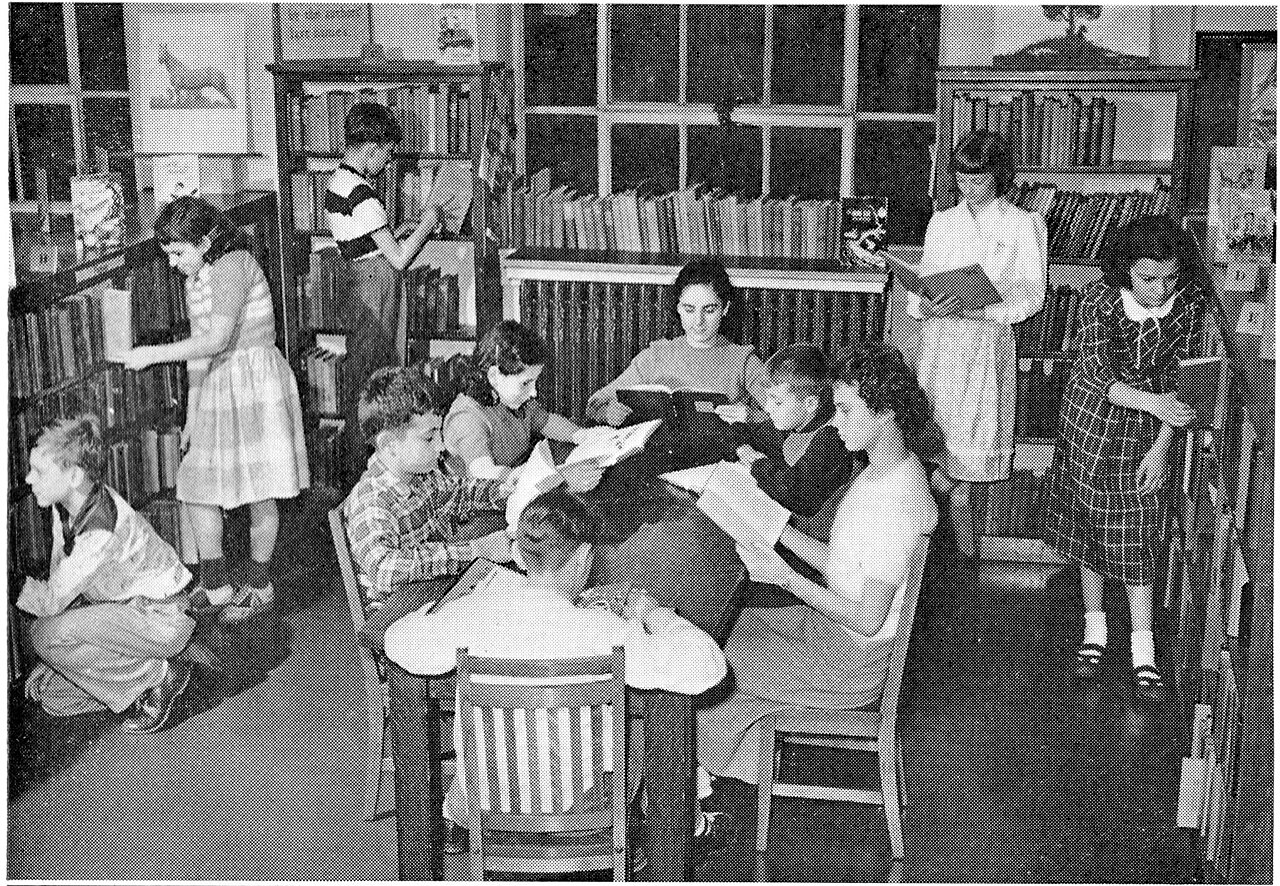
Visual AidReading it for yourself
Photograph of the children’s reading room at the Allentown Free Library in Pennsylvania, taken in 1945. The Knowledge Bank says Dahl (author) shows you what a person is like instead of announcing it, and Matilda’s trips to the library are his main clue. This is an American library from decades before the book, not the English village library Matilda walks to — that one is invented, so no photograph of it exists. Notice how many of the children have a book open already, most of them reading on their own. That small ordinary action is the kind of evidence the Knowledge Bank asks you to read a character from.
1The Knowledge Bank explains that Roald Dahl (author) shows what a character is like mainly by —Ch.1
2True or False: Matilda’s parents are proud of her reading ability and encourage her to read as many books as she wants.Ch.1–2
3What is Mr. Wormwood’s job, and what is dishonest about the way he does it?Ch.2
4True or False: In Chapter 3, Matilda superglues the inside of her father’s hat so that he cannot remove it at breakfast the next morning.Ch.3
5Put the events from Chapters 1–3 in the correct order. Write 1–4 (1 = first).Ch.1–3
Matilda puts superglue inside her father’s hat as revenge for his unkindness.
Matilda teaches herself to read and walks to the library alone each afternoon.
Mr. Wormwood arrives at breakfast to find his hat completely stuck to his head.
Mr. Wormwood dismisses Matilda’s reading as a waste of time and tells her to watch television.
6True or False: Mrs. Phelps, the librarian, encourages Matilda’s reading and helps her choose books.Ch.1
7Why does Matilda decide to prank her father rather than simply ignore his cruelty?Ch.3
8True or False: After the superglue prank, Mr. Wormwood realizes that Matilda did it and punishes her.Ch.3
9In Ch.1, which library does Matilda visit by herself each afternoon?Ch.1
10In Ch.3, what substance does Matilda put inside her father's hat to punish him for destroying her library book?Ch.3
Part 3
Literary Elements
Understanding HOW and WHY Dahl (author) creates certain effects in Chapters 1–3.
🧠Knowledge Bank · Dahl’s Scab Metaphor
Literary Craft · MetaphorA metaphor says that one thing IS another to make a picture flash in the mind. When Dahl (author) compares an unwanted child to a scab — something itchy and irritating, to be endured until you can be rid of it — he is not being literal. He is joining a feeling to a small, ugly, everyday thing, and the comparison stings because we all know exactly how a scab feels. That is the power of a good metaphor: it turns an idea we cannot see into an object we can almost touch. Dahl (author) loved bold, slightly disgusting images because they make young readers laugh and remember. Notice how much heavier this lands than simply saying the parents were unkind. When an author reaches for a surprising comparison, slow down and ask which two things are being joined, and why that pairing carries such bite.
📚 Literary Devices in This Part · definitions & examples
Characterization is the way an author reveals what a character is like. Dahl (author) uses contrast: Matilda is shown as brilliant, curious, and kind, while her parents are shallow and dismissive — all revealed through their actions and words, not long descriptions.Satire uses humor, irony, and exaggeration to criticize faults in people or society. Dahl (author) makes Mr. Wormwood, the crooked car dealer who cheats his customers, an exaggerated comic figure so we laugh at — and judge — dishonest, greedy adults.Exposition is the part of a story that introduces the characters, setting, and background the reader needs before the main conflict begins. Chapters 1–3 set up Matilda, her gifts, her dreadful family, and her love of books — the foundation for everything that follows.
The questions below are mixed — not grouped by device. Decide which device each one is about.
🧠Knowledge Bank question
1According to the Knowledge Bank, why does Dahl’s scab comparison sting so much?Ch.1–2
2True or False: Satire always makes the reader feel sympathy for the person being mocked.Ch.2
3Fill in the blanks with the correct words.Ch.1–3
Word choices:expositionbackgroundrhymesatireclimax- some words will not be used
The opening part of a story that gives information and introduces the characters is called the .
4Mr. Wormwood cheats his customers with sawdust in the gearbox and crooked deals. By mocking such dishonest, greedy adults, Dahl (author) is using —Ch.2
5True or False: Exposition is the part of a story that introduces the characters, setting, and background information.Ch.1–3
6Fill in the blanks with the correct words.Ch.1–3
Word choices:characterizationactionsrhymesatire- some words will not be used
The way an author reveals what a character is like is called . Dahl (author) shows Matilda’s brilliance through her rather than telling us directly.
7What is the main job of Chapters 1–3 in the novel?Ch.1–3
8True or False: Good characterization always requires long, detailed physical descriptions of a character.Ch.1–3
9Fill in the blanks with the correct words.Ch.2
Word choices:satirecheatsrhymepathos- some words will not be used
Using humor and exaggeration to criticize faults in people is called . Dahl (author) mocks Mr. Wormwood, the car dealer who his customers.
10Dahl (author) gives Mr. Wormwood sawdust-in-the-gearbox tricks AND makes him ridiculous while doing it. Which pairing best names what Dahl (author) achieves?Ch.1–3
Part 4
Think Deeper
Four deeper challenges — no single-word recall. Read, weigh the evidence, and reason it through.
🧠Knowledge Bank · When a Bright Child Is Unseen
Ethics · The Overlooked ChildMatilda is clever, kind, and eager, yet her own family treats her as a nuisance. This is a quiet kind of unfairness: a child being overlooked by the adults meant to notice her. Dahl (author) asks us to feel the wrongness of it. Every child deserves to be seen, encouraged, and taken seriously, and when grown-ups are too busy or too selfish to look, a bright spark can be left cold. Notice that Matilda does not turn bitter; instead she finds her own comfort in books and builds a rich inner world nobody can take from her. That is a kind of resilience — the strength to keep growing even without support. Still, Dahl (author) wants us angry on her behalf, because injustice should never feel normal. As you read, ask who in the story truly sees Matilda, and how much a little genuine attention might change a lonely child’s life.
1Claim: “Matilda’s parents fail to value her gifts.” — choose the two details that best prove it.Claim & Evidence
2What does each detail show? Tap each item to sort it — tap again to switch sides. You can keep tapping to change your answer.Sort into two
◄ Matilda’s brillianceHer parents’ neglect ►
3Match each cause to its result. For each cause, pick its result.Cause & Effect
Matilda is ignored and belittled at home→
Mr Wormwood brags about cheating his customers→
Matilda hides superglue in his hat band→
The grown-ups never face any consequences→
🧠Knowledge Bank question
4Fill both blanks to complete the reasoning.Build the Argument
Matilda shows resilience because , which shows that .
Part 5
Standardized Test · Vocabulary in Context & Main Idea
Part 1 builds four exam reading skills — Vocabulary in Context, Main Idea, Inference, and Author’s Purpose — in the styles the SAT and TOEFL use. Read the passage (the highlighted words are tested below), then choose the answer best supported by the text.
Read the passage — the highlighted words are tested — then answer. Tap an answer, then tap it again to confirm.
SATWords in Context — a word's meaning in this passage
SATCentral Ideas — the passage's main point
SATInference — a conclusion the passage implies
SATText Structure & Purpose — how the passage is built, and why
TOEFLFactual Information — a fact stated in the passage
TOEFLVocabulary — a tested word's meaning here
TOEFLInference — what the passage implies
The Radical Idea of Free Libraries
A public library is one of the quietest revolutions in history. For most of human civilization, books were rare, costly treasures — chained to desks in monasteries, locked in the private collections of the wealthy. The idea that any citizen, rich or poor, young or old, could walk through a door and borrow any book for free was once considered radical. Yet that idea spread, and it transformed who was allowed to learn. The great age of library-building began in the nineteenth century. The industrialist Andrew Carnegie, who had been a poor boy with no access to books, spent much of his fortune building more than 2,500 free libraries around the world.
His reasoning was simple: a library rewards initiative. It does not choose who may become educated; it lets readers choose themselves. A determined child could walk in knowing nothing, devour book after book as if she were starving for them, and, shelf by shelf, acquire an education no one had offered to give her. That is why librarians often say the library is the most democratic room in town: it asks no fees, no qualifications, and no permission. It cannot force anyone to learn — but for the motivated reader, it removes every wall. Teachers may overlook a child, and families may neglect one, giving her no care or attention, but the library keeps no such opinions: whoever reaches for the shelf, the shelf reaches back.
Original passage written for Garden Heights — not a quotation from the novel.
1As used in the passage, the word “radical” most nearly means —SAT · Words in Context
2According to the passage, what does a library require of its visitors?TOEFL · Factual Information
3According to the passage, how were books kept for most of history?TOEFL · Factual Information
4In the passage, devour most nearly means ___.SAT · Words in Context
5According to the passage, what did Andrew Carnegie do with much of his fortune?TOEFL · Factual Information
6In the passage, neglect most nearly means ___.TOEFL · Vocabulary
7Which statement best expresses the central idea of the passage?SAT · Central Ideas
8The passage most strongly suggests that a library helps a child whom teachers overlook because it —SAT · Inference
9The passage most strongly suggests that a brilliant child ignored at home and school could still —TOEFL · Inference
10Why does the author end with the sentence “whoever reaches for the shelf, the shelf reaches back”?SAT · Text Structure & Purpose
Part 6 · Optional
Creative Writing
A bonus challenge to practice your English.
About This Section
This writing task is optional and not part of your auto-graded score. Feedback checks length, spelling, and grammar only.
Writing Task — Part 1 “The Reader of Books”
Imagine you are Matilda at the library for the first time. You have just finished all the children’s books. Mrs. Phelps points you toward the adult novels. What do you feel? What do you see? Write at least 40 words.
You can start with: “Mrs. Phelps pointed to the tall shelves and said, ‘These are for you now.’…”
0 / 40 words minimum
🗣 Teach It · Just for Fun (optional)
No right or wrong — close the screen and tell someone nearby what happened in this part. Can’t find anyone? Tell yourself out loud. The moment you teach it, you truly understand it.
Part 1 Complete!
You finished Chapters 1–3 of Matilda.
Here are your auto-graded results:
-
points out of 100
Teach it to someone
The best last step is to teach it. In your own words, explain what happened — retell a favorite scene, teach a character’s big choice, or sum up the main idea for a parent, friend, or classmate. When you can teach it clearly, you truly own it.
SAT® is a registered trademark of College Board, which is not affiliated with, and does not endorse, these materials. TOEFL® is a registered trademark of ETS. These materials are not endorsed or approved by ETS. Garden Heights is an independent provider of test-style reading practice.