New here? Just sign up with Google — your account includes Matilda, our gift book, forever.
📚
Garden Heights Academy
Members sign in to continue.
Matilda · Garden Heights Academy
Part 2
for Matilda · Part 2 · Chapters 4–7
a novel by Roald Dahl (author)
40 min6 Parts
This workbook is built on a solid pedagogical foundation, integrating content and language learning based on the CLIL framework.
💭 Before You Read · Just for Fun
No right or wrong answers — just think or chat about it: What is something you can do that adults once refused to believe? If you could skip ahead two school years tomorrow, would you — and what would you miss? And which teacher has understood you best in your life so far?
What Happens in Part 2
Matilda's pranks get bolder, she starts school, and one adult finally sees her clearly.
The haunted parrotMatilda's pranks continue and her world grows. In Chapter 4 comes a clever second revenge: she hides a parrot in the chimney, and the whole family believes their house is haunted.
School and hair tonicIn Chapter 5 she arrives at school and stuns everyone with her amazing mental arithmetic. Chapter 6 brings her most spectacular prank yet: peroxide in her father's hair tonic, which turns him platinum blond.
Miss Honey sees herThen, in Chapter 7, the tone changes. Miss Honey, Matilda's teacher, sees her astonishing intelligence and tries to help. It is the first time an adult has truly seen Matilda for who she is.
What We Will Learn
Literary Element
What It Means
Dramatic Irony
When the reader knows something a character does not
Humor and Tone
How Dahl (author) blends comedy with serious ideas about injustice
Foil Characters
How Miss Honey and Mr. Wormwood contrast each other to highlight values
Chapter Summary
Chapter
Title & Key Events
Ch.4
The Ghost — Matilda hides a parrot in the chimney; the family thinks their house is haunted
Ch.5
Arithmetic — Matilda starts school; she demonstrates extraordinary mental maths far beyond her age
Ch.6
The Platinum-Blond Man — Matilda puts peroxide in her father’s hair tonic; his hair turns blond overnight
Ch.7
Miss Honey — Miss Honey recognizes Matilda’s genius and tries to get her moved to a higher class; Mr. Wormwood refuses
Copyright Notice
Independent study guide by Garden Heights Academy. Not affiliated with or endorsed by Roald Dahl or the Roald Dahl Story Company. No text from the novel is reproduced. Reference text: This workbook follows Roald Dahl’s classic text (the standard Puffin edition sold worldwide). Revised 2023 UK editions change some wording and may not match the vocabulary studied here.
Part 1
Vocabulary
Study 10 key words from Chapters 4–7, then answer each question.
🧠Knowledge Bank · The Math Behind Matilda’s Mind
Cognitive Science · Mental ArithmeticIn these chapters Matilda multiplies large numbers in her head almost instantly, and real prodigies can do the same. Fast mental arithmetic is not magic; it relies on a well-trained working memory, the brain’s small mental notepad that holds numbers while you juggle them. Skilled calculators break a hard problem into easier pieces, a trick psychologists call chunking, and they store handy shortcuts — doubles, tens, familiar patterns — so their minds are never starting from zero. With practice these steps grow so quick they feel automatic, the way you no longer sound out the word cat. Matilda’s gift is exaggerated for fun, yet it points at something true: a curious brain that plays with numbers early builds astonishing speed. What looks like a flash of pure genius is really a fast, practiced path worn smooth by a mind that genuinely delights in solving problems.
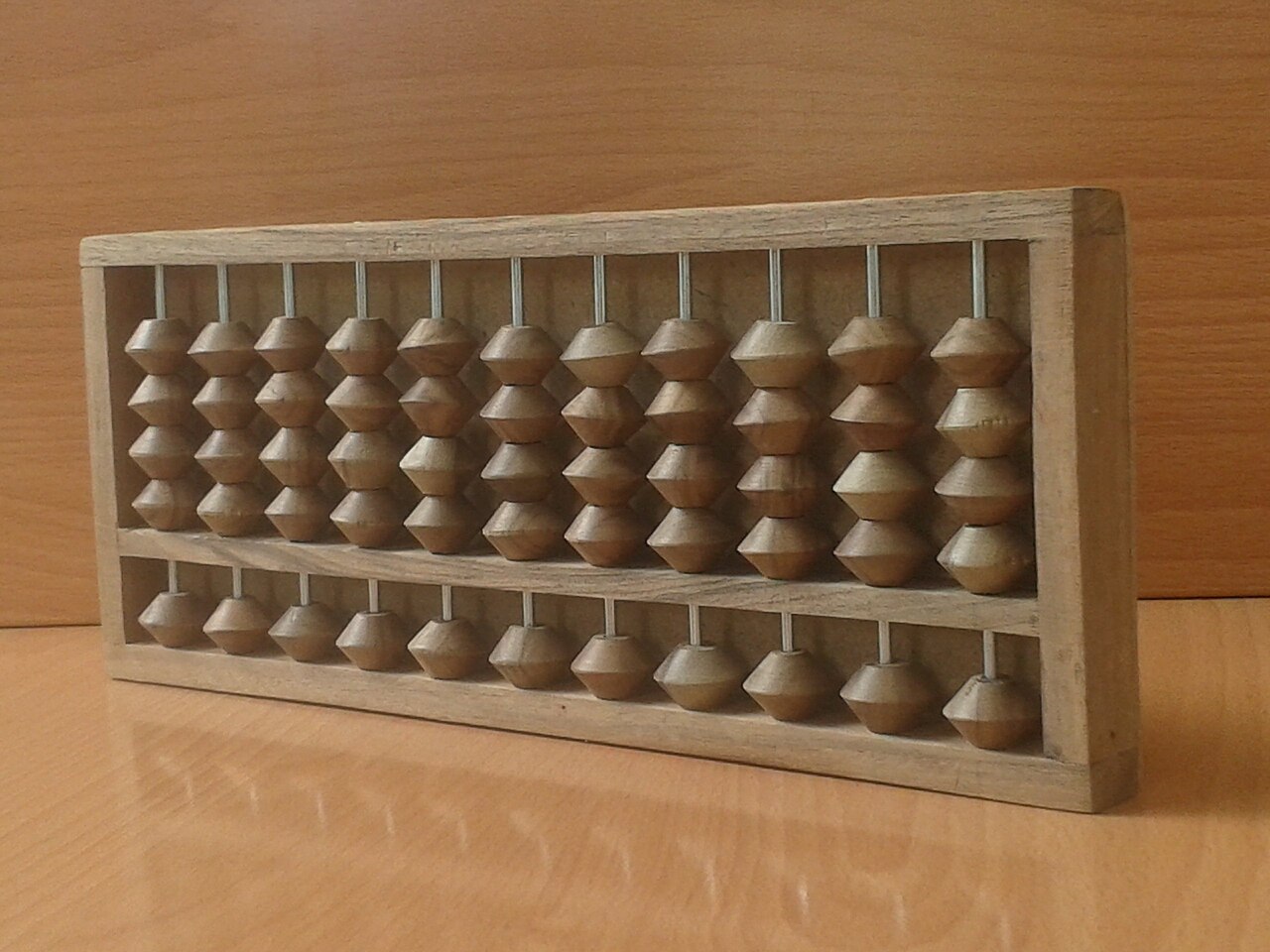
Visual AidNumbers you can move with a finger
Photograph of a soroban, the Japanese abacus. Look at how it is built: a bar runs the length of the frame, with one bead above it on every rod and four beads below. The single bead counts five, each lower bead counts one, so any digit is set with a small movement of one finger. That is what the Knowledge Bank means by chunking — a hard sum broken into pieces small enough to handle without starting from zero. Practiced users go on to picture the beads and work with no abacus at all, which is the closest real thing to what Matilda does. This one sits empty on a desk, showing no sum; Matilda never touches an abacus, and her speed is Dahl (author) exaggerating for fun.
Soroban (Japanese abacus). Source: Wikimedia Commons, file "A made in Morocco soroban - 1.jpg", CC0.
ⓘ Vocabulary words are selected to help you understand and complete this workbook. Some may not appear verbatim in the novel.
bewilderedadj.Ch.4–5
Completely confused and unable to explain or understand something
“Her parents were bewildered by the noises from the chimney — they had no idea there was a parrot inside.”
astonishv.Ch.5
To surprise someone greatly; to cause a feeling of wonder or shock
“Matilda’s answers astonished her teacher — no child of five had ever solved problems like these before.”
prodigyn.Ch.5–7
A person, especially a child, with exceptional talent or abilities far beyond what is normal for their age
“Miss Honey recognized that Matilda was not just a bright child — she was a prodigy, something she would perhaps never see again.”
peroxiden.Ch.6
A chemical used to bleach hair to a very light blond or white color
“Matilda had quietly added peroxide to his hair tonic, knowing it would react overnight and change everything.”
flabbergastedadj.Ch.6
Extremely surprised or shocked; unable to speak or react because of how unexpected something is
“Mr. Wormwood was flabbergasted when he looked in the mirror and saw his hair had turned platinum blond overnight.”
arithmeticn.Ch.5
The branch of mathematics dealing with numbers, addition, subtraction, multiplication, and division
“Miss Honey tested Matilda’s arithmetic and found that she could multiply large numbers in her head instantly.”
petitionv./n.Ch.7
To formally request or appeal to someone with authority to do or change something
“Miss Honey went to petition Mr. Wormwood, hoping to persuade him to allow Matilda to be moved to a higher class.”
dismissv.Ch.7
To refuse to consider something seriously; to reject an idea or concern without proper attention
“Mr. Wormwood dismissed Miss Honey’s concerns completely — he could not understand why anyone would care about Matilda’s education.”
remarkableadj.Ch.5–7
Worthy of attention or notice; unusual and impressive
“Even among the cleverest children Miss Honey had taught, Matilda was remarkable — unlike anyone she had ever met.”
mischievousadj.Ch.4–6
Fond of causing trouble or playing tricks in a playful way; slightly wicked but in an amusing manner
“Matilda had a mischievous quality that adults struggled to detect — she always looked perfectly innocent.”
🧠Knowledge Bank question
1According to the Knowledge Bank, what makes a prodigy’s fast mental arithmetic possible?Ch.4
2True or False: To “astonish” someone means to bore them and leave them feeling unimpressed.Ch.5
3Miss Honey had never in all her years of teaching seen a child with abilities like Matilda’s. Which word describes a child with exceptional talent far beyond what is normal?Ch.7
4True or False: “Arithmetic” is the branch of mathematics dealing with numbers, addition, subtraction, multiplication, and division.Ch.5
5Fill in each blank with the correct word.Ch.6–7
Word choices:peroxideflabbergastedpetitiondismissremarkable— some words will not be used
Mr. Wormwood was utterly when he saw his reflection — his hair had turned blond overnight and he had no idea how.
Miss Honey went to Mr. Wormwood, asking that Matilda be moved to a higher class — but he refused to listen.
6True or False: To “dismiss” someone’s concern means to give it careful thought and take it very seriously.Ch.7
7Matilda always looked perfectly innocent, but she was constantly planning her next trick. Which word describes someone who enjoys causing trouble in a playful, amusing way?Ch.4–6
8True or False: A “prodigy” is an ordinary child who works very hard and slowly improves over many years of practice.Ch.5–7
9Fill in each blank with the correct word.Ch.5–7
Word choices:remarkableastonishprodigymischievousbewildered— some words will not be used
Even among the cleverest children Miss Honey had ever taught, Matilda was — something she had simply never encountered before.
Matilda continued to her teacher with answers she gave before Miss Honey had even finished writing the problem on the board.
10Matilda mixed a chemical into her father’s hair tonic that bleached it to a very pale color overnight. What is the name of this chemical?Ch.6
Part 2
Comprehension
How well do you understand Chapters 4–7?
🧠Knowledge Bank · Following the Chain of Events
Reading Skill · Cause & EffectStories run on cause and effect: one event makes another happen, like a line of falling dominoes. In these chapters Mr Wormwood insults and cheats Matilda, and each cruelty triggers a clever, secret revenge — the superglued hat, the borrowed parrot, the bleached hair. Skilled readers keep asking two linked questions: what caused this, and what will it cause next? Tracing that chain keeps the plot from feeling like random mischief and shows it instead as fair, deliberate justice. Notice that Matilda never strikes first; her tricks are always answers to unkindness, which is why we cheer rather than wince. When you can name the cause behind an action and predict its effect, you are reading like a detective instead of a bystander. Watch the dominoes fall, and you will grasp the hidden machinery that quietly drives the whole plot.
Visual AidEach unkindness knocks over a trick
Flow diagram of the cause-and-effect chain the Knowledge Bank describes: an adult’s unkindness on the left, Matilda’s quiet answer on the right. The first pair happens at the end of Part 1; the diagram shows the pattern, not the exact wording or timing of each scene, and it leaves out everything that is not a cause or an effect.
Sequence as listed in the Knowledge Bank, from Matilda, Chapters 2–6 (Jonathan Cape, 1988). Drawn for Garden Heights Academy.
🧠Knowledge Bank question
1The Knowledge Bank explains that Matilda’s tricks feel like fair justice rather than random mischief because —Ch.4
2True or False: When Matilda arrives at school in Chapter 5, she is placed in the top class immediately because her parents told the school how gifted she is.Ch.5
3What does Matilda add to her father’s hair tonic in Chapter 6, and what is the result?Ch.6
4True or False: In Chapter 7, Miss Honey visits the Wormwood home to tell Matilda’s parents that she is a gifted child who should be moved to a more advanced class.Ch.7
5Put the events from Chapters 4–7 in the correct order. Write 1–4 (1 = first).Ch.4–7
Matilda adds peroxide to her father’s hair tonic and he wakes up with platinum blond hair.
Miss Honey visits the Wormwoods to ask if Matilda can be moved to a higher class; Mr. Wormwood refuses.
Matilda starts school and shows her class extraordinary mental arithmetic abilities.
Matilda hides the parrot in the chimney; her family is convinced the house is haunted.
6True or False: Mr. Wormwood agrees with Miss Honey that Matilda is exceptional and promises to support her education.Ch.7
7Why is Miss Honey’s visit to the Wormwoods in Chapter 7 an important moment in the story?Ch.7
8True or False: Matilda’s pranks in Chapters 4, 5, and 6 are all aimed at the same target: her father, Mr. Wormwood.Ch.4–6
9In Ch.5, what subject does Miss Honey ask Matilda to demonstrate in front of the class?Ch.5
10What is the Trunchbull's attitude when Miss Honey tries to explain that Matilda is gifted?Ch.7
Part 3
Literary Elements
Understanding HOW and WHY Dahl (author) creates certain effects in Chapters 4–7.
🧠Knowledge Bank · Irony, Tone, and Contrast
Literary Craft · Irony & ToneTwo tools shine in these chapters. Irony is a gap between what seems true and what really is: Mr Wormwood boasts that he is the clever one, yet his small daughter outwits him at every turn, and we enjoy the gap between his pride and the truth. Tone is the author’s attitude, the mood colouring the words. Dahl’s tone here is gleeful and mischievous, half fairy tale and half practical joke, so even a cruel father becomes comic rather than frightening. Watch, too, for contrast: a tiny, gentle girl set against a loud, boastful man makes her victories feel sweeter. Together these devices let Dahl (author) scold bad grown-ups while keeping us laughing. When you sense the narrator smiling behind the words, or notice a character’s big talk collapse into foolishness, you have caught the story’s playful, knowing spirit.
📚 Literary Devices in This Part · definitions & examples
Dramatic irony is when the reader knows something important that a character does not. We know Matilda is extraordinarily clever, so when Mr. Wormwood tells Miss Honey she is an ignorant little nuisance, we feel the gap between what he says and what is true.Tone is the overall attitude or feeling a piece of writing expresses. Chapters 4–7 are mostly playful and comic — the “ghost” and the platinum-hair prank — but the tone softens into warmth and tenderness the moment kind Miss Honey appears.Foil characters are characters whose contrasting personalities highlight each other’s qualities. Gentle, encouraging Miss Honey stands in sharp contrast to the harsh, dismissive Wormwoods — and her warmth makes their coldness stand out all the more.
The questions below are mixed — not grouped by device. Decide which device each one is about.
🧠Knowledge Bank question
1According to the Knowledge Bank, where is the irony in Mr Wormwood’s boasting?Ch.7
2True or False: Tone is the overall attitude or feeling that a piece of writing expresses.Ch.4–7
3Fill in the blanks with the correct words.Ch.7
Word choices:foilcontrastrhymetoneirony- some words will not be used
A character who sets off another by being their opposite is called a . The sharp between Miss Honey and the Wormwoods makes both clearer to the reader.
4Which best describes the tone of Chapters 4–7?Ch.4–7
5True or False: A foil character must always be the villain or enemy of the main character.Ch.7
6Fill in the blanks with the correct words.Ch.7
Word choices:dramatic ironygeniusrhymetone- some words will not be used
When the reader knows more than a character does, the writer is using . We know Matilda is a , even as her father insists she is ordinary.
7Miss Honey is gentle and encouraging; Mr. Wormwood is harsh and dismissive. Their contrast highlights each other’s qualities. Characters used this way are called —Ch.7
8True or False: Dramatic irony occurs when the reader knows something important that a character does not.Ch.4–7
9Fill in the blanks with the correct words.Ch.4–7
Word choices:tonecomicrhymefoil- some words will not be used
The overall attitude or feeling of a piece of writing is its . For most of these chapters the writing is light and , full of mischief and jokes.
10Chapters 4–6 are prank comedy; Chapter 7 turns warm and hopeful when Miss Honey appears. What does this TONE shift accomplish?Ch.7
Part 4
Think Deeper
Four deeper challenges — no single-word recall. Read, weigh the evidence, and reason it through.
🧠Knowledge Bank · Mischief, Fairness, and Being Believed
Ethics · FairnessMatilda’s pranks raise a serious question hidden inside the comedy: what should a child do when adults are unfair and refuse to listen? The Wormwoods lie, cheat, and belittle her, and no grown-up steps in to help. One of the hardest injustices any child faces is not being believed, especially by the very people who hold all the power. Dahl (author) clearly enjoys Matilda’s revenge, yet he is also making us think about fairness — about how tempting mischief becomes when honest complaints are ignored. Notice that her tricks are careful and never truly dangerous; they aim to teach, not to harm. We might ask whether this is the wisest path, or simply the only one left to a powerless child. Reading well means enjoying the joke and still weighing the ethics beneath it, because standing up to unkindness should never turn a good heart cruel.
1Claim: “Miss Honey quickly recognizes how gifted Matilda is.” — choose the two details that best prove it.Claim & Evidence
2Recognizes Matilda’s gift, or dismisses it? Tap each item to sort it — tap again to switch sides. You can keep tapping to change your answer.Sort into two
◄ Recognizes itDismisses it ►
3Match each cause to its result. For each cause, pick its result.Cause & Effect
Matilda multiplies huge numbers at once→
Matilda feels her parents are unjust→
Matilda slips peroxide into the hair tonic→
Miss Honey sees Matilda’s quick mind→
🧠Knowledge Bank question
4Fill both blanks to complete the reasoning.Build the Argument
It is hard to blame Matilda for her pranks because , which shows that .
Part 5
Standardized Test · Main Idea & Detail
Part 2 sharpens two core exam skills — Main Idea and Factual Detail — with Vocabulary in Context practice, in the styles the SAT and TOEFL use. Read the passage (the highlighted words are tested below), then choose the answer best supported by the text.
Read the passage — the highlighted words are tested — then answer. Tap an answer, then tap it again to confirm.
SATWords in Context — a word's meaning in this passage
SATInference — a conclusion the passage implies
SATText Structure & Purpose — how the passage is built, and why
TOEFLFactual Information — a fact stated in the passage
TOEFLVocabulary — a tested word's meaning here
TOEFLProse Summary — the three sentences that sum it up
Recognizing a Child Prodigy
In 1761, a five-year-old boy in Salzburg sat at a keyboard and began to compose his own minuets. Within three years, Wolfgang Amadeus Mozart was performing for empresses and kings. History calls such children prodigies — children whose talent is so remarkable, so far beyond their years, that it cannot be missed. Prodigies have appeared in every field: Picasso in painting, Blaise Pascal in mathematics, chess champions who astonish adult experts with master-level play before they are ten. Yet schools are built for the average, and a prodigy in an ordinary classroom faces a strange ordeal: sitting, hour after hour, through lessons mastered years before. That tedium is not harmless — a mind with enormous capacity and nothing to lift grows restless, and restlessness is easily mistaken for misbehavior.
Some schools respond by choosing to accelerate the child into higher classes; others bring harder material down to her. But every remedy begins the same way: an adult must first be convinced that the ability is genuine. And that is often the hardest step. Adults expect childhood to fit its timetable, so an early talent invites doubt before it invites wonder; the burden of proof falls, unfairly, on the child. The wise teacher does what good scientists do: instead of dismissing the claim, she tests it — a harder book, a longer sum, a real question. Talent that is tested can be recognized, and talent that is recognized can finally be fed.
Original passage written for Garden Heights — not a quotation from the novel.
1In the passage, remarkable most nearly means ___.SAT · Words in Context
2According to the passage, what does a wise teacher do with a child’s surprising talent?TOEFL · Factual Information
3According to the passage, what was Mozart doing by the age of five?TOEFL · Factual Information
4In the passage, astonish most nearly means ___.SAT · Words in Context
5According to the passage, what ordeal does a prodigy face in an ordinary classroom?TOEFL · Factual Information
6In the passage, the word “genuine” is closest in meaning to —TOEFL · Vocabulary
7Prose Summary (TOEFL).The passage explains what child prodigies are and why schools struggle to serve them. This TOEFL task lists six sentences; choose the THREE that best capture the passage’s main ideas. The other three do not belong — they state minor details or ideas the passage does not present.TOEFL · Prose Summary
8According to the passage, why is a prodigy’s restlessness dangerous for her?TOEFL · Factual Information
9The passage most strongly suggests that an unusual early talent is doubted because it —SAT · Inference
10Why does the author compare the wise teacher to a good scientist?SAT · Text Structure & Purpose
Part 6 · Optional
Creative Writing
A bonus challenge to practice your English.
About This Section
This writing task is optional and not part of your auto-graded score. Feedback checks length, spelling, and grammar only.
Writing Task — Part 2 “Miss Honey”
Imagine you are Miss Honey, walking home after her visit to the Wormwood house. She has just been dismissed by Mr. Wormwood. What is she thinking? What does she feel for Matilda? Write at least 40 words.
You can start with: “I walked home in the dark, thinking about that small girl sitting in the corner while her father spoke…”
0 / 40 words minimum
🗣 Teach It · Just for Fun (optional)
No right or wrong — close the screen and tell someone nearby what happened in this part. Can’t find anyone? Tell yourself out loud. The moment you teach it, you truly understand it.
Part 2 Complete!
You finished Chapters 4–7 of Matilda.
Here are your auto-graded results:
-
points out of 100
Teach it to someone
The best last step is to teach it. In your own words, explain what happened — retell a favorite scene, teach a character’s big choice, or sum up the main idea for a parent, friend, or classmate. When you can teach it clearly, you truly own it.
SAT® is a registered trademark of College Board, which is not affiliated with, and does not endorse, these materials. TOEFL® is a registered trademark of ETS. These materials are not endorsed or approved by ETS. Garden Heights is an independent provider of test-style reading practice.