New here? Just sign up with Google — your account includes Matilda, our gift book, forever.
📚
Garden Heights Academy
Members sign in to continue.
The Boxcar Children · Garden Heights Academy
Part 3
for The Boxcar Children · Part 3 · Chapters 5–6
a novel by Gertrude Chandler Warner
30 min5 Parts
This workbook is built on a solid pedagogical foundation, effectively integrating content and language learning based on the CLIL framework (Content and Language Integrated Learning), elevated by our unique 5th C — Connection — and an integrated Standardized Test section that weaves every SAT & TOEFL question type right into the novel, so learners build real test skills easily, naturally, and with fun.
What Happens in Part 3
At the town dump the children find treasure, and a lost dog finds them.
Treasure at the dumpThe children become explorers. At an old dump they find things other people threw away: cracked dishes, cups, a teapot, spoons, and a kettle. To the Aldens these are treasure.
Benny's pink cupBenny finds a pink cup that is all his own. The children carry everything home and scrub each piece until it shines. Nothing they find is wasted.
A cold spotThey build a cool spot in the brook and set their milk and butter in the running water. The cold water keeps the food fresh, just as a refrigerator would.
A thorn removedOne night a strange noise frightens them. The next day they find a lost dog with a thorn stuck in its paw. Jessie gently pulls it out, and the grateful dog stays. Benny names him Watch.
What We Will Learn
Literary Element
What It Means
Cause and Effect
How one event (a cause) makes another event (an effect) happen
Theme
The big idea or lesson behind a story, such as kindness
Imagery
Describing words that help you picture a scene
Chapter Summary
Chapter
Key Events
Ch.5
The Explorers Find Treasure — the children gather useful things from a dump and set up a cool store in the brook for their food
Ch.6
A Queer Noise in the Night — a strange noise turns out to be a lost dog; Jessie removes a thorn from its paw and Benny names it Watch
Copyright Notice
Independent study guide by Garden Heights Academy. Not affiliated with or endorsed by Gertrude Chandler Warner or Albert Whitman & Company. No text from the novel is reproduced. Students should read the original book. Reference edition: this workbook follows the standard Albert Whitman & Company edition (the 1942 text) — the version sold in bookstores today. Early 1924-text reprints differ substantially and will not match this workbook’s chapters.
Part 1
Vocabulary
Study 10 key words from Chapters 5–6, then answer each question.
🧠Knowledge Bank · Treasure from the Dump
Background · CultureIn the early 1900s most towns had an open dump, and it was a far richer place than it sounds. Before plastic and cheap factory goods flooded every store, objects were made to last and to be mended, so a chipped cup was rarely truly worthless. Thrifty families lived by the old saying waste not, want not, repairing and reusing whatever they could. When the Alden children pick through the dump, they are doing something ordinary people really did — hunting for usable castoffs. They carry home cracked dishes, an old kettle, and a pink cup for Benny, then scrub each piece until it shines. To the careful eye, one family’s rubbish became another family’s honest treasure.
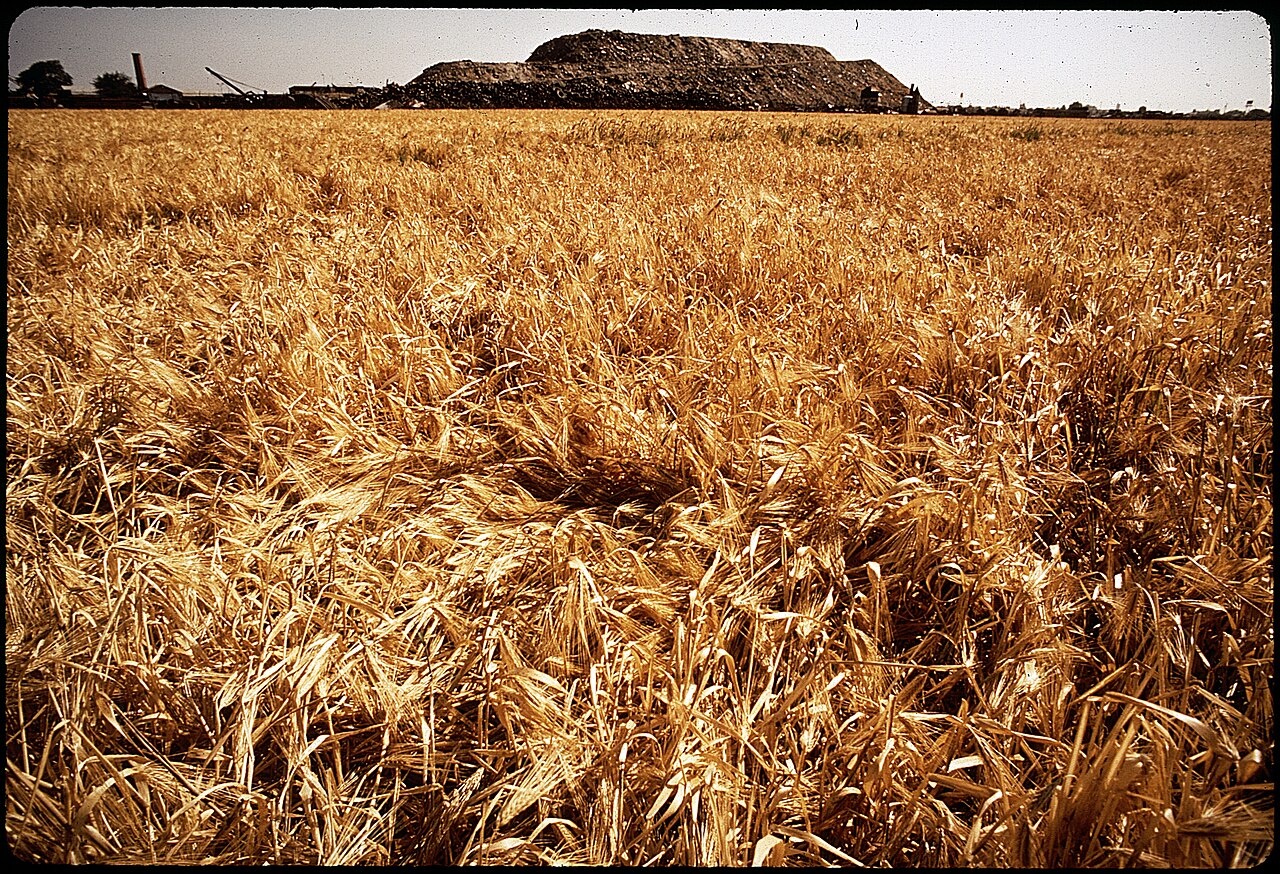
Visual AidWhere a dump goes now
Photograph of a modern American landfill, where the rubbish is covered over with soil as it arrives. It is here for the contrast. The Knowledge Bank describes an open town dump that anyone could walk into and pick through, and this is what replaced it: sealed, machine-worked, and impossible to search. Nothing in this picture comes from the story's time, and nothing on this mound could be carried home and scrubbed until it shone. Notice what is missing. There is nothing to see and nothing to find, because everything has been buried on purpose.
Soil-covered landfill, United States Environmental Protection Agency photograph; U.S. National Archives (NARA 542536). Source: Wikimedia Commons, public domain.
ⓘ Vocabulary words are selected to help you understand and complete this workbook. Some may not appear verbatim in the novel.
explorev.Ch.5
To travel through a place to discover what is there
“The children set out to explore the woods around the boxcar.”
“To the children, the old dishes were real treasure.”
dumpn.Ch.5
A place where rubbish is thrown away
“They searched the dump for things they could use.”
discardv.Ch.5
To throw away something you do not want
“People discard things that others can still use.”
kettlen.Ch.5
A metal pot for boiling water
“They found an old kettle to boil water in.”
examinev.Ch.6
To look at something closely and carefully
“Jessie knelt to examine the dog’s sore paw.”
thornn.Ch.6
A sharp point growing on a plant stem
“A sharp thorn was stuck deep in the dog’s paw.”
gratefuladj.Ch.6
Feeling thankful
“The grateful dog licked Jessie’s hand.”
loyaladj.Ch.6
Faithful; always sticking by someone
“Watch became a loyal friend to the children.”
wagv.Ch.6
To move from side to side, as a dog’s tail does
“The dog began to wag its tail happily.”
🧠Knowledge Bank question
1According to the Knowledge Bank, why was an old dump a rich place to search?Ch.5
2A “dump” is a place where rubbish is thrown away.Ch.5
3To the children, the thrown-away dishes and cups were real —Ch.5
4Fill in each blank with the correct word.Ch.5
Word choices:discardkettleexploreloyal- some words will not be used
To throw something away is to
They boiled water in an old
5To “examine” something means to ignore it.Ch.6
6The sharp point stuck in the dog’s paw was a —Ch.6
7The dog that always sticks by the children is —Ch.6
8Someone who is “grateful” feels thankful.Ch.6
9Fill in each blank with the correct word.Ch.6
Word choices:waggratefulthorndump- some words will not be used
A happy dog will
Jessie pulled the sharp
10When a dog is happy, it will often — its tail.Ch.6
Part 2
Comprehension
How well do you understand Chapters 5–6?
🧠Knowledge Bank · Cause and Effect
Narrative Logic · Cause and EffectA cause is why something happens; an effect is what happens as a result. Skilled readers watch for the thread that ties them together, because almost nothing in a good story happens by accident. Part 3 is packed with these links. The children need dishes (cause), so they explore the dump (effect); the brook runs cold (cause), so their milk stays fresh (effect). A handy trick is to pause after any event and ask a two-part question: what led to this, and what will it lead to next? When you can answer both, you understand not just what happened but why it matters. Tracing cause and effect turns a scattered list of events into one tightly connected chain.
Visual AidA cause and its effect
Structure diagram of the cause-and-effect links the Knowledge Bank points to in Part 3, drawn as three tidy pairs. Real stories are not this neat: one cause often has several effects, and an effect can become the cause of the next thing. The drawing teaches the habit of asking what led to this and what will it lead to, rather than listing everything that happens in the part. Notice the third row. A small kindness is the cause, and a dog who never leaves is the effect.
Cause and effect as a reading habit, as set out in the Knowledge Bank. Drawn for Garden Heights Academy.
🧠Knowledge Bank question
1The Knowledge Bank says a cause is —Ch.5
2Everything the children find is brand new from a shop.Ch.5
3What special cup does Benny get for his own?Ch.5
4How do the children keep their milk and butter cool?Ch.5
5Put these events from Part 3 in the correct order. Write 1–4 (1 = first).Ch.6
The next day the children find a lost dog.
Benny names the dog Watch.
Jessie gently pulls the thorn from the dog’s paw.
A queer noise frightens the children in the night.
6A strange noise in the night turns out to be a dog.Ch.6
7What is wrong with the dog when the children find it?Ch.6
8Who pulls the thorn out of the dog’s paw?Ch.6
9The children name the dog Watch.Ch.6
10Why is the dog named “Watch”?Ch.6
Part 3
Literary Elements
Understanding HOW and WHY Gertrude Chandler Warner writes Chapters 5–6 the way she does.
🧠Knowledge Bank · Warner’s Word-Craft: ‘Treasure’ from the Dump
Language · Metaphor SpotlightA metaphor paints one thing as if it were another, and it can change how we see something plain. When Warner calls the children’s dump finds treasure, she is using a small but powerful metaphor. A cracked pink cup is not gold, yet naming it treasure tells us how the Aldens feel: proud, lucky, delighted. The word does the work of a whole sentence, because it drops the sparkle of a pirate’s chest onto an ordinary teacup. That is the magic of figurative language — a feeling shared in one vivid stroke. As you read, hunt for other moments when Warner makes humble objects glow, and notice how one well-chosen word can turn junk into gold.
📚 Literary Devices in This Part · definitions & examples
Cause and effect means one event makes another happen. The cause: Jessie removes the thorn. The effect: the grateful dog stays and becomes loyal.Theme is the big idea or lesson behind a story. One theme of Part 3 is that kindness is rewarded.Imagery is describing words that help you picture a scene, like the shining dishes and the cool, clear brook.
The questions below are mixed — not grouped by device. Decide which device each one is about.
🧠Knowledge Bank question
1According to the Knowledge Bank, calling the dump finds treasure is a metaphor because it —Ch.5–6
2Cause and effect links an action to its result.Ch.5–6
3Fill in each blank with the correct word.Ch.5–6
Word choices:cause and effectthemeimagerysetting- some words will not be used
The thorn causing the dog to limp is
The big idea that kindness is repaid is a .
4Words that make us see the bright cup and cool brook are —Ch.5–6
5A theme is a big idea a story explores, like kindness.Ch.5–6
6Fill in each blank with the correct word.Ch.5–6
Word choices:themecause and effectimagerymood- some words will not be used
The idea that kindness is rewarded is a
The thorn causing the limp shows .
7Jessie’s kindness to the dog leading to its loyalty shows —Ch.5–6
8That helping the dog wins its friendship reflects the story’s —Ch.5–6
9Fill in each blank with the correct word.Ch.5–6
Word choices:imagerycause and effectthemeplot- some words will not be used
Vivid pictures of the treasures are
The thorn causing the limp is .
10The vivid images of the children’s finds mainly make the boxcar feel —Ch.5–6
Part 4
Think Deeper
Four deeper challenges — no single-word recall. Read, weigh the evidence, and reason it through.
🧠Knowledge Bank · Kindness Comes Back Around
Ethical Inquiry · Kindness Comes Back AroundPart 3 plants a warm idea: kindness given freely tends to circle back. The children share what little they have — a helping hand, a rescued dog named Watch — and the world answers with kindness in return. Henry works honestly for Dr. Moore, and the doctor’s household repays it by watching over the children instead of turning them in. Warner is not preaching; she shows how trust and generosity build a web of care that holds a community together. Notice that the Aldens never demand anything; they simply give what they can and stay grateful. Ask why so much good keeps flowing toward children who own so little, and what that reveals about everyday kindness.
1Claim: “The children find value in things other people threw away.” — choose the two details that best prove it.Claim & Evidence
2Shows the children’s resourcefulness, or just a detail of the scene? Tap each item to sort it — tap again to switch sides. You can keep tapping to change your answer.Sort into two
◄ ResourcefulnessJust a detail ►
3Match each cause to its result. For each cause, pick its result.Cause & Effect
The children explore the dump→
The dishes are cracked but usable→
Benny hunts too→
They need to keep milk fresh→
🧠Knowledge Bank question
4Fill both blanks to complete the reasoning.Build the Argument
The Knowledge Bank says good keeps flowing toward the Aldens because , which shows that .
Part 5
Standardized Test · Words in Context & Factual Detail
Part 3 practices exam reading skills — Vocabulary in Context, Factual Detail & Main Idea — in the styles the SAT and TOEFL use. Read the passage (the highlighted words are tested below), then choose the answer best supported by the text.
Read the passage — the highlighted words are tested — then answer. Tap an answer, then tap it again to confirm.
SATWords in Context — a word's meaning in this passage
SATInference — a conclusion the passage implies
SATCentral Ideas — the passage's main point
SATRhetorical Purpose — why the author put a sentence there
SATText Structure & Purpose — how the passage is built, and why
TOEFLFactual Information — a fact stated in the passage
TOEFLInference — what the passage implies
A Seed's Plan for Growing
Every vegetable in a garden begins as a tiny seed with a plan folded inside it. When a seed is planted in warm, damp soil, it swells, splits, and sends a white root downward for water while a green shoot pushes up toward the light. Leaves act like little green factories: they absorb sunlight and use its energy to make food for the whole plant. Roots do more than drink, for they grip the soil so that wind and rain cannot easily dislodge the plant. A gardener has to be patient, because a plant grows on its own schedule and cannot be rushed, and a careful one will examine the leaves often for trouble. Weeds are pulled so they do not compete for water and light, and a gardener will discard them at once. Week by week the plant grows sturdy and tall, until at last it produces the vegetables the gardener worked for. A garden rewards steady care with food that no money bought.
Original passage written for Garden Heights — not a quotation from the novel.
1As used in the passage, the word “examine” most nearly means —SAT · Words in Context
2The passage suggests a plant pulled up too early will —SAT · Inference
3According to the passage, what job do the leaves do?TOEFL · Factual Information
4As used in the passage, the word “discard” most nearly means —SAT · Words in Context
5According to the passage, why does a gardener pull weeds?TOEFL · Factual Information
6As used in the passage, the word “sturdy” most nearly means —SAT · Words in Context
7Which statement best expresses the central idea of the passage?SAT · Central Ideas
8The passage mainly presents gardening as something that rewards —SAT · Rhetorical Purpose
9The passage most strongly suggests that a plant with weak roots would —TOEFL · Inference
10Why does the author call leaves “little green factories”?SAT · Text Structure & Purpose
Part 6 · Optional
Creative Writing
A bonus challenge to practice your English.
About This Section
This writing task is optional and not part of your auto-graded score. Feedback checks length, spelling, and grammar only.
Writing Task — Part 3 “Finding Watch”
Tell the story of the night the children hear the ‘queer noise’ and find the dog the next day. Use cause and effect to show how their kindness wins them a loyal friend. Write at least 40 words.
You can start with: “In the middle of the night a strange sound came from the dark woods, and the children…”
0 / 40 words minimum
🗣 Teach It · Just for Fun (optional)
No right or wrong — close the screen and tell someone nearby what happened in this part. Can’t find anyone? Tell yourself out loud. The moment you teach it, you truly understand it.
Part 3 Complete!
You finished Chapters 5–6 of The Boxcar Children.
Here are your auto-graded results:
-
points out of 100
Teach it to someone
The best last step is to teach it. In your own words, explain what happened — retell a favorite scene, teach a character’s big choice, or sum up the main idea for a parent, friend, or classmate. When you can teach it clearly, you truly own it.
SAT® is a registered trademark of College Board, which is not affiliated with, and does not endorse, these materials. TOEFL® is a registered trademark of ETS. These materials are not endorsed or approved by ETS. Garden Heights is an independent provider of test-style reading practice.