New here? Just sign up with Google — your account includes Matilda, our gift book, forever.
📚
Garden Heights Academy
Members sign in to continue.
The Boxcar Children · Garden Heights Academy
Part 8
for The Boxcar Children · Part 8 · Chapter 13
a novel by Gertrude Chandler Warner
25 min5 Parts
This workbook is built on a solid pedagogical foundation, effectively integrating content and language learning based on the CLIL framework (Content and Language Integrated Learning), elevated by our unique 5th C — Connection — and an integrated Standardized Test section that weaves every SAT & TOEFL question type right into the novel, so learners build real test skills easily, naturally, and with fun.
What Happens in Part 8
The children move into their grandfather's house, and the boxcar comes with them.
A grand houseThe children settle into their grandfather's grand house in Greenfield. There are comfortable beds and plenty to eat. After the woods, everything is easy.
Missing the boxcarYet they so love their old boxcar home that they miss it. It is where they learned to look after themselves and after each other.
A gift outdoorsTheir thoughtful grandfather has the boxcar moved into his own garden. Now the children, and Watch too, can visit it and play in it whenever they like.
Together and contentTheir dear old home is preserved, the family is together, and everyone is content. Nothing they built in the woods is thrown away.
What We Will Learn
Literary Element
What It Means
Resolution
The ending, where the story’s problems are solved
Symbol
An object that stands for a bigger idea
Theme
The big idea behind a story, such as the meaning of home and family
Chapter Summary
Chapter
Key Events
Ch.13
A New Home for the Boxcar — the children move in with their grandfather, who moves the beloved boxcar into his garden so they can keep it forever
Copyright Notice
Independent study guide by Garden Heights Academy. Not affiliated with or endorsed by Gertrude Chandler Warner or Albert Whitman & Company. No text from the novel is reproduced. Students should read the original book. Reference edition: this workbook follows the standard Albert Whitman & Company edition (the 1942 text) — the version sold in bookstores today. Early 1924-text reprints differ substantially and will not match this workbook’s chapters.
Part 1
Vocabulary
Study 10 key words from Chapter 13, then answer each question.
🧠Knowledge Bank · The Boxcar That Never Left
Background · Author ContextThe boxcar does not vanish once the children move into their grandfather’s grand house. He has the old freight car hauled into his garden and set up as a playhouse, so the Aldens can visit their first home whenever they wish. That idea has echoed into the real world: fans of the book have restored actual red boxcars to honor the story, including one that stands as a small museum in Warner’s hometown of Putnam, Connecticut. Keeping the boxcar is everyday thrift as well — a sturdy object preserved and reused rather than thrown away. Notice how a humble railroad car, once a shelter of last resort, becomes a treasured keepsake.
ⓘ Vocabulary words are selected to help you understand and complete this workbook. Some may not appear verbatim in the novel.
mansionn.Ch.13
A very large, grand house
“The grandfather’s mansion had many rooms.”
settlev.Ch.13
To make your home in a place
“The children began to settle into their new home.”
contentadj.Ch.13
Happy and satisfied
“At last the children felt safe and content.”
treasuredadj.Ch.13
Loved and valued very much
“The boxcar was their most treasured home.”
permanentadj.Ch.13
Lasting; meant to stay for a long time
“At last they had a permanent home.”
preservev.Ch.13
To keep something safe so it lasts
“Grandfather wanted to preserve the old boxcar.”
memoryn.Ch.13
Something you remember from the past
“The boxcar held many happy memories.”
belongv.Ch.13
To have a proper place where you fit
“At last the children felt they truly belonged.”
thoughtfuladj.Ch.13
Thinking of what others would like
“It was thoughtful of Grandfather to keep the boxcar.”
cherishv.Ch.13
To care for and love something dearly
“They would always cherish their boxcar home.”
🧠Knowledge Bank question
1According to the Knowledge Bank, what happens to the boxcar at the end?Ch.13
2To “settle” in a place means to make your home there.Ch.13
3The children felt happy and satisfied at last. They felt —Ch.13
4Fill in each blank with the correct word.Ch.13
Word choices:permanentpreservemansionmemory- some words will not be used
At last the children had a lasting, or
Grandfather wanted to keep the boxcar safe, or
5Something “treasured” is loved and valued very much.Ch.13
6Something you remember from the past is a —Ch.13
7To have a proper place where you fit in is to —Ch.13
8To “cherish” something means to care for and love it dearly.Ch.13
9Fill in each blank with the correct word.Ch.13
Word choices:thoughtfulcontentsettlemansion- some words will not be used
Keeping the boxcar was kind and
Safe at last, the children felt
10Moving the boxcar so the children could keep it shows the grandfather is —Ch.13
Part 2
Comprehension
How well do you understand Chapter 13?
🧠Knowledge Bank · How a Story Ends
Narrative Logic · How a Story EndsThe final part of a story is its resolution — the place where problems are solved and loose threads are tidied up. Reading an ending well means checking how each earlier trouble is answered: the children needed a home, and now they have a loving one; they feared their grandfather, and now they trust him; they worried about being split apart, and now they are safely together. A satisfying resolution does not leave big questions dangling. As you finish, match every problem to its answer, and notice the calm, contented mood of the last chapter. Reading an ending this way helps you judge whether a story feels complete and fair, right to the final ending.
Visual AidEvery problem gets its answer
Structure diagram of the resolution the Knowledge Bank asks you to check, matching each of the book's problems to the answer it finally receives. Three rows is fewer than the book actually settles, and the answers do not arrive as neatly or in this order. The drawing shows how to test an ending, not how the last chapter is written. Notice that every row points forward. That is what makes this a resolution rather than a stop: nothing large is left for the reader to worry about.
Resolution, and matching each problem to its answer, as set out in the Knowledge Bank. Drawn for Garden Heights Academy.
🧠Knowledge Bank question
1The Knowledge Bank says the resolution of a story is where —Ch.13
2Even in the fine house, the children miss their old boxcar.Ch.13
3What does the grandfather do with the boxcar?Ch.13
4Why does the grandfather move the boxcar?Ch.13
5Put these events from Part 8 in the correct order. Write 1–4 (1 = first).Ch.13
Grandfather has the boxcar moved into his garden.
The children play happily in their old home again.
The children find they miss their old boxcar.
The children move into Grandfather’s big house.
6The boxcar is thrown away at the end of the story.Ch.13
7Who else gets to enjoy the new home?Ch.13
8The story ends happily with the family together.Ch.13
9How do the children feel at the end of the book?Ch.13
10What does moving the boxcar show about the grandfather?Ch.13
Part 3
Literary Elements
Understanding HOW and WHY Gertrude Chandler Warner writes Chapter 13 the way she does.
🧠Knowledge Bank · Warner’s Word-Craft: The Preserved Boxcar
Language · Symbol SpotlightA symbol is an object that stands for an idea far larger than itself. By the last chapter, the boxcar has become exactly that. It is no longer just an old freight car; it stands for the children’s courage, their teamwork, and the home they built with their own hands when they had nothing. That is why the grandfather moving it into his garden feels so right — he is not saving a heap of wood, he is honoring everything the boxcar represents. Watch how a writer can load a single, ordinary object with deep meaning, so that later just the sight of it stirs a whole story of feeling. That is the quiet power of a well-chosen symbol.
📚 Literary Devices in This Part · definitions & examples
The resolution is the ending, where the story’s problems are solved. Here, the children gain a home, a family, and keep their boxcar.A symbol is an object that stands for a bigger idea. The boxcar is a symbol of the home, freedom, and family the children made for themselves.Theme is the big idea behind a story. The main theme of the whole book is the meaning of home and family.
The questions below are mixed — not grouped by device. Decide which device each one is about.
🧠Knowledge Bank question
1According to the Knowledge Bank, the boxcar has become a symbol because it stands for —Ch.13
2The resolution is how a story’s problems are finally settled.Ch.13
3Fill in each blank with the correct word.Ch.13
Word choices:resolutionsymbolthemesetting- some words will not be used
The children settling happily at last is the story’s
The kept boxcar that stands for their adventure is a .
4The boxcar, kept as a keepsake, stands for the children’s adventure — it is a —Ch.13
5A symbol is an object that stands for a bigger idea.Ch.13
6Fill in each blank with the correct word.Ch.13
Word choices:symbolresolutionthememood- some words will not be used
The saved boxcar that stands for their adventure is a
The children’s happy settling is the story’s .
7The big idea that family and love matter most is the book’s —Ch.13
8The boxcar kept in the garden mainly works as a —Ch.13
9Fill in each blank with the correct word.Ch.13
Word choices:resolutionsymbolthemeplot- some words will not be used
The happy settling of the story is the
The kept boxcar that stands for adventure is a .
10Keeping the boxcar as a symbol mainly honors the children’s —Ch.13
Part 4
Think Deeper
Four deeper challenges — no single-word recall. Read, weigh the evidence, and reason it through.
🧠Knowledge Bank · Why Keep the Boxcar?
Ethical Inquiry · Why Keep the BoxcarThe book closes with a gentle question worth pondering: why keep the boxcar at all, now that the children live in comfort? The Aldens treasure it because it holds their memories of a time when they had only one another, and remembering that hardship makes their new happiness even richer. Keeping it is an act of gratitude — a way of honoring how far they have come and never forgetting who stood by them. A happy ending is not about leaving the past behind but about carrying its best lessons forward. Ask yourself what the boxcar means to each child, and why a family might hold tight to the humble place that first taught them the meaning of belonging.
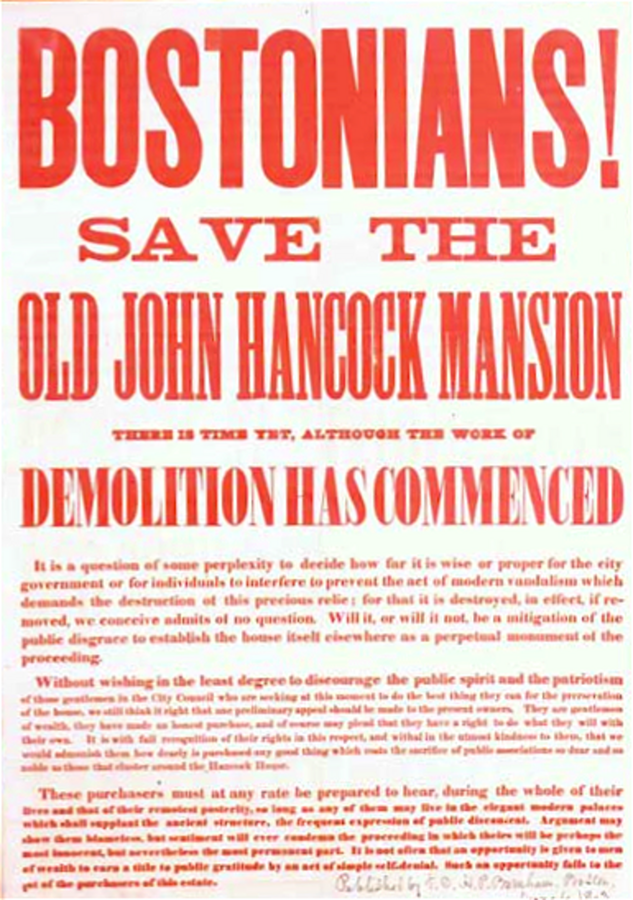
Visual AidAn old thing somebody tried to save
Photograph of a printed appeal from 1863, asking the city of Boston to save the Hancock House on Beacon Street. The Knowledge Bank asks why the Aldens keep the boxcar once they live in comfort, and this sheet is somebody asking the same question about a building a hundred and sixty years ago. Do not try to read it — the type is small and old, and the argument is not the point. The point is that a person cared enough to have it printed. Notice how it ends: the appeal failed and the house was pulled down that year. Whether an old thing is worth keeping is a question people lose as often as they win.
Broadside urging preservation of the Hancock House, Beacon Street, Boston, 1863. Source: Wikimedia Commons, public domain.
1Claim: “The children’s grandfather understands that home is about love, not luxury.” — choose the two details that best prove it.Claim & Evidence
2Shows what really makes the children happy, or just a detail of the ending? Tap each item to sort it — tap again to switch sides. You can keep tapping to change your answer.Sort into two
◄ What really makes them happyJust a detail ►
3Match each cause to its result. For each cause, pick its result.Cause & Effect
The children move to the grand house→
They love their old boxcar→
Grandfather sees how they feel→
Their old home is returned→
🧠Knowledge Bank question
4Fill both blanks to complete the reasoning.Build the Argument
The Knowledge Bank says the Aldens keep the boxcar because , which shows that .
Part 5
Standardized Test · Mixed Practice · All Question Types
Part 8 practices exam reading skills — all four question families in one mixed set — in the styles the SAT and TOEFL use. Read the passage (the highlighted words are tested below), then choose the answer best supported by the text.
Read the passage — the highlighted words are tested — then answer. Tap an answer, then tap it again to confirm.
SATWords in Context — a word's meaning in this passage
SATInference — a conclusion the passage implies
SATRhetorical Purpose — why the author put a sentence there
SATCentral Ideas — the passage's main point
TOEFLFactual Information — a fact stated in the passage
TOEFLInference — what the passage implies
TOEFLInsert Text — where a sentence best fits
Why Museums Preserve Old Objects
Why do people keep a chipped cup or a faded ticket long after it stops being useful? Because objects can hold memories that words alone cannot. Museums do the same thing on a giant scale: they preserve ordinary and extraordinary things so that future people can touch the past. Keeping an old object is harder than it sounds, for light, damp, and dust slowly damage almost everything, and nothing is truly permanent without care. Experts store fragile items in cool, dry rooms and handle them with gloves so that the oils on bare skin do not ruin them. A humble object — a lunch pail, a train ticket, a worn toy — can sometimes tell more about daily life than a grand painting does. That is why a treasured keepsake grows more valuable with age, even when it could never be sold for money. To save an object is to protect a story, and a story kept alive is the truest treasure of all.
Original passage written for Garden Heights — not a quotation from the novel.
1As used in the passage, the word “preserve” most nearly means —SAT · Words in Context
2The passage suggests that touching an old object with bare hands can —SAT · Inference
3According to the passage, why do experts handle old items with gloves?TOEFL · Factual Information
4As used in the passage, the word “permanent” most nearly means —SAT · Words in Context
5According to the passage, what can a humble object like a lunch pail sometimes do?TOEFL · Factual Information
6As used in the passage, the word “treasured” most nearly means —SAT · Words in Context
7The passage mainly presents old keepsakes as worth —SAT · Rhetorical Purpose
8Which statement best expresses the central idea of the passage?SAT · Central Ideas
9The passage most strongly suggests that a worn childhood toy could be —TOEFL · Inference
10Insert Text (TOEFL). Look at the four squares [1]–[4] in the excerpt below. They show where this sentence could be added: “Kept safe, such an object can carry a family’s story for a hundred years or more.”
An old keepsake is more than a worn thing. [1] It holds the memory of the people who used it. [2] Handled gently and kept from harm, it lasts. [3] Left in damp or careless hands, it slowly falls apart. [4]
Where would the sentence fit best?TOEFL · Insert Text
Part 6 · Optional
Creative Writing
A bonus challenge to practice your English.
About This Section
This writing task is optional and not part of your auto-graded score. Feedback checks length, spelling, and grammar only.
Writing Task — Part 8 “The Boxcar’s New Home”
Describe how the children feel when they see their old boxcar in Grandfather’s garden. Explain what the boxcar means to them as a symbol of their adventure together. Write at least 40 words.
You can start with: “When the children saw their old boxcar standing in Grandfather’s garden, they ran to it and…”
0 / 40 words minimum
🗣 Teach It · Just for Fun (optional)
No right or wrong — close the screen and tell someone nearby what happened in this part. Can’t find anyone? Tell yourself out loud. The moment you teach it, you truly understand it.
🏆
Part 8 Complete!
You finished Chapter 13 of The Boxcar Children.
Here are your auto-graded results:
-
points out of 100
Teach it to someone
The best last step is to teach it. In your own words, explain what happened — retell a favorite scene, teach a character’s big choice, or sum up the main idea for a parent, friend, or classmate. When you can teach it clearly, you truly own it.
SAT® is a registered trademark of College Board, which is not affiliated with, and does not endorse, these materials. TOEFL® is a registered trademark of ETS. These materials are not endorsed or approved by ETS. Garden Heights is an independent provider of test-style reading practice.