New here? Just sign up with Google — your account includes Matilda, our gift book, forever.
Bud, Not Buddy · Garden Heights
Part 7
for Bud, Not Buddy · Part 7 · Chapters 13–15
8 Parts40 min
What Happens in Part 7
The band decides Bud is theirs to look after. They take him to a restaurant, order him a huge meal, and give him a musician’s nickname — ‘Sleepy LaBone’ — a sign that he belongs. Warm Miss Thomas becomes almost a mother to him, and the friendly Steady Eddie promises to find him an instrument of his own. Bud is brought to live at Grand Calloway Station, the big house where the band members stay between shows, and for the first time in years he has a bed, regular meals, chores, and people who notice him. But a mystery is quietly deepening. Bud sees that gruff old Herman E. Calloway has a strange habit: he collects rocks, and on each one he has written the name of a place and a date — exactly like the rocks Bud has carried in his suitcase all along, the rocks that belonged to his mother. Bud cannot make sense of it, and he does not yet dare show the old man his own stones. Calloway stays distant and hard, but the band folds Bud deeper into their world of music and family, and Bud, happier than he has been since his mother died, senses that the rocks are a clue to something enormous he cannot yet name.
A clue that ties the ends together, a found family, and rising mystery
Cross-Curricular
The golden age of big-band jazz on the road
Chapter Summary
Ch.
What happens
Chapters 13–14
Sleepy LaBone — the band feeds Bud, gives him a nickname, and brings him to live at Grand Calloway Station, where he finally has a home and people who notice him.
Chapter 15
The Matching Rocks — Bud notices that Calloway collects rocks marked with places and dates — exactly like the rocks from his mother’s suitcase — and senses a clue he cannot yet explain.
Part 1
Vocabulary
Study 10 key words from Chapters 13–15, then answer each question.
🧠Knowledge Bank · Words of a New Home
Lexical Semantics · Words of a New Home
Four words that turn a runaway into a member of a band. A nickname is a friendly name used instead of a real one, and the band gives Bud one — Sleepy LaBone — which matters enormously to a boy who has spent the whole novel correcting people about his name. An instrument is a tool used to make music, and Steady Eddie promises him one. To rehearse is to practice for a performance, which is what the band does before every show and what Bud is now expected to attend. A collection is a group of objects gathered together, and Calloway keeps a strange one of rocks. A name, an instrument, a rehearsal schedule — these are the furniture of belonging. Three of these words let Bud in. The fourth is the one that will tell him why.
nicknamen.Ch.13
A friendly name used instead of a real one
“The band gave Bud the nickname ‘Sleepy LaBone.’”
instrumentn.Ch.15
A tool used to make music
“Steady Eddie promised Bud an instrument.”
rehearsev.Ch.14
To practice for a performance
“The band would rehearse before each show.”
collectionn.Ch.15
A group of objects gathered together
“Calloway kept a strange collection of rocks.”
choresn.Ch.14
Small regular jobs
“Bud was given chores around the house.”
belongv.Ch.13
To have a rightful place in a group
“For once, Bud began to belong.”
curiousadj.Ch.15
Eager to know or learn
“The matching rocks made Bud curious.”
habitn.Ch.15
Something done regularly
“Marking rocks was Calloway’s odd habit.”
anticipationn.Ch.15
Excited waiting for something to come
“A sense of anticipation filled the house.”
settlev.Ch.14
To make a home in a place
“Bud began to settle at Grand Calloway Station.”
ⓘ The vocabulary words in this list are selected to help you understand and complete this workbook. Some may not appear verbatim in the original novel.
🧠Knowledge Bank question
1According to the Knowledge Bank, why does the nickname matter so much to Bud?Ch.13
2To ‘rehearse’ is to practice for a performance.Ch.14
3A tool used to make music is an ___.Ch.15
4A ‘collection’ is a single lonely object.Ch.15
5Fill in each blank with the correct word.Ch.15
Word choices:collectioninstrumentnicknamesneer- some words will not be used
Calloway kept a strange of marked rocks.
Steady Eddie promised Bud an of his own.
6To ‘belong’ is to have a rightful place in a ___.Ch.13
7Someone ‘curious’ is eager to know or learn.Ch.15
8A ‘habit’ is something done ___.Ch.15
9Fill in each blank with the correct word.Ch.14
Word choices:choressettlerehearsehabit- some words will not be used
Bud was given around the house.
He began to at Grand Calloway Station.
10‘Anticipation’ is excited waiting for something to ___.Ch.15
Part 2
Comprehension
Show you understood what happens in Chapters 13–15.
🧠Knowledge Bank · A Home and a Clue
Narrative Causality · A Home and a Clue
The narrative’s growing tension gives way to a crucial revelation and redirects the story’s direction. The band decides Bud is theirs to look after. They take him to a restaurant, order him a huge meal, and give him a musician’s nickname — ‘Sleepy LaBone’ — a sign that he belongs. Warm Miss Thomas becomes almost a mother to him, and the friendly Steady Eddie promises to find him an instrument of his own. Bud is brought to live at Grand Calloway Station, the big house where the band members stay between shows, and for the first time in years he has a bed, regular meals, chores, and people who notice him. But a mystery is quietly deepening. Bud sees that gruff old Herman E. Calloway keeps a collection of small rocks, each one marked with the name of a place and a date — exactly like the rocks that have been in Bud’s own suitcase since chapter one. The accumulated tension makes “A Home and a Clue” a genuine story threshold.
🧠Knowledge Bank question
1The Knowledge Bank explains that Bud notices Calloway ___.Ch.13
2Bud’s nickname from the band is ___.Ch.13
3Steady Eddie promises to find Bud an instrument.Ch.15
4Bud is brought to live at ___.Ch.14
5Write the numbers 1–5 in the boxes to show the correct order of events. Number 1 = what happens first.Chapters 13–15
Bud moves into Grand Calloway Station.
He is given chores and a place in the household.
They give him the nickname ‘Sleepy LaBone.’
Bud notices Calloway’s rocks match his own.
The band feeds Bud a big restaurant meal.
6Calloway suddenly becomes warm and loving in Part 7.Ch.14
7The strange clue Bud notices is that Calloway ___.Ch.15
8Bud does NOT yet ___.Ch.15
9Bud is unhappier than ever at Grand Calloway Station.Ch.14
10The matching rocks make Bud sense ___.Ch.15
Part 3
Literary Elements
Understanding HOW and WHY Christopher Paul Curtis tells the story across Chapters 13–15.
🧠Knowledge Bank · The Rocks Tie the Knot
Narrative Technique · The Rocks Tie the Knot
As the story nears its end, payoff, family, and suspense turn earlier details into consequences. Remember the rocks from Part 1 — the smooth stones in Bud’s suitcase, each marked with a place and a date, that seemed like a strange, sad keepsake? Now Curtis snaps the trap he set two hundred pages ago: Calloway keeps the very same kind of rocks. This is master plotting — a detail planted early, apparently meaningless, that suddenly becomes the key to everything. The matching rocks are the physical link between Bud and Calloway, the proof the whole book has been quietly carrying. Notice that Curtis lets the READER feel the click before Bud fully does. We are ahead of the boy now, watching him circle the truth, which fills the last chapters with almost unbearable anticipation. That authorial design makes “The Rocks Tie the Knot” a lesson in deliberate structure.
Visual AidA clue carried two hundred pages
Diagram for the Knowledge Bank on the rocks. The three cards are where the stones appear, in order, and card 4 is what the third appearance does to everything before it. Notice that nothing about the rocks changes. The same bag has been in the same suitcase all along; what changes is that a second collection turns up, and suddenly the first one has a meaning.
How the rocks become the key to the book, as described in the Knowledge Bank. Drawn for Garden Heights Academy.
Payoff
The rocks from Part 1 return as the crucial clue — a planted detail paying off at last.
Found family
The band — Miss Thomas, Steady Eddie, the household — becoming Bud’s home.
Suspense
The matching rocks — the reader senses the truth before Bud, and waits for it to break.
🧠Knowledge Bank question
1According to the Knowledge Bank, what makes the rocks master plotting?Ch.15
2Fill in each blank with the correct literary term.Ch.15
Word choices:payofffound familysettingrhyme- some words will not be used
The rocks from Part 1 returning as the key clue is a .
The band that becomes Bud’s home is his .
3A payoff is when an early planted detail becomes important later.Ch.15
4The band becoming Bud’s home is an example of ___.Ch.14
5Curtis lets the reader sense the rocks’ meaning before Bud does, which builds ___.Ch.15
6A payoff works best when the planted detail seemed unimportant at first.Ch.15
7Bud gets a home and a nickname BEFORE anyone knows he is kin, which shows family here is ___.Ch.13
8Fill in each blank with the correct literary term.Ch.15
Word choices:suspensepayoffnarratormotif- some words will not be used
The reader sensing the truth before Bud creates .
The rocks from Part 1 returning as the key is a .
9Found family means only people related to you by blood.Ch.14
10The clearest sign the story is nearing its answer is ___.Ch.15
Part 4
Think Deeper
Four deeper challenges — no single-word recall. Read, weigh the evidence, and reason it out.
🧠Knowledge Bank · The Band on the Road
The Big-Band Era · The Band on the Road
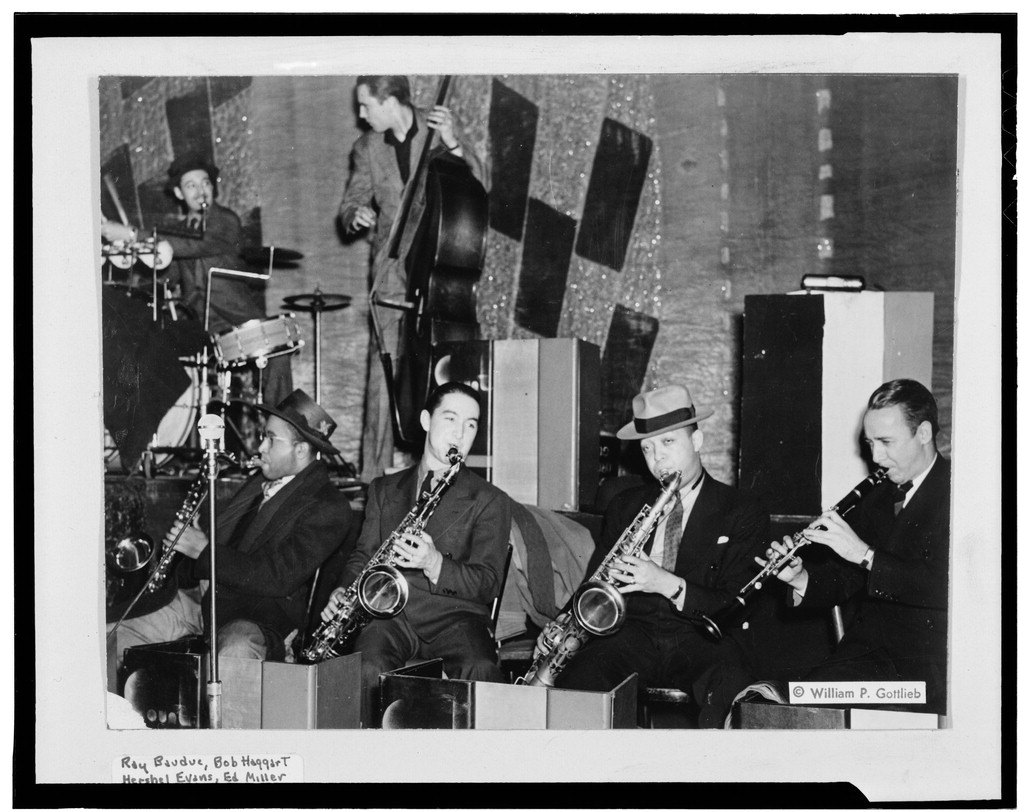
Herman E. Calloway and his band belong to the golden age of big-band jazz. Through the 1920s, 30s, and 40s, live bands were the heartbeat of American entertainment, playing dance halls, clubs, and ‘Log Cabin’-style roadhouses in town after town. For Black musicians especially, a working band could be both an art and an escape — a way to earn a living and win respect in a segregated country. But the life was hard: constant travel, long nights, low and uncertain pay, and, on the road, the daily insults of Jim Crow, which could deny a famous player a hotel room or a meal. That is why the band’s piano player is white. Calloway keeps Dirty Deed on because in 1936 a Black man cannot easily hold a property deed, and the nickname is the joke and the explanation at once.
Visual AidA working band
A band photographed on a theater stage in about 1941 — saxophones and clarinet in the front row, bass and drums behind. The Knowledge Bank explains that live bands were the center of American entertainment from the 1920s into the 1940s, and that for a Black band the road meant constant travel and the walls of segregation. Look at how close together they sit. A band worked, traveled and ate in that arrangement, which is why one could become a home for a boy with nowhere else to go.
A band on stage at the Howard Theater, Washington, D.C., about 1941; William P. Gottlieb collection, Library of Congress. Source: Wikimedia Commons, public domain.
Think back over these chapters. A boy who has been nobody’s child for years is suddenly somebody’s ‘Sleepy LaBone,’ handed a plate, promised a horn, given a bed and chores and a place at the table by a band that has decided, without a word of blood, that he is theirs. And in that same house sits a hard old man who will barely look at him — a man who, Bud notices with a jolt, keeps a box of smooth rocks, each one marked with a town and a date, exactly like the rocks that have ridden in Bud’s suitcase since his mother died. Bud does not yet dare say a word. But the reader, who remembers page one, can feel the whole book leaning toward its answer.
Original passage written for Garden Heights — not a quotation from the novel.
1Claim: “Part 7 pays off the rocks planted in Part 1, turning an early clue into the key to Bud’s story.” — choose the two details that best prove it.Claim & Evidence
2Blood family (not yet known), or Found family (already given)? Tap each detail to sort it — tap again to switch sides. You can keep tapping to change your answer.Sort into two
◄ Blood family (not yet known)Found family (already given) ►
3Match each cause to its result. For each cause, pick its result.Cause & Effect
The band nicknames Bud→
Bud moves into the house→
Calloway keeps marked rocks→
The reader senses the truth→
🧠Knowledge Bank question
4Fill both blanks to complete the reasoning.Build the Argument
The Knowledge Bank argues that the band's piano player is white because , which shows that .
Part 5
Standardized Test
Reading passage · The Golden Age of Big-Band Jazz · SAT & TOEFL-style practice
Read the passage — the highlighted words are tested — then answer. Tap an answer, then tap it again to confirm.
SATCentral Ideas — the passage's main point
SATDetail — a fact stated in the passage
SATWords in Context — a word's meaning in this passage
TOEFLFactual Information — a fact stated in the passage
TOEFLVocabulary — a tested word's meaning here
TOEFLRhetorical Purpose — why the author included a detail
The Golden Age of Big Bands
Herman E. Calloway’s band comes straight out of the golden age of big-band jazz. From the 1920s into the 1940s, live bands were the center of American popular entertainment. Before television, and when records were still a luxury, people heard every instrument played in person — in grand city ballrooms, in small-town dance halls, and in roadhouses like the fictional Log Cabin. A good band could fill a floor with dancers and make its leader a local star. Many of the era’s greatest bands were led by Black musicians, whose artistry helped make jazz the defining American sound of the century.
For a Black band, though, the music was only half the story; the other half was the road. Bands traveled constantly, often hundreds of miles between shows, and everywhere they went they met the walls of segregation. A celebrated musician might thrill a crowd at night and then be refused a hotel room or a restaurant meal because of his color; bands learned which towns to pass through without stopping. The pay was uncertain, the nights were long, and the members spent nearly all their time together — eating, traveling, rehearsing, and living side by side — until a band became less like a job and more like a family. This is the world Bud stumbles into, and it explains how a scruffy group of musicians could so quickly become the home a lonely boy had been searching for. In Curtis’s hands, the band is both a real slice of history and a haven.
Original passage written for Garden Heights — not a quotation from the novel.
1What does the passage mainly describe?SAT · Central Ideas
2In the 1920s–40s, live bands were the center of American ___.TOEFL · Factual Information
3Bands played in ballrooms, dance halls, and ___.SAT · Detail
4Many great bands of the era were led by ___.TOEFL · Factual Information
5For a Black band, the ‘other half’ of the story was ___.SAT · Detail
6A celebrated Black musician might be refused a ___ because of his color.TOEFL · Factual Information
7In the passage, an instrument is ___.SAT · Words in Context
8In the passage, rehearsing means ___.TOEFL · Vocabulary
9The passage says bands learned which towns were ___.SAT · Detail
10Why does this passage matter for Part 7?TOEFL · Rhetorical Purpose
Part 6 · Optional
Creative Writing
A bonus challenge to practice your English. Take your time and have fun with it.
About This Section
This writing task is optional and is not part of your auto-graded score. The feedback below checks only the basics — length, spelling, and grammar — not whether your ideas are right or wrong. It is meant for classroom discussion and creative practice, so feel free to use your imagination!
Writing Task — Part 7 “Where I Belong”
The band gives Bud a nickname, a home, and a place before anyone knows he is family. Write about a group or place where you truly feel you belong — a team, a club, a family, a friend group. What makes you feel you belong there, and why does it matter? 6–10 sentences. End with what belonging gives you.
You can start with: “There is one place where I never have to wonder if I fit...”
0 / 40 words minimum
🗣 Teach It · Just for Fun (optional)
No right or wrong — tell someone nearby what happened in this part. Can’t find anyone? Tell yourself out loud. The moment you teach it, you truly understand it.
Part 7 Complete!
You finished Chapters 13–15 of Bud, Not Buddy.
Here are your auto-graded results:
-
points out of 100
Teach it to someone
The best last step is to teach it. In your own words, explain what happened — retell a favorite scene, teach a character’s big choice, or sum up the main idea for a parent, friend, or classmate. When you can teach it clearly, you truly own it.
Independent study guide by Garden Heights. Not affiliated with or endorsed by Christopher Paul Curtis. Contains original analysis only; no text from the novel is reproduced. Reference text: This workbook follows Christopher Paul Curtis’s classic text (the standard Puffin edition sold worldwide). Revised 2023 UK editions change some wording and may not match the vocabulary studied here.
SAT® is a registered trademark of College Board, which is not affiliated with, and does not endorse, these materials. TOEFL® is a registered trademark of ETS. These materials are not endorsed or approved by ETS. Garden Heights is an independent provider of test-style reading practice.