
Chains cover
Garden Heights

Chains

This workbook is for Garden Heights members. Sign in to continue.

Sign in with Google →
New here? Just sign up with Google — your account includes Matilda, our gift book, forever.
Chains · Garden Heights

Part 8

for Chains · Part 8 · Chapters 42–45
8 Parts40 min
What Happens in Part 8

Isabel learns Ruth is alive in Charleston, forges a pass, frees Curzon, and rows to New Jersey.

A Penny for NewsIt is January 1777 in occupied New York, and Isabel finishes a pamphlet arguing that all people begin as equals — if that is true, her bondage is neither natural nor permanent. Two officers use her as a messenger, one sending a single penny he calls a wager about the royal ball; the second says the coin stands for news and sends an answer back. Madam Lockton meets her in the kitchen with a riding crop.

Ruth Is AliveMadam learns Isabel has spoken with a rebel officer and demands the note; Isabel throws it into the fire, and Madam threatens her with sale and threatens Ruth with drowning. In that fight Isabel finally hears the truth: Ruth was never sold. No buyer could be found, so Madam sent her south to Charleston. Ruth is alive, and Isabel now has somewhere to go.

Isabel GardenerLocked in the potato bin, she kicks away rotten boards and lets herself into Lockton's office, where she takes a map and forges a pass declaring herself free — the written permission any enslaved traveler had to show. Thinking of the gardens she wants, she becomes Isabel Gardener, and decides the letter burned into her cheek now stands for Isabel, not insolence. On the ball night Lady Seymour wakes, forces her damaged voice to work, and tells her to run.

Over JordanRather than leave Curzon in a British jail, Isabel tells the guard she was sent to clean the cells, finds him fevered among the dead, reports another body to remove, and wheels him out in a barrow. Fireworks for the Queen pull the soldiers' eyes upward; she runs ten blocks to the wharf, takes a boat, and rows until her body quits. She wakes free on the Jersey shore, Curzon alive beside her, and calls the crossing over Jordan.

What We Will Learn
SectionWhat you will practice
VocabularyEscape, paper, and the river: pamphlet, forge, pass, sentry, current
Literary ElementsEpigraphs taken from real 1777 documents, an allusion to the crossing of the river Jordan, and a resolution that deliberately refuses to close
Cross-CurricularBlack Americans and the Revolution — the freedom both armies offered, who crossed the lines to take it, and the ledger that recorded the survivors
Chapter Summary
Ch.What happens
Chapter 42A Penny Between Officers — Isabel finishes the pamphlet arguing that no one is born the master of anyone else, and cannot unthink it. An officer lodging in the house sends her across town with a penny for a second officer, who says the coin means news and sends a reply back. Madam Lockton meets her in the kitchen with a riding crop.
Chapter 43Ink, Map, and a Name — Madam demands the rebel officer’s note; Isabel burns it and is threatened with sale, but learns that Ruth was never sold and is in Charleston. Kicking loose from the potato bin, she gets into Lockton’s office, takes a map, forges a pass declaring herself free, names herself Isabel Gardener, and rules that her brand now stands for Isabel.
Chapter 44The Night of the Ball — Dressed in everything she owns, with her seeds and her pamphlet packed, Isabel reaches for Lady Seymour’s purse; the old woman wakes and tells her to run. She will not leave Curzon behind, so she enters the jail claiming she was sent to clean the cells, finds him fevered among the dead, calls him another body, and loads him into a wheelbarrow.
Chapter 45Crossing Over Jordan — Soldiers block the street until fireworks for the Queen distract them. Isabel runs the ten blocks to the wharf, takes a boat, and rows until her body quits. She wakes frost-covered on the New Jersey shore, free, with Curzon alive; the book ends on a question about whether he can walk.
Part 1
Vocabulary
Study 10 key words from Chapters 42–45, then answer each question.
📚Knowledge Bank · Papers That Owned a Person
Law · Passes and the Slave CodesIn the American colonies an enslaved person who walked down a public road could be stopped by almost any white adult and made to produce a pass — a note, signed by an owner, stating where the bearer was going and when to return. The colonial slave codes made those notes into walls. Anyone traveling without one could be seized, whipped, jailed, or advertised for; organized patrols rode the roads at night looking for exactly that. A single scrap of paper decided whether a person on a highway was a servant on an errand or a fugitive. Writing was the second lock on the same door. Owners understood that a person who could form letters could also copy a signature, so several states eventually made it a crime to teach an enslaved child to read or write. That is why a girl at a desk with ink is such a dangerous picture, and why the choice to forge the paper is the turning point it is: literacy was the tool that could make its holder free.
Visual AidOne road, one scrap of paper
One road, one scrap of paperA box for a person on a public road leads by an arrow to a box reading: stopped by almost any white adult, show your pass. Two arrows branch from it. The upper one reaches a box reading pass shown, a servant on an errand, walk on. The lower one reaches a box reading no pass, seized, whipped, jailed or advertised for. Underneath, a wide box reads: the second lock, several states made it a crime to teach an enslaved child to read or write, beside the note that a hand that can form letters can also form a pass. Notes say organized patrols rode the roads at night, and that literacy was the one tool that could make its holder free.ONE ROAD, ONE SCRAP OF PAPERA PERSON ONA PUBLIC ROADSTOPPED BY ALMOSTANY WHITE ADULT —show your passPASS SHOWN — a servanton an errand; walk onNO PASS — seized, whipped,jailed, or advertised forTHE SECOND LOCK: several states made it a crimeto teach an enslaved child to read or writea hand that can form letterscan also form a passorganized patrols rode the roads at night looking for exactly thatliteracy was the one tool that could make its holder free
Structure diagram of the system the Knowledge Bank describes: on a public road an enslaved person could be stopped by almost any white adult, and one signed note decided whether the walk continued or ended in seizure. The branch is drawn as two clean outcomes, which the road never was — a pass could be doubted, ignored or torn up — and the codes differed from colony to colony and hardened over time. The drawing describes the law, not any journey Isabel makes. Notice the second lock at the foot of the drawing: the same hand that could copy a signature was the hand the codes tried hardest to keep untaught.
Colonial pass requirements, slave patrols and the later statutes criminalizing the teaching of reading and writing, as set out in the Knowledge Bank and in standard histories of the slave codes. Drawn for Garden Heights Academy.
pamphletn.Ch.42
A short printed booklet that argues for an idea
“The pamphlet claimed that no family is born above another.”
wagern.Ch.42
A bet placed on the outcome of something
“The officer called the penny part of a wager about the ball.”
bondagen.Ch.42
The state of being owned by another person and forced to work
“The pamphlet gave Isabel new words for her own bondage.”
forgev.Ch.43
To make or change a document in order to deceive
“She sat down with ink to forge a pass for herself.”
passn.Ch.43
A written paper giving permission to travel
“Without a pass, any traveler could be stopped and held.”
brandn.Ch.43
A mark burned into the skin to show ownership or punishment
“She looked at the brand on her cheek and gave it a new meaning.”
sentryn.Ch.44
A soldier posted to stand guard over a place
“A sentry watched the prison door on the night of the ball.”
corpsen.Ch.44
A dead body
“Curzon left the cells wrapped up and carried as a corpse.”
wharfn.Ch.45
A platform built along the shore where boats tie up
“She pushed him the last blocks to the wharf in the dark.”
currentn.Ch.45
The steady flow of water moving in one direction
“The current shoved the little boat sideways as she rowed.”

ⓘ The vocabulary words in this list are selected to help you understand and complete this workbook. Some may not appear verbatim in the original novel.

🧠Knowledge Bank question
1According to the Knowledge Bank, several colonies made it a crime to teach an enslaved child to write because ___.Ch.42
2A ‘wager’ is ___.Ch.42
3‘Bondage’ means being owned by another person and forced to work.Ch.42
4To ‘forge’ a document is to ___.Ch.43
5Fill in each blank with the correct word.Ch.43
Word choices:forgepassbrandwager- some words will not be used
Isabel takes ink and paper in order to a document.
The paper she writes is a traveling .
6A ‘brand’ is a mark that has been ___.Ch.43
7A ‘sentry’ is a prisoner kept locked inside a cell.Ch.44
8A ‘corpse’ is ___.Ch.44
9Fill in each blank with the correct word.Ch.45
Word choices:wharfcurrentsentrycorpse- some words will not be used
She ran the last blocks to the where the boats were tied.
The river’s shoved the little boat sideways.
10The ‘current’ of a river is the steady flow of its water.Ch.45
Part 2
Comprehension
Show you understood what happens in Chapters 42–45.
🔍Knowledge Bank · The Coldest Winter in the Bridewell
Military History · Prisons of Occupied New YorkWhen the British took New York in September 1776, they suddenly held thousands of captured American soldiers and had nowhere to put them. They filled the city jail beside the Commons — the Bridewell, the very building Isabel keeps returning to — and then overflowed into sugar warehouses, churches, and old ships anchored in the water off Brooklyn. Conditions were lethal rather than merely harsh. Windows went unglazed through the first winter, fuel was scarce, and rations arrived short, spoiled, or not at all, so hunger, cold, and typhus — a fever spread by body lice in crowded quarters — did the killing. Historians estimate that more Americans died in British prisons and prison ships than were killed in every battle of the Revolution combined; the ships alone are usually credited with something near eleven thousand deaths. That is the arithmetic behind Isabel’s decision to turn back. Leaving Curzon in his cell would not have meant leaving him uncomfortable; it would have meant handing him to the war’s single deadliest place, a British prison.
🧠Knowledge Bank question
1The Knowledge Bank explains that most deaths in the British prisons were caused by ___.Ch.42
2How does Madam Lockton treat Isabel when she returns to the kitchen?Ch.42
3Isabel learns that Ruth was not sold after all and is in Charleston.Ch.43
4What does Isabel write for herself in Chapter 43?Ch.43
5Write the numbers 1–5 in the boxes to show the correct order of events. Number 1 = what happens first.Chapters 42–45
  • Madam Lockton punishes Isabel in the kitchen.
  • Isabel carries a penny between two officers lodging in the house.
  • Isabel rows across the water and wakes on the Jersey shore.
  • A barrow leaves the prison yard without being stopped.
  • Isabel writes herself a new name and a way out.
6Isabel decides that the letter branded on her cheek now stands for ___.Ch.43
7Lady Seymour wakes, forbids Isabel to take the money, and calls for help.Ch.44
8Why does Isabel go back to the prison instead of leaving alone?Ch.44
9How does Isabel get Curzon past the prison guard?Ch.44
10Isabel and Curzon cross the water and reach New Jersey.Ch.45
Part 3
Literary Elements
Understanding HOW and WHY Laurie Halse Anderson tells the story across Chapters 42–45.
🎭Knowledge Bank · The Real Words Above Each Chapter
Authorial Craft · Epigraph and Open EndingEvery chapter of this novel opens with an epigraph — a short quotation set above the text — and Laurie Halse Anderson (author) took hers from genuine 1770s paper: letters, diaries, army orders, laws, newspaper columns, and advertisements offering rewards for the return of runaway people. Setting a real document over an invented scene does two jobs at once. It certifies the world, so a reader stops asking whether things were truly this bad; and it convicts that world out of its own mouth, since the finest sentences about liberty sit directly above a girl being sold. The ending borrows differently. Calling the escape a crossing of Jordan is an allusion — a glance at a text the reader is expected to know — reaching for the river the Israelites crossed out of the wilderness and for the spirituals that had used that same river to mean escape from slavery for generations. The result is a resolution that refuses to shut: one danger ends, one road stays open.
Epigraph
A short quotation printed above the start of a chapter. Every chapter here carries one, taken from real letters, laws, diaries, and newspapers of the 1770s.
Allusion
A brief reference to another well-known text. Naming the crossing after the river Jordan borrows centuries of meaning in four words.
Resolution
The part of a story where the conflicts settle. This one settles the escape and leaves the search for Ruth wide open.
🧠Knowledge Bank question
1According to the Knowledge Bank, setting real 1770s documents above invented scenes works by ___.Ch.42
2The documents quoted above the chapters of this novel were invented by the author.Ch.43
3Naming the escape a crossing of Jordan reaches back to an older text, which makes it ___.Ch.45
4Which of these is the clearest example of an epigraph?Ch.44
5Fill in each blank with the correct literary term.Ch.42
Word choices:epigraphallusionresolutionglossary- some words will not be used
A real 1777 letter set above a chapter is an .
A quick reference to the river Jordan is an .
6The part of a story where the conflicts settle is the ___.Ch.45
7An allusion is a brief reference to another text the reader is expected to know.Ch.45
8The last pages end one danger while pointing toward another journey, which makes the resolution ___.Ch.45
9Fill in each blank with the correct literary term.Ch.45
Word choices:resolutionepigraphallusionpreface- some words will not be used
The final chapters bring the conflicts to a .
The real words printed above each chapter form its .
10A resolution must answer every question a story has raised.Ch.45
Part 4
Think Deeper
Four deeper challenges — no single-word recall. Read, weigh the evidence, and reason it out.
📑Knowledge Bank · Three Thousand Names
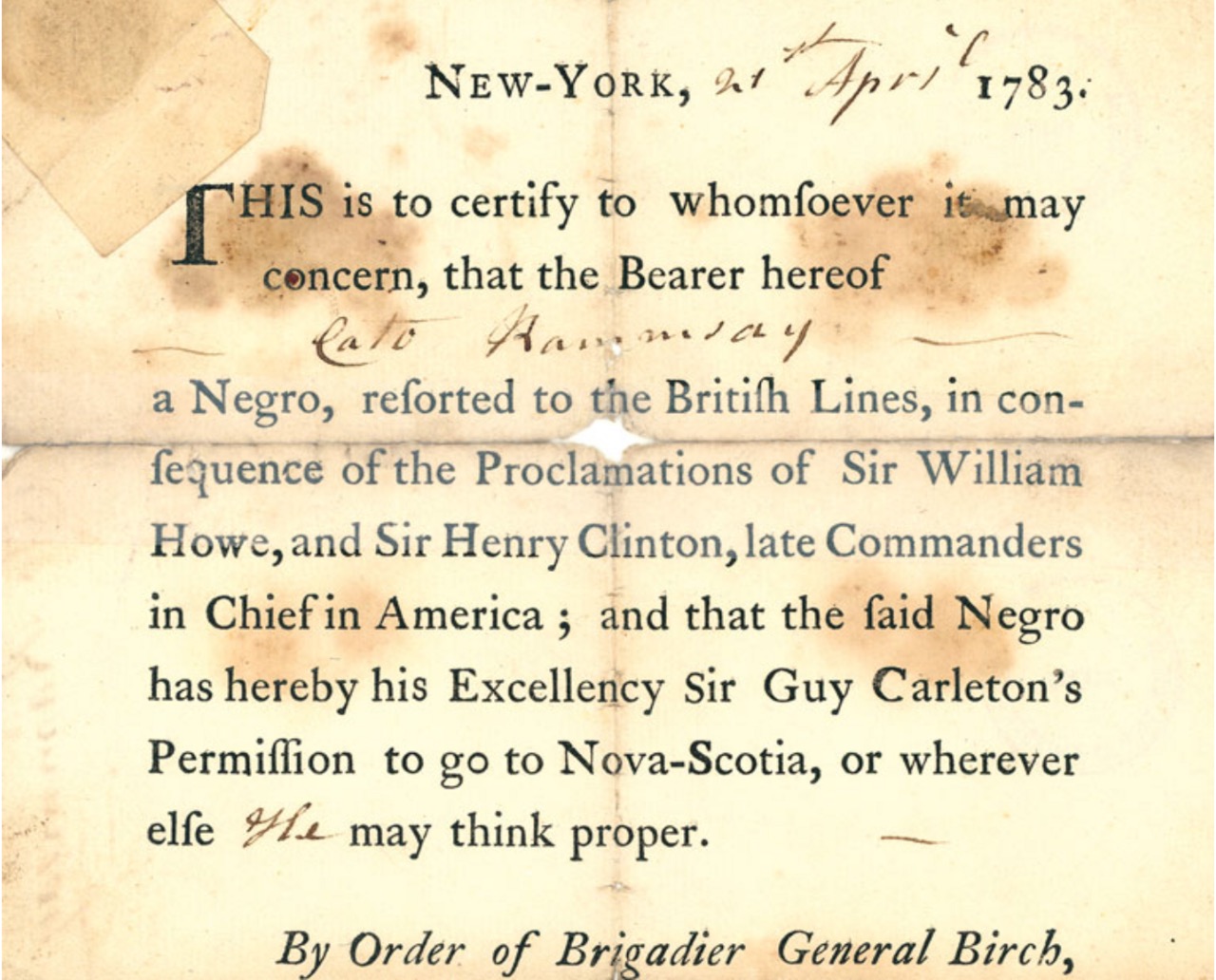
Public History · The Book of NegroesThe most important document to come out of Black America’s Revolution is a list. As the British prepared to leave New York in 1783, thousands of people who had escaped slavery to reach their lines faced being handed back, and American negotiators demanded exactly that. The British commander refused for anyone who had arrived before the peace, and ordered his clerks to keep an accounting instead. The resulting ledger, called the Book of Negroes, recorded each Black passenger leaving by ship — name, age, height, former owner, and how the escape had happened — roughly three thousand people in all. The evacuation carried most of them to Nova Scotia, where a settlement at Birchtown became the largest free Black community outside Africa, and where promised land arrived poorly or not at all; about twelve hundred sailed on to Sierra Leone in 1792. Historians prize the ledger because it was compiled to settle a property claim and instead preserved the opposite — a generation of self-freed people entered into the record under their own names.
Visual AidThe certificate that carried a person out
A stained and folded printed certificate headed New-York, with the date 21 April 1783 written in by hand, a name written into a blank line in the middle of the printed text, and the words by order of Brigadier General Birch cut off at the bottom edge
Photograph of a printed certificate issued at New York on 21 April 1783 to a man named Cato Ramsay, stating that the bearer had come into the British lines and had the commander’s permission to go to Nova Scotia. This is the paper the accounting in the Knowledge Bank handed out; it is not a page of the ledger itself, and the sheet is shown cut off at the foot, below the officer’s line. Its wording is the wording of 1783, including a term for Black people that nobody would write today. Notice how little is handwritten — only the date and the name. Everything else was printed in advance, because the British expected to issue thousands, and each one moved a self-freed person out of reach of an American claim.
Certificate of permission to leave New York issued to Cato Ramsay by order of Brigadier General Samuel Birch, New York, 21 April 1783. Source: Wikimedia Commons, file "Book of Negroes, Samuel Birch.png", public domain.

A girl sits alone in a rich family’s library in occupied New York, finishing a pamphlet that argues no person is born above another. She has been beaten. She has been branded on the face. Her little sister has been carried off to Charleston. And she has just read, in cold print, the sentence that every owner in the city would rather she never saw. Watch what she does with it. She does not weep over it and she does not hide it. She waits for the day the whole town is looking somewhere else — January 18, 1777, the Queen’s birthday, when every candle and every firework in New York is burning for somebody else’s party — and she picks up a pen. Ink, paper, and a steady hand are the tools the law kept for masters. In Part 8 an enslaved girl uses them on her own behalf: she writes herself a traveling pass, gives herself a family name, and decides for herself what the letter burned into her cheek is going to stand for from now on. Then, with the water and the free shore already in sight, she turns around and walks back toward the prison.

Original passage written for Garden Heights — not a quotation from the novel.
1Claim: “Part 8 shows that Isabel takes her freedom rather than waiting to be given it.” — choose the two details that best prove it.Claim & Evidence
2Freedom she takes for herself, or Things the world does to her? Tap each detail to send it left or right.Sort into two
◄ Freedom she takes for herselfThings the world does to her ►
3Match each cause to its result. For each cause, pick its result.Cause & Effect
Isabel finishes a pamphlet about human equality
She forges a pass and chooses a surname
Curzon lies fevered among the dead in the jail
Water lies between the island city and Jersey
🧠Knowledge Bank question
4Fill both blanks to complete the reasoning.Build the Argument
According to the Knowledge Bank, historians prize the Book of Negroes because , even though British clerks compiled it .
Part 5
Standardized Test
Two Promises of Freedom · Reading & Vocabulary · SAT & TOEFL-style practice
Two Promises of Freedom

On November 7, 1775, Lord Dunmore, the royal governor of Virginia, issued a proclamation from the deck of a warship. Any enslaved man belonging to a rebel who reached the King's forces and bore arms for them would be free. The offer was narrow on purpose. It left out women and children, left out everyone owned by loyal subjects, and was a war measure rather than a judgment about slavery. Hundreds reached the ships within weeks, slipping past every sentry ordered to stop them; some served in a unit called the Ethiopian Regiment.

The American side made promises of its own, and made them late. George Washington at first barred Black men from the Continental Army, then reversed himself as enlistments dried up. In 1778 Rhode Island offered freedom to any enslaved man who would enlist and serve to the end, paying the owner of each recruit. Roughly five thousand Black soldiers served the American cause at Bunker Hill, at Saratoga, and in the winter camps. Some were sent as substitutes by their owners, and a few were forced back into bondage after discharge, owned again by the men who had sent them.

When the fighting stopped, the two promises were weighed. British officers in New York refused to hand back people who had reached their lines, and in 1783 their clerks compiled a ledger naming every Black passenger evacuated by sea, roughly three thousand people. Most sailed to Nova Scotia, where promised land and supplies came slowly or never, and about twelve hundred left in 1792 for Sierra Leone. Freedom offered as a tactic proved thin. Yet tens of thousands refused to wait for permission, and their flight made the Revolution the largest emancipation in America before 1863.

Original passage written for Garden Heights — not a quotation from the novel.
1What is the main idea of the passage?SAT · Central Ideas
2According to the passage, Dunmore’s offer of freedom applied only to ___.TOEFL · Factual Information
3According to the passage, Rhode Island’s 1778 offer included ___.TOEFL · Factual Information
4The passage suggests that Washington changed his position on Black soldiers because ___.SAT · Inference
5Insert Text (TOEFL). Look at the four squares [1][4] in the excerpt below. They show where this sentence could be added:
“That refusal turned a diplomatic argument into a paperwork problem.”
When the British agreed to leave New York in 1783, thousands of formerly enslaved people were living behind their lines and feared being handed back. [1] American negotiators demanded the return of what they called their property, and the British commander refused for anyone who had reached his lines before the peace. [2] British clerks instead spent the summer writing down every Black person who boarded a ship: name, age, height, former owner, and the story of each escape. [3] The resulting ledger, known as the Book of Negroes, recorded roughly three thousand people carried north to Nova Scotia. [4]
Where would the sentence fit best?
TOEFL · Insert Text
6It can be inferred that the British refusal in 1783 was ___.SAT · Inference
7In the passage, proclamation most nearly means ___.SAT · Words in Context
8In the passage, sentry most nearly means ___.TOEFL · Vocabulary
9In the passage, bondage most nearly means ___.TOEFL · Vocabulary
10The author mentions substitutes sent by owners mainly to ___.SAT · Author’s Purpose
Part 6 · Optional
Creative Writing
A bonus challenge to practice your English. Take your time and have fun with it.
About This Section

This writing task is optional and is not part of your auto-graded score. The feedback below checks only the basics — length, spelling, and grammar — not whether your ideas are right or wrong. It is meant for classroom discussion and creative practice, so feel free to use your imagination!

Writing Task — Part 8 “The Name You Would Choose”

Isabel gives herself a family name and decides for herself what the mark on her face will mean. Write about a name, nickname, or label that has been put on you, and what you would choose instead if the decision were entirely yours. Describe where the name came from, how it has felt to carry it, and the name or meaning you would pick. 6–10 sentences. End with one sentence explaining what your choice says about who you are.

You can start with: “The name people use for me came from somebody else...”
0 / 40 words minimum
🗣 Teach It · Just for Fun (optional)

No right or wrong — tell someone nearby what happened in this part. Can’t find anyone? Tell yourself out loud. The moment you teach it, you truly understand it.

Garden Heights

Part 8 Complete — You Finished the Book! 🎉

You finished Chapters 42–45 — the final part of Chains.

Here are your auto-graded results:

-
points out of 100
🗣 Teach It · Just for Fun (optional)
Explore the next book →📊 See Your Full Report Card

Independent study guide by Garden Heights. Not affiliated with or endorsed by Laurie Halse Anderson. Contains original analysis only; no text from the novel is reproduced. Reference text: This workbook follows Laurie Halse Anderson’s classic text (the standard Puffin edition sold worldwide). Revised 2023 UK editions change some wording and may not match the vocabulary studied here.