New here? Just sign up with Google — your account includes Matilda, our gift book, forever.
Charlie and the Chocolate Factory · Garden Heights
Part 3
for Charlie and the Chocolate Factory · Part 3 · Chapters 9–12
8 Parts40 min
What Happens in Part 3
With only one Golden Ticket left, Grandpa Joe takes a gamble: he digs out a coin he has hidden for years and sends Charlie to buy one more chocolate bar. They open it together — no ticket — and simply laugh. Then a hard winter closes in. Mr. Bucket’s toothpaste factory shuts down, and though he earns a few pennies shovelling snow, it is nowhere near enough. The family slowly begins to starve, and Charlie grows thin and weak. One freezing afternoon, walking home, Charlie spots some money half-buried in the snow. He buys a chocolate bar and eats it — then buys a second. Inside the wrapper of that second bar is a flash of gold: the last Golden Ticket. The shopkeeper spots it, a crowd gathers, and Charlie races home. The ticket says he may bring one or two family members to the factory — and Grandpa Joe leaps out of bed to go with him.
What We Will Learn
Section
What you will practice
Vocabulary
Words of hardship and hope: gamble, starve, bitter, glimpse, miracle, deserve…
Literary Elements
Mood, symbolism, and the story’s turning point
Cross-Curricular
Food as fuel for the body, and how coincidence and long odds work
Chapter Summary
Ch.
What happens
9
Grandpa Joe Takes a Gamble — he gives Charlie a hidden coin for one last bar; no ticket.
10
The Family Begins to Starve — the factory closes, winter bites, and the Buckets go hungry.
11
The Miracle — Charlie finds money in the snow and the last Golden Ticket in a second bar.
12
What It Said on the Golden Ticket — the instructions arrive, and Grandpa Joe will go with Charlie.
Part 1
Vocabulary
Study 10 key words from Chapters 9–12, then answer each question.
🧠Knowledge Bank · Sugar and the Sweet Shop
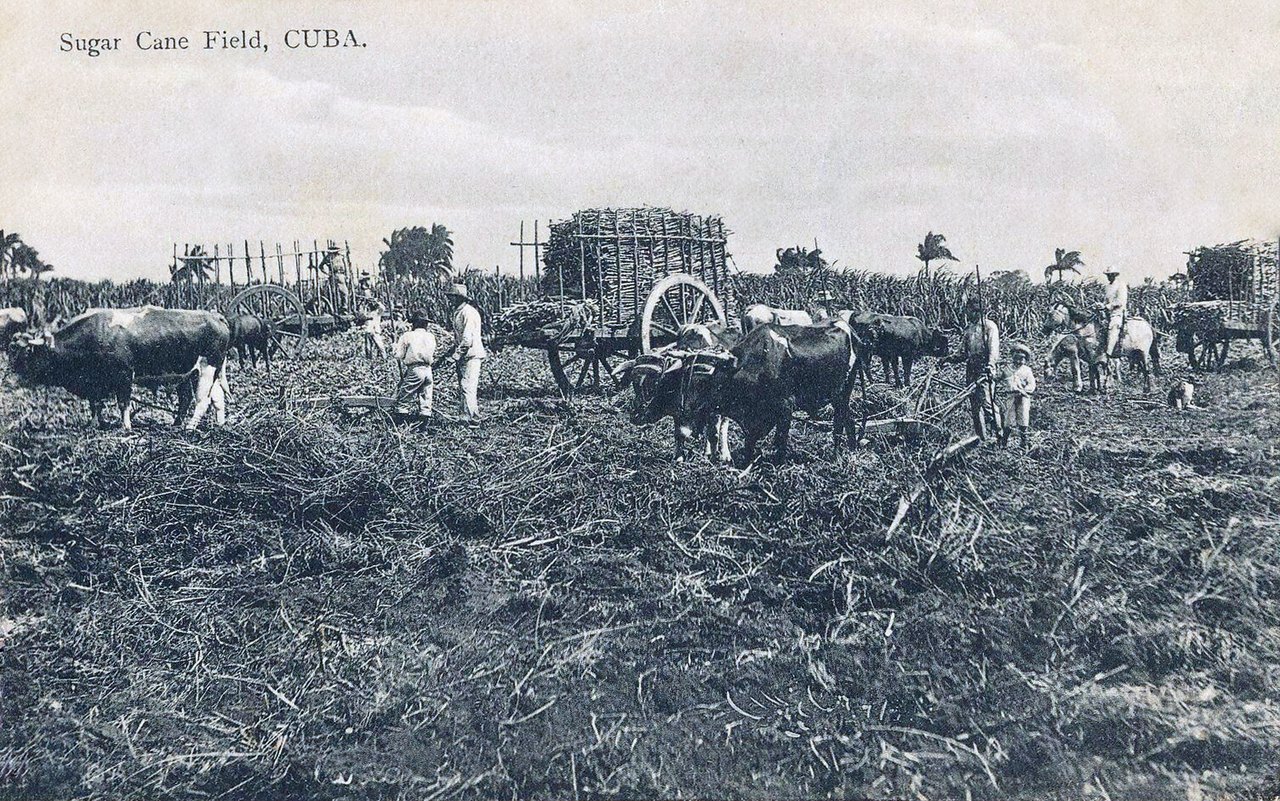
Candy Science · Sugar & the Sweet ShopThe bar Charlie finally buys comes from a long tradition of the corner sweet shop, and its magic rests on one humble ingredient: sugar. Sugar is squeezed from tall tropical cane or from pale beets, then boiled down into the crystals that make candy possible. For most of history sugar was so costly that households locked it away like treasure, and even in Charlie’s day a wrapped bar was a small luxury a poor family could rarely afford. That is why a coin half buried in the snow matters so much: in a winter when the toothpaste factory has closed and no wage comes in, one found coin becomes a doorway. Notice too that the bar is sealed in paper, so nobody — buyer or seller — can know what the wrapper hides.
Visual AidWhere the sugar came from
Photograph taken around 1908 of a sugar-cane harvest in Cuba. The Knowledge Bank explains that the magic of a sweet shop rests on one humble ingredient, that sugar is squeezed from tall tropical cane or from pale beets and boiled into crystals, and that for most of history sugar was so costly that households locked it away like treasure. Look at the ox carts. This is the labor that sat behind a wrapped bar a poor family could rarely afford.
Sugar-cane harvest in Cuba, circa 1908; published by Harris Brothers, Havana. Source: Wikimedia Commons, public domain.
gamblen.Ch.9
A risky bet on chance
“Buying one last bar was a real gamble.”
starvev.Ch.10
To suffer from lack of food
“The family began to starve that winter.”
bitteradj.Ch.10
Sharp and biting (of cold)
“A bitter wind swept through the town.”
shovelv.Ch.10
To lift or clear with a spade
“Mr. Bucket shovelled snow for pennies.”
faintadj.Ch.10
Weak and dizzy
“Charlie felt faint from hunger.”
glimpsen.Ch.11
A quick, brief look
“He caught a glimpse of gold paper.”
miraclen.Ch.11
A wonderful, unexpected event
“Finding the ticket felt like a miracle.”
clutchv.Ch.11
To grip tightly
“Charlie clutched the ticket to his chest.”
instructionsn.Ch.12
Directions telling what to do
“The ticket gave careful instructions.”
deservev.Ch.12
To be worthy of
“Grandpa Joe deserved the trip most.”
🧠Knowledge Bank question
1According to the Knowledge Bank, sugar is squeezed from tall tropical cane or from ___.Ch.9
2To ‘starve’ is to —Ch.10
3Fill in each blank with the correct word.Ch.10
Word choices:bittershovelfaintgamble- some words will not be used
A wind cut through the little house.
Weak with hunger, Charlie felt at school.
4A ‘bitter’ cold wind is —Ch.10
5A ‘miracle’ is a dull, everyday event that surprises no one.Ch.11
6A ‘glimpse’ is —Ch.11
7Fill in each blank with the correct word.Chs. 11–12
Word choices:clutchinstructionsmiracledeserve- some words will not be used
Charlie will the golden ticket tightly.
On the back, the ticket gave clear .
8To ‘clutch’ something is to —Ch.11
9To ‘deserve’ something is to —Ch.12
10To ‘shovel’ snow is to clear it away with a spade.Ch.10
Part 2
Comprehension
Show you understood what happens in Chapters 9–12.
🧠Knowledge Bank · Reading Between the Lines
Reading Skill · InferenceAn inference is a smart guess a reader builds by adding clues to what they already know, filling gaps the writer leaves open. Dahl rarely spells out feelings; instead he trusts us to read between the lines. When the family grows thinner and the winter colder, he does not announce that Charlie is starving — he shows a boy walking slower, feeling the wind sharper, and we infer the hunger for ourselves. That quiet guessing pulls us deep inside the story. Practice it here: when Grandpa Joe gambles his hidden coin on a single bar, infer how much hope and fear are folded into that choice, though Dahl never lists them. When Charlie finds money in the snow, infer why he first thinks only of food, not toys. Reading the unsaid is a skill, and this hopeful, hungry chapter rewards every reader willing to guess.
🧠Knowledge Bank question
1The Knowledge Bank says Dahl shows Charlie walking slower and feeling the wind sharper instead of ___.Ch.9
2When they open that bar together, what happens?Ch.9
3Fill in each blank with the correct word.Ch.10
Word choices:toothpastestarvesnowfactory- some words will not be used
That winter, Mr. Bucket’s factory closed down.
With almost no food, the family began to .
4How does Mr. Bucket try to earn a little money after losing his job?Ch.10
5The Bucket family had plenty to eat during the cold winter.Ch.10
6What does Charlie find in the snow on his way home?Ch.11
7What is inside the second bar Charlie buys?Ch.11
8Write the numbers 1–5 in the boxes to show the correct order of events in Part 3. Number 1 = what happens first.Chs. 9–12
The toothpaste factory closes and the family begins to starve.
The second bar Charlie buys holds the last Golden Ticket.
The ticket says Charlie may bring one or two of his family.
Charlie finds some money half-buried in the snow.
Grandpa Joe gives Charlie a hidden coin for one last bar.
9According to the ticket, whom may Charlie bring to the factory?Ch.12
10Grandpa Joe is the family member who goes with Charlie.Ch.12
Part 3
Literary Elements
Understanding HOW and WHY Roald Dahl tells the story across Chapters 9–12.
🧠Knowledge Bank · Mood, Symbol & the Turn
Author’s Craft · Mood & SymbolTwo tools shape these chapters: mood and symbol. Mood is the feeling a scene presses upon you, and Dahl swings it hard — from the gray ache of a starving winter to a sudden burst of light. He builds the gloom on purpose so that the turn toward joy feels enormous by contrast. His word choices do the swinging: starve and gamble weigh the reader down, and then miracle lifts everything at once. Meanwhile the golden ticket becomes a true symbol, an object that stands for far more than itself. It is only printed paper, yet it comes to mean hope, escape, and a change of fortune for a whole family. Writers reach for symbols so that one small image can carry a heavy load of meaning.
Visual AidHow far the mood falls before it lifts
Diagram for the Knowledge Bank on mood. The numbered points trace the feeling of these chapters rather than the events, dropping through hunger and cold to a lowest point before the steep climb. The Knowledge Bank says Dahl builds the gloom on purpose so the turn toward joy feels enormous by contrast. Notice the rise is steeper than the fall, which is what makes the lift feel sudden.
The shape of a mood, as described in the Knowledge Bank. Drawn for Garden Heights Academy.
📚 Literary Devices in This Part · definitions & examples
Mood is the feeling a scene gives the reader (the bleak, hungry winter). Symbolism is an object standing for a bigger idea (the Golden Ticket as hope). A turning point is the moment a story changes direction (Charlie finding the ticket).
🧠Knowledge Bank question
1According to the Knowledge Bank, Dahl builds the gloom on purpose so that ___.Ch.10
2Symbolism is when an object stands for a larger idea.Ch.11
3Fill in each blank with the correct word.Chs. 10–11
Word choices:moodsymbolismsettingrhyme- some words will not be used
The cold, hungry feeling of the winter chapters is their .
The Golden Ticket standing for hope is an example of .
4When the Golden Ticket stands for hope and luck, that is —Ch.11
5The bleak winter and the joyful miracle create exactly the same mood.Chs. 10–11
6Fill in the blank with the correct word.Ch.11
Word choices:turning pointhyperboleindex- some words will not be used
Charlie finding the ticket is the story’s .
7The moment Charlie finds the ticket is best called the story’s —Ch.11
8Why does Dahl make the winter so bleak just before the miracle?Chs. 10–11
9Fill in the blank with the correct word.Ch.10
Word choices:moodrhymeplot- some words will not be used
The feeling of gloom and hunger a scene creates is its .
10Charlie’s good luck right after such hardship mainly makes readers feel —Chs. 10–11
Part 4
Think Deeper
Four deeper challenges — no single-word recall. Read, weigh the evidence, and reason it through.
🧠Knowledge Bank · Luck, Need & Fairness
Ethics · Luck, Need & FairnessThese chapters raise a hard question about luck. Charlie finds his ticket partly by chance: a coin half buried in snow, and then a sudden urge to buy one more bar. Two unlikely events landing together is what we call a coincidence, and long odds really do come good now and then, which is why the moment feels like a miracle rather than a plan. But is it fair that fortune should rescue him? Dahl’s answer is subtle. Luck opens the door; character decides what a person does once inside. Remember that the family never chose their winter: when the toothpaste factory closed, their only wage vanished, and in those years little existed to catch a family that fell. Chance may deal the cards, but the playing of them belongs to goodness.
1Claim: “Charlie wins the last ticket by luck and honest need, not by wealth or scheming.” — choose the two details that best prove it.Claim & Evidence
2Hard times, or the miracle? Tap each detail to sort it — tap again to switch sides. You can keep tapping to change your answer.Sort into two
◄ Hard timesThe miracle ►
3Match each cause to its result. For each cause, pick its result.Cause & Effect
The toothpaste factory closes→
Charlie finds money in the snow→
The second bar holds the last ticket→
Charlie brings the ticket home→
🧠Knowledge Bank question
4Fill both blanks to complete the reasoning.Build the Argument
The Knowledge Bank says two unlikely events landing together is what we call , and it answers the fairness question by saying luck only .
Part 5
Standardized Test
Food as Fuel · SAT & TOEFL-style practice
Read the passage — the highlighted words are tested — then answer. Tap an answer, then tap it again to confirm.
SATWords in Context — a word's meaning in this passage
SATCause & Effect — what led to what
SATDetail — a fact stated in the passage
SATCentral Idea — the passage's main point
TOEFLFactual Information — a fact stated in the passage
TOEFLVocabulary — a tested word's meaning here
TOEFLRhetorical Purpose — why the author included a detail
Calories Energy and Starvation
Every time you run, think, or even sleep, your body is burning fuel, and that fuel comes from food. Scientists measure the energy in food in units called calories. A single day of ordinary living costs a child a couple of thousand of them. A slice of bread, a bowl of soup, a bar of chocolate: each carries a certain number of calories your body can burn to keep warm, to move, and to grow. Chocolate happens to be packed with energy, which is one reason a hungry child treasures it so much. Fats and sugars carry more energy than almost anything else, which is why a small bar can hold more than a large plate of vegetables.
When a person begins to starve, the body has too little fuel to work with, and bit by bit it begins to weaken. The body protects the brain and the heart first, and everything else is asked to make do. A hungry person feels cold, because there is not enough energy to stay warm, and may feel faint on standing up, because every movement costs fuel that cannot be spared. Cold weather makes the shortage worse, since staying warm burns fuel a hungry body does not have. This is why a long, hungry winter is so dangerous, and why a single good meal can feel, to someone who has gone without, almost like a miracle.
Original passage written for Garden Heights — not a quotation from the novel.
1According to the passage, where does the body get its fuel?TOEFL · Factual Information
2In the passage, to starve is to ___.SAT · Words in Context
3Why does chocolate matter so much to a hungry child?SAT · Cause & Effect
4What does the body do with the energy from food?SAT · Detail
5In the passage, to “weaken” means to —TOEFL · Vocabulary
6Why does a starving person feel cold?SAT · Cause & Effect
7Why does a starving person feel tired?TOEFL · Factual Information
8In the passage, to feel faint is to feel ___.SAT · Words in Context
9What is the passage mainly about?SAT · Central Idea
10This passage connects to Part 3 because it explains why —TOEFL · Rhetorical Purpose
Part 6 · Optional
Creative Writing
A bonus challenge to practice your English. Take your time and have fun with it.
About This Section
This writing task is optional and is not part of your auto-graded score. The feedback below checks only the basics — length, spelling, and grammar — not whether your ideas are right or wrong. It is meant for classroom discussion and creative practice, so feel free to use your imagination!
Writing Task — Part 3 “An Unbelievable Stroke of Luck”
Charlie finds money in the snow and then, against all odds, the last Golden Ticket. Write about a time something lucky or unexpected happened to you. What happened, and how did it feel? Write at least 40 words.
You can start with: “I could hardly believe my eyes when…”
0 / 40 words minimum
🗣 Teach It · Just for Fun (optional)
No right or wrong — close the screen and tell someone nearby what happened in this part. Can’t find anyone? Tell yourself out loud. The moment you teach it, you truly understand it.
Part 3 Complete!
You finished Chapters 9–12 of Charlie and the Chocolate Factory.
Here are your auto-graded results:
-
points out of 100
Teach it to someone
The best last step is to teach it. In your own words, explain what happened — retell a favorite scene, teach a character’s big choice, or sum up the main idea for a parent, friend, or classmate. When you can teach it clearly, you truly own it.
Independent study guide by Garden Heights. Not affiliated with or endorsed by Roald Dahl. Contains original analysis only; no text from the novel is reproduced. Reference text: This workbook follows Roald Dahl’s classic text (the standard Puffin edition sold worldwide). Revised 2023 UK editions change some wording and may not match the vocabulary studied here.
SAT® is a registered trademark of College Board, which is not affiliated with, and does not endorse, these materials. TOEFL® is a registered trademark of ETS. These materials are not endorsed or approved by ETS. Garden Heights is an independent provider of test-style reading practice.