
New here? Just sign up with Google — your account includes Matilda, our gift book, forever.
Charlotte's Web · Garden Heights Academy
Part 1
for Charlotte's Web · Part 1 · Chapters 1–3
a novel by E.B. White
35 min5 Parts
This workbook is built on a solid pedagogical foundation, effectively integrating content and language learning based on the CLIL framework (Content and Language Integrated Learning), elevated by our unique 5th C — Connection — and an integrated Standardized Test section that weaves every SAT & TOEFL question type right into the novel, so learners build real test skills easily, naturally, and with fun.
What Happens in Part 1
When a piglet is born the runt of the litter, Fern Arable’s father plans to do away with the weak little animal — until Fern bravely begs to save it, calling the plan unfair. She wins, names the piglet Wilbur, and raises him with a bottle like a baby. As Wilbur grows, he becomes too big to keep, so he is sold to Fern’s uncle, Homer Zuckerman, and moves to his barn. There Wilbur soon finds an open board and escapes into the yard, but freedom is frightening and confusing, and he is happily lured back home by a warm bucket of food.
What We Will Learn
Focus
What It Means
Character & Kindness
How Fern’s compassion sets the story in motion
Setting (the Farm)
Life on an American family farm and barn
Theme
Fairness, mercy, and caring for the weak
Chapter Summary
Chapter
Key Events
Ch.1
Fern stops her father from killing the runt piglet and is allowed to raise it; she names him Wilbur
Ch.2
Fern bottle-feeds Wilbur; when he grows too big, he is sold to her uncle, Homer Zuckerman
Ch.3
Wilbur escapes the barnyard but finds freedom scary, and is lured back with a bucket of food
💭 Before You Read · Warm-Up (not scored)
There are no wrong answers here — just think, guess, and talk:
Fern calls the plan to kill the runt ‘unfair.’ Do you agree that being born small and weak is a reason to be treated differently? Why or why not?
Wilbur escapes to freedom — then chooses to come back for a warm bucket of food. Why might freedom feel frightening rather than wonderful?
Predict: a lonely little pig needs a friend. What kind of unlikely creature do you think might become Wilbur’s best friend?
Copyright Notice
This is an independent study guide created by Garden Heights Academy to support reading comprehension and literary analysis. It contains original analysis questions and does not reproduce any text from the novel. Charlotte's Web is a work by E.B. White. This guide is not affiliated with, authorized by, or endorsed by the author or any associated rights holders. Students should read the original book, available from libraries and booksellers.
Part 1
Vocabulary
Study 10 key words from Chapters 1–3, then answer each question.
🧠Knowledge Bank · The Runt of the Litter
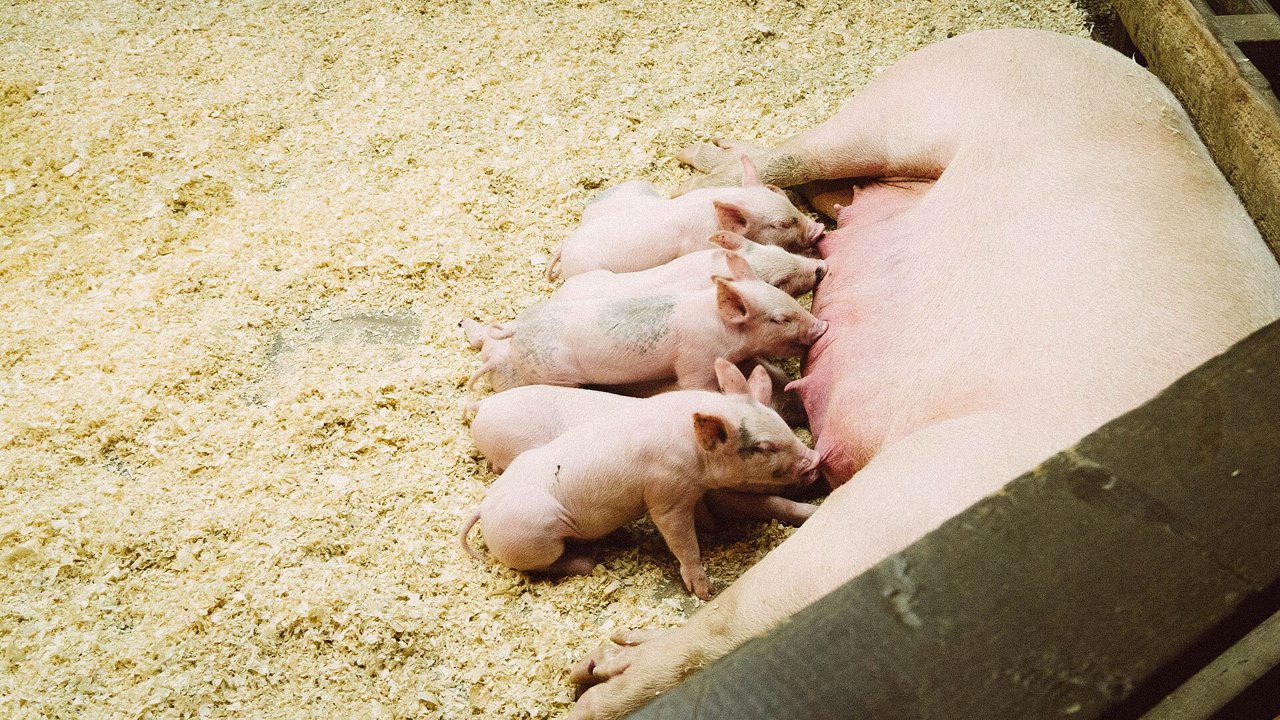
Science · Runts & LittersOn a farm a mother pig gives birth to a whole litter — ten or twelve piglets at once — and almost always one of them arrives smaller and weaker than the rest. Farmers have an old name for that piglet: the runt. Pushed away from the milk by bigger brothers and sisters, a runt grows slowly, and by the old rules of the barnyard it was not thought worth the feed. The rescue is a bottle. Warm shelter, milk given by hand every few hours, and plain patience will often bring a runt through, and American farm children have raised orphan animals this way for generations; clubs such as 4-H still teach them to do it themselves. Their workplace is the barn, the tall building where pigs, cows, and sheep are housed and fed. Wilbur’s story begins with the smallest life in it being handed a chance.
runtn.Ch.1
The smallest, weakest animal in a litter
“Wilbur was the runt of the litter.”
injusticen.Ch.1
Something that is unfair or wrong
“Fern felt it was an injustice to kill the piglet.”
raisev.Ch.2
To care for and help something grow up
“Fern was allowed to raise Wilbur herself.”
barnn.Ch.2
A large farm building for animals
“Wilbur was moved to Zuckerman’s barn.”
escapev.Ch.3
To get free from a place
“Wilbur found a loose board and escaped.”
lurev.Ch.3
To gently tempt someone to come
“They lured Wilbur back with food.”
sturdyadj.Ch.2
Strong and healthy
“Wilbur grew into a sturdy young pig.”
weaklingn.Ch.1
A small or feeble creature
“The runt looked like a tiny weakling.”
comfortn.Ch.3
A feeling of ease and safety
“The warm food gave Wilbur comfort.”
sparev.Ch.1
To choose not to harm someone
“Fern begged her father to spare the pig.”
ⓘ The vocabulary words in this list are selected to help you understand and complete this workbook. Some may not appear verbatim in the original novel.
1The smallest, weakest animal in a litter is the ___.Ch.1
2True or False: An “injustice” is something that is fair and right.Ch.1
3To care for an animal and help it grow up is to ___ it.Ch.2
4True or False: A “barn” is a large farm building for animals.Ch.2
5Fill in each blank with the correct word.Ch.1–2
Word choices:runtinjusticeraisebarn- some words will not be used
Fern felt it was an to harm the , so she was allowed to him.
6True or False: To “spare” someone means to harm them.Ch.1
7To gently tempt Wilbur to come back, the people ___ him with food.Ch.3
8True or False: “Sturdy” means strong and healthy.Ch.2
9Fill in the blanks with the correct words.Ch.3
Word choices:escapecomfortlureweakling- some words will not be used
Wilbur managed to , but the warm food gave him and drew him home.
10To get free from a place is to ___.Ch.3
Part 2
Comprehension
How well do you understand Chapters 1–3?
🧠Knowledge Bank · Reading a Character by Their Actions
Reading Skill · Noticing CharacterGood readers learn about people not from labels but from what those people do. In these first chapters, no one tells us that Fern is brave or tender-hearted; instead we watch her grab her father’s arm, argue against the axe, and beg for the runt’s life. From those actions we build our own idea of who she is — this quiet detective work is called characterization. Notice too how differently the grown-ups behave: her father sees a weak piglet as a simple farm problem, while Fern sees a baby who is frightened and alone. Because the author shows us both, we can measure Fern against the adults and understand that her gift is not strength but compassion. As you read on, keep collecting small actions like clues in a case, for how a character treats the helpless will always tell you the truest thing about their heart.
1Why does Fern’s father plan to get rid of the piglet at first?Ch.1
2What does Fern do about it?Ch.1
3Why is Wilbur sold to Homer Zuckerman?Ch.2
4True or False: Homer Zuckerman is Fern’s uncle.Ch.2
5Write the numbers 1–5 in the boxes to show the correct order across Part 1. Number 1 = what happens first.Ch.1–3
Wilbur escapes through a loose board into the yard.
Wilbur grows too big and is sold to Uncle Zuckerman.
Fern saves the runt and names him Wilbur.
Wilbur is lured back home with a bucket of food.
Fern’s father plans to do away with the runt piglet.
6True or False: Fern bottle-feeds Wilbur like a baby when he is little.Ch.2
7How does Wilbur get out of the barnyard?Ch.3
8How does Wilbur feel about being free outside?Ch.3
9True or False: Wilbur is happy to be lured back home with food.Ch.3
10Fill in the blanks to complete the sentence.Ch.1–3
Word choices:WilburZuckermanFernbarn- some words will not be used
saved the piglet and named him .
Part 3
Literary Elements
Understanding HOW and WHY E.B. White creates certain feelings across Chapters 1–3.
🧠Knowledge Bank · Finding the Theme
Literary Craft · ThemeA theme is the big idea a story is really about, humming quietly beneath everything that happens. E. B. White plants his theme in the very first pages, when Fern insists that killing the runt just for being small is wrong. That single argument opens the book’s deepest question: is every life, even the weakest, worth saving? Everything that follows will circle back to it, scene by scene, in the choices the characters make. A theme is different from the plot: the plot is what happens, while the theme is what it all means. Skilled writers rarely announce a theme in plain words; instead they let it grow from the way characters behave. So when Fern calls the plan an injustice, tuck that moment away. You have just heard the seed of an idea that will blossom across the whole book.
📚 Literary Devices in This Part · definitions & examples
A theme is a big idea in a story. Fern saving Wilbur introduces the theme of kindness and mercy.Characterization: Fern’s pleading to save Wilbur shows she is brave and compassionate.The setting — a family farm and barn — shapes everything that happens.
The questions below are mixed — not grouped by device. Decide which device each one is about.
1Fern saving Wilbur introduces the big idea of kindness and mercy. This big idea is the story’s —Ch.1–3
2A theme is a big idea or message that runs through a story.Ch.1–3
3Fill in each blank with the correct word.Ch.1–3
Word choices:themecharacterizationsettingplot- some words will not be used
Fern saving Wilbur introduces the
Her brave pleading reveals her through .
4Fern’s pleading to save the piglet shows she is brave and kind. Revealing her through her actions is —Ch.1–3
5The setting of a story is only the year it was written.Ch.1–3
6Fill in each blank with the correct word.Ch.1–3
Word choices:settingthemecharacterizationmood- some words will not be used
The family farm and barn form the story’s
Fern’s mercy toward Wilbur is the book’s .
7The family farm and barn where events unfold are the story’s —Ch.1–3
8How do we mainly learn that Fern is compassionate?Ch.1–3
9Fill in each blank with the correct word.Ch.1–3
Word choices:settingthemecharacterizationplot- some words will not be used
The barn and farm are the
The lesson that mercy matters is the .
10Showing Fern’s mercy in Chapter 1 mainly sets up the story’s —Ch.1–3
Part 4
Think Deeper
Four deeper challenges — no single-word recall. Read, weigh the evidence, and reason it through.
🧠Knowledge Bank · The Worth of a Life
Social-Emotional · The Worth of a LifeAt the heart of these chapters lies a question people have argued about for centuries: does a life have worth simply because it exists? To Fern’s father, the runt is a practical matter — a weak animal costs money and may die anyway. To Fern, the piglet is a someone, not a something, and his weakness is exactly why he needs a protector. Notice that she does not claim Wilbur is special, clever, or useful; she argues only that he is alive, and that this alone is reason enough to let him live. This is a powerful kind of kindness — caring for a creature not for what it can give you, but for its own sake. As you meet Wilbur, ask yourself Fern’s question about the smallest, plainest lives around you. The whole book grows from her belief that no life is too little to matter.
1Claim: “Fern saves Wilbur because she believes killing the runt is unjust.” — choose the two details that best prove it.Claim & Evidence
2Fern’s plea for justice, or just an event in the story? Tap each item to send it left or right.Sort into two
◄ Fern’s plea for justiceJust an event ►
3Match each cause to its result. For each cause, pick its result.Cause & Effect
Wilbur is born the weak runt→
Fern thinks the plan is unjust→
Fern wins the argument→
Wilbur grows too big to keep→
4Fill both blanks to complete the reasoning.Build the Argument
Fern stands up for Wilbur because , which shows that .
Part 5
Standardized Test
Vocabulary in Context & Main Idea — SAT & TOEFL-style practice
🎯 You already have the skills from the sections above — this is just a fun way to meet real SAT & TOEFL-style questions. Read the passage (the highlighted words are tested below), then answer the questions below. Tap an answer to select it, then tap it again to confirm — you can change your choice until you confirm.
In many animal families the babies are not all born the same size. The smallest and weakest newborn is called the runt. Because it is little, the runt often struggles to reach its mother’s milk when the bigger babies push in, so at first it may grow slowly and seem frail. In a large litter of pigs or puppies there may be one such newborn, and sometimes two. For a long time people believed a runt could never catch up with the rest of the family.
Farmers and scientists have since learned that this is not always true. With a warm place to rest, steady food, and a bit of extra attention, many runts grow into perfectly healthy adults — sometimes even the friendliest animals of the whole litter. Feeding a weak newborn by hand every few hours is slow, tiring work, but it often makes all the difference. What a runt needs most is simply a fair chance. This is why some people work so hard to help the weakest young survive, believing that size at birth does not decide an animal’s whole future, and that a tiny, trembling newborn today may become the strongest friend of all.
Original passage written for Garden Heights — not a quotation from the novel.
1What is a “runt”?SAT · Words in Context
2Why does the runt often struggle at first?TOEFL · Factual Information
3Something “frail” is —SAT · Words in Context
4According to the passage, what did people once wrongly believe?TOEFL · Factual Information
5According to the passage, what does a runt need most?TOEFL · Factual Information
6What does the passage say a runt needs most?TOEFL · Factual Information
7A fair “chance” is —SAT · Words in Context
8What can the reader infer from the passage?SAT · Inference
9Which sentence best states the main idea of the passage?SAT · Central Ideas
10The author ends “may become the strongest friend of all” mainly to —TOEFL · Rhetorical Purpose
Part 6 · Optional
Creative Writing
A bonus challenge to practice your English. Take your time and have fun with it.
About This Section
This writing task is optional and is not part of your auto-graded score. The feedback below checks only the basics — length, spelling, and grammar — not whether your ideas are right or wrong. It is meant for classroom discussion and creative practice, so feel free to use your imagination!
Writing Task — Part 1 “Standing Up for What’s Right”
Fern bravely speaks up to save Wilbur because she thinks it is unfair. Write about a time you stood up for something or someone you believed in. What did you do, and why? Write at least 40 words.
You can start with: “I knew it was not fair, so I decided to…”
0 / 40 words minimum
🗣 Teach It · Just for Fun (optional)
No right or wrong — close the screen and tell someone nearby what happened in this part. Can’t find anyone? Tell yourself out loud. The moment you teach it, you truly understand it.

Part 1 Complete!
You finished Chapters 1–3 of Charlotte's Web.
Here are your auto-graded results:
-
points out of 100
Your Writing
Your writing was checked automatically for length, spelling, grammar, and whether you included the key parts of the scene. Scroll back to Part 5 anytime to read your feedback and improve your work.
Independent study guide by Garden Heights Academy. Not affiliated with or endorsed by the author or any rights holders. Contains original analysis only; no text from the novel is reproduced.