New here? Just sign up with Google — your account includes Matilda, our gift book, forever.
Charlotte's Web · Garden Heights Academy
Part 6
for Charlotte's Web · Part 6 · Chapters 16–18
a novel by E.B. White
35 min5 Parts
This workbook is built on a solid pedagogical foundation, effectively integrating content and language learning based on the CLIL framework (Content and Language Integrated Learning), elevated by our unique 5th C — Connection — and an integrated Standardized Test section that weaves every SAT & TOEFL question type right into the novel, so learners build real test skills easily, naturally, and with fun.
What Happens in Part 6
The big day arrives, and everyone heads to the County Fair — with Charlotte and Templeton secretly hiding in Wilbur’s crate to come along. The fair is a dazzling, exciting place full of crowds, food, and animals. But Wilbur faces a worry: in the next pen sits a huge, prize-worthy pig named Uncle, a serious rival. During the quiet, magical cool of the evening, Templeton goes off scavenging for food among the fairground litter while a tired Charlotte studies new words. Charlotte, growing weaker but as loyal as ever, prepares to weave one final, perfect word to make sure Wilbur wins.
What We Will Learn
Focus
What It Means
Setting (the Fair)
The sights and excitement of a County Fair
Rivalry & Suspense
A competitor raises the stakes
Sacrifice
Charlotte keeps helping though she is tired
Chapter Summary
Chapter
Key Events
Ch.16
Everyone goes to the Fair; Charlotte and Templeton secretly come along in the crate
Ch.17
Wilbur worries about Uncle, a large rival pig in the next pen
Ch.18
In the cool of the evening, Templeton scavenges; tired Charlotte plans one last word
💭 Before You Read · Warm-Up (not scored)
There are no wrong answers here — just think, guess, and talk:
Templeton the selfish rat only comes to the fair for the food — yet his scavenging ends up helping. Can a person do good for entirely selfish reasons? Does the reason change the good they do?
Charlotte is growing weary just when the biggest moment arrives. Why do writers often make a hero weakest right before the climax?
Predict: Wilbur faces a huge rival pig named Uncle. What could tip the contest in small Wilbur’s favor?
Copyright Notice
This is an independent study guide created by Garden Heights Academy to support reading comprehension and literary analysis. It contains original analysis questions and does not reproduce any text from the novel. Charlotte's Web is a work by E.B. White. This guide is not affiliated with, authorized by, or endorsed by the author or any associated rights holders. Students should read the original book, available from libraries and booksellers.
Part 1
Vocabulary
Study 10 key words from Chapters 16–18, then answer each question.
🧠Knowledge Bank · The County Fair
Agriculture · The County FairWilbur’s great test takes place at a real American institution, the county fair. Every late summer, farm families gathered to show the best of what they had raised — the fattest pigs, the finest cows, the largest pumpkins, the sweetest pies. Judges walked the livestock barns with clipboards, scoring a pig on weight, health, and shape, and pinning colored ribbons on the winners; a blue one could raise the price of an animal and make a farmer proud for years. Around those barns spun the other half of the fair — a Ferris wheel, shooting galleries, and fried food you smelled before you saw. For a farm child it was the crown of the whole year. Knowing that helps you feel how much rides on a few days in the fairground.
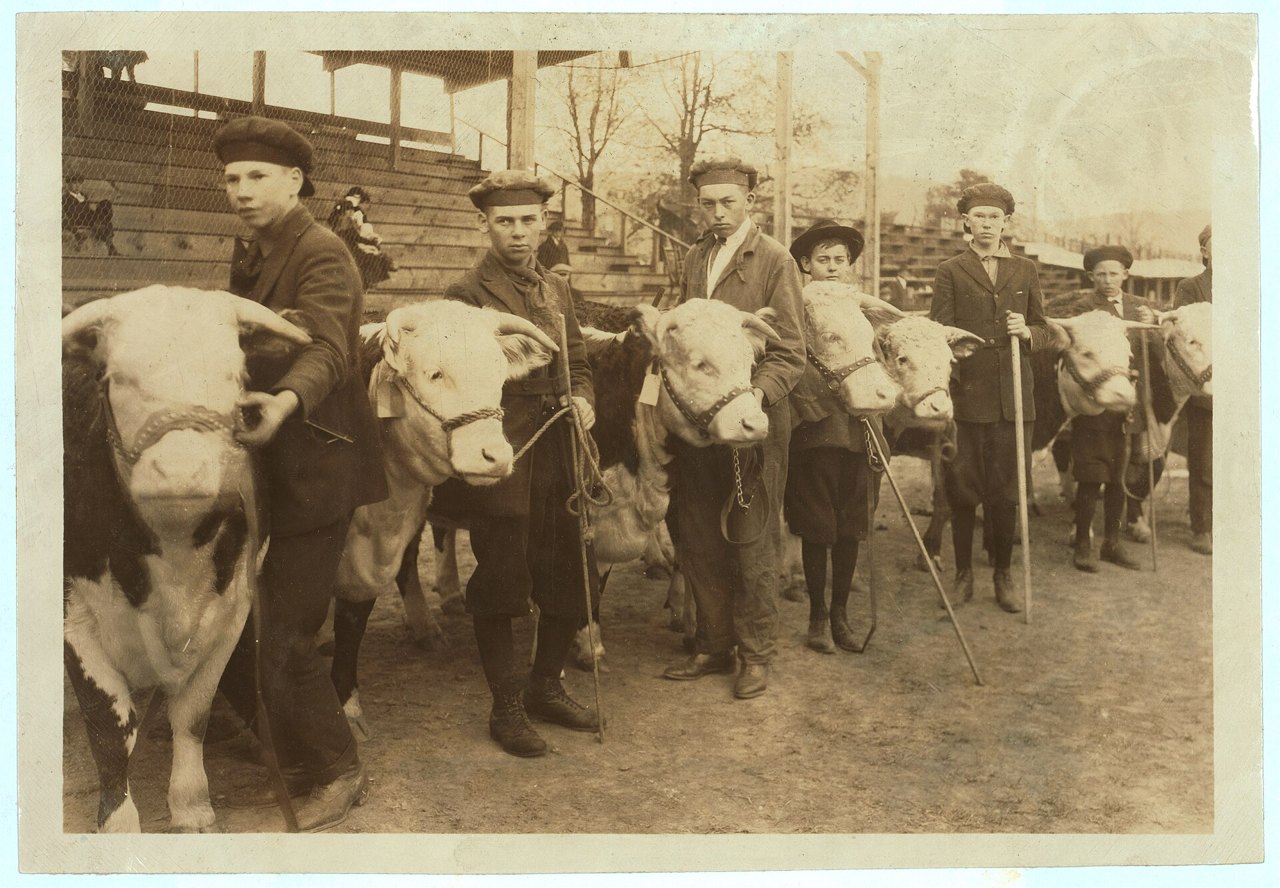
Visual AidJudging day at a club fair
Photograph of boys showing prize heifers at a 4-H club fair in Charleston, West Virginia, taken about 1921. The Knowledge Bank explains that at a county fair judges walked the livestock barns scoring animals and pinning ribbons on the winners, and that a blue ribbon could make a farmer proud for years. These are cattle, not pigs, and the fair is not the one in the novel. Notice how still the boys stand, each holding his animal for the judge — the same test Wilbur faces in the pig barn.
Boys judging prize heifers, 4-H Club Fair, Charleston, West Virginia, about 1921; Library of Congress. Source: Wikimedia Commons, public domain.
fairgroundn.Ch.16
The grounds where a fair is held
“The fairground buzzed with people.”
rivaln.Ch.17
Someone you compete against
“Uncle was Wilbur’s biggest rival.”
craten.Ch.16
A wooden box for carrying things
“Charlotte hid in Wilbur’s crate.”
scavengev.Ch.18
To search for food or scraps
“Templeton went off to scavenge.”
dazzlingadj.Ch.16
Wonderfully bright and exciting
“The fair was a dazzling sight.”
competev.Ch.17
To try to win against others
“Wilbur would compete at the fair.”
wearyadj.Ch.18
Very tired
“Charlotte was growing weary.”
enormousadj.Ch.17
Extremely large
“Uncle was an enormous pig.”
loyaladj.Ch.18
Faithful to a friend
“Charlotte stayed loyal to the end.”
littern.Ch.18
Bits of rubbish left lying around
“Templeton found food in the litter.”
ⓘ The vocabulary words in this list are selected to help you understand and complete this workbook. Some may not appear verbatim in the original novel.
🧠Knowledge Bank question
1According to the Knowledge Bank, judges at a county fair scored a pig on ___.Ch.17
2True or False: To “scavenge” is to search for food or scraps.Ch.18
3A wonderfully bright and exciting sight is ___.Ch.16
4True or False: A “rival” is a close, helpful friend.Ch.17
5Fill in each blank with the correct word.Ch.16–17
Word choices:fairgroundrivalcratescavenge- some words will not be used
Charlotte hid in the , and at the Wilbur met his , Uncle.
6True or False: Someone “weary” is full of energy.Ch.18
7To try to win against others is to ___.Ch.17
8True or False: “Enormous” means extremely large.Ch.17
9Fill in the blanks with the correct words.Ch.18
Word choices:wearyloyalscavengelitter- some words will not be used
Though , Charlotte stayed and kept planning to help Wilbur.
10Bits of rubbish left lying around are called ___.Ch.18
Part 2
Comprehension
How well do you understand Chapters 16–18?
🧠Knowledge Bank · A Theme That Repeats
Reading Skill · Tracking a ThemeA theme is a big idea that runs through an entire story, showing itself again and again in different scenes. One theme grows especially strong here: the idea that helping a friend has a real cost. At the fair, in the very middle of triumph, White keeps returning to a small, tired word — Charlotte is growing weary. Track that repetition, because a theme reveals itself by repeating. The busier and more joyful Wilbur’s days become, the more we sense that Charlotte is spending herself to make them possible. A skilled reader notices when the same idea keeps surfacing and asks what the author is trying to say. Here the answer is tender and grown-up: love often means giving something of yourself away. Hold this theme gently as you read, and the happy scenes at the fair will begin to carry a deeper, quieter meaning.
🧠Knowledge Bank question
1The Knowledge Bank says a theme reveals itself by ___.Ch.16
2How do Charlotte and Templeton travel to the fair?Ch.16
3Who is Uncle?Ch.17
4True or False: Wilbur worries about competing against Uncle.Ch.17
5Write the numbers 1–5 in the boxes to show the correct order across Part 6. Number 1 = what happens first.Ch.16–18
Charlotte and Templeton secretly ride along in Wilbur’s crate.
Tired Charlotte prepares to weave one final word.
Everyone heads to the exciting County Fair.
In the cool evening, Templeton goes off to scavenge.
Wilbur worries about his huge rival, Uncle.
6True or False: The fair is shown as a dull, empty place.Ch.16
7What does Templeton do at the fair in the evening?Ch.18
8How is Charlotte feeling by this part of the story?Ch.18
9True or False: Charlotte plans to weave one more special word at the fair.Ch.18
10Fill in the blanks to complete the sentence.Ch.16–17
Word choices:FairUnclecraterival- some words will not be used
At the County , Wilbur’s big rival was a pig named .
Part 3
Literary Elements
Understanding HOW and WHY E.B. White creates certain feelings across Chapters 16–18.
🧠Knowledge Bank · Raising the Suspense
Literary Craft · SuspenseAt the fair, White tightens the story’s suspense — the pleasurable worry that keeps us anxious to know what happens next. He does it by raising the stakes. Now Wilbur is not just any pig but a famous one, and in the next pen sits Uncle, a huge rival pig who might easily win the prize. Suddenly Wilbur could lose, and losing might still mean the butcher. Notice how the author makes us care more and then puts the very thing we care about in danger — that is exactly how suspense is built. A good writer never lets us feel too safe; just as things look brightest, a new worry appears. Because we now love Wilbur and know Charlotte is tiring, every turn at the fair pulls tight on our feelings. Learn to notice how an author raises the stakes, and you will see the machinery that keeps every page turning.
Visual AidHow White raises the stakes
Diagram for the Knowledge Bank on suspense. It stacks the four steps the Knowledge Bank describes, each box wider than the one below it, because each step gives the reader more to lose. The top box is outlined in red for the danger it names. It does not tell you how the fair ends. Notice that the boxes grow before the danger appears — making us care comes first, and the threat comes after.
Steps described in the Knowledge Bank. Drawn for Garden Heights Academy.
📚 Literary Devices in This Part · definitions & examples
Stakes are what a character can win or lose. Uncle the rival raises the stakes for Wilbur.Suspense: will Wilbur win, and what is happening to tired Charlotte?Charlotte’s weariness foreshadows that her hard work may be costing her dearly.
The questions below are mixed — not grouped by device. Decide which device each one is about.
🧠Knowledge Bank question
1According to the Knowledge Bank, White builds suspense at the fair by ___.Ch.17–19
2Stakes are what a character stands to win or lose.Ch.17–19
3Fill in each blank with the correct word.Ch.17–19
Word choices:stakessuspenseforeshadowingsetting- some words will not be used
Rival Uncle raises the
Not knowing if Wilbur will win keeps us in .
4Wondering whether Wilbur will win, and what is wrong with tired Charlotte, is —Ch.17–19
5Suspense grows only when the reader already knows the ending.Ch.17–19
6Fill in each blank with the correct word.Ch.17–19
Word choices:foreshadowingstakessuspensemood- some words will not be used
Charlotte’s weariness is a hint, an example of
The rival Uncle raises the .
7Charlotte’s growing weariness hints that her hard work is costing her. This clue is —Ch.17–19
8Why does the author add a bigger, stronger rival pig?Ch.17–19
9Fill in each blank with the correct word.Ch.17–19
Word choices:suspensestakesforeshadowingplot- some words will not be used
Not knowing Wilbur’s fate keeps us in
Charlotte’s tiredness is quiet .
10Charlotte weakening while she works mostly makes the reader feel —Ch.17–19
Part 4
Think Deeper
Four deeper challenges — no single-word recall. Read, weigh the evidence, and reason it through.
🧠Knowledge Bank · The Quiet Cost of Love
Social-Emotional · SelflessnessIn the middle of Wilbur’s brightest days, the book slips in a quiet ache: the friend doing all the work is wearing out. Charlotte spins and writes and plans, and it is costing her strength she cannot spare. This is selflessness — putting another’s good ahead of your own comfort or safety. Notice that Charlotte never complains, and never asks Wilbur to feel sorry for her; she simply keeps giving, quietly, because she loves him. Real kindness, the story suggests, often goes unseen, done by someone who expects no reward and makes no fuss about it. It would be easy for a happy reader to miss the cost entirely, swept up in Wilbur’s success. That is exactly why White makes us look. As you enjoy the triumph, remember to notice who is paying for it, and let yourself feel the beauty and the sorrow of such faithful, silent giving.
1Claim: “Charlotte and Templeton go to the fair to keep helping Wilbur.” — choose the two details that best prove it.Claim & Evidence
2A reason for hope at the fair, or a worry Wilbur faces? Tap each item to sort it — tap again to switch sides. You can keep tapping to change your answer.Sort into two
◄ A reason for hopeA worry Wilbur faces ►
3Match each cause to its result. For each cause, pick its result.Cause & Effect
Wilbur is entered in the fair→
Charlotte comes secretly along→
Templeton is lured by the garbage→
A huge rival pig is entered→
🧠Knowledge Bank question
4Fill both blanks to complete the reasoning.Build the Argument
The Knowledge Bank says it would be easy to miss what Charlotte's help costs her because , which shows that .
Part 5
Standardized Test
Reference & Sentence Simplification — SAT & TOEFL-style practice
Read the passage — the highlighted words are tested — then answer. Tap an answer, then tap it again to confirm.
SATWords in Context — a word's meaning in this passage
SATInference — a conclusion the passage implies
SATCentral Ideas — the passage's main point
TOEFLFactual Information — a fact stated in the passage
TOEFLReference — what a pronoun refers to
TOEFLSentence Simplification — the shorter sentence that keeps the meaning
TOEFLProse Summary — the three sentences that sum it up
Nature's Unsung Scavengers
Not every helpful animal is beautiful or beloved. Some of nature’s most important workers are its scavengers — creatures like rats, crows, and beetles that feed on scraps, litter, leftovers, and dead matter. People often find them unpleasant, but without them the world would quickly grow buried in an enormous pile of waste. A scavenger’s job is to recycle: it eats what other animals leave behind and returns those nutrients to the soil, where new plants can use them again. Farmers, gardeners, and city cleanup crews all quietly depend on that unpaid labor.
Vultures, for example, clean away dead animals that would otherwise spread disease, while tiny beetles bury and eat waste on the forest floor. On a farm, rats do the same rough work with spilled grain, which is one reason they are so hard to drive out of a barn. Because they do this quiet work, scavengers keep whole habitats healthy. It is a useful reminder that an animal need not be pretty, or even likeable, to be valuable. The next time you see a crow picking at scraps, remember: that bird is doing a job the whole living world depends on.
Original passage written for Garden Heights — not a quotation from the novel.
1What do scavengers feed on?TOEFL · Factual Information
2In the passage, litter means ___.SAT · Words in Context
3To “recycle” is to —SAT · Words in Context
4In “it eats what other animals leave behind,” the word “it” refers to —TOEFL · Reference
5Which sentence best keeps the essential meaning of: “Vultures, for example, clean away dead animals that would otherwise spread disease, while tiny beetles bury and eat waste on the forest floor”?TOEFL · Sentence Simplification
6According to the passage, what do vultures clean away?TOEFL · Factual Information
7In the passage, an enormous pile is ___.SAT · Words in Context
8What can the reader infer from the passage?SAT · Inference
9Which sentence best states the main idea of the passage?SAT · Central Ideas
10Prose Summary (TOEFL).Scavengers may be unlovely, but they do vital work the living world depends on. This TOEFL task lists six sentences; choose the THREE that best capture the passage’s main ideas. The other three do not belong — they state minor details or ideas the passage does not present.TOEFL · Prose Summary
Part 6 · Optional
Creative Writing
A bonus challenge to practice your English. Take your time and have fun with it.
About This Section
This writing task is optional and is not part of your auto-graded score. The feedback below checks only the basics — length, spelling, and grammar — not whether your ideas are right or wrong. It is meant for classroom discussion and creative practice, so feel free to use your imagination!
Writing Task — Part 6 “A Day at the Fair”
The County Fair is a dazzling, exciting place. Describe a fair, festival, or big event you have been to or would love to visit. What would you see, hear, smell, and do there? Write at least 40 words.
You can start with: “When I arrived at the fair, the first thing I noticed was…”
0 / 40 words minimum
🗣 Teach It · Just for Fun (optional)
No right or wrong — close the screen and tell someone nearby what happened in this part. Can’t find anyone? Tell yourself out loud. The moment you teach it, you truly understand it.
Part 6 Complete!
You finished Chapters 16–18 of Charlotte's Web.
Here are your auto-graded results:
-
points out of 100
Teach it to someone
The best last step is to teach it. In your own words, explain what happened — retell a favorite scene, teach a character’s big choice, or sum up the main idea for a parent, friend, or classmate. When you can teach it clearly, you truly own it.
Independent study guide by Garden Heights Academy. Not affiliated with or endorsed by the author or any rights holders. Contains original analysis only; no text from the novel is reproduced.
SAT® is a registered trademark of College Board, which is not affiliated with, and does not endorse, these materials. TOEFL® is a registered trademark of ETS. These materials are not endorsed or approved by ETS. Garden Heights is an independent provider of test-style reading practice.