New here? Just sign up with Google — your account includes Matilda, our gift book, forever.
The Chocolate Touch · Garden Heights Academy
Part 2
for The Chocolate Touch · Part 2 · Chapters 3–4
a novel by Patrick Skene Catling
30 min5 Parts
This workbook is built on a solid pedagogical foundation, effectively integrating content and language learning based on the CLIL framework (Content and Language Integrated Learning), elevated by our unique 5th C — Connection — and an integrated Standardized Test section that weaves every SAT & TOEFL question type right into the novel, so learners build real test skills easily, naturally, and with fun.
What Happens in Part 2
A strange coin buys John a box from a shop he has never seen.
A coin with initialsOn his way to buy sweets, John finds a strange coin in the road, marked with his own initials, J.M.
The new shopHe discovers a candy shop he has never seen before, where the odd storekeeper already knows his name.
One piece of chocolateThe single coin buys a whole box. At home the box holds just one piece, and it is the most delicious chocolate John has ever tasted.
Everything turns sweetThe next morning something alarming happens. Everything John puts in his mouth, from toothpaste to breakfast, turns to chocolate.
What We Will Learn
Focus
What It Means
Plot (The Magic Begins)
The coin, the strange shop, and the chocolate touch
Vocabulary
Coins, shops, and flavors
Prediction
Guessing where the magic will lead
Chapter Summary
Chapter
Key Events
Ch.3
John finds a coin with his initials and visits a strange new candy shop; the box holds one amazing chocolate
Ch.4
The next day everything John tastes turns to chocolate; he chews his gloves, and the bully Spider Wilson mocks him
Copyright Notice
This is an independent study guide created by Garden Heights Academy to support reading comprehension and literary analysis. It contains original analysis questions and does not reproduce any text from the novel. The Chocolate Touch is a work by Patrick Skene Catling. This guide is not affiliated with, authorized by, or endorsed by the author or any associated rights holders. Students should read the original book, available from libraries and booksellers.
Part 1
Vocabulary
Study 10 key words from Chapters 3–4, then answer each question.
🧠Knowledge Bank · Where Chocolate Comes From
Food History · Cacao & the AmericasChocolate does not grow in a wrapper; it begins on a tree. In warm, rainy places near the equator the cacao tree grows heavy pods, and inside each pod sit seeds we call cocoa beans. Hundreds of years ago the Maya and Aztec peoples ground those beans into a bitter, spicy drink they valued almost as highly as money. Only much later did Europeans stir in sugar and milk to make the smooth bars John loves. One small square has traveled a long way, from a faraway farm through many careful hands. Knowing that journey can make a single bar feel almost like a miracle.
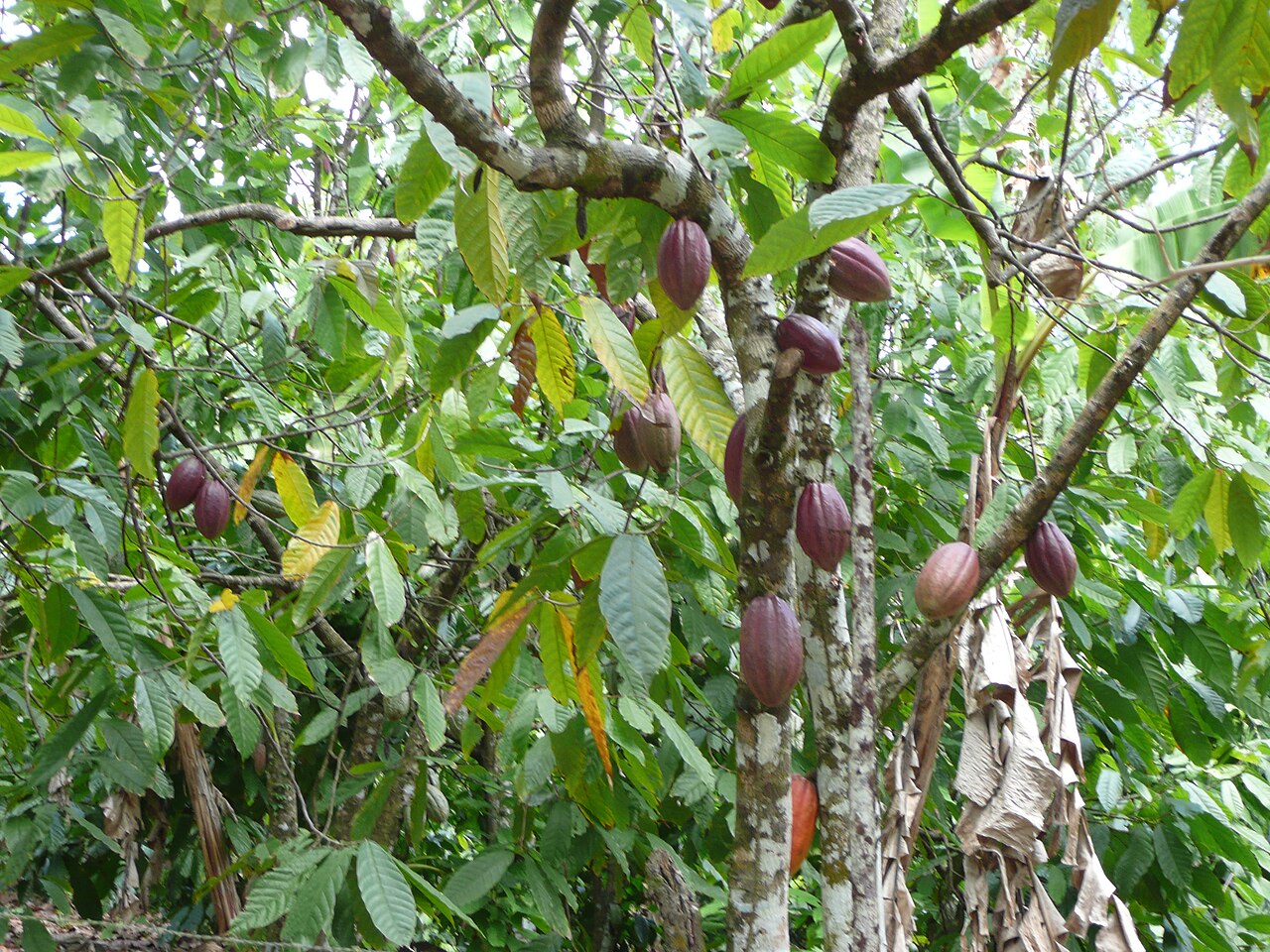
Visual AidWhere a chocolate bar starts
Photograph of a cacao tree carrying the pods the Knowledge Bank describes. Look where they grow: straight out of the trunk and the thickest branches, not on twigs at the ends like apples. Each pod holds the seeds that become cocoa beans. This tree is in the Dominican Republic, and the picture shows only the very first step — nothing here has been fermented, dried, roasted or sweetened yet. Notice how many colors a pod passes through as it ripens.
Cacao tree (Theobroma cacao) in fruit, Punta Cana, Dominican Republic. Source: Wikimedia Commons, file "Punta Cana Theobroma cacao tree 2.jpg", public domain.
coinn.Ch.3
A piece of metal money
“He found a strange coin in the road.”
initialsn.Ch.3
The first letters of your names
“The coin showed his initials, J.M.”
storekeepern.Ch.3
A person who runs a shop
“The storekeeper knew John’s name.”
deliciousadj.Ch.3
Tasting very good
“It was the most delicious chocolate ever.”
magicaladj.Ch.4
Having strange, wonderful powers
“Something magical was happening.”
ordinaryadj.Ch.4
Normal and usual
“His ordinary breakfast turned to chocolate.”
glovesn.Ch.4
Coverings for the hands
“He chewed on his leather gloves.”
leathern.Ch.4
Material made from animal skin
“The gloves were made of leather.”
bullyn.Ch.4
Someone who frightens or teases others
“Spider Wilson was a bully.”
vanishv.Ch.3
To disappear suddenly
“The other chocolates seemed to vanish.”
ⓘ The vocabulary words in this list are selected to help you understand and complete this workbook. Some may not appear verbatim in the original novel.
🧠Knowledge Bank question
1According to the Knowledge Bank, what did the Maya and Aztec peoples make from cocoa beans?Ch.3
2True or False: Your “initials” are the first letters of your names.Ch.3
3A person who runs a shop is a ___.Ch.3
4True or False: Something “delicious” tastes very bad.Ch.3
5Fill in each blank with the correct word.Ch.3
Word choices:coininitialsstorekeeperdelicious- some words will not be used
John gave the strange to the and tasted the most chocolate ever.
6True or False: “Magical” means having strange, wonderful powers.Ch.4
7Coverings for your hands are called ___.Ch.4
8True or False: A “bully” is someone who is kind to everyone.Ch.4
9Fill in the blanks with the correct words.Ch.4
Word choices:ordinaryleathervanishmagical- some words will not be used
His gloves turned to chocolate when he chewed them.
10To disappear suddenly means to ___.Ch.3
Part 2
Comprehension
How well do you understand Chapters 3–4?
🧠Knowledge Bank · Cause and Effect
Reading Skill · Cause & EffectStories move because one thing makes another thing happen. The first event is the cause; what happens next is the effect. Good readers watch for this chain. In these chapters, John finds a strange coin and buys a box of chocolate from an odd little shop. That is the cause. The magic that follows is the effect. When you read, try saying the word ‘so’ to link events: he was greedy, so he grabbed the box; he ate a sweet, so a strange power began. Following cause and effect helps the whole story make sense.
Visual AidOne thing makes the next thing happen
Diagram for the Knowledge Bank on cause and effect, following one chain from John’s greed to the first sign of magic. Four steps stand for a longer story, and the diagram gives away nothing about what the magic later does. It does not claim every event in a book links this neatly. Notice that the word so fits between every pair. That is the test the Knowledge Bank offers for telling a cause from an effect.
Chain taken from the events of Chapters 3 and 4. Drawn for Garden Heights Academy.
🧠Knowledge Bank question
1According to the Knowledge Bank, which word helps you link two events?Ch.3
2What is strange about the candy shop?Ch.3
3How many chocolates are in the box when John gets home?Ch.3
4True or False: The next morning, everything John puts in his mouth turns to chocolate.Ch.4
5Write the numbers 1–5 in the boxes to show the correct order of events in Part 2.Ch.3–4
He discovers a strange new candy shop.
At home the box holds just one delicious chocolate.
The next morning everything he tastes turns to chocolate.
John finds a coin marked with his initials.
The storekeeper sells him a box for the coin.
6True or False: The single chocolate is the most delicious John has ever tasted.Ch.3
7What happens when John chews his leather gloves?Ch.4
8Who makes fun of John in Chapter 4?Ch.4
9True or False: When Spider eats the glove, it tastes like chocolate to him too.Ch.4
10Fill in the blanks.Ch.3–4
Word choices:coinchocolategoldwater- some words will not be used
John paid with the magic , and soon everything he tasted became .
Part 3
Literary Elements
Understanding HOW and WHY Patrick Skene Catling creates certain feelings across Chapters 3–4.
🧠Knowledge Bank · Catling’s Word-Craft: The Coin Marked ‘J.M.’
Literary Craft · SymbolWatch the small round coin John finds. It carries the letters J.M., his own initials. An object that stands for a bigger idea is called a symbol, and ordinary money works the same way: a disc of metal buys bread only because everyone agrees it is worth something. Catling’s coin buys a box of chocolate, so it stands for the wish John is about to make and the price he may pay for it. When an author plants a clue that hints at trouble ahead, we call it foreshadowing. One tiny detail can quietly carry a heavy warning.
📚 Literary Devices in This Part · definitions & examples
One magical rule (the chocolate touch) is dropped into an ordinary, real world.The strange shop and storekeeper create a sense of mystery.The coin marked ‘J.M.’ is a symbol that the magic was meant for John.
The questions below are mixed — not grouped by device. Decide which device each one is about.
🧠Knowledge Bank question
1According to the Knowledge Bank, why is ordinary money like a symbol?Ch.3–4
2A symbol is an object that stands for a bigger idea.Ch.3–4
3Fill in each blank with the correct word.Ch.3–4
Word choices:symbolmysterymagicsetting- some words will not be used
The coin marked J.M. is a
The shop that appears from nowhere fills the story with .
4Why does the author make the candy shop appear from nowhere?Ch.3–4
5The storekeeper knowing John’s name by heart makes the gift feel warm, safe, and ordinary.Ch.3–4
6Fill in each blank with the correct word.Ch.3–4
Word choices:foreshadowingmysterysymbolrhyme- some words will not be used
The odd coin and the vanishing shop are clues, an example of
The whole strange scene is wrapped in .
7The coin stamped with John’s own initials mainly suggests that —Ch.3–4
8How does the chocolate touch seem to John at first?Ch.3–4
9Fill in each blank with the correct word.Ch.3–4
Word choices:magicordinarysymbolmystery- some words will not be used
Mixing a touch of
with an everyday, believable, and .
10The strange shop and storekeeper mainly fill these chapters with a sense of —Ch.3–4
Part 4
Think Deeper
Four deeper challenges — no single-word recall. Read, weigh the evidence, and reason it through.
🧠Knowledge Bank · A Gift With a Catch
Folklore · The Wish BargainA magic power sounds wonderful, does it not? Old folktales almost always attach a price to one. In story after story a stranger’s shop appears out of nowhere, offers a bargain, and then vanishes — a doorway into enchantment that nobody can ever find twice. Storytellers built that pattern on purpose, to teach one simple truth: be careful what you wish for, because you just might get it. John is so thrilled by his new power that he never stops to ask what could go wrong. Grabbing first and thinking later is the habit of greed. A good wish needs a slow, patient mind.
1Claim: “Strange, magical signs surround John’s new box of chocolate.” — choose the two details that best prove it.Claim & Evidence
2A strange, magical sign, or just an ordinary detail? Tap each item to sort it — tap again to switch sides. You can keep tapping to change your answer.Sort into two
◄ A magical signAn ordinary detail ►
3Match each cause to its result. For each cause, pick its result.Cause & Effect
John walks to buy sweets→
The coin leads him on→
He steps inside→
He hands over the coin→
🧠Knowledge Bank question
4Fill both blanks to complete the reasoning.Build the Argument
The Knowledge Bank says the strange shop vanishes because , which shows that .
Part 5
Standardized Test · Vocabulary in Context & Inference
Part 2 practices exam reading skills — Vocabulary in Context, Inference & Main Idea — in the styles the SAT and TOEFL use. Read the passage (the highlighted words are tested below), then choose the answer best supported by the text.
Read the passage — the highlighted words are tested — then answer. Tap an answer, then tap it again to confirm.
SATWords in Context — a word's meaning in this passage
SATCentral Ideas — the passage's main point
TOEFLFactual Information — a fact stated in the passage
TOEFLVocabulary — a tested word's meaning here
TOEFLInference — what the passage implies
TOEFLProse Summary — the three sentences that sum it up
From Bartering to Coins
Before money existed, people traded by swapping goods directly, exchanging a basket of grain for a clay pot. This system, called barter, was clumsy, because a trade only worked if each person wanted exactly what the other offered. To solve the problem, societies began using small pieces of metal as money, and the first coins were stamped thousands of years ago. A coin was useful because everyone agreed on its value, so it could be traded for almost anything. Metal was chosen because it is hard to copy and does not rot or vanish the way food and cloth do. An ordinary coin could be saved for years without losing its worth. Money made trade faster and let people store up value for the future. In time, the simple coin transformed how the whole world buys and sells.
Original passage written for Garden Heights — not a quotation from the novel.
1In the passage, “ordinary” most nearly means ___.SAT · Words in Context
2According to the passage, the first coins were made of —TOEFL · Factual Information
3According to the passage, why was barter clumsy?TOEFL · Factual Information
4In the passage, “vanish” most nearly means ___.TOEFL · Vocabulary
5According to the passage, why was metal chosen for money?TOEFL · Factual Information
6As used in the passage, the word “worth” most nearly means —SAT · Words in Context
7The passage most strongly implies that food made poor money because it —TOEFL · Inference
8Which statement best expresses the central idea of the passage?SAT · Central Ideas
9The passage most strongly suggests that a food used as money would be a poor choice because it —TOEFL · Inference
10Prose Summary (TOEFL).Money replaced clumsy barter because coins carried a value everyone agreed on. This TOEFL task lists six sentences; choose the THREE that best capture the passage’s main ideas. The other three do not belong — they state minor details or ideas the passage does not present.TOEFL · Prose Summary
Part 6 · Optional
Creative Writing
A bonus challenge to practice your English. Take your time and have fun with it.
About This Section
This writing task is optional and is not part of your auto-graded score. The feedback below checks only the basics — length, spelling, and grammar — not whether your ideas are right or wrong. It is meant for classroom discussion and creative practice, so feel free to use your imagination!
Writing Task — Part 2 “A Magic Gift”
John is given a magical gift that seems wonderful at first. Imagine you could turn anything you touched into your favorite food or thing. What would you choose, and how might it cause problems? Write at least 40 words.
You can start with: “If everything I touched turned into…”
0 / 40 words minimum
🗣 Teach It · Just for Fun (optional)
No right or wrong — close the screen and tell someone nearby what happened in this part. Can’t find anyone? Tell yourself out loud. The moment you teach it, you truly understand it.
Part 2 Complete!
You finished Chapters 3–4 of The Chocolate Touch.
Here are your auto-graded results:
-
points out of 100
Teach it to someone
The best last step is to teach it. In your own words, explain what happened — retell a favorite scene, teach a character’s big choice, or sum up the main idea for a parent, friend, or classmate. When you can teach it clearly, you truly own it.
Independent study guide by Garden Heights Academy. Not affiliated with or endorsed by the author or any rights holders. Contains original analysis only; no text from the novel is reproduced.
SAT® is a registered trademark of College Board, which is not affiliated with, and does not endorse, these materials. TOEFL® is a registered trademark of ETS. These materials are not endorsed or approved by ETS. Garden Heights is an independent provider of test-style reading practice.