New here? Just sign up with Google — your account includes Matilda, our gift book, forever.
The Chocolate Touch · Garden Heights Academy
Part 6
for The Chocolate Touch · Part 6 · Chapter 10
a novel by Patrick Skene Catling
30 min5 Parts
This workbook is built on a solid pedagogical foundation, effectively integrating content and language learning based on the CLIL framework (Content and Language Integrated Learning), elevated by our unique 5th C — Connection — and an integrated Standardized Test section that weaves every SAT & TOEFL question type right into the novel, so learners build real test skills easily, naturally, and with fun.
What Happens in Part 6
John is sick of chocolate and longs for an ordinary glass of water.
The wish turns sourThe magic that once seemed wonderful has become a nightmare. John is utterly sick of chocolate.
Longing for plain foodHe longs for an ordinary meal, anything at all that is not sweet and sticky.
Lonely and afraidHe feels lonely, unwell, and afraid, because nothing he does can stop the curse.
What he wished forJohn begins to understand that getting everything he wished for has made him miserable.
What We Will Learn
Focus
What It Means
Plot (Low Point)
John becomes sick and tired of chocolate
Character (Change)
John’s feelings turn from greed to regret
Theme
Too much of a good thing
Chapter Summary
Chapter
Key Events
Ch.10
Sick of chocolate and unable to eat or drink normally, a lonely, frightened John longs for the curse to end
Copyright Notice
This is an independent study guide created by Garden Heights Academy to support reading comprehension and literary analysis. It contains original analysis questions and does not reproduce any text from the novel. The Chocolate Touch is a work by Patrick Skene Catling. This guide is not affiliated with, authorized by, or endorsed by the author or any associated rights holders. Students should read the original book, available from libraries and booksellers.
Part 1
Vocabulary
Study 10 key words from Chapter 10, then answer each question.
🧠Knowledge Bank · Your Body Needs Balance
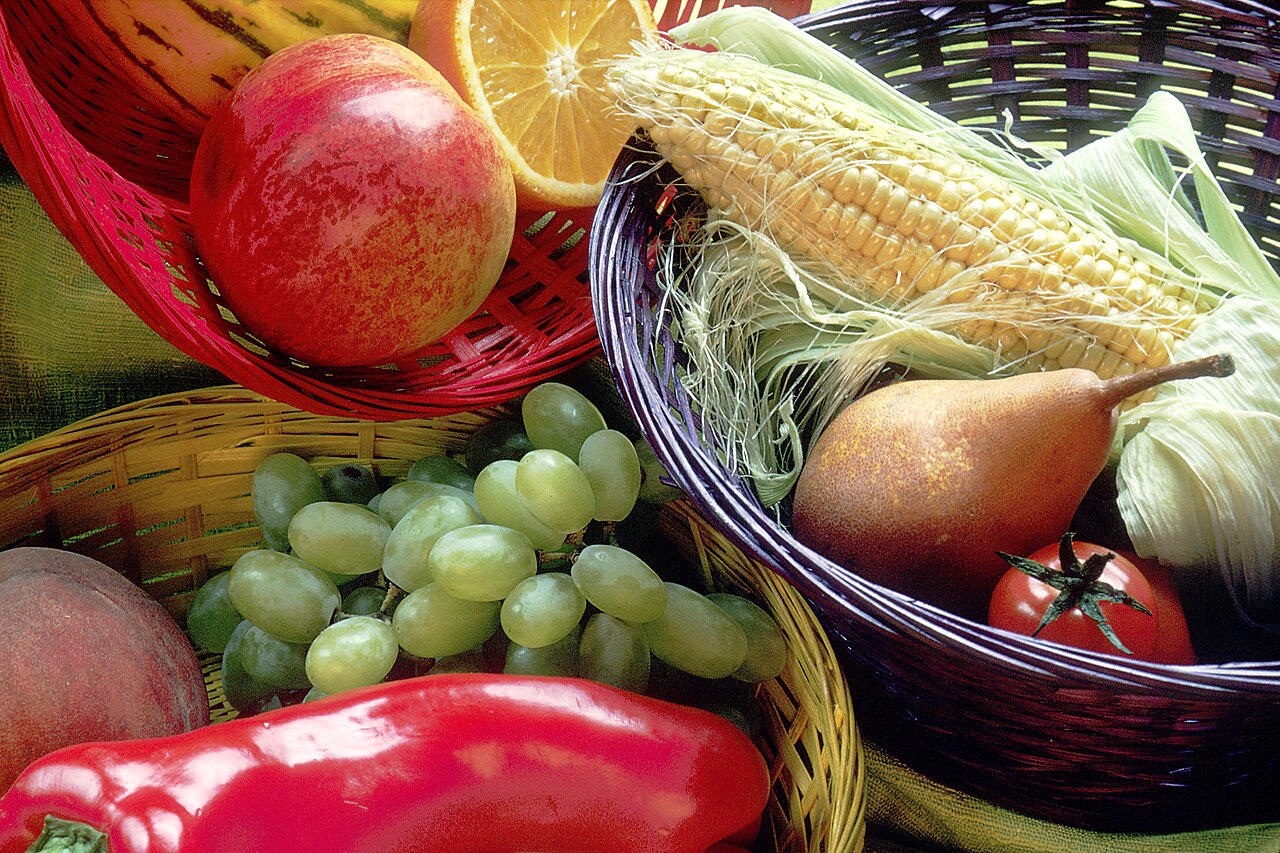
Nutrition Science · A Balanced DietCandy is not evil, but it cannot be your only food. Your body is like a busy machine, and it needs many kinds of fuel to run well. Fruits and vegetables give you vitamins. Bread and rice give you energy. Milk and beans help you grow strong. Sugar gives quick energy, but almost nothing else your body needs. That is why doctors talk about a balanced diet — a little of many good foods, not a mountain of one. John tried to live on chocolate alone, and his body rebelled. Real strength and health come from careful balance.
Visual AidWhat a balanced diet looks like
Photograph of fruit and vegetables in three baskets, showing the variety the Knowledge Bank means by a balanced diet. Count the different foods rather than studying any one of them: grapes, a peach, an orange, corn, a pear, a tomato, a red pepper. It is a posed studio picture made for a health agency, so a real shopping basket is rarely this tidy, and it does not claim these particular foods are the right ones to eat. Notice that no single food fills a basket. That is what balance means: a little of many good things rather than a mountain of one.
‘Fruit and Vegetables Basket’, U.S. National Cancer Institute. Source: Wikimedia Commons, file "Fruit and vegetables basket.jpg", public domain.
nightmaren.Ch.10
A frightening experience or dream
“The magic had become a nightmare.”
cravev.Ch.10
To want something very badly
“He began to crave plain water.”
plainadj.Ch.10
Simple and ordinary
“He longed for plain, normal food.”
lonelyadj.Ch.10
Sad at being alone
“The curse left John feeling lonely.”
dreadv.Ch.10
To feel great fear about something
“He came to dread every meal.”
regretv.Ch.10
To feel sorry about something you did
“John began to regret his greed.”
wearyadj.Ch.10
Very tired
“He felt weary of chocolate.”
gloomyadj.Ch.10
Sad and without hope
“His mood grew gloomy.”
reliefn.Ch.10
A glad feeling when trouble ends
“He longed for the relief of a cure.”
miserableadj.Ch.10
Very unhappy
“John was utterly miserable.”
ⓘ The vocabulary words in this list are selected to help you understand and complete this workbook. Some may not appear verbatim in the original novel.
🧠Knowledge Bank question
1According to the Knowledge Bank, what does sugar give besides quick energy?Ch.10
2True or False: To “crave” something is to want it very badly.Ch.10
3Simple and ordinary means ___.Ch.10
4True or False: Someone “lonely” feels happy in a crowd.Ch.10
5Fill in each blank with the correct word.Ch.10
Word choices:nightmarecraveplainrelief- some words will not be used
The magic was now a , and John began to water.
6True or False: To “regret” something is to feel sorry about it.Ch.10
7Feeling very tired means feeling ___.Ch.10
8True or False: A “gloomy” mood is cheerful and bright.Ch.10
9Fill in the blanks with the correct words.Ch.10
Word choices:dreadreliefregretmiserable- some words will not be used
John was and longed for the of a cure.
10To feel great fear about something coming means to ___ it.Ch.10
Part 2
Comprehension
How well do you understand Chapter 10?
🧠Knowledge Bank · Drawing Conclusions
Reading Skill · Drawing ConclusionsBy now you have read many chapters about John and his magic. A careful reader uses everything learned so far to reach a conclusion — a firm judgment built from all the evidence a book has offered. In this bleak chapter John reaches his hardest moment yet, and from everything you have seen you can conclude that his own greed, not bad luck, has caused the misery. A conclusion is not the same as a quick guess: a guess leaps, while a conclusion is built. Gather what you know, weigh it fairly, and decide what the whole story has worked to prove.
🧠Knowledge Bank question
1According to the Knowledge Bank, how does a conclusion differ from a guess?Ch.10
2What ordinary thing does John long for?Ch.10
3How does the curse make John feel?Ch.10
4True or False: John now wishes the chocolate touch would go away.Ch.10
5Write the numbers 1–5 in the boxes to show the correct order of John’s feelings in Part 6.Ch.10
Now he is completely sick of chocolate.
He longs for an ordinary meal and a drink.
He wishes desperately that the curse would end.
John once could not get enough chocolate.
He feels lonely, unwell, and afraid.
6True or False: John still thinks the chocolate touch is wonderful.Ch.10
7Why can John not feel better by eating?Ch.10
8What is growing inside John now?Ch.10
9True or False: Getting his wish has made John happy.Ch.10
10Fill in the blanks.Ch.10
Word choices:waterchocolatecandygold- some words will not be used
John was so sick of that he longed for a plain glass of .
Part 3
Literary Elements
Understanding HOW and WHY Patrick Skene Catling creates certain feelings across Chapter 10.
🧠Knowledge Bank · Catling’s Word-Craft: The ‘Nightmare’
Literary Craft · Mood & the Cautionary TaleNotice how this chapter feels darker than the cheerful opening; magic that once looked like a dream now feels like a nightmare. The feeling a story gives you as you read is its mood, and writers build it out of small choices: shadows, silence, worry, things going quietly wrong. Catling swings the mood from funny to frightening so that we share John’s misery instead of laughing at it. That swing is deliberate, because this is a cautionary tale. For centuries storytellers have punished a bad habit inside a story so that listeners would never have to learn the lesson in real life. When a book turns tense, ask which words are doing the work.
Visual AidHow the mood swings
Diagram for the Knowledge Bank on mood, setting an early scene beside a later one. Two moments stand for the whole swing, and the diagram gives away nothing that happens after them. It does not claim a story may only hold one mood at a time. Notice that the magic itself never changes between the two boxes. Only what it costs John changes, and the mood follows that rather than the magic.
Scenes taken from Chapters 3 and 10. Drawn for Garden Heights Academy.
📚 Literary Devices in This Part · definitions & examples
John changes from greedy to regretful — the heart of the story.Now John battles feelings inside himself: regret and fear (internal conflict).The theme — too much of a good thing — becomes clear here.
The questions below are mixed — not grouped by device. Decide which device each one is about.
🧠Knowledge Bank question
1According to the Knowledge Bank, why do storytellers punish a bad habit inside a story?Ch.10
2A dynamic character is one who changes in an important way during the story.Ch.10
3Fill in each blank with the correct word.Ch.10
Word choices:dynamicinternalthemesetting- some words will not be used
John grows and changes, so he is a
His new struggle with guilt and fear is an .
4John now battles his own guilt and fear inside himself. This is —Ch.10
5The theme is just the exact place where a story happens.Ch.10
6Fill in each blank with the correct word.Ch.10
Word choices:themeinternaldynamicplot- some words will not be used
The big idea, that too much of a good thing can harm you, is the
John’s battle with regret is an .
7The story’s big message — too much of a good thing can harm you — is its —Ch.10
8How do we know John is a dynamic character by this chapter?Ch.10
9Fill in each blank with the correct word.Ch.10
Word choices:internaldynamicthememood- some words will not be used
By the climax John feels a fierce
His deep change makes him a truly .
10Showing John finally change mainly helps the story deliver its —Ch.10
Part 4
Think Deeper
Four deeper challenges — no single-word recall. Read, weigh the evidence, and reason it through.
🧠Knowledge Bank · Learning Through Hardship
Psychology · Learning from SetbacksThis is John’s lowest, saddest point, and that is exactly why it matters. Some of life’s biggest lessons only come through hardship — the hard, unhappy times. When everything was easy and sweet, John learned nothing at all. Now that his magic has brought him real trouble, he is finally beginning to understand. Pain is never fun, but it can be a strong teacher. Think about a time something went wrong for you and later taught you something important. John’s misery is not the end of his story; it may be the very thing that helps him grow.
1Claim: “John now longs for the ordinary things he once took for granted.” — choose the two details that best prove it.Claim & Evidence
2What John once wanted, or what he wants now? Tap each item to sort it — tap again to switch sides. You can keep tapping to change your answer.Sort into two
◄ What he once wantedWhat he wants now ►
3Match each cause to its result. For each cause, pick its result.Cause & Effect
John has far too much chocolate→
Everything turns sweet and sticky→
He misses ordinary food→
His craving has backfired→
🧠Knowledge Bank question
4Fill both blanks to complete the reasoning.Build the Argument
The Knowledge Bank calls John’s lowest point the moment that matters because , which shows that .
Part 5
Standardized Test · Vocabulary & Author’s Purpose
Part 6 practices exam reading skills — Vocabulary in Context, Author’s Purpose & Inference — in the styles the SAT and TOEFL use. Read the passage (the highlighted words are tested below), then choose the answer best supported by the text.
Read the passage — the highlighted words are tested — then answer. Tap an answer, then tap it again to confirm.
SATWords in Context — a word's meaning in this passage
SATCentral Ideas — the passage's main point
TOEFLFactual Information — a fact stated in the passage
TOEFLInference — what the passage implies
TOEFLProse Summary — the three sentences that sum it up
The Marshmallow Test of Patience
Self-control is the ability to resist a treat you crave now in order to win a bigger reward later. In a famous experiment, young children were each given one marshmallow and promised a second one if they could resist eating the first for fifteen minutes. Some gobbled it at once, but others found clever tricks to distract themselves, such as singing or covering their eyes. Years later, the children who had waited tended to do better in school and work. Scientists believe self-control works like a muscle: it grows stronger the more a person practices it. Making a plan in advance can reduce the pull of temptation, because a decision is easier before the treat is in front of you. Learning to wait is one of the most valuable skills a young person can build, and it leaves less to regret. Patience, it turns out, can be taught.
Original passage written for Garden Heights — not a quotation from the novel.
1In the passage, “crave” most nearly means ___.SAT · Words in Context
2According to the passage, the children who waited for the second marshmallow later tended to —TOEFL · Factual Information
3According to the passage, what were the children promised for waiting?TOEFL · Factual Information
4In the passage, “regret” most nearly means ___.SAT · Words in Context
5According to the passage, why can making a plan in advance help?TOEFL · Factual Information
6As used in the passage, the word “reduce” most nearly means —SAT · Words in Context
7The passage most strongly suggests self-control is like a muscle because it —TOEFL · Inference
8Which statement best expresses the central idea of the passage?SAT · Central Ideas
9The passage most strongly suggests that a person who practices self-control often will —TOEFL · Inference
10Prose Summary (TOEFL).Self-control can be strengthened, and learning to wait brings lasting rewards. This TOEFL task lists six sentences; choose the THREE that best capture the passage’s main ideas. The other three do not belong — they state minor details or ideas the passage does not present.TOEFL · Prose Summary
Part 6 · Optional
Creative Writing
A bonus challenge to practice your English. Take your time and have fun with it.
About This Section
This writing task is optional and is not part of your auto-graded score. The feedback below checks only the basics — length, spelling, and grammar — not whether your ideas are right or wrong. It is meant for classroom discussion and creative practice, so feel free to use your imagination!
Writing Task — Part 6 “Learning the Hard Way”
John learns an important lesson only after things go wrong. Write about a time you (or someone you imagine) learned something important the hard way. What happened, and what did you learn? Write at least 40 words.
You can start with: “I learned my lesson the hard way when…”
0 / 40 words minimum
🗣 Teach It · Just for Fun (optional)
No right or wrong — close the screen and tell someone nearby what happened in this part. Can’t find anyone? Tell yourself out loud. The moment you teach it, you truly understand it.
Part 6 Complete!
You finished Chapter 10 of The Chocolate Touch.
Here are your auto-graded results:
-
points out of 100
Teach it to someone
The best last step is to teach it. In your own words, explain what happened — retell a favorite scene, teach a character’s big choice, or sum up the main idea for a parent, friend, or classmate. When you can teach it clearly, you truly own it.
Independent study guide by Garden Heights Academy. Not affiliated with or endorsed by the author or any rights holders. Contains original analysis only; no text from the novel is reproduced.
SAT® is a registered trademark of College Board, which is not affiliated with, and does not endorse, these materials. TOEFL® is a registered trademark of ETS. These materials are not endorsed or approved by ETS. Garden Heights is an independent provider of test-style reading practice.