New here? Just sign up with Google — your account includes Matilda, our gift book, forever.
The Chocolate Touch · Garden Heights Academy
Part 8
for The Chocolate Touch · Part 8 · Chapter 12
a novel by Patrick Skene Catling
30 min5 Parts
This workbook is built on a solid pedagogical foundation, effectively integrating content and language learning based on the CLIL framework (Content and Language Integrated Learning), elevated by our unique 5th C — Connection — and an integrated Standardized Test section that weaves every SAT & TOEFL question type right into the novel, so learners build real test skills easily, naturally, and with fun.
What Happens in Part 8
Offered a choice between his mother and the magic, John chooses his mother.
The shop returnsThe strange candy shop appears again, its window now filled with everything John turned to chocolate: his trumpet, his pencil, a coin.
Who could see itThe storekeeper explains that only a greedy person could ever see and spend that magic coin.
The choiceHe offers John a choice: save his mother, or keep the chocolate touch for himself. Without hesitating, John begs to save his mother.
The curse breaksThat unselfish choice breaks the curse. Everything is restored, and John has learned to value love and others above his own greed.
What We Will Learn
Focus
What It Means
Plot (Resolution)
John’s unselfish choice breaks the curse
Theme
Generosity and love over greed
Moral
The lesson the whole story teaches
Chapter Summary
Chapter
Key Events
Ch.12
The shop reappears; the storekeeper offers John a choice, and John’s unselfish wish to save his mother lifts the curse and cures him
Copyright Notice
This is an independent study guide created by Garden Heights Academy to support reading comprehension and literary analysis. It contains original analysis questions and does not reproduce any text from the novel. The Chocolate Touch is a work by Patrick Skene Catling. This guide is not affiliated with, authorized by, or endorsed by the author or any associated rights holders. Students should read the original book, available from libraries and booksellers.
Part 1
Vocabulary
Study 10 key words from Chapter 12, then answer each question.
🧠Knowledge Bank · Coins, Gold, and Greed
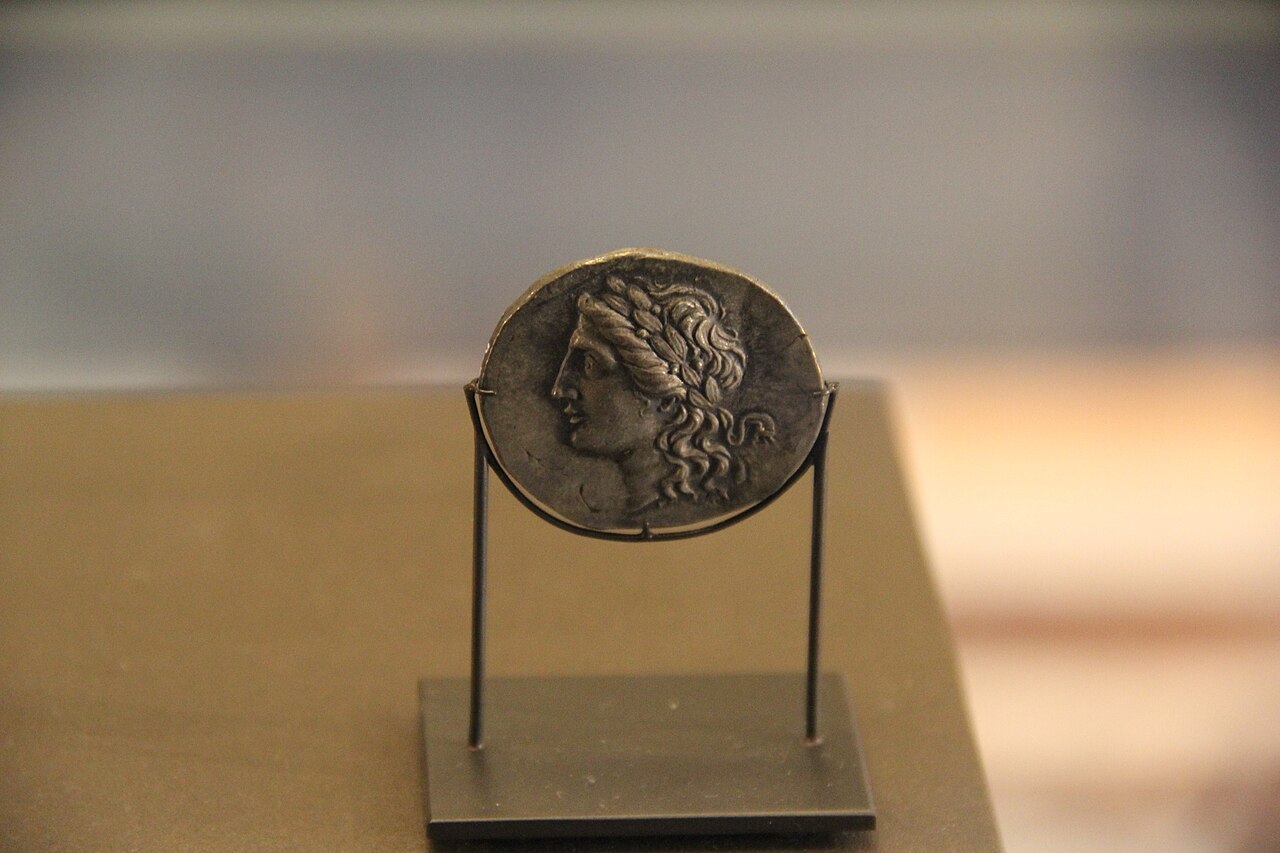
Money History · Coins & GoldLong before paper bills and plastic cards, people bought and sold with small discs of metal — coins stamped from silver or gold. Coins made trading simple, but they also gave some people an appetite for more and more. The myth of King Midas was invented to warn against exactly that appetite. In the oldest tellings the king is released only when he gives the golden touch back, washing it out of his hands in a river until the sand there glitters. Look at what the story finally asks of him: not another ounce of gold, but the willingness to surrender.
Visual AidMoney made of metal
Photograph of an ancient Greek silver coin of the kind the Knowledge Bank describes. It is a small disc of metal with a design stamped into it, which is all a coin has ever needed to be. This one stands in a museum mount, so it is no longer spent on anything. Notice that the design is struck into the metal rather than printed on. That is what made a coin hard to copy, and it is why metal was chosen over food or cloth.
ⓘ The vocabulary words in this list are selected to help you understand and complete this workbook. Some may not appear verbatim in the original novel.
🧠Knowledge Bank question
1According to the Knowledge Bank, how is King Midas finally released?Ch.12
2True or False: A “choice” is a decision between two or more things.Ch.12
3Thinking of others before yourself means being ___.Ch.12
4True or False: To “restore” something is to bring it back to how it was.Ch.12
5Fill in each blank with the correct word.Ch.12
Word choices:choiceunselfishrestorecure- some words will not be used
John’s became the that broke the curse.
6True or False: Someone “generous” is happy to give and share.Ch.12
7Something important that is learned is a ___.Ch.12
8True or False: To be “humble” is to be proud and boastful.Ch.12
9Fill in the blanks with the correct words.Ch.12
Word choices:gratefulforgivegenerousappear- some words will not be used
John was to be cured, and his family was glad to him.
10Something that ends an illness or curse is a ___.Ch.12
Part 2
Comprehension
How well do you understand Chapter 12?
🧠Knowledge Bank · Finding the Lesson
Fable Tradition · ThemeNow that the story is finished you can name its theme — the wise idea living underneath the events. Some books hide their theme; others state it outright. Aesop’s fables, told in Greece thousands of years ago, close with a moral, a single line telling the listener how to live. This book belongs to that old family. It argues that too much of even a good thing can hurt you, and that thinking of others matters more than getting your own way. Say the lesson in one sentence of your own and you have caught what the whole book was quietly teaching.
🧠Knowledge Bank question
1According to the Knowledge Bank, what does a fable close with?Ch.12
2What is in the shop window now?Ch.12
3What choice does the storekeeper give John?Ch.12
4True or False: John chooses to save his mother.Ch.12
5Write the numbers 1–5 in the boxes to show the correct order of events in Part 8.Ch.12
Its window shows the things John turned to chocolate.
The storekeeper offers John a choice.
His unselfish choice breaks the curse and cures him.
Without hesitating, John chooses to save his mother.
The strange candy shop appears once more.
6True or False: Only a greedy person could see and spend the magic coin.Ch.12
7What breaks the curse?Ch.12
8What happens to John’s mother and the other things?Ch.12
9True or False: John has learned to value love and others over his own greed.Ch.12
10Fill in the blanks.Ch.12
Word choices:unselfishmothergreedycandy- some words will not be used
John’s wish to save his lifted the curse.
Part 3
Literary Elements
Understanding HOW and WHY Patrick Skene Catling creates certain feelings across Chapter 12.
🧠Knowledge Bank · Catling’s Word-Craft: ‘Selfish’ and ‘Unselfish’
Literary Craft · ContrastLook at how much John changes from the first page to the last. At the start he is selfish — he thinks only of what he wants. By the end he has become unselfish, ready to care for others before himself. Placing two opposite ideas side by side, like selfish and unselfish, is called contrast. Authors use contrast to make a change stand out sharply and clearly. When you compare the John of chapter one with the John of the ending, his whole journey shines. Watching a character travel between two opposites shows you exactly how much they have grown.
Visual AidTwo opposite words
Diagram for the Knowledge Bank on contrast, placing the word for John at the start beside the word for him at the end. Two words stand for a whole book, and the diagram says nothing about how he travels between them. It does not claim a character can only be one or the other. Notice that the distance between the boxes is the story. Take either word away and the change stops being visible at all.
Words taken from the opening and closing chapters. Drawn for Garden Heights Academy.
📚 Literary Devices in This Part · definitions & examples
The resolution ends the conflict: the curse is lifted and all is restored.The moral is the lesson: love and generosity beat greed.John’s arc runs from greedy and selfish to humble and kind.
The questions below are mixed — not grouped by device. Decide which device each one is about.
🧠Knowledge Bank question
1According to the Knowledge Bank, what is contrast?Ch.12
2The resolution is the part of a story where the main conflict is settled.Ch.12
3Fill in each blank with the correct word.Ch.12
Word choices:resolutionmoralarcclimax- some words will not be used
The curse being lifted is the story’s
Its lesson, that love beats greed, is the .
4The lesson of the whole story — love and generosity beat greed — is its —Ch.12
5A character arc means the character stays exactly the same from start to finish.Ch.12
6Fill in each blank with the correct word.Ch.12
Word choices:arcmoralresolutionmood- some words will not be used
John’s journey of change is his character
The story’s lesson that love beats greed is its .
7John changes from greedy and selfish to humble and kind. This whole change is his character —Ch.12
8How do we know the story reaches a full resolution?Ch.12
9Fill in each blank with the correct word.Ch.12
Word choices:resolutionmoralarcplot- some words will not be used
By the end, the conflict is settled in the
John’s full journey of change is his character .
10The story’s moral is best summed up as —Ch.12
Part 4
Think Deeper
Four deeper challenges — no single-word recall. Read, weigh the evidence, and reason it through.
🧠Knowledge Bank · Choosing to Be Good
Behavioral Science · Self-ControlScientists have a name for what John finally learns: self-control, the power to refuse a small reward now in order to win a larger one later. In one famous study, young children were left alone with a single treat and told they could have two if they waited for the researcher to return. Some waited; many did not. The useful discovery was that self-control is not a fixed gift but a skill that strengthens with practice, like reading or swimming. So being good is something we decide, again and again, rather than something that simply happens.
1Claim: “John is cured only after he learns his lesson about greed.” — choose the two details that best prove it.Claim & Evidence
2The lesson and cure, or just a detail of the ending? Tap each item to sort it — tap again to switch sides. You can keep tapping to change your answer.Sort into two
◄ The lesson and cureJust a detail ►
3Match each cause to its result. For each cause, pick its result.Cause & Effect
The candy shop appears again→
Only a greedy boy takes the gift→
John truly regrets his greed→
John has learned his lesson→
🧠Knowledge Bank question
4Fill both blanks to complete the reasoning.Build the Argument
The Knowledge Bank says self-control is not a fixed gift because , which shows that .
Part 5
Standardized Test · Mixed Practice · All Question Types
Part 8 practices exam reading skills — all four question families in one mixed set — in the styles the SAT and TOEFL use. Read the passage (the highlighted words are tested below), then choose the answer best supported by the text.
Read the passage — the highlighted words are tested — then answer. Tap an answer, then tap it again to confirm.
SATWords in Context — a word's meaning in this passage
SATCentral Ideas — the passage's main point
SATText Structure & Purpose — how the passage is built, and why
TOEFLFactual Information — a fact stated in the passage
TOEFLVocabulary — a tested word's meaning here
TOEFLInsert Text — where a sentence best fits
TOEFLInference — what the passage implies
Reversible and Irreversible Changes
Not every change can be undone, and telling the two kinds apart is a key idea in science. When chocolate melts in a warm hand it changes shape, but cooling turns it solid again, so melting is a reversible change. Freezing water into ice and melting it back works in exactly the same way. Burning, however, is different: once a log turns to ash, no amount of cooling can restore the wood. A change that cannot be undone is called permanent, or irreversible. Baking a cake is also permanent, because the runny batter can never be recovered once it has set. Scientists look for clues, such as a new smell or a new color, that signal a permanent change has happened. Knowing which changes can be reversed helps us predict what materials will do.
Original passage written for Garden Heights — not a quotation from the novel.
1As used in the passage, the word “reversible” most nearly means —SAT · Words in Context
2According to the passage, which change is permanent?TOEFL · Factual Information
3According to the passage, what is an example of a reversible change?TOEFL · Factual Information
4As used in the passage, the word “permanent” most nearly means —SAT · Words in Context
5According to the passage, why is baking a cake a permanent change?TOEFL · Factual Information
6In the passage, “restore” most nearly means ___.TOEFL · Vocabulary
7Insert Text (TOEFL). Look at the four squares [1]–[4] in the excerpt below. They show where this sentence could be added: “Boiling an egg, for example, can never be undone, no matter how long it cools.”
Some changes can be reversed. [1] Melting chocolate and then cooling it back is one clear example. [2] Other changes, though, are permanent and cannot be reversed. [3] Once a change is permanent, cooling or waiting will not bring the first material back. [4]
Where would the sentence fit best?TOEFL · Insert Text
8Which statement best expresses the central idea of the passage?SAT · Central Ideas
9The passage most strongly suggests that a new smell during a change is a sign the change is —TOEFL · Inference
10Why does the author contrast melting chocolate with burning a log?SAT · Text Structure & Purpose
Part 6 · Optional
Creative Writing
A bonus challenge to practice your English. Take your time and have fun with it.
About This Section
This writing task is optional and is not part of your auto-graded score. The feedback below checks only the basics — length, spelling, and grammar — not whether your ideas are right or wrong. It is meant for classroom discussion and creative practice, so feel free to use your imagination!
Writing Task — Part 8 “The Lesson I Learned”
John learns to put others before himself and to enjoy treats in moderation. Write about the lesson John learns, and a lesson you have learned about sharing, kindness, or not being greedy. Use examples. Write at least 40 words.
You can start with: “The most important lesson in this story is…”
0 / 40 words minimum
🗣 Teach It · Just for Fun (optional)
No right or wrong — close the screen and tell someone nearby what happened in this part. Can’t find anyone? Tell yourself out loud. The moment you teach it, you truly understand it.
Part 8 Complete!
You finished Chapter 12 of The Chocolate Touch.
Here are your auto-graded results:
-
points out of 100
Teach it to someone
The best last step is to teach it. In your own words, explain what happened — retell a favorite scene, teach a character’s big choice, or sum up the main idea for a parent, friend, or classmate. When you can teach it clearly, you truly own it.
Independent study guide by Garden Heights Academy. Not affiliated with or endorsed by the author or any rights holders. Contains original analysis only; no text from the novel is reproduced.
SAT® is a registered trademark of College Board, which is not affiliated with, and does not endorse, these materials. TOEFL® is a registered trademark of ETS. These materials are not endorsed or approved by ETS. Garden Heights is an independent provider of test-style reading practice.