New here? Just sign up with Google — your account includes Matilda, our gift book, forever.
The City of Ember · Garden Heights
Part 2
for The City of Ember · Part 2 · Chapters 3–5
8 Parts40 min
What Happens in Part 2
Doon meets the river and the baffling generator below while Lina learns Ember's streets — until the longest blackout falls.
Down the PipeworksDoon's first day in the Pipeworks begins with worn boots, a tool belt, and a long stairway far below the streets. His guide, Arlin Froll, hands him routine work — patching a leak in Tunnel 97 — but Doon came down to save the city, and the first thing that stops him is the river: not a tidy stream but a wide, thunderous torrent.
The baffling generatorAt lunch Doon slips into the generator room and finds a machine deafening and utterly baffling; an older worker says nobody alive understands its design — they only patch it when it stumbles. At home his father tells him to keep watching, because attention is how a person gathers power.
Lina the messengerAbove ground, Lina learns the city too. Messenger work teaches her its streets, gossip, and shortages: sick potatoes in the greenhouses, new jobs invented for sifting trash, and Sadge Merrall returning shaken from the darkness past the last lamp. Granny's memory slips further, so Mrs. Murdo steps in to watch Poppy.
Pencils and blackoutA rumor sends Lina to Looper's unmarked shop on Night Street, where colored pencils cost nearly what a coat costs. She buys two. While she pays, Poppy slips out the door — and the longest blackout in the city's history falls over her search.
What We Will Learn
Section
What you will practice
Vocabulary
Tunnel and shortage words: cavern, shoring, sodden, dwindle, extravagance…
Literary Elements
Parallel plots, dramatic irony, and a city drawn in contrast
Cross-Curricular
Tunnel engineering: shoring, ventilation, drainage, and the cost of depth
Chapter Summary
Ch.
What happens
3
Under Ember — Doon draws worn boots and a tool belt, follows Arlin Froll down a long stairway into the Pipeworks, meets a river far bigger than he had pictured, patches a leak in Tunnel 97, and slips into the generator room to find a roaring machine nobody can explain.
4
Something Lost, Nothing Found — Lina runs messages across the city while Granny’s memory slips and Poppy needs watching; Mrs. Murdo steps in to help, the greenhouse potatoes sicken, Clary hands Lina a bean seed, and Sadge Merrall comes back terrified from the dark beyond the streets.
5
On Night Street — Lina finds colored pencils in Looper’s unmarked shop and buys two she can barely afford; while she pays, Poppy slips out the door, and the longest blackout yet stops the search until Doon appears holding the child’s hand.
Part 1
Vocabulary
Study 10 key words from Chapters 3–5, then answer each question.
📚Knowledge Bank · The Language of Tunnels
Engineering · Words for Underground WorkEvery trade builds a vocabulary that keeps its work exact, and underground engineering is no exception. A vertical passage sunk from the surface is a shaft; a level passage driven in from a hillside is an adit; the wider space where a crew works is often called a gallery. The braces, arches, and sprayed linings that hold those openings against the weight of the ground are shoring, and the low pit where leaking water gathers before pumps lift it away is a sump. Air has its own terms as well: fresh air travels an intake, used air leaves through a return, and the whole loop is a working’s ventilation. Notice how many of these words name a problem rather than a place. Rock presses inward, water runs downhill, air goes stale, and each term marks a point where people had to answer nature with a plan. When Doon straps on borrowed boots and follows a stairway into the dark, he is stepping into a system whose language was written by necessity.
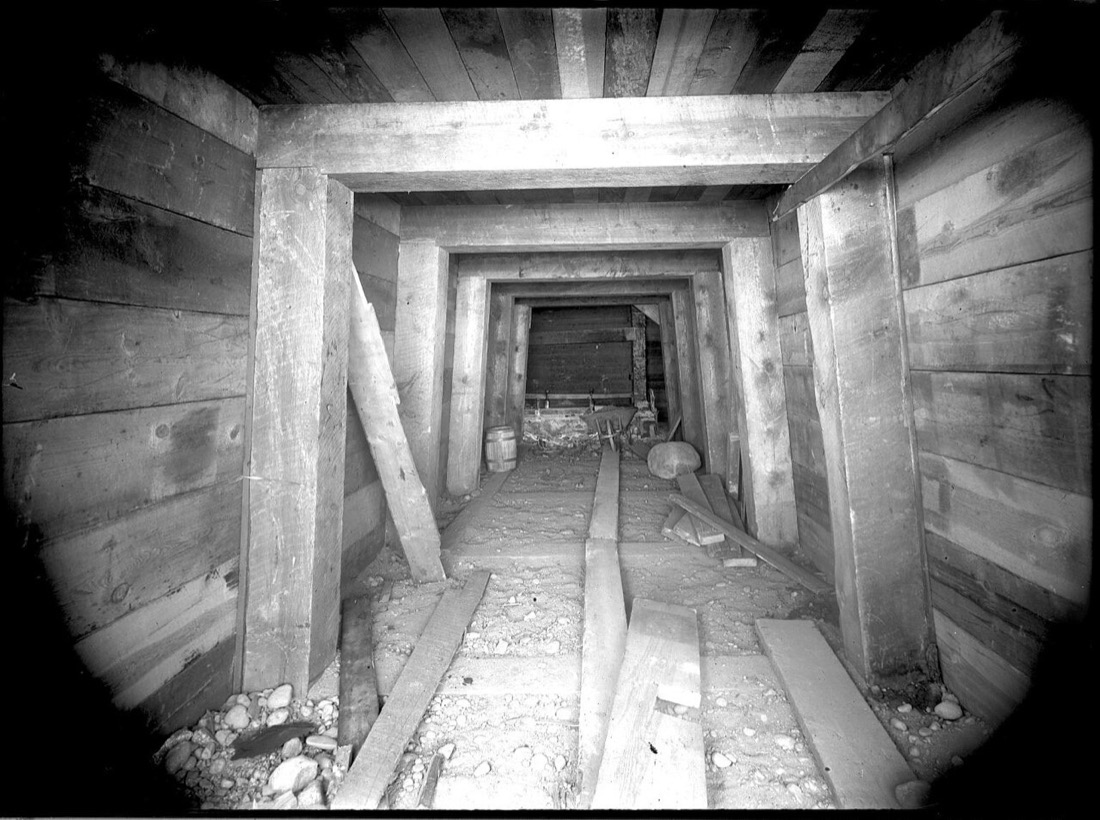
Visual AidTimber holding the ground open
Photograph, about a century old, of a mine tunnel held open by exactly what the Knowledge Bank calls shoring: squared timber sets braced against roof and walls, one frame behind another down the passage, with a barrel and a wheelbarrow left at the working face. The black-and-white film dates the scene, not the method — modern crews do the same job in steel ribs and sprayed concrete. It is a real mine, not the Pipeworks, which Jeanne DuPrau (author) invented; notice how many frames stand between the camera and the far wall, each one a place the ground pressed inward.
Interior view of a timbered mine tunnel; photograph by Lachlan McLean (1843–1929); University of Colorado libraries, via the Digital Public Library of America. Source: Wikimedia Commons, File:Interior view of mine tunnel - DPLA - 77e7501647c72a4faf236a56735c3563.jpg, public domain.
cavernn.Ch.3
A large chamber hollowed out underground
“The stairway ended in a cavern loud with running water.”
torrentn.Ch.3
A fast, violent rush of water
“The river moved past the tunnel mouth in a cold torrent.”
soddenadj.Ch.3
Soaked completely through with water
“A shift below left every sleeve and boot sodden.”
shoringn.Ch.3
Braces and timbers that hold a tunnel open
“Old shoring sagged where the damp had softened the wood.”
deafeningadj.Ch.3
So loud that every other sound is lost
“The generator room was deafening, and the crew wore earmuffs.”
maintenancen.Ch.3
Routine repair that keeps equipment running
“Maintenance kept the machine alive without explaining it.”
dwindlev.Ch.4
To grow steadily smaller in supply
“Bulbs, cloth, and paper dwindle a little every season.”
bewilderedadj.Ch.4
Confused and unable to make sense of things
“Granny stood bewildered in the middle of the emptied room.”
extravagancen.Ch.5
A costly purchase beyond what is needed
“Two colored pencils were an extravagance she could not defend.”
franticadj.Ch.5
Wild with fear, worry, or haste
“A frantic search began the moment the doorway stood empty.”
ⓘ The vocabulary words in this list are selected to help you understand and complete this workbook. Some may not appear verbatim in the original novel.
🧠Knowledge Bank question
1The Knowledge Bank explains that while shoring holds an opening against the weight of the ground, a sump is ___.Ch.3
2‘Sodden’ means completely soaked through.Ch.3
3Braces and timbers that hold a tunnel open are ___.Ch.3
4Fill in each blank with the correct word.Ch.3
Word choices:torrentmaintenancedwindledeafening- some words will not be used
The river passes the tunnel mouth in a cold .
Routine keeps the old machine limping along.
5So loud that every other sound is lost is ___.Ch.3
6To ‘dwindle’ is to grow steadily larger.Ch.3–5
7Soaked completely through with water is ___.Ch.3
8Routine repair that keeps equipment running is ___.Ch.3
9Fill in the blanks with the correct words.Ch.5
Word choices:extravagancefranticbewilderedcavern- some words will not be used
Two colored pencils are an Lina cannot defend.
A search starts the moment the doorway stands empty.
10Confused and unable to make sense of things is ___.Ch.4
Part 2
Comprehension
Show you understood what happens in Chapters 3–5.
📋Knowledge Bank · Holding Up the Roof, Moving the Air
Civil Engineering · Shoring, Air, and DrainageA tunnel is not a hole; it is a structure rebuilt against gravity every day. Crews cut forward, then immediately brace what they have opened, because ground around a new passage starts moving within hours. Timber sets, steel ribs, rock bolts, and sprayed concrete all perform one job: they transfer the weight overhead into ground that can still carry it, and engineers call that job support. Air is the second system. Deep workings have no natural breeze, so fans and paired shafts create a one-way circuit that draws fresh air down one route and pushes warm, dusty air out another, holding oxygen steady while fumes keep moving. Water is the third. Groundwater seeps through cracks constantly, so floors are cut on a slight grade that leads it to a collecting pit, where pumps raise it toward daylight in stages. The three systems only work together; let one lapse and the other two follow. A passage stays usable exactly as long as all three receive daily attention.
Visual AidThree jobs keep a tunnel alive
Cut-away structure diagram of the three systems the Knowledge Bank assigns to every deep working: support passes the weight overhead into ground that can still carry it, ventilation drives a one-way loop of air, and a floor cut on a slight grade leads seeping water to a sump for pumping. Timber, fans, and pumps are reduced to labeled rectangles, arrows, and one circle, and nothing is to scale. The drawing explains how any tunnel stays open; it is not a plan of the Pipeworks beneath Ember.
Tunnel support, ventilation, and drainage as described in standard introductions to mining and tunnel engineering. Drawn for Garden Heights Academy.
🧠Knowledge Bank question
1According to the Knowledge Bank, timber sets, steel ribs, and rock bolts all perform one job: they ___.Ch.3
2Who guides Doon through the tunnels?Ch.3
3The river under Ember turns out to be a small trickle, exactly as Doon expected.Ch.3
4What does Doon learn about the generator?Ch.3
5Write the numbers 1–5 in the boxes to show the correct order of events in Chapters 3–5. Number 1 = what happens first.Ch.3–5
Lina pays for two colored pencils in Looper’s shop.
Doon is fitted with boots and follows Arlin into the tunnels.
Lina asks Mrs. Murdo to help with Poppy and Granny.
The longest blackout yet stops the search for Poppy.
Doon slips into the generator room during the lunch break.
6Granny forgets that Poppy needs watching, so Lina arranges help from Mrs. Murdo.Ch.4
7What worrying news comes from the greenhouses?Ch.4
8Why does Sadge Merrall come back frightened?Ch.4
9Lina finds colored pencils for sale in an ordinary, clearly marked shop.Ch.5
10What happens while Lina searches for Poppy?Ch.5
Part 3
Literary Elements
Understanding HOW and WHY Jeanne DuPrau (author) tells the story across Chapters 3–5.
🧠Knowledge Bank · Descent as a Storytelling Tool
Literary Craft · Descent and Parallel PlotsDuPrau tells these chapters through descent and distance rather than through action. Doon’s half moves downward: borrowed boots, a long stairway, damp walls, and then a river whose size corrects everything he had imagined. Lina’s half moves outward across streets, shops, greenhouses, and crowded rooms, collecting rumor and shortage as she runs. Because the chapters alternate, readers assemble a city neither child can see whole, a structure critics call parallel plotting. The prologue adds a second layer: we already know a box of instructions exists, so every unexplained machine and emptying shelf carries weight the characters cannot feel, which is dramatic irony doing quiet work. Notice, too, how little this author explains directly. She trusts objects instead — a soaked sleeve, two costly pencils, a grandmother pulling furniture apart — to carry information that a summary would flatten. Ordinary detail becomes evidence, and the reader learns to study Ember the way its two children do, by noticing.
Parallel plots
Doon goes down into the Pipeworks while Lina moves across the streets — two searches, one city, told in turns.
Dramatic irony
The prologue told us a box of instructions exists; nobody in Ember knows it, so every unexplained machine carries extra weight.
Contrast
Lina’s drawings of a bright, towering city sit beside streets where the lamps now go dark for hours.
🧠Knowledge Bank question
1The Knowledge Bank explains that because the chapters alternate between Doon and Lina, readers ___.Ch.3–5
2Fill in each blank with the correct literary term.Ch.3–5
Word choices:contrastironyplotsrhyme- some words will not be used
Lina’s bright drawings stand in to Ember’s dimming streets.
Because the prologue told us more than the characters know, these chapters run on dramatic .
3Why does DuPrau send Doon down a long stairway before showing him the river?Ch.3
4The reader knows about the Builders’ instructions before any character in Ember does.Ch.3–5
5The small green worm Doon keeps notes on mainly shows ___.Ch.3
6Lina’s drawings of a bright city are shown as a private habit she repeats.Ch.4–5
7The long blackout does more than darken the city; it also ___.Ch.5
8Fill in the blank with the correct literary term.Ch.3
Word choices:settingmotifsequelpreface- some words will not be used
Doon’s descent makes feel almost like a character.
9Ember’s failing lights are only background detail with no thematic weight.Ch.3–5
10Chapters 3–5 mainly work to ___.Ch.3–5
Part 4
Think Deeper
Four deeper challenges — no single-word recall. Read, weigh the evidence, and reason it out.
💡Knowledge Bank · Who Carries the Risk Below
Ethics · Risk in Underground LaborUnderground work has always raised a hard question: who accepts the danger, and who decides that the danger is acceptable? Through most of mining history the answer was the youngest and poorest workers, sent below with little instruction and no voice in the choice. Nineteenth-century inquiries in Britain found children hauling coal through passages too low to stand in, and reform followed only after those findings became public. Modern law answers differently, requiring two exits, gas monitors, refuge chambers, and above all real training, on the reasoning that nobody can consent to a hazard that has never been explained. Ember fails that standard plainly. Twelve-year-olds draw jobs from a bag, descend toward a river most citizens have never seen, and repair machinery whose design no living person can describe. When a system runs on habit instead of understanding, risk quietly shifts from the institution that owns the machine to the crew that touches it. Ask who owes those workers an explanation, because unexplained danger is not caution but negligence.
Think back over these chapters. A stairway goes down and down until the air turns damp and the walls sweat, and then a door opens onto water so loud that talking is pointless — a river nobody in the city above has ever seen. Somewhere behind another door a machine hammers away while workers in earmuffs tend it, patching whatever fails without knowing why any of it was built that way. Up in the streets a messenger runs her routes, learning which shelves are empty this week, which shop hides what, and how long the lights stay out when they fail. She keeps drawing a city she has never visited: tall, crowded, and burning with light. Both children are asking the same question from opposite ends of it.
Original passage written for Garden Heights — not a quotation from the novel.
1Claim: “DuPrau makes Ember frightening by showing systems that are still running but no longer understood.” — choose the two details that best prove it.Claim & Evidence
2Doon’s world below, or Lina’s world above? Tap each detail to sort it — tap again to switch sides. You can keep tapping to change your answer.Sort into two
◄ Doon’s world belowLina’s world above ►
3Match each cause to its result. For each cause, pick its result.Cause & Effect
Doon opens the door marked for the main tunnel→
Doon slips into the generator room at lunch→
Granny forgets that Poppy needs watching→
Lina stops to pay for two colored pencils→
🧠Knowledge Bank question
4Fill both blanks to complete the reasoning.Build the Argument
The Knowledge Bank argues that modern mining law requires real training because , which shows that in Ember risk has quietly shifted to .
Part 5
Standardized Test
Reading passage · Building Tunnels That Stay Open · Central Ideas & Words in Context · SAT & TOEFL-style practice
Read the passage — the highlighted words are tested — then answer. Tap an answer, then tap it again to confirm.
SATCentral Ideas — the passage's main point
SATWords in Context — a word's meaning in this passage
SATInference — a conclusion the passage implies
TOEFLFactual Information — a fact stated in the passage
TOEFLVocabulary — a tested word's meaning here
TOEFLProse Summary — the three sentences that sum it up
The Hidden Engineering of Tunnels
Digging a tunnel is only the beginning of the work. The moment a crew cuts into rock or soil, gravity begins pressing the new opening closed, so miners install shoring — timber sets, steel arches, or sprayed concrete that carry the weight of the ground overhead. Engineers choose supports by testing the ground: hard granite may stand alone for years, while wet clay squeezes inward within hours. A tunnel is therefore not a hole but a structure, held open against earth that would rather close it.
Air and water are the next problems. Deep workings have no natural breeze, so air stalls, warms, and collects dust and engine exhaust; crews answer with a ventilation circuit, in which one shaft draws fresh air down, fans push it along the working faces, and a second shaft carries the used air out. Water arrives uninvited as seepage, groundwater weeping through joints in the rock until a quiet trickle swells into a torrent. Tunnels are therefore cut on a slight slope, so water runs to a low collecting pit where pumps lift it out in stages. Neglect either system and a solid-looking passage becomes unbreathable, flooded, or both.
Depth multiplies every hazard. Rock grows warmer as a shaft goes deeper, escape takes longer, and one blocked exit can seal a crew underground for days, which is why modern mines require two ways out, refuge chambers, and gas monitors worn on the body. The most dangerous working, safety inspectors argue, is the one where machinery still runs but nobody remembers why it was built that way. Routine maintenance — the daily care of pumps and fans — can run on habit; conditions below ground keep changing, and only understanding tells a crew which change matters.
Original passage written for Garden Heights — not a quotation from the novel.
1What is the passage mainly about?SAT · Central Ideas
2According to the passage, why is shoring installed?TOEFL · Factual Information
3How does a ventilation circuit move air?TOEFL · Factual Information
4In the passage, shoring means ___.SAT · Words in Context
5How is seeping water removed from a tunnel?TOEFL · Factual Information
6In the passage, torrent most nearly means ___.TOEFL · Vocabulary
7Why do modern mines require two ways out?SAT · Inference
8Prose Summary (TOEFL).The passage explains what it takes to keep a deep tunnel open and survivable. This TOEFL task lists six sentences; choose the THREE that best capture the passage’s main ideas. The other three do not belong — they state minor details or ideas the passage does not present.TOEFL · Prose Summary
9In the passage, maintenance most nearly means ___.SAT · Words in Context
10Based on the passage, why are Ember’s Pipeworks in danger?SAT · Inference
Part 6 · Optional
Creative Writing
A bonus challenge to practice your English. Take your time and have fun with it.
About This Section
This writing task is optional and is not part of your auto-graded score. The feedback below checks only the basics — length, spelling, and grammar — not whether your ideas are right or wrong. It is meant for classroom discussion and creative practice, so feel free to use your imagination!
Writing Task — Part 2 “The Thing Nobody Explains”
Doon discovers that Ember’s most important machine is repaired by people who cannot explain it. Write about something you use or depend on every day without understanding how it works — a phone, an elevator, a bus system, a rule at school. What would you want to find out first, and what could go wrong if nobody understood it? 6–10 sentences. End with the one question you would ask if you could ask anyone.
You can start with: “I use it every single day, and until I stopped to think about it I could not explain...”
0 / 40 words minimum
🗣 Teach It · Just for Fun (optional)
No right or wrong — close the screen and tell someone nearby what happened in this part. Can’t find anyone? Tell yourself out loud. The moment you teach it, you truly understand it.
Part 2 Complete!
You finished Chapters 3–5 of The City of Ember.
Here are your auto-graded results:
-
points out of 100
Teach it to someone
The best last step is to teach it. In your own words, explain what happened — retell a favorite scene, teach a character’s big choice, or sum up the main idea for a parent, friend, or classmate. When you can teach it clearly, you truly own it.
Independent study guide by Garden Heights. Not affiliated with or endorsed by Jeanne DuPrau. Contains original analysis only; no text from the novel is reproduced. Reference text: This workbook follows Jeanne DuPrau’s classic text (the standard Puffin edition sold worldwide). Revised 2023 UK editions change some wording and may not match the vocabulary studied here.
SAT® is a registered trademark of College Board, which is not affiliated with, and does not endorse, these materials. TOEFL® is a registered trademark of ETS. These materials are not endorsed or approved by ETS. Garden Heights is an independent provider of test-style reading practice.