New here? Just sign up with Google — your account includes Matilda, our gift book, forever.
The City of Ember · Garden Heights
Part 8
for The City of Ember · Part 8 · Chapters 18–20
8 Parts40 min
What Happens in Part 8
The river carries the three out of Ember to a climb that ends under the first sky they have ever seen.
Riding the riverThe pipe swallows the little boat and spits it into darkness. Lina, Doon, and Poppy ride the underground river away from the only city they have ever known — a wild, roaring stretch first, then a slow, wide calm where Doon can strike a light and see how enormous the cavern really is.
Ashore with a bookThe river ends in a still pool; they wade ashore, and Poppy tugs from the ground a cloth-wrapped packet — an old handwritten book. Lina realizes she never left her instructions for Clary, but the only way now is forward, up a waiting path. A framed notice for Ember's refugees warns the climb will take hours; it does, and they take turns carrying Poppy until their candles gutter out — yet the dark is not complete.
First sunriseThey step out into cold moving air under a ceiling of countless small lights and one large round one. At dawn the edge of the sky burns orange, then red, then a huge orb lifts over the land, too bright to face, and the world turns green and blue and warm. The old book explains where Ember came from.
The dropped noteThen a tunnel brings them to a crevice, and far below, small and lit and unaware, lies Ember. Lina adds to her unsent note, they weight it with a rock inside Doon's shirt, and drop it — and in a darkening street below, Mrs. Murdo picks up a bundle that has landed at her feet.
Resolution, first-sight imagery, and an ending built as a door
Cross-Curricular
Caves, underground rivers, and eyes meeting daylight
Chapter Summary
Ch.
What happens
18–20
Out of the Dark — the river carries the three travelers through roaring blackness into a vast quiet cavern and leaves them on a shore where Poppy unearths an old handwritten book; a framed notice for Ember’s refugees warns of a climb that costs them hours and their last candles; they emerge under stars, then under a sunrise, learn from the book how their city was founded, find a crevice looking down on Ember’s lamps — and drop a weighted message to the people they left behind.
Part 1
Vocabulary
Study 10 key words from Chapters 18–20, then answer each question.
📚Knowledge Bank · Naming Caves and Light
Earth Science · Cave and Light WordsPeople who explore underground carry a precise vocabulary, and Part 8 is easier to picture once you own it. A cavern is a large chamber inside rock, wide enough to swallow a river and a boat together; a narrow split in the same rock is a crevice. The scientific study of such spaces is called speleology, and the pitted landscape that forms above a cave system — hollows, dry valleys, streams that end at a hole — is known as karst. Water language matters too. The steady one-way push that carries a boat downstream is a current, and the long climb back toward the surface is an ascent. Light has its own terms. An object that gives off steady light is luminous, while light strong enough to overwhelm the eye does not merely shine, it dazzles. And the line where land seems to meet sky, a line no citizen of a buried city has ever had reason to name, is the horizon.
cavernn.Ch.18
A large chamber inside rock, underground
“The river opened into a cavern taller than any building in the city.”
currentn.Ch.18
The steady flow of water in one direction
“The current took the boat before anyone could reach for an oar.”
ascentn.Ch.19
A journey upward; a climb
“The ascent went on for hours, one switchback after another.”
crevicen.Ch.20
A narrow crack or split in rock
“A crevice in the cave floor looked straight down on the lighted city.”
thresholdn.Ch.19
The point of entry where one place becomes another
“The mouth of the tunnel was a threshold between two whole worlds.”
dazzlev.Ch.20
To overwhelm someone’s eyes with too much light
“Sunrise can dazzle eyes that have only ever known lamplight.”
luminousadj.Ch.19
Giving off a steady light; glowing
“Thousands of luminous specks were scattered across the night sky.”
horizonn.Ch.20
The line where the land and the sky appear to meet
“Color spread along the horizon before the great light appeared.”
refugen.Ch.19
A place that offers shelter from danger
“The notice on the wall spoke of the city as a refuge, not a home.”
legacyn.Ch.20
Something valuable handed down to later generations
“The buried book was a legacy left for whoever managed to escape.”
ⓘ The vocabulary words in this list are selected to help you understand and complete this workbook. Some may not appear verbatim in the original novel.
🧠Knowledge Bank question
1According to the Knowledge Bank, the karst landscape above a cavern system shows ___.Ch.18
2A ‘crevice’ is a wide, open plain.Ch.20
3A journey upward is an ___.Ch.19
4Something ‘luminous’ gives off a steady light.Ch.19
5Fill in each blank with the correct word.Ch.18–20
Word choices:currentthresholdlegacydazzle- some words will not be used
The river’s carried the boat away from the city.
A sunrise can eyes that have only known lamplight.
6The line where the land and the sky appear to meet is the ___.Ch.20
7A ‘refuge’ is a place that offers shelter from danger.Ch.19
8Something valuable handed down to later generations is a ___.Ch.20
9Fill in the blanks with the correct words.Ch.18–19
Word choices:refugecavernascenthorizon- some words will not be used
The tunnels opened into a huge .
The long took hours of climbing in the dark.
10The point of entry where one place becomes another is a ___.Ch.19
Part 2
Comprehension
Show you understood what happens in Chapters 18–20.
📋Knowledge Bank · Where Cave Rivers Run
Geology · Groundwater and LimestoneLimestone is the reason a river can run beneath a city. Rain takes up carbon dioxide from air and soil and becomes a weak acid, and limestone is one of the few common rocks that such water can slowly dissolve. Over tens of thousands of years the water widens joints and seams into passages, so a stream that once crossed a valley may vanish into a sinkhole and keep flowing in total darkness. Underground it behaves like any other river. It follows the steepest route available, cuts downward, roars where the channel narrows, and spreads into slow pools wherever the floor levels out. Eventually it meets rock it cannot dissolve, turns sideways along that barrier, and leaves the hillside at a spring. Cave explorers treat that pattern as a rule of thumb, because water is always hunting the lowest way out. Following a cave river downstream therefore tends to point toward open air, unless the roof dips under the water into a flooded sump.
Visual AidA river walks out of a hill
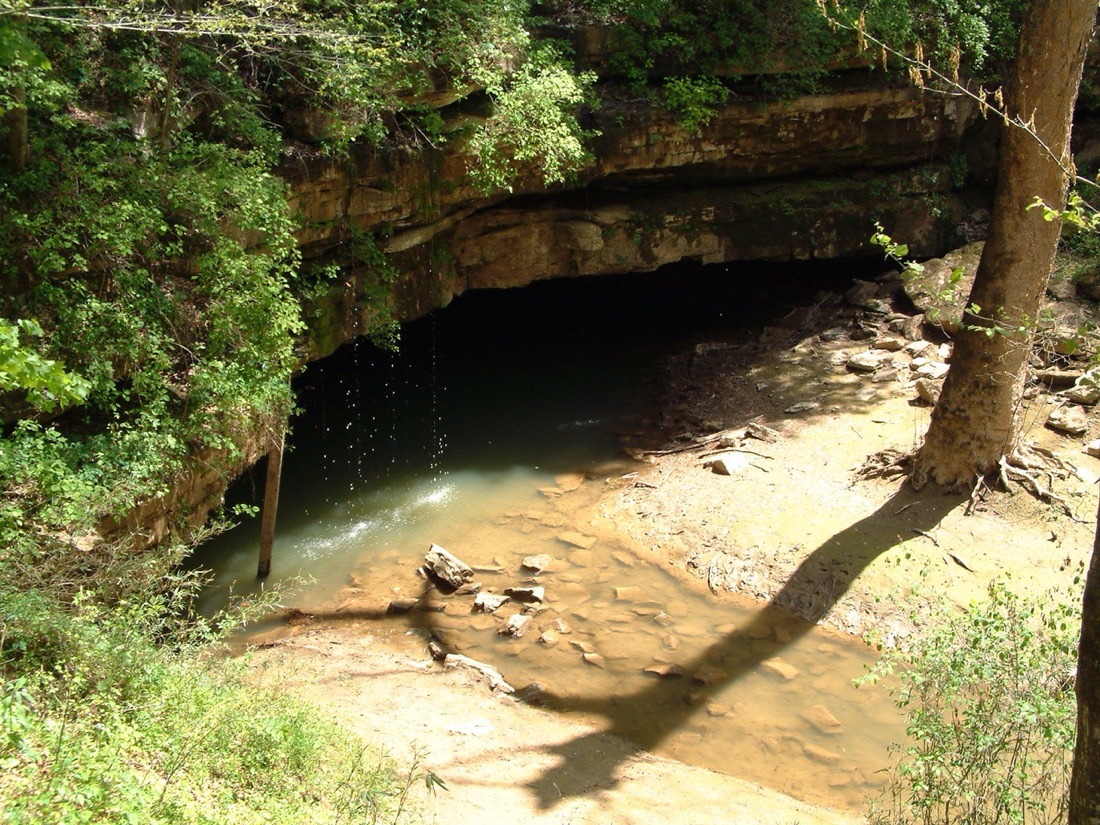
Photograph of the River Styx emerging from Mammoth Cave in Kentucky — a real underground river reaching daylight, completing the exact pattern the Knowledge Bank traces: water that slowly dissolved limestone in the dark meets rock it cannot pass, turns sideways, and leaves the hillside as a spring. The camera stands on the surface looking in; no photograph taken inside the darkness could show this edge. It is not the river beneath Ember, whose geography Jeanne DuPrau (author) invented — what is real is that rivers truly do this.
River Styx emerging from Mammoth Cave, Mammoth Cave National Park, Kentucky; photograph by Huw Williams, 2007. Source: Wikimedia Commons, File:Mammoth Cave River Styx.png, public domain.
🧠Knowledge Bank question
1The Knowledge Bank explains that following a cave river downstream usually leads out because ___.Ch.18
2What does Poppy pull out of the ground on the shore?Ch.18
3Doon manages to light a candle only after the current slows down.Ch.18
4The framed notice on the cave wall is addressed to ___.Ch.19
5Write the numbers 1–5 in the boxes to show the correct order of events in Chapters 18–20. Number 1 = what happens first.Ch.18–20
Sunrise breaks over open land, and a weighted message drops toward Ember.
The current slows and Doon lights a candle inside a vast cavern.
A framed notice warns of a climb, and the path takes them hours.
The three wade ashore and Poppy digs up a cloth-wrapped book.
The boat is swept away from Ember down the roaring dark river.
6The climb up the path out of the cave takes only a few minutes.Ch.19
7What do the children see overhead on their first night above ground?Ch.19
8What does the old book explain about how Ember began?Ch.20
9From above, Lina and Doon can look down through a crevice and see Ember still lit.Ch.20
10How does the novel end?Ch.20
Part 3
Literary Elements
Understanding HOW and WHY Jeanne DuPrau (author) tells the story across Chapters 18–20.
🧠Knowledge Bank · Endings That Open Outward
Literary Craft · Resolution and First SightA final chapter has two jobs, and DuPrau splits them cleanly. The first is resolution: the questions the plot raised get answered, so readers learn where the river goes, who posted the notice on the cave wall, and why anyone built a city underground at all. The second job is harder, because a book that settles everything can feel closed and airless. DuPrau keeps her ending open by handing the discovery to somebody else, dropping a weighted message toward the lights below and stopping before anyone acts on it. Notice how she writes the surface, too. Nothing is named with an adult reader’s vocabulary; light arrives first as scattered specks, then as a burning orb, and green is a color before it is a plant. Describing the ordinary through eyes that have no word for it is called defamiliarization, and it turns a plain sunrise into an event. The story ends satisfied and unfinished at once, which is exactly what a series opener must be: an aperture.
Resolution
The last chapters pay out every held question: where the river goes, who left the notice, and why a city was buried in the first place.
First-sight imagery
A sunrise described by people with no word for sun — specks, then an orb, then color arriving in stages.
Open ending
The bundle falls and the story stops — one plot closes while a larger one is handed to the reader.
🧠Knowledge Bank question
1According to the Knowledge Bank, defamiliarization means ___.Ch.18–20
2Fill in the blank with the correct literary term.Ch.18–20
Word choices:resolutionimageryallegorysuspense- some words will not be used
These last chapters supply the story’s .
A sun described without its name is first-sight .
3DuPrau describes the sunrise using only words a child of Ember would own, which ___.Ch.20
4The novel ends with every citizen of Ember already safely above ground.Ch.20
5Dropping the message instead of showing a rescue makes the ending ___.Ch.20
6Lamplight giving way to sunrise completes the book’s ___.Ch.18–20
7The old book Poppy finds is a document inside the story that explains the city’s origin.Ch.20
8Fill in the blank with the correct literary term.Ch.18–20
Word choices:motifsatiresymbolmeter- some words will not be used
Light against darkness is the book’s central .
9Stopping the story with Mrs. Murdo untying the bundle turns the reader’s attention toward ___.Ch.20
10These chapters answer the question the prologue raised about the Builders’ plan.Ch.18–20
Part 4
Think Deeper
Four deeper challenges — no single-word recall. Read, weigh the evidence, and reason it out.
💡Knowledge Bank · The Duty of the First to Know
Ethics & Science · Evidence and WarningLina and Doon reach open air holding knowledge nobody in Ember has, and that creates two problems worth arguing about. The first is whether their own senses can be trusted yet. A retina that has spent its entire life under lamps is not a reliable witness at sunrise: bright light instantly floods the rods, and several minutes pass before the cones deliver color and sharp detail, so a first impression of the surface is genuinely weak evidence. Careful thinkers wait, look twice, and mark the difference between a measurement and an inference. The second problem is what a person owes the people left behind. The two could have walked on into the green country, protected themselves, and called the risk somebody else’s business. Instead they weight a note with a rock and aim it at a city of strangers, accepting that a warning helps nobody unless it reaches someone able to act on it. Judging their choice means asking what turns a private discovery into a public responsibility.
Visual AidThe first minutes of daylight
Sequence diagram of the minutes the Knowledge Bank warns about: in the first seconds of daylight the rods flood and deliver nothing but glare; as minutes pass the cones take over, bringing color and edges; only then is the eye a usable witness. Exact times vary with brightness and from person to person, and three tidy stages compress a gradual change. The point to notice is about evidence, not anatomy: a first impression at sunrise is a measurement still in progress, so wait, and look twice.
Light and dark adaptation of rods and cones as described in introductory sensory physiology. Drawn for Garden Heights Academy.
Think back over these chapters. A pipe swallows a boat, and three children are gone from the only city on earth they know of. Roaring dark, then a stillness so wide that one candle finds no walls. A shore. A packet in the dirt with someone’s handwriting inside it. A notice in a frame, addressed to people who have not arrived yet, promising a climb that will take hours — and taking them. Candles gutter out, and the dark refuses to be complete. Cold air moves against skin that has never felt wind. Overhead: specks beyond counting, and one round white light. Then an edge of the sky catches fire, an orb climbs too bright to look at, and the world has colors nobody warned them about. Later, through a crack in the rock, they find a small bowl of lights far below, and recognize it.
Original passage written for Garden Heights — not a quotation from the novel.
1Claim: “DuPrau ends the novel by handing the discovery to the people left behind rather than finishing the rescue herself.” — choose the two details that best prove it.Claim & Evidence
2Life inside Ember (all they had known), or The world above (all that is new)? Tap each detail to sort it — tap again to switch sides. You can keep tapping to change your answer.Sort into two
◄ Life inside Ember (all they had known)The world above (all that is new) ►
3Match each cause to its result. For each cause, pick its result.Cause & Effect
The current slows in a wide, still stretch of river→
Poppy digs a wrapped packet out of the shore→
Their candles burn out partway up the long path→
A crevice opens in the rock above the lighted city→
🧠Knowledge Bank question
4Fill both blanks to complete the reasoning.Build the Argument
The Knowledge Bank calls a first impression of the surface weak evidence because , which shows that a careful observer should .
Part 5
Standardized Test
Reading passage · Caves, Cave Rivers, and the Eye · Central Ideas & Words in Context · SAT & TOEFL-style practice
Read the passage — the highlighted words are tested — then answer. Tap an answer, then tap it again to confirm.
SATCentral Ideas — the passage's main point
SATWords in Context — a word's meaning in this passage
SATInference — a conclusion the passage implies
TOEFLFactual Information — a fact stated in the passage
TOEFLVocabulary — a tested word's meaning here
TOEFLInsert Text — where a sentence best fits
How Caves Form and Eyes Adapt
Rain that lands on a limestone hill does not stay pure water for long. Soaking through soil, it takes up carbon dioxide and becomes a weak acid, and limestone is soluble in exactly that kind of acid. Water slips into thin joints and eats a little more of each wall every year, until over many thousands of years a finger-wide crack opens into a walkable passage. Geologists call the landscape this produces karst.
A cave river usually begins as a surface stream vanishing underground at a sinkhole. Below, its current — the steady push of the water — takes the easiest route it can find, widening cracks into corridors and dropping through shafts. Sooner or later the water reaches a layer it can neither dissolve nor soak through, and it runs sideways along that barrier until it escapes into open air at a spring called a resurgence. Because water hunts the lowest exit, explorers treat a flowing passage as a map: follow it far enough and it generally leads out, unless the ceiling dips into a flooded sump.
Coming out of a cave tests a different system. The retina holds two kinds of cells — rods, hugely sensitive but blind to color, and cones, which need more light and supply color and fine detail. Spend an hour in darkness and the pigment inside the rods rebuilds itself, a process called dark adaptation that needs roughly twenty to forty minutes. Travel the other way, out of gloom into a sunrise, and that sensitivity turns against you: light strong enough to dazzle the eye floods the rods at once, and for several minutes the world is glare with vague shapes inside it. Color comes last, once the cones have taken over.
Original passage written for Garden Heights — not a quotation from the novel.
1What is the main idea of the passage?SAT · Central Ideas
2In the passage, current most nearly means ___.SAT · Words in Context
3According to the passage, what lets rainwater dissolve limestone?TOEFL · Factual Information
4In the passage, a resurgence is ___.TOEFL · Vocabulary
5Insert Text (TOEFL). Look at the four squares [1]–[4] in the excerpt below. They show where this sentence could be added: “That barrier is often a bed of shale or clay lying beneath the limestone.”
A cave river usually begins as an ordinary surface stream that vanishes underground at a sinkhole. [1] Below, it takes the easiest route it can find, widening cracks into corridors and dropping through shafts wherever the rock allows. [2] Sooner or later the water reaches a layer it can neither dissolve nor soak through, and it runs sideways along that barrier until it escapes into open air at a spring called a resurgence. [3] Because water is forever hunting the lowest exit, cave explorers read a flowing passage as a rough map: follow the river far enough and it will generally take you out, unless the ceiling dips beneath the surface into a flooded stretch known as a sump. [4]
Where would the sentence fit best?TOEFL · Insert Text
6Which cells in the retina work best in very dim light?TOEFL · Factual Information
7In the passage, dazzle most nearly means ___.SAT · Words in Context
8About how long does full dark adaptation take?TOEFL · Factual Information
9Why would a person raised under lamps meet a green hillside ‘in stages’?SAT · Inference
10Which Part 8 development does this passage BEST explain?SAT · Inference
Part 6 · Optional
Creative Writing
A bonus challenge to practice your English. Take your time and have fun with it.
About This Section
This writing task is optional and is not part of your auto-graded score. The feedback below checks only the basics — length, spelling, and grammar — not whether your ideas are right or wrong. It is meant for classroom discussion and creative practice, so feel free to use your imagination!
Writing Task — Part 8 “Out of the Dark”
Lina and Doon see a sunrise with no words for it — light comes to them as specks, then an orb, then colors arriving one at a time. Write about the first time you saw or experienced something you had no words for. Describe it only as you understood it at that moment, not with the name you learned later. 6–10 sentences. End with the moment you finally realized what you were looking at.
You can start with: “I had no name for it yet, so I only noticed the small things first...”
0 / 40 words minimum
🗣 Teach It · Just for Fun (optional)
No right or wrong — tell someone nearby what happened in this part. Can’t find anyone? Tell yourself out loud. The moment you teach it, you truly understand it.
Part 8 Complete — You Finished the Book! 🎉
You finished Chapters 18–20 — the final part of The City of Ember.
Here are your auto-graded results:
-
points out of 100
Teach it to someone
The best last step is to teach it. In your own words, explain what happened — retell a favorite scene, teach a character’s big choice, or sum up the main idea for a parent, friend, or classmate. When you can teach it clearly, you truly own it.
Independent study guide by Garden Heights. Not affiliated with or endorsed by Jeanne DuPrau. Contains original analysis only; no text from the novel is reproduced. Reference text: This workbook follows Jeanne DuPrau’s classic text (the standard Puffin edition sold worldwide). Revised 2023 UK editions change some wording and may not match the vocabulary studied here.
SAT® is a registered trademark of College Board, which is not affiliated with, and does not endorse, these materials. TOEFL® is a registered trademark of ETS. These materials are not endorsed or approved by ETS. Garden Heights is an independent provider of test-style reading practice.