New here? Just sign up with Google — your account includes Matilda, our gift book, forever.
The Cricket in Times Square · Garden Heights
Part 5
for The Cricket in Times Square · Part 5 · Chapters 9–10
8 Parts40 min
What Happens in Part 5
Chester dines like a prince twice in two chapters — and nearly loses everything. First, Mario carries him back to Chinatown, where Sai Fong and an ancient friend serve a true Chinese feast: noodles, rice, vegetables, even duck, with a tiny saucer set out for the guest of honor while Mario wrestles his first chopsticks. Afterward the two old men consult a venerable book and find the answer to a great question — what should a treasured cricket eat? A princess of old China fed hers mulberry leaves. Leaves are picked fresh from the tree outside, Chester falls in love with his new food, and he thanks the company with a concert. Back home, the animals throw a party to celebrate Chester’s two-month anniversary in New York: Tucker raids the lunch counter for treats and iced drinks, the radio plays, Harry sings along — and Chester makes the discovery of his life: after one hearing, he can imitate any song on the radio, note for perfect note. Then joy tips into disaster. Tucker’s wild victory dance lands him in a box of matches; flames catch the newspapers; and the friends are trapped inside the locked stand as the fire spreads. Quick-thinking Chester sets off the alarm clock, and Paul, the shuttle conductor, hears the clanging, throws open the cover, and pulls them all to safety — leaving a scorched newsstand and a very guilty-looking cricket.
What We Will Learn
Section
What you will practice
Vocabulary
Words of feasts and flames: feast, consult, celebrate, imitate, blaze…
Literary Elements
Rising action, mood shifts, and a turning point in smoke
Cross-Curricular
Musical memory — playing by ear — and the mulberry tree’s secret fame
Chapter Summary
Ch.
What happens
9
The Chinese Dinner — a feast with Sai Fong and his old friend, chopstick lessons for Mario, and a discovery from an ancient book: treasured crickets dine on mulberry leaves.
10
The Dinner Party — an anniversary party with radio music; Chester finds he can imitate any song after one hearing — then Tucker’s dance ignites the matches, and Paul the conductor rescues the friends from the burning stand.
Part 1
Vocabulary
Study 10 key words from Chapters 9–10, then answer each question.
🧠Knowledge Bank · The Song Nobody Taught Him
Animal Behavior · Innate SongChester astonishes the station because he performs music no one taught him, and real crickets are nearly as strange. A young cricket takes no lessons and copies no elder; the pattern of its species’ song is built into its nerves and muscles before it ever hatches. Biologists call such behavior innate, meaning inborn rather than learned, which is why crickets of one kind raised in fields a hundred miles (160.9 km) apart rub out almost the same tune. Human musicians have their own version of the marvel: playing by ear, reproducing a melody from listening alone with no written notes at all. Mozart is said to have written out a long, closely guarded piece of church music after hearing it once. A radio left murmuring beside a newsstand can therefore serve as a whole conservatory.
feastn.Ch.9
A large, special meal for guests
“Sai Fong spread a feast of noodles, rice, and duck.”
consultv.Ch.9
To look something up or ask for expert advice
“The two old men went to consult an ancient book.”
ancientadj.Ch.9
Very, very old; from long ago
“The book’s ancient pages held the answer.”
chopsticksn.Ch.9
A pair of thin sticks used for eating
“Mario chased a slippery noodle with his chopsticks.”
celebratev.Ch.10
To do something special for a happy occasion
“The friends met to celebrate Chester’s two months in the city.”
anniversaryn.Ch.10
The date an event is remembered each month or year
“The party marked the anniversary of Chester’s arrival.”
imitatev.Ch.10
To copy the way something sounds or is done
“Chester could imitate any song after one hearing.”
blazen.Ch.10
A bright, strong fire
“The blaze leaped from the matchbox to the newspapers.”
escapev.Ch.10
To get away from danger
“The friends had no way to escape the locked stand.”
conductorn.Ch.10
A person in charge of a train and its passengers
“Paul the conductor heard the alarm and ran to help.”
ⓘ The vocabulary words in this list are selected to help you understand and complete this workbook. Some may not appear verbatim in the original novel.
🧠Knowledge Bank question
1According to the Knowledge Bank, innate behavior is ___.Ch.9
2To ‘consult’ a book is to throw it away without reading it.Ch.9
3To copy the way something sounds is to ___ it.Ch.10
4An ‘anniversary’ marks the date when something happened.Ch.10
5Fill in each blank with the correct word.Ch.9–10
Word choices:blazefeastchopsticksconductor- some words will not be used
Mario fumbled with his at the Chinese dinner.
The spread quickly through the stacked papers.
6Something ‘ancient’ is ___.Ch.9
7In this part, the ‘conductor’ is a person who leads an orchestra.Ch.10
8To do something special for a happy occasion is to ___.Ch.10
9Fill in the blanks with the correct words.Ch.9–10
Word choices:escapeimitatecelebrateancient- some words will not be used
Chester could a whole song after hearing it once.
Trapped inside, the friends could not on their own.
10To get away from danger is to ___.Ch.10
Part 2
Comprehension
Show you understood what happens in Chapters 9–10.
🧠Knowledge Bank · The Leaf That Built a Trade Route
World History · Silk & the MulberryThe mulberry is no ordinary tree. Its leaves are the single food of the silkworm, the caterpillar whose cocoon is unwound into the thread that becomes silk, once the most valuable cloth on earth. Whole trade routes existed because of that one appetite; the Silk Road carried the finished cloth thousands of miles westward out of China for centuries, and the secret of how it was made was guarded like treasure. So an old book prescribing mulberry leaves for a treasured cricket places him in exclusive company: small creatures, extraordinary gifts, and a diet fit for emperors. The station’s other luxury was much newer. By 1960 a cheap radio poured opera, jazz, and popular songs through the city all day, free to anybody who owned a receiver.
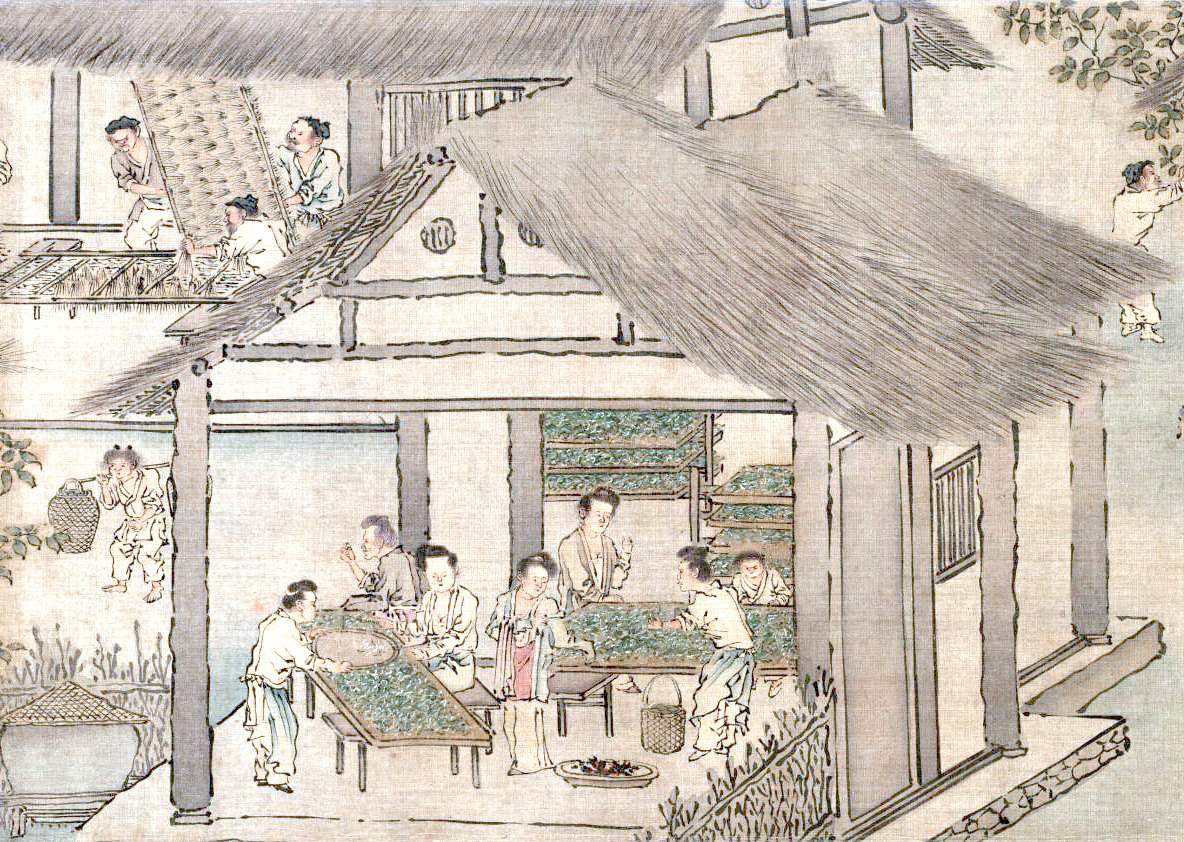
Visual AidFeeding silkworms on mulberry leaves
Detail of a Chinese painting from the 1200s attributed to Liang Kai, now in the Cleveland Museum of Art, showing women in an open-sided building spreading silkworms and mulberry leaves across flat trays. The Knowledge Bank says mulberry leaves are the single food of the silkworm, that whole trade routes existed because of that one appetite, and that the secret of silk was guarded like treasure. This scroll shows the guarded work itself, about eight hundred years ago. It is a painting, not a photograph, and no cricket is anywhere in it. Notice the flat trays — every leaf on them is a meal on its way to becoming thread.
Women placing silkworms on trays with mulberry leaves, detail of Sericulture, attributed to Liang Kai, 13th century; Cleveland Museum of Art. Source: Wikimedia Commons, public domain.
🧠Knowledge Bank question
1The Knowledge Bank says the mulberry tree matters because its leaves are ___.Ch.9
2How do the old men discover what a treasured cricket should eat?Ch.9
3The mulberry leaves come from a tree growing outside Sai Fong’s window.Ch.9
4What is the party in Chapter 10 celebrating?Ch.10
5Write the numbers 1–5 in the boxes to show the correct order of events in Chapters 9–10. Number 1 = what happens first.Ch.9–10
An ancient book prescribes mulberry leaves.
The animals gather to celebrate Chester’s anniversary.
Tucker’s wild dance tips him into the matchbox.
A feast is served in the back of Sai Fong’s shop.
Paul hears the alarm clock and opens the burning stand.
6Chester discovers at the party that he can imitate songs from the radio after one hearing.Ch.10
7How does the fire start?Ch.10
8Why can’t the friends simply run from the fire?Ch.10
9The fire is put out before anyone outside the newsstand notices it.Ch.10
10What clever action saves the trapped friends?Ch.10
Part 3
Literary Elements
Understanding HOW and WHY George Selden tells the story across Chapters 9–10.
🧠Knowledge Bank · How Writers Set a Feeling
Literary Craft · MoodRead the feast and you feel cozy; read what follows and your chest tightens. That shift is mood — the emotional weather an author builds out of word choice, pace, and detail. During the party Selden crowds the page with warmth, light, and the smell of good food. Then sentences shorten, verbs quicken, smoke and flame crowd in, and the mood turns to alarm. The facts alone do not carry that feeling; the chosen words do, and the same events told in calm, slow language would leave a reader unafraid. Mood is how a story reaches past the mind and touches the nerves. Pause to name the feeling in a scene, then hunt for the exact words that planted it — that is where the craft is quietly working its spell.
Visual AidThe words change, the feeling changes
Diagram for the Knowledge Bank on mood. The left card gathers the kind of language the Knowledge Bank says fills the party pages, warmth, light, and the smell of good food in long easy sentences; the right card gathers what replaces it when the fire comes, smoke, flame, short sentences, and quick verbs; the teal card is the definition. It lists kinds of words, not sentences from the book. Notice that the events are the same party in both cards — only the words moved, and the feeling moved with them.
Party words, fire words and the definition of mood as described in the Knowledge Bank. Drawn for Garden Heights Academy.
Mood
The feeling a scene gives readers — the party’s giddy joy, snapped in one instant into smoke and panic.
Turning point
An event that changes the story’s direction — after the fire, Chester’s place at the newsstand hangs by a thread.
Rising action
Events building toward the story’s peak — the new gift and the new disaster, delivered in the same night, set the final chapters in motion.
🧠Knowledge Bank question
1According to the Knowledge Bank, mood is built out of ___.Ch.10
2Fill in the blank with the correct literary term.Ch.10
Word choices:turningfallingopeningclosing- some words will not be used
The fire, which changes the story’s whole direction, is a point.
3Selden places Chester’s great discovery — perfect imitation — just BEFORE the fire so that ___.Ch.10
4The two feasts — Chinese dinner and newsstand party — give the part a pattern of celebration before disaster.Ch.9–10
5Tucker’s dance starting the fire fits his character because he is ___.Ch.10
6The alarm-clock rescue shows a side of Chester the party also revealed: he ___.Ch.10
7The mood of a scene is the feeling it creates in the reader.Ch.9–10
8Fill in the blank with the correct literary term.Ch.9–10
Word choices:risingresolvedrhymedreversed- some words will not be used
Events that build toward a story’s peak are called action.
9Ending the chapter with a scorched stand and a guilty-looking cricket leaves readers asking ___.Ch.10
10Taken together, Chapters 9–10 balance gains and losses. Which trade do they set up?Ch.9–10
Part 4
Think Deeper
Four deeper challenges — no single-word recall. Read, weigh the evidence, and reason it out.
🧠Knowledge Bank · When a Good Deed Goes Wrong
Social-Emotional · Mistakes & ForgivenessThe disaster begins inside an act of pure kindness: the animals throw a party to comfort a homesick friend. That the celebration ends in ruin carries a grown-up truth — our warmest efforts sometimes cause the very trouble we hoped to prevent. What matters next is not the accident but the response. The Bellinis are a hardworking family for whom every burned dollar is a real loss, and Chester dreads their anger with good reason. Yet the story leans toward forgiveness, the choice to look at the good heart behind a mistake rather than only at the damage. Learning to forgive others, and yourself, is among the hardest parts of growing up, and a single bad night need not be allowed to end a friendship.
Think back over the chapters. In a back room in Chinatown, two old men bend over a book older than the city outside, hunting the proper supper for a cricket — and find a princess who answered the question centuries ago. Days later, under Times Square, a mouse dances on a ledge, a cat hums with the radio, and a cricket discovers that every song in the world will stay with him after a single hearing. Then a box of matches tips, flame runs along the newspapers like a living thing, and the happiest night of Chester’s new life ends with him blinking in the smoke of the home that took him in.
Original passage written for Garden Heights — not a quotation from the novel.
1Claim: “By the end of the party, Chester’s musical powers have clearly grown.” — choose the two details that best prove it.Claim & Evidence
2The Chinese dinner, or The newsstand party? Tap each detail to sort it — tap again to switch sides. You can keep tapping to change your answer.Sort into two
◄ The Chinese dinnerThe newsstand party ►
3Match each cause to its result. For each cause, pick its result.Cause & Effect
The old men consult the ancient book→
The radio plays through the anniversary party→
Tucker’s dance tips him into the matchbox→
Chester sets off the alarm clock→
🧠Knowledge Bank question
4Fill both blanks to complete the reasoning.Build the Argument
The Knowledge Bank says the disaster begins inside , which shows that what matters next is .
Part 5
Standardized Test
Reading passage · How the Radio Learned to Sing · SAT & TOEFL-style practice
Read the passage — the highlighted words are tested — then answer. Tap an answer, then tap it again to confirm.
SATCentral Idea — the passage's main point
SATWords in Context — a word's meaning in this passage
SATAuthor’s Purpose — what the author wants to achieve
SATText Connections — how two parts of the text relate
SATText Structure — how the passage is built, and why
TOEFLFactual Information — a fact stated in the passage
TOEFLVocabulary — a tested word's meaning here
TOEFLRhetorical Purpose — why the author included a detail
TOEFLNegative Factual Information — the statement the passage does NOT support
How Radio Waves Carry Music
When the first radio stations began broadcasting in the 1920s, something changed forever: music learned to travel. A singer in one room could be heard, at the same instant, in a million rooms. The trick works in three steps. At the station, a microphone turns sound into an electrical pattern, and a tall tower broadcasts that pattern outward in every direction as radio waves — ripples of energy that are completely invisible and utterly silent as they pass through air, walls, and even people. In each home, a receiver catches the waves, turns the pattern back into sound, and pours the song from its speaker. By 1960, radios sang everywhere — kitchens, taxicabs, corner newsstands — and a listener could hear more music in a week than a villager of old heard in a lifetime. Stations played through the night, mixing opera, jazz, and popular songs, and none of it cost the listener a penny. For most people the radio was company. But for anyone learning music, it was a school with the world's greatest teachers, holding class all day long — free to every listener with an ear good enough to keep what it heard and imitate it.
Original passage written for Garden Heights — not a quotation from the novel.
1What is the main idea of the passage?SAT · Central Idea
2What is the FIRST step of the radio’s three-step trick?TOEFL · Factual Information
3In the passage, to imitate a song is to ___.SAT · Words in Context
4In the passage, radio waves are described as ___.TOEFL · Factual Information
5In the passage, a receiver is ___.TOEFL · Vocabulary
6The passage compares a modern listener to a villager of old to show ___.TOEFL · Rhetorical Purpose
7According to the passage, by 1960 radios could be found in all of these places EXCEPT ___.TOEFL · Negative Factual Information
8The author calls the radio ‘a school with the world’s greatest teachers’ because it ___.SAT · Author’s Purpose
9The passage’s final words — ‘an ear good enough to keep what it heard’ — point most directly to ___.SAT · Text Connections
10How is the passage organized?SAT · Text Structure
Part 6 · Optional
Creative Writing
A bonus challenge to practice your English. Take your time and have fun with it.
About This Section
This writing task is optional and is not part of your auto-graded score. The feedback below checks only the basics — length, spelling, and grammar — not whether your ideas are right or wrong. It is meant for classroom discussion and creative practice, so feel free to use your imagination!
Writing Task — Part 5 “The Best Party That Ever Went Wrong”
The anniversary party swings from the happiest night of Chester’s new life to smoke and rescue in minutes. Write about a celebration — real or invented — where everything was wonderful until one small accident changed the evening. Build the joy first, then let the accident strike, in 6–10 sentences. Try Selden’s trick: make the disaster grow out of the fun itself.
You can start with: “Looking back, we were having too much fun to notice what was about to happen...”
0 / 40 words minimum
🗣 Teach It · Just for Fun (optional)
No right or wrong — close the screen and tell someone nearby what happened in this part. Can’t find anyone? Tell yourself out loud. The moment you teach it, you truly understand it.
Part 5 Complete!
You finished Chapters 9–10 of The Cricket in Times Square.
Here are your auto-graded results:
-
points out of 100
Teach it to someone
The best last step is to teach it. In your own words, explain what happened — retell a favorite scene, teach a character’s big choice, or sum up the main idea for a parent, friend, or classmate. When you can teach it clearly, you truly own it.
Independent study guide by Garden Heights. Not affiliated with or endorsed by George Selden. Contains original analysis only; no text from the novel is reproduced. Reference text: This workbook follows George Selden’s classic text (the standard Puffin edition sold worldwide). Revised 2023 UK editions change some wording and may not match the vocabulary studied here.
SAT® is a registered trademark of College Board, which is not affiliated with, and does not endorse, these materials. TOEFL® is a registered trademark of ETS. These materials are not endorsed or approved by ETS. Garden Heights is an independent provider of test-style reading practice.