New here? Just sign up with Google — your account includes Matilda, our gift book, forever.
Diary of a Wimpy Kid · Garden Heights
Part 3
for Diary of a Wimpy Kid · Part 3 · November
8 Parts40 min
What Happens in Part 3
November opens with terrible news taped to the gym wall: a wrestling unit in Physical Education. Greg does the math instantly — tiny singlet uniforms, a spot in the lowest weight class, and a practice opponent named Fregley, the strangest kid in school. Desperate for muscles, Greg asks his parents for exercise equipment; they answer that he must first prove he has the discipline to use it. Greg’s solution is pure Greg: a homemade weight set built from milk and juice jugs filled with sand — tested on Rowley, who promptly gets trapped under the barbell. The fitness plan is quietly abandoned. At school, Patty Farrell asks the teacher to cover the wall map during a Geography quiz, wiping out Greg’s secret advantage; Greg flunks and vows revenge. His chance arrives from a strange direction: Mom signs him up for the school’s winter play, The Wizard of Oz — and there is Patty, auditioning for Dorothy. Greg auditions to be a Tree, dreaming of the apple-throwing scene… then learns the tree costumes have no arm holes, and that his part is too small to even get himself cut from the show.
What We Will Learn
Section
What you will practice
Vocabulary
Words of the gym and the stage: opponent, technique, discipline, audition…
Literary Elements
Character motivation, the running gag, and comic escalation
Cross-Curricular
Why weight classes exist, and how leverage beats muscle
Diary Summary
Month
What happens
Nov.
Muscle month — the wrestling unit pairs Greg with Fregley; the sand-jug weight set traps Rowley; Patty Farrell sinks Greg’s Geography quiz; and Greg joins The Wizard of Oz as a Tree with apple-sized plans and no arm holes.
Part 1
Vocabulary
Study 10 key words from the November diary entries, then answer each question.
🧠Knowledge Bank · Why Everyone Feels Watched
Social Science · The Spotlight EffectWhen the gym unit throws Greg into wrestling and he ends up tangled on a mat with Fregley, his misery is not only about losing — it is about being seen losing. Psychologists have a name for the feeling that all eyes are locked on you: the spotlight effect. In truth, other people notice our stumbles far less than we imagine, because they are busy worrying about their own. Yet a middle-schooler’s brain is wired to treat every blush as a public event, which is why embarrassment can sting worse than real pain. This social alarm has a purpose: the fear of looking foolish once helped humans stay inside the safety of the group. Understanding it helps you read Greg fairly, because so many of his schemes are really attempts to control how he appears. Half his troubles begin the moment he starts performing for an audience that is barely watching.
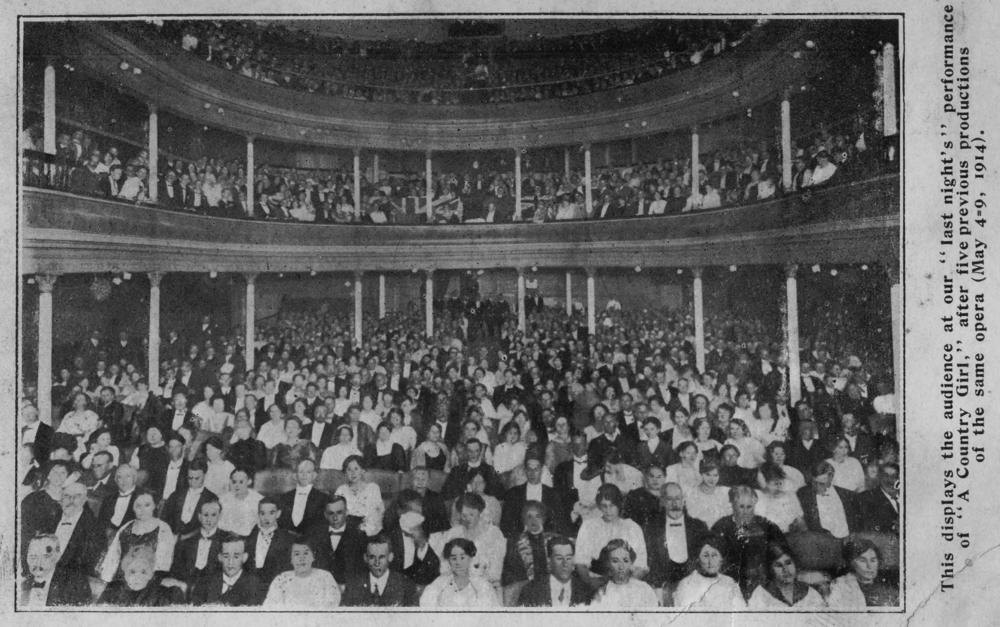
Visual AidHundreds of faces, all pointed one way
Photograph taken in 1914 of the audience at a large theater in Brisbane, Australia, taken from the stage looking out. The Knowledge Bank explains the spotlight effect: the feeling that all eyes are locked on you, when in truth other people notice our stumbles far less than we imagine because they are busy worrying about their own. This is roughly the view that produces the feeling. Look closely and you will see that plenty of the faces are turned away or talking.
Audience at a Brisbane theater, 1914; John Oxley Library, State Library of Queensland. Source: Wikimedia Commons, public domain.
opponentn.Nov.
The person you compete against
“In the wrestling unit, your opponent comes from your own weight class.”
techniquen.Nov.
A skilled way of doing something
“Good technique can beat pure strength on the mat.”
disciplinen.Nov.
The self-control to keep working at something
“Greg’s parents want proof of discipline before buying equipment.”
equipmentn.Nov.
The tools or gear needed for an activity
“Real exercise equipment costs more than Greg expects.”
homemadeadj.Nov.
Made at home instead of bought
“The homemade barbell was two jugs of sand and a broom-length bar.”
auditionn.Nov.
A tryout for a part in a show
“Patty’s audition for Dorothy went perfectly, of course.”
assignv.Nov.
To officially give someone a task or role
“The teacher can assign any practice partner she likes.”
vowv.Nov.
To promise something very seriously
“Greg vows revenge before the quiz papers are even collected.”
revengen.Nov.
Harm returned for a wrong done to you
“The apple scene looked like the perfect revenge.”
competitionn.Nov.
An event where people try to win against others
“Even a class quiz can feel like a competition to Greg.”
ⓘ The vocabulary words in this list are selected to help you understand and complete this workbook. Some may not appear verbatim in the original novel.
🧠Knowledge Bank question
1According to the Knowledge Bank, the spotlight effect is the feeling that ___.Nov.
2‘Discipline’ means the self-control to keep working at something.Nov.
3A skilled way of doing something is a ___.Nov.
4An ‘audition’ is the final performance of a play in front of parents.Nov.
5Fill in each blank with the correct word.Nov.
Word choices:homemaderevengeequipmentassign- some words will not be used
Greg’s weight set was built from sand-filled jugs.
After the quiz disaster, Greg wanted on Patty.
6To promise something very seriously is to ___.Nov.
7Something ‘homemade’ is bought new from a store.Nov.
8The tools or gear needed for an activity are ___.Nov.
9Fill in the blanks with the correct words.Nov.
Word choices:auditionopponentcompetitiontechnique- some words will not be used
Greg’s for the play lasted about a minute.
A quiz can turn into a when Patty Farrell is in the room.
10To officially give someone a task or role is to ___ it.Nov.
Part 2
Comprehension
Show you understood what happens in November.
🧠Knowledge Bank · Asking Why Greg Does It
Reading Skill · Character MotivationTo understand a character, a strong reader looks past what he does to motivation — the hidden want that drives the deed. November is full of Greg’s schemes: dodging a tough wrestling partner, angling for a good role in the school play, steering blame away from himself. Each action makes far more sense once you name the desire beneath it, and almost always that desire is to avoid embarrassment or climb a little higher. When you can state a character’s goal in a single sentence, his next move stops being random and starts feeling almost predictable. Kinney rarely announces these motives; he trusts you to work them out from the pattern of choices, the way you would read a friend you know well. Practice by pausing after each scheme and finishing the sentence ‘Greg is doing this because…’ The answer you find is the real engine of the whole plot.
🧠Knowledge Bank question
1The Knowledge Bank says that once you can state a character’s goal in one sentence, his next move ___.Nov.
2What do Greg’s parents say when he asks for exercise equipment?Nov.
3Greg builds a homemade weight set out of milk and juice jugs filled with sand.Nov.
4What happens when Rowley tests the homemade barbell?Nov.
5Write the numbers 1–5 in the boxes to show the correct order of November’s events. Number 1 = what happens first.Nov.
Greg’s parents demand proof of discipline.
Patty has the map covered and Greg flunks the quiz.
Rowley is trapped under the sand-jug barbell.
The school announces a wrestling unit in P.E.
Greg auditions to be a Tree in the winter play.
6Patty Farrell asks the teacher to cover the wall map during the Geography quiz.Nov.
7Why does Greg audition for the part of a Tree?Nov.
8What ruins Greg’s apple-throwing plan?Nov.
9Greg performs so badly at his audition that he is cut from the play immediately.Nov.
10What connects the weight set, the quiz, and the play this month?Nov.
Part 3
Literary Elements
Understanding HOW and WHY Jeff Kinney tells the story across November.
🧠Knowledge Bank · When Plans Backfire
Author’s Craft · Situational IronyAgain and again Greg builds a clever plan, and again and again it collapses into the opposite of what he wanted. That gap between expectation and result is called irony, and Kinney leans on a flavor of it known as situational irony: a scheme meant to make Greg look good instead makes him look worse. He tries to land an easy role and lands a role he hates; he tries to dodge effort and doubles it. The comedy lands because the reader can often see the crash coming while Greg cannot, so we wince and laugh at once. Irony does more than amuse, though — it quietly argues that Greg’s shortcuts do not work, letting the story teach a lesson without ever preaching one. As you read, try to spot the exact moment a plan tips from clever to doomed, because that turn is where the comedy does its sharpest teaching.
Visual AidWhen a plan turns into its opposite
Diagram for the Knowledge Bank on situational irony. Card 1 is what a scheme is meant to do, card 2 is what it actually does, and card 3 is the reader, who could see the crash coming. The wording follows the Knowledge Bank, which says a plan meant to make Greg look good instead makes him look worse. Notice there is nothing between the first two cards: irony is the distance itself.
Situational irony as described in the Knowledge Bank. Drawn for Garden Heights Academy.
Character motivation
The want driving a character’s choices — Greg’s wants are small, urgent, and always about image.
Running gag
A joke that returns again and again, funnier each time — in this book, the name ‘Fregley’ is a warning label.
Comic escalation
Each solution creates a bigger problem — sand jugs to trapped best friend, quiz map to sworn revenge.
🧠Knowledge Bank question
1According to the Knowledge Bank, situational irony is when a scheme meant to make Greg look good ___.Nov.
2Fill in the blank with the correct literary term.Nov.
Word choices:motivationescalationmetaphorprologue- some words will not be used
The want behind a character’s choices is character .
A fix that creates a bigger problem is comic .
3Fregley works as a running gag because ___.Nov.
4A running gag is a joke that appears exactly once in a story.Nov.
5The sand-jug barbell trapping Rowley is comic escalation because ___.Nov.
6By giving Greg tiny, image-driven motives, Kinney makes him ___.Nov.
7Greg’s revenge plan against Patty is carried out successfully in November.Nov.
8Fill in the blank with the correct literary term.Nov.
Word choices:gagclimaxsonnetvillain- some words will not be used
A joke that keeps returning is a running .
9Kinney has the costume block Greg’s apple plan mainly to ___.Nov.
10November’s three failed schemes together establish the book’s comic pattern: ___.Nov.
Part 4
Think Deeper
Four deeper challenges — no single-word recall. Read, weigh the evidence, and reason it out.
🧠Knowledge Bank · Why Rules Try to Level the Field
Think Deeper · FairnessWrestling sorts athletes into weight classes for a simple reason: a fair contest matches people of similar size so that skill, not sheer bulk, decides the winner. That idea — shaping rules so the playing field is level — sits quietly beneath much of November. Greg, meanwhile, keeps hunting for the opposite: a shortcut that lets him win without the effort everyone else puts in. It is worth weighing the difference. Fairness asks that we accept the same rules as our rivals and earn our place; a shortcut asks that we quietly exempt ourselves. Greg is not cruel about it, and his dodges are often funny, but the story lets you notice the small dishonesty inside each one. Real respect, on a mat or a stage, tends to go to the person who competes squarely and loses well, not to the one who games the system to protect his fragile pride.
Think back over the month. A boy reads a gym notice and sees his doom in it: a tiny uniform and a practice partner no one will go near. He asks for weights; he is asked for discipline; he delivers two milk jugs full of sand — and one flattened best friend. In class, a girl politely asks the teacher to cover the map, and a quiz grade sinks like a stone. So when the winter play posts its cast list, the boy signs on as a Tree, because Trees stand near Dorothy, and Dorothy will be played by that exact girl — and apples, he reasons, practically throw themselves.
Original passage written for Garden Heights — not a quotation from the novel.
1Claim: “Greg’s fitness plan was never really about fitness.” — choose the two details that best prove it.Claim & Evidence
2What Greg wants, or What Greg will actually do to get it? Tap each detail to sort it — tap again to switch sides. You can keep tapping to change your answer.Sort into two
◄ What Greg wantsWhat Greg will actually do to get it ►
3Match each cause to its result. For each cause, pick its result.Cause & Effect
Parents demand proof of discipline first→
Rowley volunteers to test the homemade weights→
Patty has the wall map covered for the quiz→
Patty auditions for the part of Dorothy→
🧠Knowledge Bank question
4Fill both blanks to complete the reasoning.Build the Argument
The Knowledge Bank says fairness asks that we accept , whereas a shortcut asks that we .
Part 5
Standardized Test
Reading passage · Leverage: How a Smaller Wrestler Wins · SAT & TOEFL-style practice
Read the passage — the highlighted words are tested — then answer. Tap an answer, then tap it again to confirm.
SATCentral Ideas — the passage's main point
SATWords in Context — a word's meaning in this passage
SATDetail — a fact stated in the passage
SATInference — a conclusion the passage implies
SATText Connections — how two parts of the text relate
TOEFLFactual Information — a fact stated in the passage
TOEFLRhetorical Purpose — why the author included a detail
TOEFLVocabulary — a tested word's meaning here
The Physics of a Wrestling Match
Watch two well-matched wrestlers, and the winner is often not the stronger one; it is the one who best reads the opponent across the mat. A lever is one of the oldest machines in the world: a stiff bar tipping on a fixed point, letting a small force move a heavy load. Your own body is full of levers, arms, legs, hips, and wrestling is the sport of using them. When a wrestler drops her hips below the other athlete’s and lifts, she is not out-muscling anyone; she is placing her strongest levers under the weakest balance point, so a modest push does surprising work.
Balance is the other half of the sport. A wrestler in a low, wide stance is hard to tip, because his weight is centered over a broad base, like a pyramid. Stand tall and narrow, and you become a broom balanced on its handle: one nudge finishes you. This is why coaches prize discipline, the willingness to repeat a dull drill a thousand times, and why they teach technique, stance, grip and hip position, long before they ever mention strength. A certain sixth grader dreading his P.E. unit might find that encouraging: the smallest kid on the mat is one good lesson away from a fair fight.
Original passage written for Garden Heights — not a quotation from the novel.
1What is the main idea of the passage?SAT · Central Ideas
2In the passage, an opponent is ___.SAT · Words in Context
3According to the passage, when a wrestler drops her hips and lifts, she is ___.TOEFL · Factual Information
4In the passage, discipline is ___.SAT · Words in Context
5The passage compares a tall, narrow stance to ___.SAT · Detail
6Why is a low, wide stance like a pyramid?TOEFL · Rhetorical Purpose
7In the passage, technique is ___.TOEFL · Vocabulary
8According to the passage, why do weight classes exist?TOEFL · Factual Information
9The final sentence calls the lesson ‘encouraging’ for a certain sixth grader because ___.SAT · Inference
10Which November detail does this passage BEST help explain?SAT · Text Connections
Part 6 · Optional
Creative Writing
A bonus challenge to practice your English. Take your time and have fun with it.
About This Section
This writing task is optional and is not part of your auto-graded score. The feedback below checks only the basics — length, spelling, and grammar — not whether your ideas are right or wrong. It is meant for classroom discussion and creative practice, so feel free to use your imagination!
Writing Task — Part 3 “The Homemade Version”
Greg could not get real weights, so he built a barbell out of sand and jugs. Write about a time you (or someone you know) made a homemade version of something you couldn’t buy — a toy, a costume, a game, a gift. Describe how you built it, what worked, and what went hilariously wrong, in 6–10 sentences. End by saying whether the homemade version was secretly better.
You can start with: “The store version cost too much, so I gathered my materials and got to work...”
0 / 40 words minimum
🗣 Teach It · Just for Fun (optional)
No right or wrong — close the screen and tell someone nearby what happened in this part. Can’t find anyone? Tell yourself out loud. The moment you teach it, you truly understand it.
Part 3 Complete!
You finished November of Diary of a Wimpy Kid.
Here are your auto-graded results:
-
points out of 100
Teach it to someone
The best last step is to teach it. In your own words, explain what happened — retell a favorite scene, teach a character’s big choice, or sum up the main idea for a parent, friend, or classmate. When you can teach it clearly, you truly own it.
Independent study guide by Garden Heights. Not affiliated with or endorsed by Jeff Kinney. Contains original analysis only; no text from the novel is reproduced. Reference text: This workbook follows Jeff Kinney’s classic text (the standard Puffin edition sold worldwide). Revised 2023 UK editions change some wording and may not match the vocabulary studied here.
SAT® is a registered trademark of College Board, which is not affiliated with, and does not endorse, these materials. TOEFL® is a registered trademark of ETS. These materials are not endorsed or approved by ETS. Garden Heights is an independent provider of test-style reading practice.