New here? Just sign up with Google — your account includes Matilda, our gift book, forever.
Diary of a Wimpy Kid · Garden Heights
Part 8
for Diary of a Wimpy Kid · Part 8 · May – June
8 Parts40 min
What Happens in Part 8
Greg’s Class Clown campaign opens in May with a foolproof plan — unleash his best jokes on a substitute teacher — and dies instantly when the classroom door opens and the substitute is his own mother. Meanwhile the school paper unveils its new cartoonist: Rowley, whose solo Zoo-Wee-Mama is an overnight smash. Greg confronts Rowley after school about whose strip it really is, a crowd rings them, chanting for a fight neither boy knows how to have — and then a pickup truck rolls up. It is the teenagers from Halloween night, and they have not forgotten. As punishment, they march the boys to the blacktop and force Rowley to eat the Cheese. Greg escapes the same fate with an inspired lie: he is allergic to dairy. The next day, the whole school notices the Cheese is gone — and Greg, in the one unmistakably brave act of his year, tells everyone that he threw it away. The Cheese Touch lands on Greg; Rowley’s secret is safe; and the two friends reconcile as if the spring had never happened. On the last day, the yearbook’s Class Favorites page names its Class Clown: Rowley. Greg’s copy of the yearbook triumphantly enters the garbage — and his journal closes on a hero’s version of the whole affair.
What We Will Learn
Section
What you will practice
Vocabulary
Words of the showdown: substitute, confront, allergic, sacrifice, reconcile…
Literary Elements
The full-circle ending, the antihero, and one real redemption moment
Cross-Curricular
Why we dare each other, and what is scientifically alive in old cheese
Diary Summary
Month
What happens
May
The showdown — Mom substitutes on joke day; Rowley’s solo Zoo-Wee-Mama is a hit; the credit fight draws a crowd — and the Halloween teenagers return with a punishment involving the Cheese.
June
The sacrifice — Greg claims he threw the Cheese away, takes the Cheese Touch to shield Rowley, wins back his friend, and loses Class Clown to him on the last page of the yearbook.
Part 1
Vocabulary
Study 10 key words from the May – June diary entries, then answer each question.
🧠Knowledge Bank · Why a Dare Is So Hard to Refuse
Social Science · The Power of a DareA dare is a tiny machine for turning a crowd’s attention into pressure. When classmates gather and challenge someone to touch the moldy cheese, the target faces more than a gross snack — he faces the fear of looking scared in front of everyone. Psychologists call the pull to go along with a group conformity, and in the middle-school years it runs especially strong, because belonging can feel like survival itself. A dare weaponizes that pull, forcing a fast choice between comfort and reputation. The clever cruelty of the Cheese Touch game is that it uses this same force: no one wants the touch, so everyone flees and blames, and the fear itself becomes the fun. Understanding conformity helps you read the finale clearly, because the bravest thing a person can do in such a moment is to ignore the watching crowd and act on his own conscience.
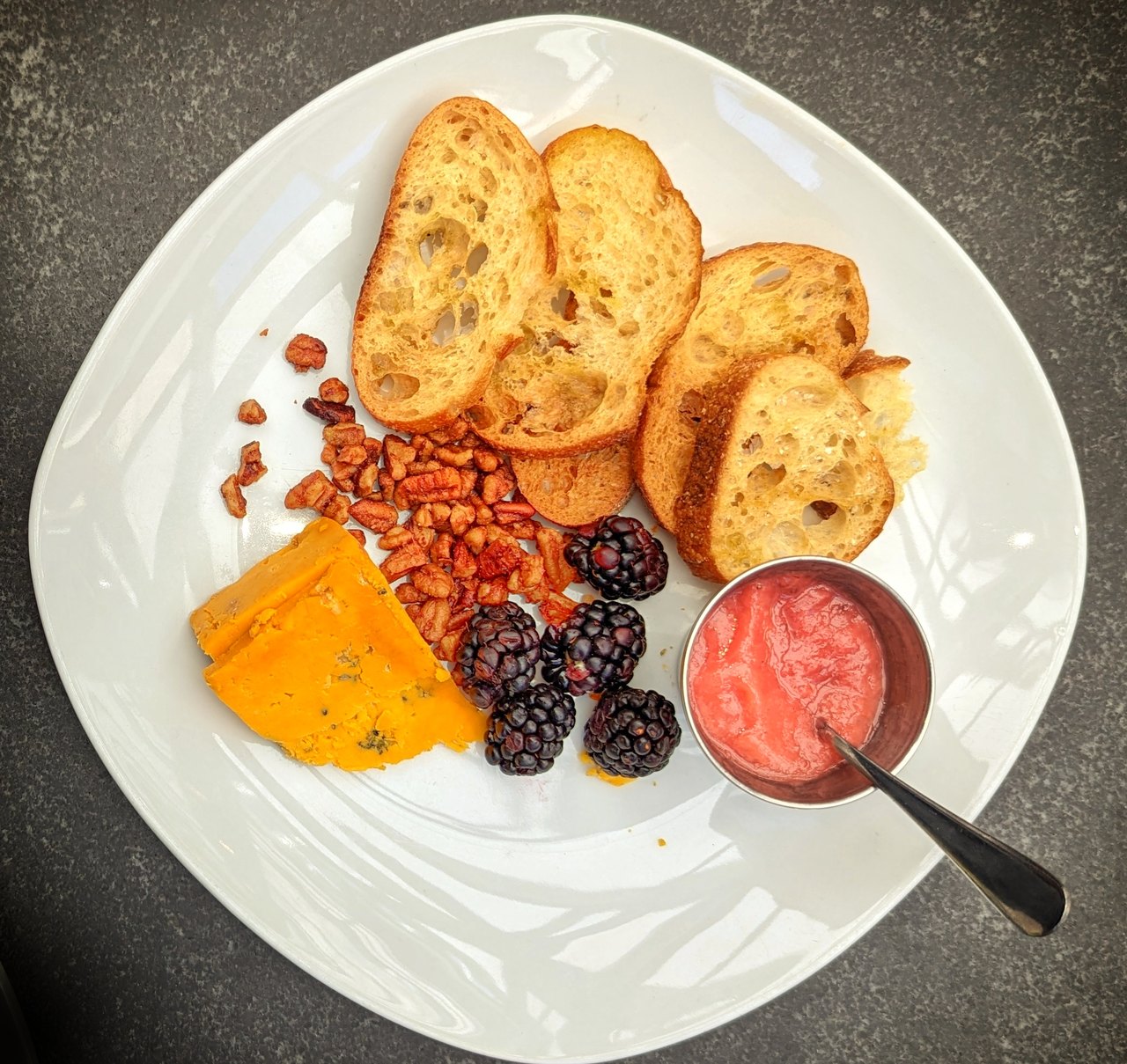
Visual AidThe food behind a school legend
Photograph taken in April 2024 of a wedge of Shropshire Blue served on a plate. The Knowledge Bank explains that a dare turns a crowd’s attention into pressure, and that the Cheese Touch works because nobody wants the touch, so everyone flees and blames. Here is the same substance in the opposite setting. The blue veins are a mold grown on purpose, and the cheese is served, admired and eaten. What made the school version unthinkable was never the cheese; it was the crowd.
Shropshire Blue cheese, April 2024; photograph by Daderot, released under CC0. Source: Wikimedia Commons, CC0.
substituten.May
A person who fills in for someone else
“Greg’s joke plan needed a substitute — any substitute but this one.”
confrontv.May
To face someone directly about a problem
“Greg decides to confront Rowley about the comic strip.”
witnessn.May
A person who sees an event happen
“Every witness at the fight also saw what the teenagers did.”
allergicadj.Jun.
Made sick by a particular thing
“Greg claims he is allergic to dairy, brilliantly.”
sacrificen.Jun.
Giving up something valuable for someone else
“Taking the Cheese Touch was a genuine sacrifice.”
reconcilev.Jun.
To become friends again after a quarrel
“One shared secret helps the boys reconcile.”
furiousadj.May
Extremely angry
“Greg is furious that Zoo-Wee-Mama runs without his name.”
rumorn.Jun.
A story passed around that may not be true
“By lunch, the rumor about the missing Cheese had ten versions.”
permanentadj.Jun.
Lasting forever; impossible to undo
“A yearbook title is permanent, which is exactly why Greg wanted one.”
triumphn.Jun.
A great victory or its joyful feeling
“Rowley’s triumph fills the Class Favorites page.”
ⓘ The vocabulary words in this list are selected to help you understand and complete this workbook. Some may not appear verbatim in the original novel.
🧠Knowledge Bank question
1According to the Knowledge Bank, conformity is the pull to ___.May
2To ‘confront’ someone is to secretly avoid them.May
3Giving up something valuable for someone else is a ___.Jun.
4If you are ‘allergic’ to something, it makes you sick.Jun.
5Fill in each blank with the correct word.May–Jun.
Word choices:reconcilefuriouswitnesstriumph- some words will not be used
The shared secret helped the two boys .
Greg was when the strip ran without his name.
6A story passed around that may not be true is a ___.Jun.
7Something ‘permanent’ can easily be undone next week.Jun.
8A person who sees an event happen is a ___.May
9Fill in the blanks with the correct words.May–Jun.
Word choices:substituteallergicsacrificerumor- some words will not be used
Greg escaped the Cheese by claiming he was to dairy.
The teacher that day was Greg’s own mother.
10A great victory, or the joyful feeling of one, is a ___.Jun.
Part 2
Comprehension
Show you understood what happens in May – June.
🧠Knowledge Bank · The Big Idea Under the Jokes
Reading Skill · Finding the ThemeA theme is the deeper idea a whole book is quietly arguing, the lesson that outlasts any single joke or scene. Finding it means stepping back from the events to ask what they add up to. Across the year, one idea keeps surfacing through Greg’s schemes: that chasing status at a friend’s expense leaves a person emptier than before. The ending sharpens the point, when a single unselfish act finally does what all his plotting could not. To locate a theme, notice which questions the story returns to again and again — here, questions of loyalty, honesty, and what popularity is really worth. A theme is rarely stated outright; you assemble it from the pattern of choices and their results. Reading for theme turns a funny diary into something that quietly stays with you, because you carry off not just the events but the meaning folded into Greg’s whole ridiculous year.
🧠Knowledge Bank question
1The Knowledge Bank says you locate a theme by noticing which questions ___.May
2What makes Rowley suddenly famous at school?May
3A crowd gathers expecting Greg and Rowley to fight after school.May
4Who interrupts the almost-fight?May
5Write the numbers 1–5 in the boxes to show the correct order of the final events. Number 1 = what happens first.May–Jun.
The teenagers force Rowley to eat the Cheese.
Mom turns up as the substitute on joke day.
The yearbook names Rowley Class Clown.
Zoo-Wee-Mama runs as Rowley’s solo strip.
Greg tells the school he threw the Cheese away.
6The teenagers force both boys to eat the Cheese together.Jun.
7How does Greg avoid eating the Cheese?Jun.
8Why does Greg tell the school HE threw the Cheese away?Jun.
9Because of his claim, the Cheese Touch passes to Greg.Jun.
10How does the school year actually end for the two boys?Jun.
Part 3
Literary Elements
Understanding HOW and WHY Jeff Kinney tells the story across May – June.
🧠Knowledge Bank · How the Story Closes Its Loop
Author’s Craft · The Circular EndingNotice that the book ends where it nearly began, back at the moldy Cheese Touch that opened the school year. When a story deliberately returns to its starting image, that shape is called a circular structure, and it gives an otherwise rambling diary a satisfying sense of design. The recurring cheese is also a motif, an object that keeps reappearing until it gathers meaning, until it stands for the whole cruel game of blame and reputation Greg has been playing all year. By bringing the cheese back for the finale, Kinney lets a single silly prop carry the book’s biggest moment. The loop also invites comparison: measure the Greg of June against the Greg of September and you can see exactly how far he has, or has not, traveled. A good ending rarely just stops; it circles back and quietly hands the reader a way to weigh the whole journey.
Visual AidA story that comes back to its start
Diagram for the Knowledge Bank on circular structure. The four numbered stations run clockwise from the opening, through a year of schemes, to an ending that lands on the same object it began with. The Knowledge Bank says this shape gives a rambling diary a sense of design, and that the returning object becomes a motif. Notice the loop closes, which is what lets a reader measure September against June.
A circular story structure, as described in the Knowledge Bank. Drawn for Garden Heights Academy.
Full-circle structure
A story that ends by returning to its opening image — the Cheese, introduced in September, decides June.
Antihero
A main character without a hero’s virtues whom we root for anyway — Greg, all year long.
Redemption moment
One act that pays for a character’s failings — the Cheese Touch, taken on purpose.
🧠Knowledge Bank question
1According to the Knowledge Bank, a motif is an object that ___.Jun.
2Fill in the blank with the correct literary term.May–Jun.
Word choices:antiheroredemptionallegoryhaiku- some words will not be used
A flawed main character we root for anyway is an .
One act that pays for a character’s failings is a moment.
3Greg qualifies as an antihero because ___.May–Jun.
4Greg’s cheese lie is presented as the one unmistakably brave act of his year.Jun.
5Mom appearing as the substitute on joke day is the book’s final ___.May
6Rowley winning Class Clown — the title Greg schemed for — delivers the book’s verdict that ___.Jun.
7The final entries show Greg completely transformed, with no trace of his old self-spin.Jun.
8Fill in the blank with the correct literary term.Jun.
Word choices:circleladdermirrorbridge- some words will not be used
An ending that returns to the opening image is full- structure.
9By having Greg trash his yearbook AND keep his friend, Kinney ends on ___.Jun.
10The journal’s closing ‘hero’s version’ of events invites readers to ___.Jun.
Part 4
Think Deeper
Four deeper challenges — no single-word recall. Read, weigh the evidence, and reason it out.
🧠Knowledge Bank · A Good Deed With a Cost
Think Deeper · Sacrifice At the very end, Greg does something new: to spare Rowley from the crowd’s scorn, he claims the blame himself and lets everyone believe the worst about him. It is worth sitting with how strange and how fine this moment is. A true sacrifice means accepting a cost so that someone else does not have to, and for a boy who has spent a whole year dodging every cost, this is real growth. There is a twist, though: Greg’s good deed arrives wrapped in a lie, which the story refuses to tidy up. What matters is the direction of the choice — for once Greg puts a friend’s comfort above his own reputation, the very thing he has guarded all year. A single unselfish act cannot erase his flaws, but it can hint at the better person he is slowly, unevenly becoming, and that hope is the book’s quiet gift.
Think back over the ending. A classroom door opens on the worst possible substitute. A comic strip with one name under it makes the whole school laugh. Two ex-friends square up in a ring of chanting kids — until a truck rolls up carrying October’s unfinished business, and a moldy slice on the blacktop finds its final victim. The next day the Cheese is gone, and a boy who spent a year guarding his own image hands it away in one sentence: I threw it away. The crowd steps back from him. His best friend steps toward him. The yearbook, when it comes, spells the wrong boy’s name under Class Clown — or exactly the right one.
Original passage written for Garden Heights — not a quotation from the novel.
1Claim: “Greg’s cheese lie was a genuine sacrifice, not another scheme.” — choose the two details that best prove it.Claim & Evidence
2The Greg of September–May, or The Greg at the blacktop in June? Tap each detail to sort it — tap again to switch sides. You can keep tapping to change your answer.Sort into two
◄ The Greg of September–MayThe Greg at the blacktop in June ►
3Match each cause to its result. For each cause, pick its result.Cause & Effect
Mom walks in as the substitute teacher→
Zoo-Wee-Mama runs as a solo strip→
The Halloween teenagers spot the boys→
Greg announces that he threw the Cheese away→
🧠Knowledge Bank question
4Fill both blanks to complete the reasoning.Build the Argument
The Knowledge Bank says a true sacrifice means accepting a cost , and it admits Greg’s good deed arrives .
Part 5
Standardized Test
Reading passage · The Secret Life of Cheese · SAT & TOEFL-style practice
Read the passage — the highlighted words are tested — then answer. Tap an answer, then tap it again to confirm.
SATCentral Ideas — the passage's main point
SATWords in Context — a word's meaning in this passage
SATDetail — a fact stated in the passage
SATText Connections — how two parts of the text relate
TOEFLVocabulary — a tested word's meaning here
TOEFLFactual Information — a fact stated in the passage
TOEFLSentence Simplification — the shorter sentence that keeps the meaning
TOEFLInsert Text — where a sentence best fits
How Bacteria Turn Milk Into Cheese
Every cheese begins as ordinary milk, and then the microbes move in. Cheesemakers add carefully chosen bacteria that begin a permanent change in the milk: they turn its sugar into acid, thickening liquid into curd, and then keep working for months as the young wheels rest on shelves. Different microbes build different cheeses; one kind blows the bubbles that become the holes in Swiss, another weaves the blue veins through blue cheese. Even a cheese’s famous smell is microbial handiwork, because as bacteria break down proteins and fats they release powerful odor compounds. The stink, in other words, is not spoilage. It is a signature.
Most of this microbial city is safe, delicious even, while the cheese is cared for. Abandon a slice outdoors, though, and the guest list changes: wild molds and bacteria from the air and ground move in, weather cracks the surface, and within weeks the slice becomes a thriving laboratory no scientist would taste. A slice left on a school blacktop for an entire year would be less a food than a small ecosystem. Middle schoolers, it turns out, built a whole rumor on sound instincts: you really, truly should not touch it.
Original passage written for Garden Heights — not a quotation from the novel.
1What is the main idea of the passage?SAT · Central Ideas
2In the passage, a permanent change is one that ___.SAT · Words in Context
3In the passage, microbes are ___.TOEFL · Vocabulary
4According to the passage, the holes in Swiss cheese are made by ___.TOEFL · Factual Information
5The passage says some washed-rind cheeses share an odor compound with ___.SAT · Detail
6The line ‘the stink…is a signature’ means the smell ___.TOEFL · Sentence Simplification
7In the passage, a rumor is ___.SAT · Words in Context
8According to paragraph 2, what changes when a slice is abandoned outdoors?TOEFL · Factual Information
9The passage says the middle schoolers’ legend rests on ‘sound instincts’ because ___.SAT · Text Connections
10Insert Text (TOEFL). Look at the four squares [1]–[4] in the excerpt below. They show where this sentence could be added: “That resting stage is called ripening, and it can last from a few weeks to several years.”
Cheesemakers add carefully chosen bacteria to fresh milk to begin the change. [1] The young wheels are then set on shelves to rest while the microbes keep working. [2] During this long wait, flavors deepen and each cheese develops its own character. [3] Only when the maker judges the taste complete does the cheese finally go to market. [4]
Where would the sentence fit best?TOEFL · Insert Text
Part 6 · Optional
Creative Writing
A bonus challenge to practice your English. Take your time and have fun with it.
About This Section
This writing task is optional and is not part of your auto-graded score. The feedback below checks only the basics — length, spelling, and grammar — not whether your ideas are right or wrong. It is meant for classroom discussion and creative practice, so feel free to use your imagination!
Writing Task — Part 8 “The Whole Story, Both Versions”
Greg’s journal ends with a hero’s version of the cheese affair. Now write the SAME event twice. First, tell a small real moment from your life the way Greg would — spinning yourself as the hero (3–5 sentences). Then tell it again the way an honest witness would (3–5 sentences). End with one line: which version was more fun to write — and which one is truer?
You can start with: “Version one, as told by the hero of this story, begins like this...”
0 / 40 words minimum
🗣 Teach It · Just for Fun (optional)
No right or wrong — tell someone nearby what happened in this part. Can’t find anyone? Tell yourself out loud. The moment you teach it, you truly understand it.
Part 8 Complete — You Finished the Book! 🎉
You finished May – June — the final part of Diary of a Wimpy Kid.
Here are your auto-graded results:
-
points out of 100
Teach it to someone
The best last step is to teach it. In your own words, explain what happened — retell a favorite scene, teach a character’s big choice, or sum up the main idea for a parent, friend, or classmate. When you can teach it clearly, you truly own it.
Independent study guide by Garden Heights. Not affiliated with or endorsed by Jeff Kinney. Contains original analysis only; no text from the novel is reproduced. Reference text: This workbook follows Jeff Kinney’s classic text (the standard Puffin edition sold worldwide). Revised 2023 UK editions change some wording and may not match the vocabulary studied here.
SAT® is a registered trademark of College Board, which is not affiliated with, and does not endorse, these materials. TOEFL® is a registered trademark of ETS. These materials are not endorsed or approved by ETS. Garden Heights is an independent provider of test-style reading practice.