New here? Just sign up with Google — your account includes Matilda, our gift book, forever.
The Miraculous Journey of Edward Tulane · Garden Heights
Part 2
for The Miraculous Journey of Edward Tulane · Part 2 · Chapters 5–8
8 Parts40 min
What Happens in Part 2
The great ship sails, and Edward — in his best traveling clothes — surveys the deck with his usual satisfaction. It does not last. Two rough boys snatch him up for a game, mocking his fine suit, tossing him higher and higher, until one wild throw sends the china rabbit over the railing. Abilene’s scream is the last sound of his old life. Edward plunges into the Atlantic and begins to descend, down and down through the darkening water, until he settles face-up on the seabed — and there, in the cold and the dark, the rabbit who felt nothing feels something at last. It is genuine, and it is fear. Day after day passes over him; currents nudge him; his gold watch keeps no time that matters anymore. Then, after nearly three hundred days, a great storm churns the deep, hurls him off the bottom, spins him — and a fisherman’s net hauls him up, astonished, into the light.
What We Will Learn
Section
What you will practice
Vocabulary
Words of the deep: deck, plunge, descend, seabed, current, haul…
Literary Elements
Symbol, mood, and the beginning of change
Cross-Curricular
The age of the great ocean liners, and what lives and moves on the sea floor
Chapter Summary
Ch.
What happens
5
At Sea — the voyage begins; Edward, elegantly dressed, admires the deck and himself.
6
The Game — two rough boys toss Edward for sport; one throw clears the railing; Abilene screams.
7
Down — the long descent; face-up on the seabed, Edward feels his first genuine emotion: fear.
8
The Storm and the Net — after nearly 300 days, a storm stirs the deep and a fishing net hauls him into the light.
Part 1
Vocabulary
Study 10 key words from Chapters 5–8, then answer each question.
🧠Knowledge Bank · Floating Cities at Sea
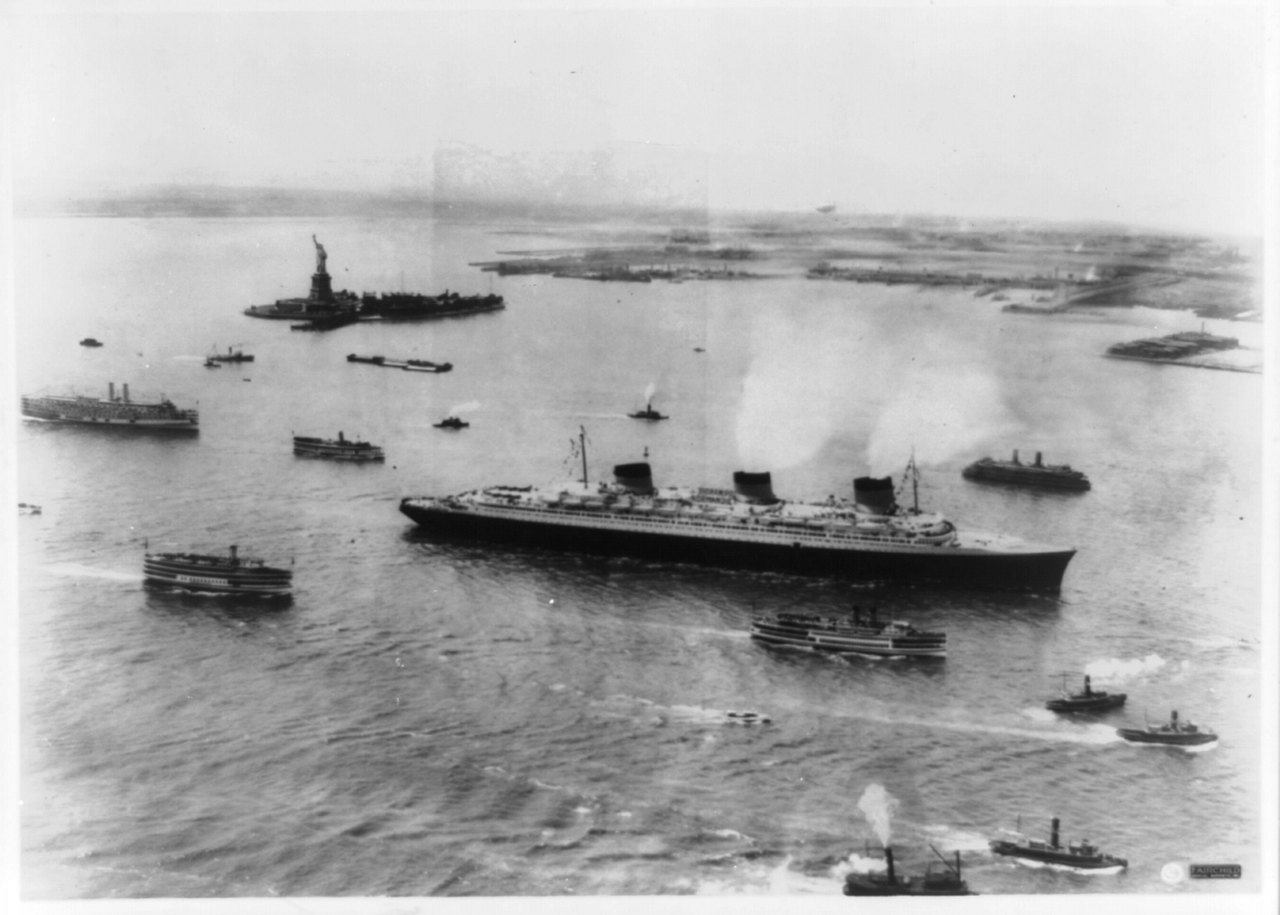
History · The Great Ocean LinersThe Tulane family sails on a grand ocean liner, the kind of ship that ruled the seas in the 1930s. These liners were like floating cities: they carried hundreds of passengers across the Atlantic with dining rooms, music, and long decks for strolling high above the waves. Crossing the ocean took days, so the ship became a small world of its own, far from any land. That is why Edward’s fall is so frightening — once he slips over the rail, there is nothing but water for miles in every direction. Understanding how vast and lonely the open sea could be helps you feel the terror of that plunge. A ship may be enormous, yet the ocean around it is endlessly deeper.
Visual AidA floating city comes into harbor
Aerial photograph of the French liner Normandie arriving in New York Harbor in the 1930s, with tugboats crowding around her and the Statue of Liberty at the upper left. The Knowledge Bank explains that liners like this were floating cities carrying hundreds of passengers across the Atlantic, with dining rooms, music, and long decks high above the waves, and that once a thing slips over the rail there is nothing but water for miles. Compare the ship with the tugs beside her, and then look at the open water beyond. This is a real ship, not the one in the story, and no rabbit fell from it. Notice how small even a giant looks against the sea.
SS Normandie arriving in New York Harbor, 1930s; Fairchild Aerial Surveys, Library of Congress Prints and Photographs Division. Source: Wikimedia Commons, public domain.
deckn.Ch.5
A floor of a ship, open to the sky
“Edward surveyed the deck with satisfaction.”
railingn.Ch.6
A protective fence at an edge
“One wild throw cleared the railing.”
plungev.Ch.6
To fall or dive suddenly downward
“The rabbit plunged into the Atlantic.”
descendv.Ch.7
To move downward
“He descended through the darkening water.”
seabedn.Ch.7
The floor of the ocean
“He settled face-up on the seabed.”
genuineadj.Ch.7
Real; truly felt
“His first genuine emotion was fear.”
currentn.Ch.7–8
Water moving within the sea
“Slow currents nudged him in the dark.”
hurlv.Ch.8
To throw with great force
“The storm hurled him off the bottom.”
driftv.Ch.7–8
To be carried along by water or air
“He drifted where the water willed.”
haulv.Ch.8
To pull with steady effort
“The net hauled him up into the light.”
ⓘ The vocabulary words in this list are selected to help you understand and complete this workbook. Some may not appear verbatim in the original novel.
🧠Knowledge Bank question
1According to the Knowledge Bank, Edward's fall is frightening because ___.Ch.5
2To ‘plunge’ means to fall or dive suddenly downward.Ch.6
3The floor of the ocean is called the ___.Ch.7
4A ‘genuine’ feeling is a fake, pretended one.Ch.7
5Fill in each blank with the correct word.Ch.6–7
Word choices:descendrailingcurrentdeck- some words will not be used
The throw carried him over the .
He began to through the dark water.
6Water moving within the sea is a ___.Ch.7–8
7To ‘haul’ something is to pull it with steady effort.Ch.8
8To throw something with great force is to ___ it.Ch.8
9Fill in the blanks with the correct words.Ch.7–8
Word choices:hauldriftgenuineplunge- some words will not be used
He could only where the water willed.
At last a net began to him upward.
10To move downward is to ___.Ch.7
Part 2
Comprehension
Show you understood what happens in Chapters 5–8.
🧠Knowledge Bank · When Fear Has No Words
Reading Skill · Inferring FeelingsEdward is a toy; he cannot cry out or make a face. So how do we know he is terrified as he sinks? We infer it — we gather the clues the author gives and add them up ourselves. The rushing water, the sinking down and down, the sudden dark: DiCamillo shows us the scene and trusts us to feel the fear underneath. To infer is to become a kind of detective of feelings, reading what is shown rather than waiting to be told. This is a powerful skill, because the strongest emotions in life are often the ones no one announces aloud. Watch closely here, for this is the moment a cold china heart feels its very first true feeling.
Visual AidReading a fear that has no words
Diagram for the Knowledge Bank on inferring feelings. The three clue boxes are the three details the Knowledge Bank names, the rushing water, the sinking, the sudden dark; the arrows carry them to the feeling a reader adds up from them. It does not quote the book. Notice that no clue says the word fear — that word is yours, which is what inferring means.
Clues named in the Knowledge Bank. Drawn for Garden Heights Academy.
🧠Knowledge Bank question
1The Knowledge Bank says we know Edward is terrified because ___.Ch.6
2What are the boys doing with Edward before the fall?Ch.6
3Abilene watches helplessly as Edward goes over the side.Ch.6
4Where does Edward finally come to rest?Ch.7
5Write the numbers 1–5 in the boxes to show the correct order of events in Chapters 5–8. Number 1 = what happens first.Ch.5–8
A storm stirs the deep, and a net hauls him up.
Two rough boys seize Edward for a tossing game.
A wild throw sends the rabbit over the railing.
On the seabed, Edward feels his first true fear.
The voyage begins; Edward admires the deck.
6Edward’s first genuine emotion, on the seabed, is joy.Ch.7
7About how long does Edward lie on the ocean floor?Ch.7–8
8What finally moves Edward off the seabed?Ch.8
9Edward is brought back to the surface by a fisherman’s net.Ch.8
10What does Edward’s gold pocket watch measure on the seabed?Ch.7–8
Part 3
Literary Elements
Understanding HOW and WHY Kate DiCamillo tells the story across Chapters 5–8.
🧠Knowledge Bank · The Meaning of the Deep
Literary Craft · SymbolismThe ocean floor where Edward lands is more than a setting; it works as a symbol. A symbol is an object or place that stands for a bigger idea. Sunk in the cold dark for many long days, Edward is as low and lost as a creature can be — and that watery depth mirrors how far he has fallen from his cozy, pampered life. Because he can no longer move or be admired, he is finally forced to think and to feel. So the bottom of the sea becomes the strange beginning of his growth: sometimes a person must reach the lowest place before the heart can start to rise. The deep water quietly stands for both a great loss and a hidden chance.
Symbol
An event carrying meaning — the vain rabbit’s fall to the seabed is pride brought low, literally.
Mood
The scene’s emotional weather — from sunlit deck to cold black floor, dimmed chapter by chapter.
Character Change
Growth’s first crack — fear, the first genuine feeling a china heart has ever held.
🧠Knowledge Bank question
1According to the Knowledge Bank, the ocean floor stands for ___.Ch.6–7
2Fill in the blank with the correct literary term.Ch.5–7
Word choices:moodsymboldialoguepacing- some words will not be used
The darkening emotional weather of these chapters is the .
The fall itself, heavy with meaning, is a .
3Why is it important that Edward’s FIRST feeling is fear rather than love?Ch.7
4DiCamillo dims the story’s mood step by step — deck, water, seabed.Ch.5–7
5The rough boys serve the story mainly as ___.Ch.6
6Edward landing FACE-UP — eyes toward the light he cannot reach — is an image of ___.Ch.7
7A story’s mood can be built from light, temperature, and depth.Ch.5–7
8Fill in the blank with the correct literary term.Ch.7
Word choices:character changemoodironytheme- some words will not be used
Fear cracking open a heart that felt nothing is the start of .
9The storm that finally moves Edward — violent, blind, impersonal — suggests the journey’s help will come ___.Ch.8
10Ending the part with a net hauling Edward into the light gives the fall’s symbol its answer: ___.Ch.8
Part 4
Think Deeper
Four deeper challenges — no single-word recall. Read, weigh the evidence, and reason it out.
🧠Knowledge Bank · How Suffering Opens a Heart
Social-Emotional · Loss & the First FeelingFor the first time, Edward is afraid, and something surprising happens: feeling that fear is the start of him becoming truly alive inside. When everything was easy, he never needed to feel much at all. But loss — losing Abilene, losing the light, losing his safe place — cracks his hard china calm and lets real emotion in. This is a tender truth the book offers gently: the hard moments in a life are often the ones that teach the heart to feel. It does not mean suffering is good; it means we can grow from it. As you read, notice that Edward’s pain is not the end of his story but the very door through which his long journey toward love finally opens.
Think back over the fall. A rabbit in his best suit admires a floating city; rough hands make him a plaything — his first taste of being handled without love. Then the rail, the scream, the plunge. Ten months in the cold dark, a stopped watch, and one new tenant in the china chest: fear. When the storm finally throws him to the net, the rabbit who rises is not quite the one who fell.
Original passage written for Garden Heights — not a quotation from the novel.
1Claim: “The seabed gives Edward the beginning of a real heart.” — choose the two details that best prove it.Claim & Evidence
2Life on Egypt Street, or Life on the seabed? Tap each detail to sort it — tap again to switch sides. You can keep tapping to change your answer.Sort into two
◄ Life on Egypt StreetLife on the seabed ►
3Match each cause to its result. For each cause, pick its result.Cause & Effect
Rough boys want a game on a dull voyage→
One throw carries too much force→
China sinks and cannot swim or call→
A great storm churns the deep water→
🧠Knowledge Bank question
4Fill both blanks to complete the reasoning.Build the Argument
The Knowledge Bank says feeling fear is the start of Edward becoming , which means that .
Part 5
Standardized Test
Floating Cities: The Great Liners · SAT & TOEFL-style practice
Read the passage — the highlighted words are tested — then answer. Tap an answer, then tap it again to confirm.
SATDetail — a fact stated in the passage
SATWords in Context — a word's meaning in this passage
SATText Connections — how two parts of the text relate
TOEFLVocabulary — a tested word's meaning here
TOEFLFactual Information — a fact stated in the passage
TOEFLProse Summary — the three sentences that sum it up
Life Aboard a Great Ocean Liner
Before airplanes crossed oceans, the only road to another continent was the sea — and its kings were the great ocean liners. A liner was a floating city: a fifth of a mile (about 320 meters) of steel, smoking funnels, ballrooms, barbershops, and decks stacked like streets, carrying two thousand passengers and a thousand crew. An Atlantic crossing took about five days, and the great ships kept to their schedules through storm and fog, which is how they earned their name: they ran their 'line' like trains of the sea. Life aboard sorted itself by ticket. First-class passengers dressed formally for dinner, promenaded on the upper decks, and traveled with trunks of clothing — even, sometimes, with beloved toys in traveling wardrobes of their own. Children of every class, though, shared one truth: five days is a long time at sea, and games on deck could turn wild. In that era, more than one treasure went over a railing — and the Atlantic, three kilometers (1.9 miles) deep in places, kept nearly everything it was given.
Original passage written for Garden Heights — not a quotation from the novel.
1In the passage, an ocean “liner” was ___.TOEFL · Vocabulary
2About how long did an Atlantic crossing take?TOEFL · Factual Information
3Why were the great ships called ‘liners’?SAT · Detail
4In the passage, a deck is ___.SAT · Words in Context
5How did first-class passengers live aboard?TOEFL · Factual Information
6What truth did children of every class share?SAT · Detail
7In the passage, a treasure that went over a railing fell ___.TOEFL · Vocabulary
8What does the passage say about things dropped into the Atlantic?TOEFL · Factual Information
9How does the passage connect to Chapters 5–8?SAT · Text Connections
10Prose Summary (TOEFL).The passage describes the great ocean liners and life aboard them. This TOEFL task lists six sentences; choose the THREE that best capture the passage’s main ideas. The other three do not belong — they state minor details or ideas the passage does not present.TOEFL · Prose Summary
Part 6 · Optional
Creative Writing
A bonus challenge to practice your English. Take your time and have fun with it.
About This Section
This writing task is optional and is not part of your auto-graded score. The feedback below checks only the basics — length, spelling, and grammar — not whether your ideas are right or wrong. It is meant for classroom discussion and creative practice, so feel free to use your imagination!
Writing Task — Part 2 “Diary from the Deep”
Edward waits on the seabed for nearly three hundred days. Write three short diary entries from something lost underwater — a toy, a coin, a message in a bottle: one from the day it sank, one from the long middle, one from the day everything changed. Write at least 40 words.
You can start with: “Day 1: The light up there is smaller than it should be…”
0 / 40 words minimum
🗣 Teach It · Just for Fun (optional)
No right or wrong — close the screen and tell someone nearby what happened in this part. Can’t find anyone? Tell yourself out loud. The moment you teach it, you truly understand it.
Part 2 Complete!
You finished Chapters 5–8 of The Miraculous Journey of Edward Tulane.
Here are your auto-graded results:
-
points out of 100
Teach it to someone
The best last step is to teach it. In your own words, explain what happened — retell a favorite scene, teach a character’s big choice, or sum up the main idea for a parent, friend, or classmate. When you can teach it clearly, you truly own it.
Independent study guide by Garden Heights. Not affiliated with or endorsed by Kate DiCamillo. Contains original analysis only; no text from the novel is reproduced. Reference text: This workbook follows Kate DiCamillo’s classic text (the standard Puffin edition sold worldwide). Revised 2023 UK editions change some wording and may not match the vocabulary studied here.
SAT® is a registered trademark of College Board, which is not affiliated with, and does not endorse, these materials. TOEFL® is a registered trademark of ETS. These materials are not endorsed or approved by ETS. Garden Heights is an independent provider of test-style reading practice.