New here? Just sign up with Google — your account includes Matilda, our gift book, forever.
Elmer and the Dragon · Garden Heights Academy
Part 4
for Elmer and the Dragon · Part 4 · Chapters 5
a novel by Ruth Stiles Gannett
30 min5 Parts
This workbook is built on a solid pedagogical foundation, effectively integrating content and language learning based on the CLIL framework (Content and Language Integrated Learning), elevated by our unique 5th C — Connection — and an integrated Standardized Test section that weaves every SAT & TOEFL question type right into the novel, so learners build real test skills easily, naturally, and with fun.
What Happens in Part 4
As Elmer explores, a little yellow canary flutters up — and it is none other than Flute, Elmer’s own pet canary who once escaped from home! Flute explains that this is Feather Island, where all the escaped pet canaries of the world have gathered. But the birds are miserable: they suffer from a strange “deadly curiosity” about a secret no one can solve, and they are too worried even to sing. Kind Elmer offers to help his old friend and the unhappy canaries.
What We Will Learn
Focus
What It Means
Animals (Birds)
Canaries as pets and famous singers
Character
The old friendship between Elmer and Flute
Plot
The mystery that troubles the canaries
Chapter Summary
Chapter
Key Events
Ch.5
Elmer meets his escaped pet canary, Flute, who explains this is Feather Island; the canaries suffer from a deadly curiosity, and Elmer offers to help
💭 Before You Read · Warm-Up (not scored)
There are no wrong answers here — just think, guess, and talk:
Elmer’s own lost pet turns up on a faraway island. Have you ever met someone or something familiar in a completely unexpected place? How did it feel?
The canaries are so troubled by an unsolved mystery that they can’t even sing. Can worrying about a question really steal your happiness? When?
Predict: what secret could be so troubling that a whole island of birds falls silent over it?
Copyright Notice
This is an independent study guide created by Garden Heights Academy to support reading comprehension and literary analysis. It contains original analysis questions and does not reproduce any text from the novel. Elmer and the Dragon is a work by Ruth Stiles Gannett. This guide is not affiliated with, authorized by, or endorsed by the author or any associated rights holders. Students should read the original book, available from libraries and booksellers.
Part 1
Vocabulary
Study 10 key words from Chapters 5, then answer each question.
🧠Knowledge Bank · Why Canaries Sing
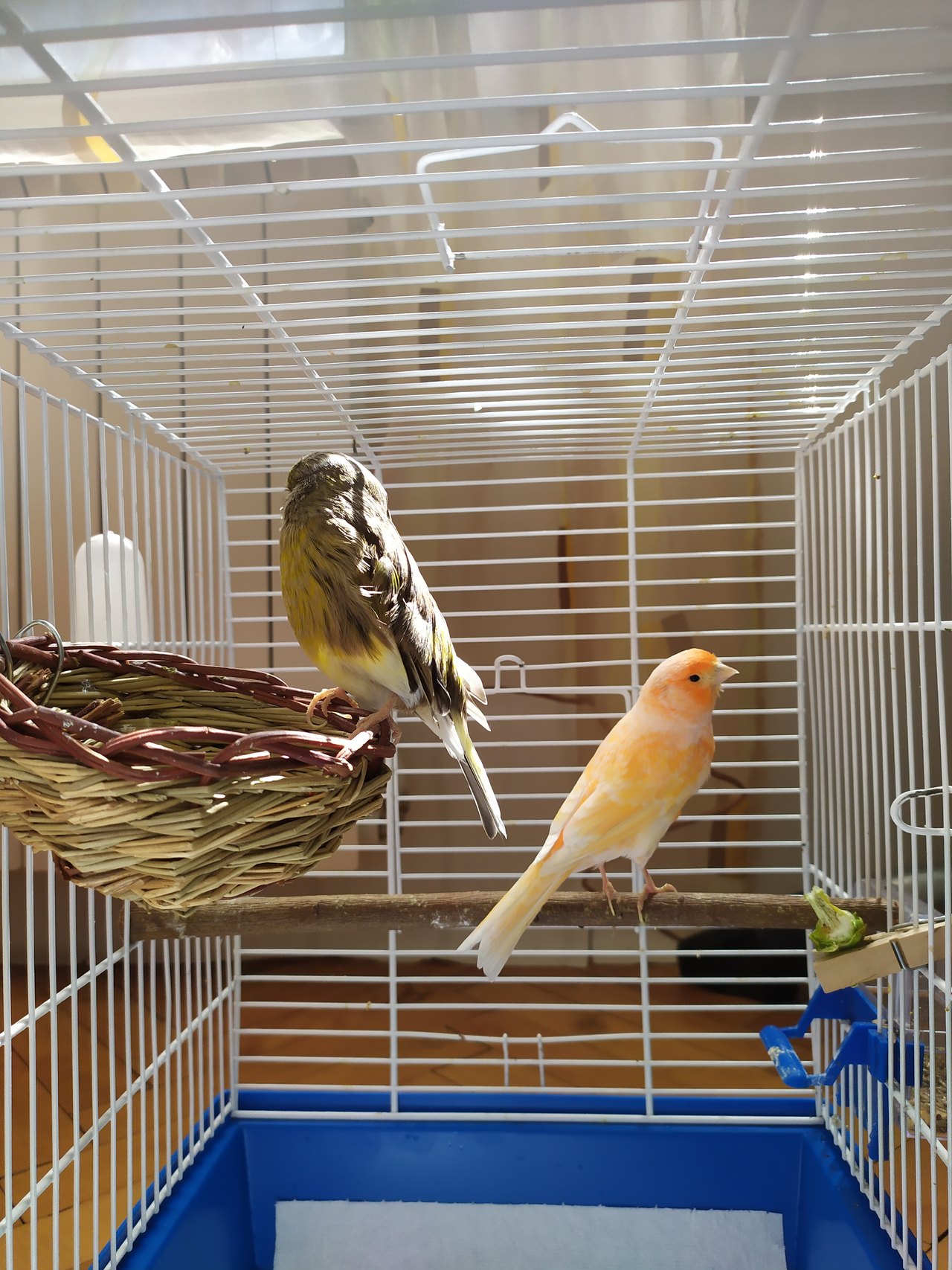
Ornithology · BirdsongThe canaries never stop singing, and real canaries are champion singers too. In the wild, it is mostly the male canary that sings. His song can say this spot is mine or call to a mate. Each bird has its own tune, and young canaries actually learn their songs by listening, a little like children learning to talk. People have kept singing canaries in homes for hundreds of years to enjoy the music. Miners once carried them underground for a different reason — the birds’ sharp senses warned of bad air. Behind every trill lies a real and useful bird song.
Visual AidTwo canaries, and one of them singing
Photograph taken in April 2021 of two kept canaries in a cage, one brown and streaked, the other pale yellow. The Knowledge Bank explains that in the wild it is mostly the male canary that sings, that his song can mean this spot is mine or can call to a mate, and that each bird has its own tune which young canaries learn by listening. The two colors here show how much variety humans have bred into the same species. These are somebody’s pet birds and are not the canaries of the story.
Two canaries (Serinus canaria), April 2021; photograph by Yavor Momchilov Uzunov, released under CC0. Source: Wikimedia Commons, CC0.
canaryn.Ch.5
A small yellow songbird often kept as a pet
“A bright canary landed on Elmer’s hand.”
escapev.Ch.5
To get free from a place
“Flute had escaped from his cage long ago.”
flutterv.Ch.5
To fly with quick, light wing-beats
“The little bird fluttered down to Elmer.”
recognizev.Ch.5
To know someone from before
“Elmer recognized his old pet at once.”
miserableadj.Ch.5
Very unhappy
“The silent canaries looked miserable.”
volunteerv.Ch.5
To offer to help without being asked
“Elmer volunteered to help the birds.”
perchv.Ch.5
To sit or rest on something high
“Flute perched on a branch nearby.”
anxiousadj.Ch.5
Worried and uneasy
“The anxious birds could not sing.”
flockn.Ch.5
A group of birds
“A whole flock of canaries lived there.”
reunitev.Ch.5
To bring together again
“The friends were happy to reunite.”
ⓘ The vocabulary words in this list are selected to help you understand and complete this workbook. Some may not appear verbatim in the original novel.
🧠Knowledge Bank question
1According to the Knowledge Bank, in the wild it is mostly the male canary that ___.Ch.5
2True or False: To “escape” means to get free from a place.Ch.5
3To “flutter” means to ___.Ch.5
4True or False: To “recognize” someone means to meet them for the very first time.Ch.5
5Fill in each blank with the correct word.Ch.5
Word choices:recognizemiserablevolunteerflock- some words will not be used
Elmer was quick to Flute, and seeing the birds so , he wanted to help.
6True or False: Someone who is “anxious” is calm and carefree.Ch.5
7To “volunteer” means to ___.Ch.5
8True or False: A “flock” is a group of birds.Ch.5
9Fill in the blanks with the correct words.Ch.5
Word choices:perchreuniteescapeanxious- some words will not be used
Flute flew down to beside Elmer, glad to with his old friend.
10To bring together again is to ___.Ch.5
Part 2
Comprehension
How well do you understand Chapters 5?
🧠Knowledge Bank · Problems and Solutions
Reading Skill · Problem & SolutionMany stories follow a problem and its solution. First a problem appears; then someone works to fix it. Here the canaries carry a heavy problem that has troubled them for a very long time, and Elmer begins to look for a way to solve it. Strong readers spot this pattern and follow it. Ask yourself: what is the problem, who wants to solve it, and how might they do it? Watching a character move from trouble toward an answer keeps you turning pages. Try to guess the fix before it comes. One of reading’s great joys is following a big problem all the way to its solution.
Visual AidA problem, and someone who works at it
Diagram for the Knowledge Bank on problem and solution. Card 1 is the trouble the Knowledge Bank says the canaries have carried for a very long time, card 2 is the visitor beginning to look into it, and card 3 marks the solution as still ahead. It does not say what the solution is. Notice that the third card is empty of detail: at this point in the book, so is the reader.
Problem and solution as described in the Knowledge Bank. Drawn for Garden Heights Academy.
🧠Knowledge Bank question
1The Knowledge Bank says many stories follow a shape in which ___.Ch.5
2What is the name of the island, according to Flute?Ch.5
3Who lives on this island?Ch.5
4True or False: The canaries are suffering from a “deadly curiosity.”Ch.5
5Write the numbers 1–5 in the boxes to show the correct order of events in Part 4.Ch.5
He realizes the canary is Flute, his own escaped pet.
Flute explains the birds suffer from a deadly curiosity.
Flute tells Elmer this is Feather Island.
A little yellow canary flutters up to Elmer.
Elmer offers to help the unhappy canaries.
6True or False: The canaries are so worried that they cannot sing.Ch.5
7How does Elmer know this particular canary?Ch.5
8What does Elmer offer to do?Ch.5
9True or False: The canaries are perfectly happy and singing when Elmer arrives.Ch.5
10Fill in the blanks to complete the sentence.Ch.5
Word choices:FeathercuriosityWildsinging- some words will not be used
Flute said this was Island, where the birds suffered from a deadly .
Part 3
Literary Elements
Understanding HOW and WHY Ruth Stiles Gannett creates certain feelings across Chapters 5.
🧠Knowledge Bank · When Paths Cross by Chance
Literary Craft · CoincidenceSometimes stories use a coincidence — a surprising event that happens by chance, when two things line up at just the right time. Of all the islands in the wide sea, Elmer happens to land on this one, where his help is exactly what is needed. That lucky match is a coincidence. Writers use coincidences to bring characters together or to start a fresh adventure. A few surprises make a tale exciting. But notice that Elmer still must think and work; luck opens the door, yet cleverness carries him through. As you read, spot the moments where chance gives the plot a helpful little push.
📚 Literary Devices in This Part · definitions & examples
A coincidence is a surprising chance event, like the canary being Elmer’s own pet.Motivation is the reason a character acts — Elmer helps because Flute is his friend.The conflict is the problem of the story: the canaries’ unsolved, painful curiosity.
The questions below are mixed — not grouped by device. Decide which device each one is about.
🧠Knowledge Bank question
1According to the Knowledge Bank, a coincidence is ___.Ch.5
2A conflict is a struggle a character or group must face.Ch.5
3Fill in each blank with the correct word.Ch.5
Word choices:conflictproblemmoodsetting- some words will not be used
The canaries’ struggle with an unsolved secret is a
The secret they cannot solve is their big .
4The secret the canaries cannot solve is their —Ch.5
5A problem is a difficulty the characters must solve.Ch.5
6Fill in each blank with the correct word.Ch.5
Word choices:problemconflictmoodtheme- some words will not be used
The unsolved secret troubling the canaries is their
Their struggle over it is a .
7The canaries wrestling with their unsolved worry is a —Ch.5
8The difficulty the canaries face is their main —Ch.5
9Fill in each blank with the correct word.Ch.5
Word choices:conflictproblemmoodsetting- some words will not be used
The canaries’ struggle is a
Their unsolved secret is their .
10The canaries’ unsolved problem mainly makes the story feel —Ch.5
Part 4
Think Deeper
Four deeper challenges — no single-word recall. Read, weigh the evidence, and reason it through.
🧠Knowledge Bank · Helping Someone in Trouble
Social-Emotional · KindnessElmer could fly straight home, but instead he stops to help. That choice shows real kindness. The old canary king is worried and unwell, and Elmer listens and offers to help. Kindness often begins just this way — by noticing someone in trouble and choosing to care. It costs Elmer time, yet he gives it gladly, expecting nothing back. In your own days, small kind acts do the same quiet good: a helping hand, a patient ear, a friendly word. Helping a stranger simply because they need it is one of the warmest and bravest forms of kindness.
1Claim: “Elmer finds both a friend and a mystery on the island.” — choose the two details that best prove it.Claim & Evidence
2Advances the story’s friendship or mystery, or just a background fact? Tap each item to sort it — tap again to switch sides. You can keep tapping to change your answer.Sort into two
◄ Advances the storyJust a background fact ►
3Match each cause to its result. For each cause, pick its result.Cause & Effect
A yellow canary flutters up→
Flute once escaped from home→
All the escaped pets gather here→
The canaries seem troubled→
🧠Knowledge Bank question
4Fill both blanks to complete the reasoning.Build the Argument
The Knowledge Bank says Elmer’s choice to stop and help shows kindness because , and says kindness often begins with .
Part 5
Standardized Test
Inference & Author’s Purpose — SAT & TOEFL-style practice
Read the passage — the highlighted words are tested — then answer. Tap an answer, then tap it again to confirm.
SATWords in Context — a word's meaning in this passage
SATInference — a conclusion the passage implies
SATCentral Ideas — the passage's main point
TOEFLFactual Information — a fact stated in the passage
TOEFLInsert Text — where a sentence best fits
The Discomfort of an Unsolved Question
Have you ever been unable to stop thinking about a riddle, a locked box, or a story that stopped just before the ending? That restless feeling has a name: scientists call it the need for closure, the strong wish to finish a thought and settle an open question. Curiosity is usually a pleasant feeling that pulls us toward learning, but when a question cannot be answered, the same feeling can turn anxious and even miserable. Our brains seem to treat an unsolved puzzle almost like an itch that begs to be scratched. In careful experiments, people who were shown the start of a mystery, then stopped, remembered it far better than people who were given the whole answer; the open question kept nagging at them. This is why a good storyteller ends a chapter on a question, and why a whole island of canary birds might fall silent over a secret they cannot solve. Not knowing, it turns out, can be one of the most powerful feelings of all.
Original passage written for Garden Heights — not a quotation from the novel.
1What do scientists call the strong wish to finish a thought and settle a question?TOEFL · Factual Information
2In the passage, an anxious feeling is ___.SAT · Words in Context
3The passage suggests that an unanswered question feels —SAT · Inference
4When can curiosity turn “distressing”?TOEFL · Factual Information
5In the passage, a miserable feeling is ___.SAT · Words in Context
6In the experiments, who remembered the mystery better?TOEFL · Factual Information
7Why do storytellers end chapters on a question?SAT · Inference
8In the passage, a canary is ___.SAT · Words in Context
9Which sentence best states the main idea of the passage?SAT · Central Ideas
10Insert Text (TOEFL). Look at the four squares [1]–[4] in the excerpt below. They show where this sentence could be added: “That restless itch is the mind’s need for closure, its hunger to finish what was started.”
Our minds dislike loose ends. [1] An unfinished story nags at us for days. [2] A question left open keeps buzzing in the head. [3] We feel a strong pull to find the missing answer. [4]
Where would the sentence fit best?TOEFL · Insert Text
Part 6 · Optional
Creative Writing
A bonus challenge to practice your English. Take your time and have fun with it.
About This Section
This writing task is optional and is not part of your auto-graded score. The feedback below checks only the basics — length, spelling, and grammar — not whether your ideas are right or wrong. It is meant for classroom discussion and creative practice, so feel free to use your imagination!
Writing Task — Part 4 “An Old Friend”
Elmer is amazed to meet his old pet canary, Flute, far from home. Write about meeting an old friend or pet again after a long time. How would you feel, and what would you say? Or imagine your own pet had an adventure — where did it go? Write at least 40 words.
You can start with: “I could hardly believe my eyes when I saw…”
0 / 40 words minimum
🗣 Teach It · Just for Fun (optional)
No right or wrong — close the screen and tell someone nearby what happened in this part. Can’t find anyone? Tell yourself out loud. The moment you teach it, you truly understand it.
Part 4 Complete!
You finished Chapters 5 of Elmer and the Dragon.
Here are your auto-graded results:
-
points out of 100
Teach it to someone
The best last step is to teach it. In your own words, explain what happened — retell a favorite scene, teach a character’s big choice, or sum up the main idea for a parent, friend, or classmate. When you can teach it clearly, you truly own it.
Independent study guide by Garden Heights Academy. Not affiliated with or endorsed by the author or any rights holders. Contains original analysis only; no text from the novel is reproduced.
SAT® is a registered trademark of College Board, which is not affiliated with, and does not endorse, these materials. TOEFL® is a registered trademark of ETS. These materials are not endorsed or approved by ETS. Garden Heights is an independent provider of test-style reading practice.