New here? Just sign up with Google — your account includes Matilda, our gift book, forever.
Esperanza Rising · Garden Heights
Part 8
for Esperanza Rising · Part 8 · Las Uvas (Final) & Rising
8 Parts40 min
What Happens in Part 8
Miguel returns — and he has not stolen the money at all. He used it to travel all the way back to Mexico and bring Abuelita north himself, guiding the frail grandmother across the border and home to the camp. Esperanza’s fury melts into overwhelming joy: her grandmother is here, Mama is recovering, and the family she feared was breaking is whole again. On the morning of her fourteenth birthday, before the sun rises, Miguel leads Esperanza out to the foothills. There she lies down and presses her ear to the earth, just as Papa taught her long ago — and after everything, she can feel the land’s heartbeat again. She has climbed all the way up the mountain from the deepest valley of her life. Later she teaches little Isabel the same lesson, passing on Papa’s gift, and Abuelita takes up the zigzag blanket once more. Esperanza has learned what Abuelita always knew: do not be afraid to start over, for the mountain always follows the valley, and no one can steal the riches of family, love, and hope. The pampered girl of the first page has become, at last, the strong and generous young woman her name always promised: Esperanza — hope, risen.
The resolution, the returning motif, and the meaning of the title
Cross-Curricular
How readers find meaning through a story’s symbols
Chapter Summary
Ch.
What happens
Las Uvas (Final)
The Grapes Again — Miguel used the money to bring Abuelita from Mexico; the family is whole, Mama mends, and at dawn on her birthday Esperanza feels the land’s heartbeat once more — risen at last.
Part 1
Vocabulary
Study 10 key words from Las Uvas (Final) & Rising, then answer each question.
🧠Knowledge Bank · Words of Rising
Lexical Semantics · Words of Rising
Five words, and only the last one is a verb. A reunion is a joyful coming together again, which Abuelita’s arrival finally makes possible. A sacrifice is giving up something for another’s sake, and Miguel’s journey is one he never announces or asks credit for. Gratitude is a feeling of deep thankfulness, and it is what Esperanza’s anger becomes once she understands what he did with her money. Resilience is the ability to recover from hardship, and the zigzag blanket carries it in a pattern anyone can see across a room. To rise is to climb up to a higher place. Ryan saves the verb for last on purpose: the first four words name things that happen to Esperanza, and the fifth names the only one she has to choose for herself.
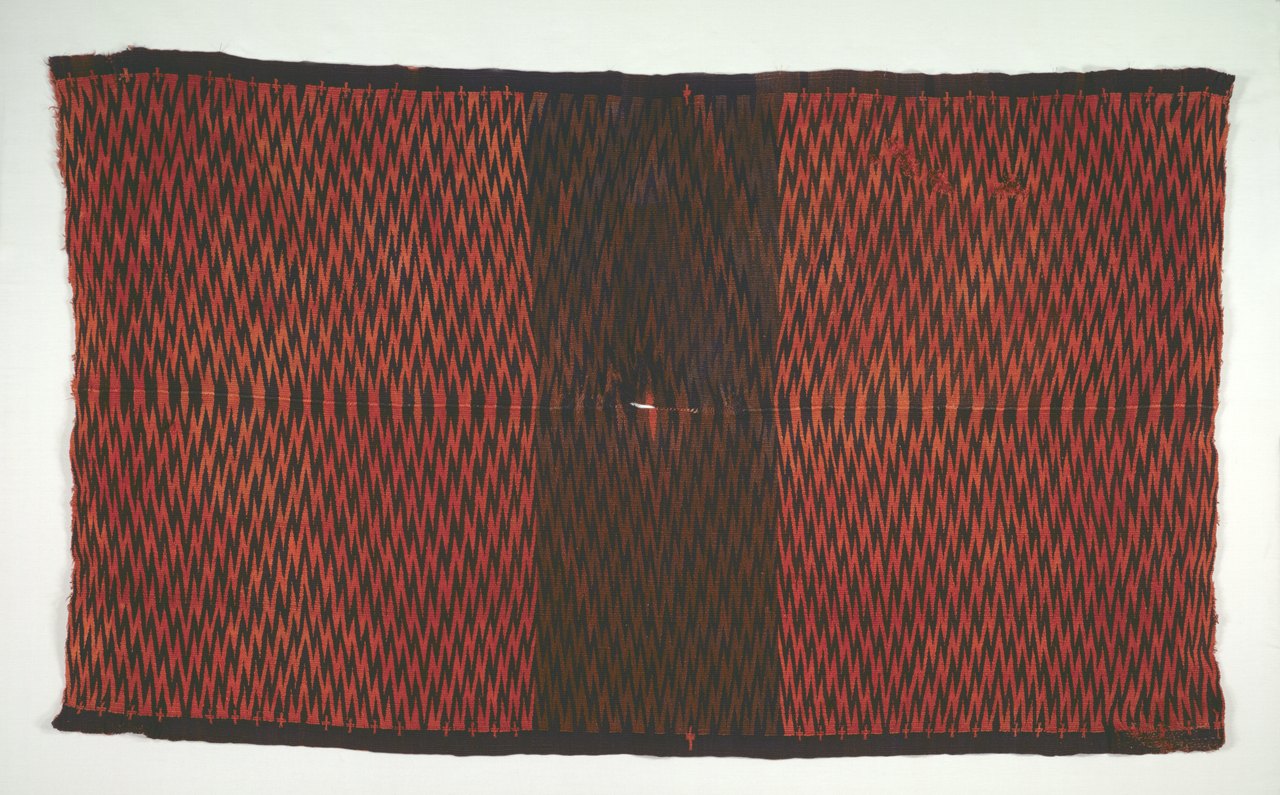
Visual AidA pattern you can read across a room
A Mexican woven blanket, or sarape, in the Saltillo style, its whole surface worked in zigzag bands. The Knowledge Bank explains that resilience is the ability to recover from hardship, and that the zigzag blanket carries that idea in a pattern anyone can see across a room. This is not Abuelita’s crochet blanket, which is invented; it is the real Mexican tradition her stripes come from. Follow one line of the zigzag from edge to edge. It never stops at the bottom of a valley.
Saltillo-style sarape, Mexico; Cleveland Museum of Art. Source: Wikimedia Commons, public domain.
reunionn.Las Uvas (Final)
A joyful coming together again
“Abuelita’s arrival brought a tearful reunion.”
sacrificen.Las Uvas (Final)
Giving up something for another’s sake
“Miguel’s journey was a quiet sacrifice.”
gratituden.Las Uvas (Final)
A feeling of deep thankfulness
“Her anger turned to gratitude.”
resiliencen.Las Uvas (Final)
The ability to recover from hardship
“The blanket is a symbol of resilience.”
risev.Las Uvas (Final)
To climb up to a higher place
“Esperanza learns that she can always rise again.”
frailadj.Las Uvas (Final)
Weak and easily harmed
“Miguel guided the frail Abuelita north.”
wholeadj.Las Uvas (Final)
Complete, with nothing missing
“At last the family felt whole again.”
dawnn.Las Uvas (Final)
The first light of morning
“They walked out before dawn.”
renewv.Las Uvas (Final)
To make new or begin again
“The heartbeat lesson renews her bond with the land.”
generousadj.Las Uvas (Final)
Kind and giving
“She has become strong and generous.”
ⓘ The vocabulary words in this list are selected to help you understand and complete this workbook. Some may not appear verbatim in the original novel.
🧠Knowledge Bank question
1According to the Knowledge Bank, what does Esperanza's anger become once she understands?Las Uvas (Final)
2A ‘sacrifice’ means keeping everything for yourself.Las Uvas (Final)
3A feeling of deep thankfulness is ___.Las Uvas (Final)
4‘Resilience’ is the ability to recover from hardship.Las Uvas (Final)
5Fill in each blank with the correct word.Las Uvas (Final)
Word choices:reunionsacrificedawnsneer- some words will not be used
Miguel’s long journey was a quiet .
Abuelita’s arrival brought a joyful .
6Someone ‘frail’ is ___.Las Uvas (Final)
7If a family feels ‘whole,’ something important is missing.Las Uvas (Final)
8‘Dawn’ is the ___.Las Uvas (Final)
9Fill in each blank with the correct word.Las Uvas (Final)
Word choices:resiliencerisegratitudefrail- some words will not be used
Esperanza learns that she can always again.
The blanket is a symbol of her .
10To ‘renew’ something is to ___.Las Uvas (Final)
Part 2
Comprehension
Show you understood what happens in Las Uvas (Final) & Rising.
🧠Knowledge Bank · The Rise
Narrative Causality · The Rise
The ending can be followed as a climax, a meaningful return, and a final closure rather than as isolated incidents. Miguel returns — and he has not stolen the money at all. He used it to travel all the way back to Mexico and bring Abuelita north himself, guiding the frail grandmother across the border and home to the camp. Esperanza’s fury melts into overwhelming joy: her grandmother is here, Mama is recovering, and the family she feared was breaking is whole again. On the morning of her fourteenth birthday, before the sun rises, Miguel leads Esperanza out to the foothills. There she lies down and presses her ear to the earth, just as Papa taught her long ago — and after everything, she can feel the land’s heartbeat again. At the close, “The Rise” completes the book’s movement toward resolution.
🧠Knowledge Bank question
1The Knowledge Bank explains that Miguel spent the money on ___.Las Uvas (Final)
2When Esperanza learns the truth, her fury turns to ___.Las Uvas (Final)
3Mama grows sicker and dies at the end of the book.Las Uvas (Final)
4On her birthday, before dawn, Miguel leads Esperanza to ___.Las Uvas (Final)
5Write the numbers 1–5 in the boxes to show the correct order of events. Number 1 = what happens first.Las Uvas (Final)
At dawn, Esperanza feels the land’s heartbeat again.
Miguel returns to the camp.
He reveals he brought Abuelita from Mexico.
She teaches Isabel the same heartbeat lesson.
The reunited family celebrates as Mama mends.
6Esperanza feels the land’s heartbeat again, as she did in Part 1.Las Uvas (Final)
7Esperanza passes on Papa’s gift by teaching the heartbeat lesson to ___.Las Uvas (Final)
8Abuelita’s return lets her take up her ___ once more.Las Uvas (Final)
9The book ends with Esperanza’s old wealth fully restored.Las Uvas (Final)
10By the last page, Esperanza has grown into ___.Las Uvas (Final)
Part 3
Literary Elements
Understanding HOW and WHY Pam Muñoz Ryan tells the story across Las Uvas (Final) & Rising.
🧠Knowledge Bank · Miguel’s Sacrifice
Narrative Technique · Miguel’s Sacrifice
The closing movement joins resolution, motif, and theme, allowing the ending to answer the beginning. The mystery of Part 7 resolves into the book’s finest act. Miguel did take the money — but to spend it, not to keep it, riding to Mexico and back to bring Abuelita home. It is a sacrifice: he gives his own labor, time, and risk for Esperanza’s family, expecting nothing. Look how far the ‘river’ between them has narrowed since Part 2, when Esperanza told him a deep divide would always separate a servant’s son from a landowner’s daughter. Now she owes him a debt no class line can measure. Ryan lets the quietest character perform the loudest act of love — and in doing so answers, at last, the book’s question about what truly makes a person rich. That authorial design makes “Miguel’s Sacrifice” a lesson in deliberate payoff.
Visual AidHow far Miguel went with her savings
Scale drawing for the Knowledge Bank on Miguel’s sacrifice. The three bars are distances at one scale: Esperanza’s working day, the family’s flight north, and the journey Miguel makes with her money. Notice that bar 3 is exactly twice bar 2 — he does the whole flight again, and then does it in reverse at the pace of an old woman. The figure measures distance only; the novel never says which roads he took.
Miguel's round trip measured on the map: Aguascalientes, Mexico, to California's southern Central Valley is about 1,375 miles (2,215 km) in a straight line, and roughly 1,500 miles (2,400 km) by the rail and road of the day. Drawn for Garden Heights Academy.
Resolution
The ending that ties the story’s threads — Abuelita home, Mama mending, the family whole.
Framing motif
The land’s heartbeat — the same image opening and closing the book, now earned and passed on.
Theme
‘Esperanza’ means hope: true riches are family and love, and one can always rise again.
🧠Knowledge Bank question
1According to the Knowledge Bank, Miguel never asks credit for what he did, which makes it ___.Las Uvas (Final)
2Fill in each blank with the correct literary term.Las Uvas (Final)
Word choices:resolutionframing motifsettingrhyme- some words will not be used
The ending that ties up the story is the .
The heartbeat, opening and closing the book, is a .
3A motif that returns changed can measure a character’s growth.Las Uvas (Final)
4The book’s title finally means what it says because Esperanza has grown into ___.Las Uvas (Final)
5Opening and closing with the same heartbeat image gives the book a ___.Las Uvas (Final)
6A resolution usually leaves every thread of the story tangled.Las Uvas (Final)
7The two heartbeat scenes differ because at the end Esperanza ___.Las Uvas (Final)
8Fill in each blank with the correct literary term.Las Uvas (Final)
Word choices:themeresolutionnarratormotif- some words will not be used
The idea that true riches are family and love is the book’s .
The ending that ties the threads together is the .
9The theme of the book is that money is the only real wealth.Las Uvas (Final)
10Passing the heartbeat lesson to Isabel shows that Esperanza’s growth will ___.Las Uvas (Final)
Part 4
Think Deeper
Four deeper challenges — no single-word recall. Read, weigh the evidence, and reason it out.
🧠Knowledge Bank · Reading the Rise
Symbol & Meaning · Reading the Rise
The ending is where every symbol Ryan planted comes home. The land’s heartbeat, felt in Part 1 and again here, frames the whole novel: Esperanza has traveled from a rich girl who took the earth for granted to a worker who has earned her place upon it. The zigzag blanket, taken up again at the close, proves Abuelita’s lesson true — the mountain always follows the valley. Even the title pays off: esperanza means hope, and the girl has finally grown into her name. Ryan ends not with wealth restored but with something sturdier — family, love, and the knowledge that one can always begin again. Notice what she does not restore. There is no vineyard at the end, no estate, no servants. Esperanza finishes the book poorer than she started and the novel calls that a rise anyway, because what she has gained is not a place to stand on but the ability to stand anywhere.
Visual AidWhat the ending gives back
Diagram for the Knowledge Bank on the close of the novel. Card 1 is everything the book does not restore and card 2 is what Esperanza actually holds at the end, with card 3 pointing to the scene that frames the whole story. Card 4 is the claim the ending makes. Notice that column 1 is longer in money and column 2 is longer in everything else, which is the argument the title has been making since page one.
What the ending restores and what it does not, as described in the Knowledge Bank. Drawn for Garden Heights Academy.
Think back over the ending. A young man walks into camp with a frail old woman on his arm — and a girl’s fury turns in an instant to tears of joy, because he did not steal her savings; he spent them bringing her grandmother home. A mother breathing easy. A blanket taken up again, its mountains and valleys running on. And on a cool birthday morning, before the sun, a girl who once slept on silk lies down in the dirt of the foothills, presses her ear to the earth, and feels it — the heartbeat, still there, hers now by right — then turns to a small cousin and says: here, listen, let me show you.
Original passage written for Garden Heights — not a quotation from the novel.
1Claim: “Part 8 argues that Esperanza has truly risen — not by regaining wealth, but by earning family, love, and hope.” — choose the two details that best prove it.Claim & Evidence
2The Esperanza of Part 1, or The Esperanza of Part 8? Tap each detail to sort it — tap again to switch sides. You can keep tapping to change your answer.Sort into two
◄ The Esperanza of Part 1The Esperanza of Part 8 ►
3Match each cause to its result. For each cause, pick its result.Cause & Effect
Miguel brings Abuelita home→
Esperanza feels the heartbeat again→
She teaches Isabel the lesson→
Abuelita takes up the blanket→
🧠Knowledge Bank question
4Fill both blanks to complete the reasoning.Build the Argument
The Knowledge Bank argues that the land's heartbeat frames the whole novel because , which shows that .
Part 5
Standardized Test
Reading passage · Reading a Story Through Its Symbols · SAT & TOEFL-style practice
Read the passage — the highlighted words are tested — then answer. Tap an answer, then tap it again to confirm.
SATCentral Ideas — the passage's main point
SATDetail — a fact stated in the passage
SATWords in Context — a word's meaning in this passage
SATInference — a conclusion the passage implies
TOEFLFactual Information — a fact stated in the passage
TOEFLInsert Text — where a sentence best fits
Reading for Symbols in Fiction
One of the most useful skills a reader can build is learning to notice symbols, objects, images or actions that carry a meaning larger than themselves. A good writer rarely explains a symbol outright. Instead, she plants it early, returns to it, and lets its meaning grow with the story. To read well is to catch these repeated images and ask what they have come to stand for. Esperanza Rising is a perfect place to practice, because Pam Muñoz Ryan builds her whole novel out of a few carefully chosen symbols that reward a watchful reader.
Consider three. The zigzag of Abuelita's blanket, with its mountains and valleys, stands for the ups and downs of a life, and for the resilience that carries a person from one to the next. The land's heartbeat, felt in the first chapter and the last, stands for Esperanza's bond with the earth and measures how she changes from a girl who is given that bond to a woman who earns it. Even the crop that names each chapter quietly marks the turning seasons of her new life. None of these meanings is announced; each must be inferred, worked out from clues.
Original passage written for Garden Heights — not a quotation from the novel.
1What is the main idea of the passage?SAT · Central Ideas
2In the passage, a symbol is something that carries ___.TOEFL · Factual Information
3According to the passage, a good writer usually ___ a symbol.TOEFL · Factual Information
4The zigzag blanket stands for ___.SAT · Detail
5The land’s heartbeat measures how Esperanza ___.TOEFL · Factual Information
6In the passage, resilience most nearly means ___.SAT · Words in Context
7The crop names of the chapters quietly mark ___.TOEFL · Factual Information
8The passage says the heartbeat is felt in the ___ chapters.SAT · Detail
9The passage suggests that asking which images returned turns a simple story into a ___ one.SAT · Inference
10Insert Text (TOEFL). Look at the four squares [1]–[4] in the excerpt below. They show where this sentence could be added: “The reader who misses them still enjoys the story; the reader who catches them understands it.”
To read well is to catch these repeated images and ask what they have come to stand for. [1] Esperanza Rising is a perfect place to practice, because Pam Muñoz Ryan builds her whole novel out of a few carefully chosen symbols that reward a watchful reader. [2] The zigzag of Abuelita’s blanket, with its mountains and valleys, stands for the ups and downs of a life. [3] The land’s heartbeat, felt in the first chapter and the last, stands for Esperanza’s bond with the earth. [4]
Where would the sentence fit best?TOEFL · Insert Text
Part 6 · Optional
Creative Writing
A bonus challenge to practice your English. Take your time and have fun with it.
About This Section
This writing task is optional and is not part of your auto-graded score. The feedback below checks only the basics — length, spelling, and grammar — not whether your ideas are right or wrong. It is meant for classroom discussion and creative practice, so feel free to use your imagination!
Writing Task — Part 8 “Rising”
By the end, Esperanza has ‘risen’ — not back to wealth, but into strength, kindness, and hope. Write about a time you came through a hard period and ended up stronger or wiser than before. What was the ‘valley,’ how did you climb out, and how had you changed by the top? 6–10 sentences. End with what ‘rising’ means to you.
You can start with: “I did not end up where I started, but I ended up stronger...”
0 / 40 words minimum
🗣 Teach It · Just for Fun (optional)
No right or wrong — tell someone nearby what happened in this part. Can’t find anyone? Tell yourself out loud. The moment you teach it, you truly understand it.
Part 8 Complete — You Finished the Book! 🎉
You finished Las Uvas (Final) & Rising — the final part of Esperanza Rising.
Here are your auto-graded results:
-
points out of 100
Teach it to someone
The best last step is to teach it. In your own words, explain what happened — retell a favorite scene, teach a character’s big choice, or sum up the main idea for a parent, friend, or classmate. When you can teach it clearly, you truly own it.
Independent study guide by Garden Heights. Not affiliated with or endorsed by Pam Muñoz Ryan. Contains original analysis only; no text from the novel is reproduced. Reference text: This workbook follows Pam Muñoz Ryan’s classic text (the standard Puffin edition sold worldwide). Revised 2023 UK editions change some wording and may not match the vocabulary studied here.
SAT® is a registered trademark of College Board, which is not affiliated with, and does not endorse, these materials. TOEFL® is a registered trademark of ETS. These materials are not endorsed or approved by ETS. Garden Heights is an independent provider of test-style reading practice.