New here? Just sign up with Google — your account includes Matilda, our gift book, forever.
📚
Garden Heights Academy
Members sign in to continue.
Fantastic Mr. Fox · Garden Heights Academy
Part 3
for Fantastic Mr. Fox · Part 3 · Chapters 7–8
a story by Roald Dahl
30 min6 Parts
This workbook is built on a solid pedagogical foundation, effectively integrating content and language learning based on the CLIL framework (Content and Language Integrated Learning), elevated by our unique 5th C — Connection — and an integrated Standardized Test section that weaves every SAT & TOEFL question type right into the novel, so learners build real test skills easily, naturally, and with fun.
💭 Before You Read · Just for Fun
No right or wrong answers — just think or chat about it: What is the longest you have ever waited for something — and what did the waiting feel like? When things look hopeless, what helps you keep going? And in a contest, is patience a strength or a weakness?
What Happens in Part 3
The giant machines did not trap Mr. Fox, so the farmers try a new, crueller plan. They decide to wait. They set up tents and bright lights all around the hole, and Bean sends dozens of men to surround the whole hill so that no fox can slip out anywhere. “We’ll never let him go!” they shout. Day and night the men guard the hole in shifts. Down below, the fox family has had nothing to eat for days. Slowly, they begin to starve. They grow weak and hungry, and for the first time things look truly hopeless for Mr. Fox.
What We Will Learn
Literary Element
What It Means
Mood
The feeling or atmosphere that a part of the story gives the reader
Protagonist & Antagonist
The hero of a story (protagonist) and the character who opposes them (antagonist)
Cliffhanger
A tense or worrying moment that makes you want to keep reading to find out what happens
Chapter Summary
Chapter
Title & Key Events
Ch.7
We’ll Never Let Him Go — the crater fails to trap the foxes, so the farmers decide to camp and wait; Bean surrounds the hill with men so no fox can escape
Ch.8
The Foxes Begin to Starve — the farmers guard the hole day and night with tents and lights; inside, the hungry fox family begins to starve
Copyright Notice
Independent study guide by Garden Heights Academy. Not affiliated with or endorsed by Roald Dahl or the Roald Dahl Story Company. No text from the novel is reproduced. Students should read the original book. Reference text: This workbook follows Roald Dahl’s classic text (the standard Puffin edition sold worldwide). Revised 2023 UK editions change some wording and may not match the vocabulary studied here.
Part 1
Vocabulary
Study 10 key words from Chapters 7–8, then answer each question.
🧠Knowledge Bank · Surviving Below Ground
Science · Life UndergroundWhen danger waits above, burrowing animals stay safe by going below ground. Deep in a den the air is calm, the soil is warm, and no hunter can reach them. But hiding has a cost: the animals cannot come out to find food. A fox or badger can live a surprisingly long time without eating, resting quietly to save its energy. Real foxes will dig deeper and wait when enemies guard the exits, exactly as Mr Fox’s family must. Their tunnels are both a shelter and a trap. Below ground, patience and a well-dug den can save an animal’s life.
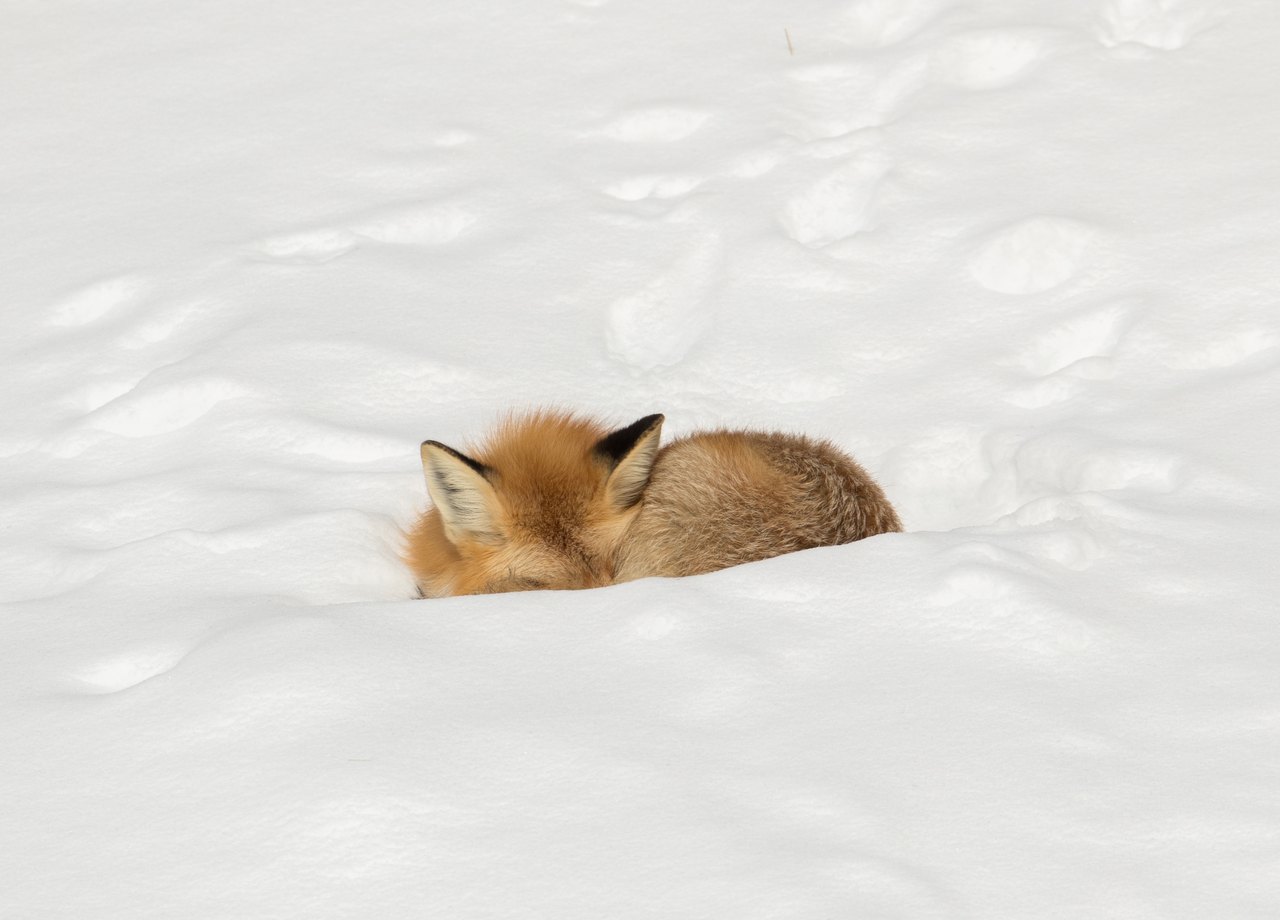
Visual AidA fox curled up to save its strength
Photograph by Jim Peaco for the National Park Service, taken in January 2017 in Yellowstone National Park, of a red fox curled into a tight ball in deep snow with its tail wrapped around its body. The Knowledge Bank explains that when hiding costs an animal its meals, a fox can live a surprisingly long time without eating by resting quietly to save its energy, and that patience can save its life. This is that resting: still, wrapped up, spending as little as possible. The fox is above ground in a winter meadow, not trapped in a den by farmers, and it is wild. Notice the tail over the nose — even the fur is arranged to lose no warmth.
Red fox resting in snow, Yellowstone National Park, January 2017; photograph by Jim Peaco, National Park Service. Source: Wikimedia Commons, public domain.
ⓘ Vocabulary words are selected to help you understand and complete this workbook. Some may not appear verbatim in the novel.
surroundv.Ch.7
To be or move all around something on every side
“Bean sent men to surround the hill so that no fox could escape.”
siegen.Ch.7
When people surround a place and wait, to force those inside to come out
“The farmers settled in for a siege, sure that hunger would beat the foxes.”
guardv.Ch.8
To watch over a place to keep something safe or to stop escape
“The men took turns to guard the hole all through the night.”
patientadj.Ch.7
Able to wait calmly for a long time without getting upset
“Bean told the others to be patient; sooner or later the fox would have to come out.”
starvev.Ch.8
To suffer badly or die from having no food
“With every road blocked, the foxes slowly began to starve.”
weakadj.Ch.8
Having little strength or energy
“The little foxes grew too weak even to lift their heads.”
determinedadj.Ch.7
Having firmly decided to do something and refusing to give up
“The farmers were determined to wait forever if that was what it took.”
darev.Ch.8
To be brave enough to do something risky
“Not one fox dared to poke its nose out into the glare of the lights.”
faintadj.Ch.8
Weak and dizzy, as if you might fall down
“Mrs. Fox felt faint with hunger after days without food.”
hopelessadj.Ch.8
Feeling that things are very bad and will never get better
“For the first time, the situation seemed completely hopeless.”
🧠Knowledge Bank question
1According to the Knowledge Bank, hiding below ground has a cost: ___.Ch.7
2True or False: To “starve” means to eat far too much food.Ch.8
3The men took turns to watch over the hole, day and night, so that no fox could slip out. Which word means this?Ch.8
4Fill in each blank with the correct word.Ch.7
Word choices:siegedeterminedweakguard- some words will not be used
The farmers set up tents for a long , planning to wait the foxes out.
They were to win, and refused to give up.
5True or False: A “patient” person is able to wait calmly for a long time.Ch.7
6After days with no food, the little foxes had almost no strength left. Which word describes them?Ch.8
7No fox was brave enough to risk going out into the bright lights. Which word means to be brave enough to do something risky?Ch.8
8True or False: If you feel “faint,” you feel weak and dizzy, as if you might fall down.Ch.8
9Fill in each blank with the correct word.Ch.8
Word choices:starvehopelesspatientsiege- some words will not be used
With no way to reach food, the family began to .
For the first time, the situation felt completely .
10The farmers had firmly decided to wait and would not give up, no matter how long it took. Which word describes them?Ch.7
Part 2
Comprehension
How well do you understand Chapters 7–8?
🧠Knowledge Bank · Cause and Effect
Reading Skill · Cause & EffectA story runs on cause and effect. A cause is why something happens; an effect is what happens because of it. In Part 3 the cause is the farmers refusing to leave the hill. The effect is that the foxes cannot come out, so they grow hungry and weak. One effect can become the next cause, like falling dominoes. Look for the words because, so, and since; they link a cause to its effect. When you can name what caused a problem, you can guess what might solve it. Reading for cause and effect helps the whole story make sense.
Visual AidFalling dominoes
Diagram for the Knowledge Bank on cause and effect. The three cards are the chain the Knowledge Bank gives for Part 3, the farmers refusing to leave, the foxes unable to come out, and the family growing hungry and weak, with the Knowledge Bank’s linking words under the arrows. It does not add later events. Notice that the middle card is both an effect and a cause — that is the domino the Knowledge Bank describes.
Cause, effect and the linking words as described in the Knowledge Bank. Drawn for Garden Heights Academy.
🧠Knowledge Bank question
1The Knowledge Bank says the words because, so, and since ___.Ch.7
2True or False: Bean sends men to surround the whole hill so that no fox can escape from any exit.Ch.7
3What is the farmers’ new plan to beat Mr. Fox in Part 3?Ch.7–8
4True or False: The men only watch the hole during the daytime and go home at night.Ch.8
5Put the events from Chapters 7–8 in the correct order. Write 1–4 (1 = first).Ch.7–8
Bean sends men to surround the hill so no fox can escape.
Trapped with no food, the fox family begins to starve.
The farmers realize the giant crater did not trap the foxes.
They decide to camp on the hill and wait him out.
6True or False: By the end of Chapter 8, the foxes are safe and well fed.Ch.8
7Why is the farmers’ waiting plan so dangerous for the foxes?Ch.8
8What do the farmers shout, showing they will never give up?Ch.7
9True or False: The bright lights and tents show that the farmers have prepared to stay for a long time.Ch.8
10How does Part 3 leave the foxes at the end?Ch.8
Part 3
Literary Elements
Understanding HOW and WHY Dahl writes Chapters 7–8 the way he does.
🧠Knowledge Bank · The Word Siege
Literary Craft · MoodDahl calls the farmers’ long wait a siege. A siege is when attackers surround a place and refuse to leave until the ones inside give up. This single strong word sets the mood — the feeling in the air. Mood here is dark and tense: we sense fear and hunger pressing on the trapped foxes. Writers pick heavy words like siege to make us feel the danger, not just read about it. A gentler word, like visit, would ruin the scene. Notice how one well-chosen word can paint a whole feeling. That feeling a story gives you is its mood.
📚 Literary Devices in This Part · definitions & examples
Mood is the feeling or atmosphere that a part of the story gives the reader. In Part 3 the mood turns dark and hopeless: the cheerful, clever escapes are gone, replaced by hunger, darkness, and fear.The protagonist is the main hero of a story, and the antagonist is the character (or characters) who opposes them. Mr. Fox is the protagonist; the three farmers are the antagonists trying to defeat him.A cliffhanger is a tense or worrying moment, often at the end of a part, that makes you want to keep reading to find out what happens. Part 3 ends with the foxes trapped and starving — we simply have to know how Mr. Fox will get out of it.
The questions below are mixed — not grouped by device. Decide which device each one is about.
🧠Knowledge Bank question
1According to the Knowledge Bank, the word siege sets a mood that is ___.Ch.8
2True or False: The antagonist is the hero that readers most want to succeed.Ch.7–8
3Fill in the blanks with the correct words.Ch.8
Word choices:cliffhangerstarvingmoodrhyme- some words will not be used
A tense ending that makes us read on is called a . Part 3 ends with the fox family trapped and .
4In Fantastic Mr. Fox, who is the protagonist (the main hero) and who are the antagonists (those against him)?Ch.7–8
5True or False: A cliffhanger is a tense moment that makes you want to keep reading to find out what happens next.Ch.8
6Fill in the blanks with the correct words.Ch.8
Word choices:moodhopelessrhymesetting- some words will not be used
The feeling a part of the story gives the reader is its . In Part 3 it becomes dark and as the foxes starve.
7Part 3 ends with the foxes trapped and starving, leaving us desperate to know what happens next. This kind of tense ending is called a —Ch.8
8True or False: Mood is the feeling or atmosphere that a part of a story gives the reader.Ch.8
9Fill in the blanks with the correct words.Ch.7–8
Word choices:protagonistantagonistsmoodsetting- some words will not be used
Mr. Fox, the hero we cheer for, is the . The three farmers, who fight against him, are the .
10Which choice best describes how the MOOD moves across Part 3?Ch.7–8
Part 4
Think Deeper
Four deeper challenges — no single-word recall. Read, weigh the evidence, and reason it through.
🧠Knowledge Bank · The Hero’s Lowest Moment
Social-Emotional · HopeEvery hero meets a lowest moment when things look hopeless. For Mr Fox it is here: he has lost his tail, his family is starving, and the enemy will not leave. Why do stories include such a sad, scary part? Because a hero only shines when the trouble is real. If winning were easy, we would not admire the brave choice that comes next. This dark moment also asks us to keep hope when life feels stuck. Notice that Mr Fox does not give up; he starts to think. The lowest point is often the doorway to a clever plan.
1Claim: “The farmers change tactics from digging to waiting the foxes out.” — choose the two details that best prove it.Claim & Evidence
2The farmers’ siege, or the foxes’ hardship? Tap each item to sort it — tap again to switch sides. You can keep tapping to change your answer.Sort into two
◄ The farmers’ siegeThe foxes’ hardship ►
3Match each cause to its result. For each cause, pick its result.Cause & Effect
Digging has failed→
They surround the hill→
The foxes cannot get out→
Days pass with no food→
🧠Knowledge Bank question
4Fill both blanks to complete the reasoning.Build the Argument
The Knowledge Bank says stories include a hero's lowest moment because , and Mr Fox's lowest point becomes .
Part 5
Standardized Test · Factual Detail & the EXCEPT Question
Part 3 adds a trickier exam family — the Negative Factual (EXCEPT / NOT) question — on top of Factual Detail, Inference and Vocabulary in Context, in the styles the SAT and TOEFL use. Read the passage (the highlighted words are tested below), then choose the answer best supported by the text.
Read the passage — the highlighted words are tested — then answer. Tap an answer, then tap it again to confirm.
SATWords in Context — a word's meaning in this passage
SATInference — a conclusion the passage implies
TOEFLVocabulary — a tested word's meaning here
TOEFLFactual Information — a fact stated in the passage
TOEFLNegative Factual — the statement the passage does NOT support
TOEFLInference — what the passage implies
How Animals Endure Winter Hunger
Every wild animal faces times when food is hard to find, and winter brings the greatest shortage of all. Many animals prepare in advance: squirrels bury nuts through the autumn as reserves, and bears eat hugely, storing energy as a thick layer of fat. When food runs out, the first rule of survival is to conserve energy: a hungry animal moves less and rests more, and may lie motionless for hours to make its strength last. Some animals take this to an extreme: hedgehogs and groundhogs sink into hibernation, a deep winter sleep in which the heart slows and the body barely burns any fuel. Above all, an animal that may starve must resist the urge to panic, because racing about in fear burns precious energy for nothing. As hungry days pass, the body grows weak and the senses grow dull. But a shortage is usually temporary: the season turns, food appears again, and the survivors are usually the ones that reduce their effort, keep calm, and stay alert for the very first chance of a meal.
Original passage written for Garden Heights — not a quotation from the novel.
1As used in the passage, the word “conserve” most nearly means —SAT · Words in Context
2An animal that grows weak ___.TOEFL · Vocabulary
3According to the passage, what do squirrels do before winter arrives?TOEFL · Factual Information
4All of the following are mentioned as ways animals survive a food shortage EXCEPT —TOEFL · Negative Factual
5An animal that may starve is one that may ___.SAT · Words in Context
6According to the passage, what happens to an animal’s body as hunger goes on?TOEFL · Factual Information
7The passage most strongly suggests that a trapped animal that panics and races about will —TOEFL · Inference
8The passage most strongly suggests that a calm, still animal survives a shortage because it —SAT · Inference
9Which of the following is NOT stated in the passage?TOEFL · Negative Factual
10Based on the whole passage, which animals are most likely to survive a long food shortage?SAT · Inference
Part 6 · Optional
Creative Writing
A bonus challenge to practice your English.
About This Section
This writing task is optional and not part of your auto-graded score. Feedback checks length, spelling, and grammar only.
Writing Task — Part 3 “The Foxes Begin to Starve”
Imagine you are Mr. Fox, hungry and trapped underground, with your weak family looking to you for help. What do you feel, and what are you starting to think of doing? Write at least 40 words.
You can start with: “My children were too weak to speak, and I knew that waiting would mean the end of us — so I began to think…”
0 / 40 words minimum
🗣 Teach It · Just for Fun (optional)
No right or wrong — close the screen and tell someone nearby what happened in this part. Can’t find anyone? Tell yourself out loud. The moment you teach it, you truly understand it.
Part 3 Complete!
You finished Chapters 7–8 of Fantastic Mr. Fox.
Here are your auto-graded results:
-
points out of 100
Teach it to someone
The best last step is to teach it. In your own words, explain what happened — retell a favorite scene, teach a character’s big choice, or sum up the main idea for a parent, friend, or classmate. When you can teach it clearly, you truly own it.
SAT® is a registered trademark of College Board, which is not affiliated with, and does not endorse, these materials. TOEFL® is a registered trademark of ETS. These materials are not endorsed or approved by ETS. Garden Heights is an independent provider of test-style reading practice.