New here? Just sign up with Google — your account includes Matilda, our gift book, forever.
Freak the Mighty · Garden Heights
Part 4
for Freak the Mighty · Part 4 · Chapters 10–12
8 Parts40 min
What Happens in Part 4
Kevin teaches Max to read and trust his own mind, while both boys' home lives deepen everything at stake.
A different doorThe bond deepens into something like brotherhood. Kevin refuses to accept that Max is slow and sets about teaching him — feeding him new words from the dictionary, showing him tricks for reading, insisting that Max's mind works fine, it simply needs a different door in. Little by little, Max begins to read, and to believe he is not the dummy the world named him.
The Fair GwenWe also see Kevin's home life and his fiercely devoted mother, Gwen, whom Kevin lovingly calls the Fair Gwen of Air — a woman who has built her whole life around her brilliant, fragile son and who slowly warms to the giant boy who has become his closest friend.
Calm before the stormWe learn more of Max's painful past: the shadow of his father, the loss of his mother, and why Gram and Grim raise him with such careful, watchful love. Rodman Philbrick (author) lets the reader feel how much the boys are healing each other — words and confidence for Max, adventures and loyalty for Kevin — the warmest stretch of the book, and the calm before the storm.
Flashback into Max’s past, the dictionary as symbol, and indirect characterization of Gwen
Cross-Curricular
How people learn to read — and learning differences like dyslexia
Chapter Summary
Ch.
What happens
Chapters 10–11
Learning to Read — Kevin refuses to let Max believe he is slow, teaching him words and reading tricks until Max begins, at last, to read.
Chapter 12
The Fair Gwen of Air — we meet Kevin’s devoted mother, Gwen, and learn more of Max’s painful past and why Gram and Grim watch over him.
Part 1
Vocabulary
Study 10 key words from Chapters 10–12, then answer each question.
🧠Knowledge Bank · Words of Healing
Lexical Semantics · Words of Healing
Four words, and three of them describe how somebody treats another person. Patient means calm and steady while waiting or teaching, and Kevin is patient in a way nobody in Max’s life has ever been with him. Devoted means deeply loyal and loving, which is what Gwen is to her son, without exception and without complaint. Confidence is belief in oneself, and Max gains it slowly, in the only way anyone ever does — by succeeding at something he was told he could not do. Fragile means easily broken or harmed, and it is the one word here about a body rather than a relationship. Nobody in these chapters is being cruel to anyone, which is rare in this novel and does not last. Notice how Philbrick arranges the four. Three of them build a boy up, and the fourth is a quiet reminder of what the book is going to take.
patientadj.Ch.10
Calm and steady while waiting or teaching
“Kevin was patient as he taught Max to read.”
devotedadj.Ch.12
Deeply loyal and loving
“Gwen was utterly devoted to her son.”
confidencen.Ch.11
Belief in oneself
“Max slowly gained confidence in his own mind.”
fragileadj.Ch.12
Easily broken or harmed
“Kevin’s small body was fragile.”
cherishv.Ch.12
To hold something dear and care for it
“Gwen came to cherish Max as a second son.”
mentorn.Ch.10
A wise person who teaches and guides another
“Kevin became Max’s patient mentor.”
brilliantadj.Ch.10
Extremely clever or bright
“Kevin’s brilliant mind never rested.”
shamen.Ch.11
A painful feeling of being unworthy
“Max had carried the shame of feeling stupid.”
guardiann.Ch.12
A person who legally cares for a child
“Gram and Grim were Max’s guardians.”
tenderadj.Ch.12
Gentle and caring
“Gwen’s tender words surprised Max.”
ⓘ The vocabulary words in this list are selected to help you understand and complete this workbook. Some may not appear verbatim in the original novel.
🧠Knowledge Bank question
1According to the Knowledge Bank, the word 'fragile' stands apart from 'patient' and 'devoted' because it ___.Ch.10
2Someone ‘devoted’ is deeply loyal and loving.Ch.12
3‘Confidence’ is belief in ___.Ch.11
4Something ‘fragile’ is strong and hard to break.Ch.12
5Fill in each blank with the correct word.Ch.12
Word choices:cherishguardianpatientshame- some words will not be used
Gram and Grim were Max’s legal s.
In time, Gwen came to Max too.
6A ‘mentor’ is a wise person who ___ another.Ch.10
7Someone ‘brilliant’ is extremely ___.Ch.10
8‘Shame’ is a painful feeling of being ___.Ch.11
9Fill in each blank with the correct word.Ch.10
Word choices:mentordevotedtenderbrilliant- some words will not be used
Kevin was Max’s patient .
Gwen’s words surprised Max.
10To ‘cherish’ someone is to hold them ___.Ch.12
Part 2
Comprehension
Show you understood what happens in Chapters 10–12.
🧠Knowledge Bank · The Warmest Days
Narrative Causality · The Warmest Days
The Warmest Days is organized around a difficult decision, the risk it creates, and the eventual result. The bond between the boys deepens into something like brotherhood. Kevin refuses to accept that Max is ‘slow,’ and sets about teaching him — feeding him new words from the dictionary, showing him tricks for reading, and insisting again and again that Max’s mind works fine, it simply needs a different door in. Little by little, Max begins to read, and to believe he is not the dummy the world named him. We also see more of Kevin’s home life and his fiercely devoted mother, Gwen, whom Kevin lovingly calls ‘the Fair Gwen of Air’ — a woman who has built her whole life around her brilliant, fragile son and who slowly warms to the giant boy who has become his closest friend. Once decision and result are joined, “The Warmest Days” supplies narrative momentum.
🧠Knowledge Bank question
1According to the Knowledge Bank, Kevin refuses to accept that Max is 'slow,' so he ___.Ch.10
2How does Kevin help Max?Ch.10
3By these chapters, Max begins to read and to believe in himself.Ch.11
4Kevin’s loving nickname for his mother is ___.Ch.12
5Write the numbers 1–5 in the boxes to show the correct order of events. Number 1 = what happens first.Chapters 10–12
We learn more of Max’s painful family past.
Max slowly begins to read and to believe in himself.
Kevin feeds Max new words and reading tricks.
We meet Kevin’s devoted mother, the Fair Gwen of Air.
Kevin insists Max is not slow, only taught wrong.
6Gwen instantly and warmly trusts Max from the first moment.Ch.12
7Gwen has built her life around ___.Ch.12
8Why do Gram and Grim watch over Max so carefully?Ch.12
9Kevin gives Max words while Max gives Kevin adventures.Ch.10
10Part 4 is best described as the book’s ___.Ch.12
Part 3
Literary Elements
Understanding HOW and WHY Rodman Philbrick (author) tells the story across Chapters 10–12.
🧠Knowledge Bank · The Dictionary and the Door to Words
Narrative Technique · The Dictionary and the Door to Words
Rodman Philbrick makes the midpoint turn through flashback, symbol, and characterization rather than through explanation alone. Watch the dictionary Kevin gives Max: it is a real book, and also the book’s quiet symbol for the power of words to set a person free. To Max, who has always felt locked out of reading, words were a wall. Kevin turns that wall into a door, teaching Max that a word is a key you can pick up and use, and that a boy who was called dumb can, in fact, learn anything. The dictionary stands for this whole transformation — the moment Max stops believing he has no brain worth using and starts collecting words like treasure. Notice how often words themselves matter in this book: Kevin loves them, Max learns them, and by the end Max will use them to write the very story we are reading. That authorial design makes “The Dictionary and the Door to Words” a lesson in deliberate symbolism.
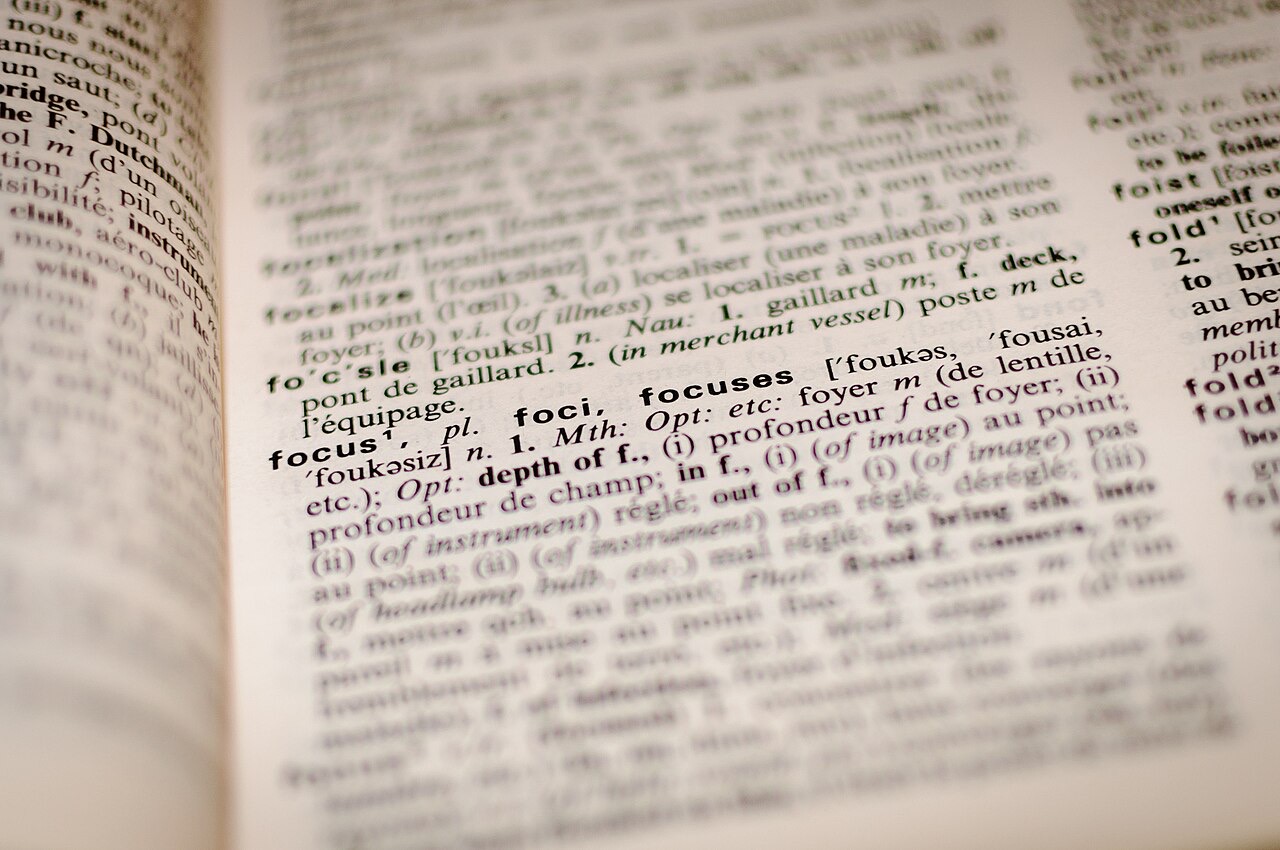
Visual AidInside the kind of book Kevin hands Max
Photograph of a dictionary lying open, the camera focused on a single entry — the word focus — while the columns around it soften into blur. The book photographed is a French-and-English dictionary, not Kevin’s, whose edition the novel never names; the blur is the camera’s choice, not the page’s. What it shows is the move The Dictionary and the Door to Words Knowledge Bank describes: a wall of print becomes a door one entry at a time, each one a key holding a spelling, a sound, and a meaning ready to be picked up and used.
Dictionary open at the entry ‘focus’; photograph by Romain Vignes, 2015 (Unsplash). Source: Wikimedia Commons, File:Focus definition (Unsplash).jpg, CC0.
Flashback
Glimpses of Max’s painful past — his father, his lost mother — reach back before the present story to explain his careful home.
Symbol
The dictionary Kevin gives Max — a real book that stands for words as a door out of feeling stupid.
Indirect characterization
We learn Gwen, the Fair Gwen of Air, from her fierce, devoted deeds, not from a label.
🧠Knowledge Bank question
1The Knowledge Bank explains that the dictionary Kevin gives Max is the book's quiet symbol of ___.Ch.12
2Fill in each blank with the correct literary term.Ch.12
Word choices:symbolflashbackrhymefootnote- some words will not be used
The dictionary Kevin gives Max is a .
A glimpse of Max’s earlier past is a .
3A flashback shows an event from earlier than the story’s present moment.Ch.12
4The dictionary mainly stands for words as a ___ out of feeling stupid.Ch.10
5Learning who Gwen is from her devoted actions is ___.Ch.12
6A symbol is an object that also stands for a larger idea.Ch.10
7Fill in each blank with the correct literary term.Ch.12
Word choices:indirect characterizationflashbacknarratorclimax- some words will not be used
Showing Gwen’s love through her actions is .
A scene from Max’s earlier life is a .
8Indirect characterization reveals a person through actions and choices.Ch.12
9The flashbacks into Max’s past mainly help explain his ___ home.Ch.12
10The clearest sign words are becoming Max’s treasure is that he ___.Ch.11
Part 4
Think Deeper
Four deeper challenges — no single-word recall. Read, weigh the evidence, and reason it out.
🧠Knowledge Bank · How People Learn to Read
The Reading Brain · How People Learn to Read
Kevin insists that Max is not stupid, only taught the wrong way — and the science of reading says Kevin is right. Here is a surprising fact: the human brain is born ready to learn to speak and listen, but it is not born ready to read. Speech is tens of thousands of years old and comes naturally to any child who simply hears it; reading and writing are much newer inventions, only a few thousand years old, and every reader’s brain has to be specially trained to do it. Learning to read means wiring together three jobs the brain already does separately: seeing the shapes of letters, hearing the sounds those letters stand for, and reaching the meanings of words. That is why Kevin’s method works when school did not. He does not drill Max harder; he hands him a dictionary and a reason, and lets a boy who has been told he is stupid discover that the wiring simply had not been built yet.
Visual AidReading is wiring, not a gift
Structure diagram of the How People Learn to Read Knowledge Bank’s surprising fact: the brain is born with three separate jobs — seeing shapes, hearing sounds, reaching meanings — and reading exists only once training wires them together into one circuit. The three arrows stand for years of practice compressed to a stroke each, and the drawing locates nothing in a real brain; the regions and their names are left out on purpose. It claims only what the Knowledge Bank claims: the wiring is built, not born.
The three-part wiring of reading as described in the How People Learn to Read Knowledge Bank; cf. standard accounts of the reading brain such as Maryanne Wolf, Proust and the Squid (2007). Drawn for Garden Heights Academy.
Picture the gentlest stretch of the whole book. A brilliant boy who cannot walk decides that his enormous friend is not stupid at all — that the world simply handed Max the wrong key — and sets out, patiently, to hand him the right one, word by word, until letters that once shimmered into nonsense begin to make sense. Nearby a fierce, loving mother who has built her life around her fragile son watches, warily at first and then warmly, as the giant boy becomes part of the family. And behind Max, always, is the shadow of a father and the memory of a mother, the reason two old people raise him with such careful, watchful love. Nothing dramatic happens here. Two boys simply mend each other, and the book quietly gathers everything it is about to risk.
Original passage written for Garden Heights — not a quotation from the novel.
1Claim: “Part 4 shows that Kevin and Max heal each other, each giving what the other most needs.” — choose the two details that best prove it.Claim & Evidence
2What Kevin gives Max, or What Max gives Kevin? Tap each detail to sort it — tap again to switch sides. You can keep tapping to change your answer.Sort into two
◄ What Kevin gives MaxWhat Max gives Kevin ►
3Match each cause to its result. For each cause, pick its result.Cause & Effect
Kevin refuses to call Max slow→
Kevin feeds Max words and tricks→
Gwen watches Max befriend her son→
The story glimpses Max’s past→
🧠Knowledge Bank question
4Fill both blanks to complete the reasoning.Build the Argument
According to the Knowledge Bank, no child is born ready to read because , so Kevin's teaching works because .
Part 5
Standardized Test
Reading passage · How People Learn to Read · SAT & TOEFL-style practice
Read the passage — the highlighted words are tested — then answer. Tap an answer, then tap it again to confirm.
SATCentral Ideas — the passage's main point
SATWords in Context — a word's meaning in this passage
SATDetail — a fact stated in the passage
SATText Connections — how two parts of the text relate
TOEFLFactual Information — a fact stated in the passage
TOEFLInsert Text — where a sentence best fits
The Reading Brain and Dyslexia
Kevin is certain that Max is not stupid, only taught the wrong way, and the science of reading proves Kevin right. A surprising fact: the human brain is born ready to learn to speak and listen, but it is NOT born ready to read. Spoken language is tens of thousands of years old, and any child who simply hears people talking will pick it up without lessons. Reading and writing, by contrast, are much younger inventions, and every reader’s brain has to be carefully trained to turn marks on a page into words.
Learning to read means wiring together three jobs the brain already does separately: seeing the shapes of letters, hearing the sounds those letters stand for, and reaching the meanings of words. With practice, most children build these connections until reading becomes automatic. But for some readers the wiring works differently: in a common reading difference called dyslexia, the letter-to-sound connections form slowly, so reading stays effortful. This has nothing to do with how smart a person is, and many people with dyslexia are gifted thinkers, builders, and problem-solvers. Years of struggling with print, though, can drain a reader’s confidence — the quiet belief that he or she can learn at all.
What such readers need is not to ‘try harder’ but to be taught in a way that fits how their brains work — patient, step-by-step methods that link seeing, saying, and touching letters at once. Given the right teaching, a struggling reader can absolutely learn to read. This is exactly what Kevin, acting as Max’s mentor, does: instead of shaming him, he finds a different door in, feeding Max words one at a time. The encouraging truth behind Max’s progress is that the reading brain can keep changing at any age.
Original passage written for Garden Heights — not a quotation from the novel.
1What is the passage mainly about?SAT · Central Ideas
2The brain IS born ready to ___.TOEFL · Factual Information
3In the passage, confidence most nearly means ___.SAT · Words in Context
4Reading wires together seeing letters, hearing sounds, and reaching ___.TOEFL · Factual Information
5In dyslexia, which part of the wiring works differently?TOEFL · Factual Information
6A reading difference has ___ to do with how smart a person is.SAT · Detail
7What such readers need most is to be ___.SAT · Central Ideas
8In the passage, mentor most nearly means ___.SAT · Words in Context
9Which event from Part 4 does this passage BEST help explain?SAT · Text Connections
10Insert Text (TOEFL). Look at the four squares [1]–[4] in the excerpt below. They show where this sentence could be added: “Kevin does exactly this, choosing patience over shame.”
What such readers need is not to try harder but to be taught in a way that fits their brains. [1] Given the right teaching, a struggling reader can absolutely learn to read. [2] Kevin finds a different door in, feeding Max words one at a time. [3] The reading brain can keep changing at any age, so no reader is truly hopeless. [4]
Where would the sentence fit best?TOEFL · Insert Text
Part 6 · Optional
Creative Writing
A bonus challenge to practice your English. Take your time and have fun with it.
About This Section
This writing task is optional and is not part of your auto-graded score. The feedback below checks only the basics — length, spelling, and grammar — not whether your ideas are right or wrong. It is meant for classroom discussion and creative practice, so feel free to use your imagination!
Writing Task — Part 4 “Learning a Different Way”
Kevin teaches Max by finding a ‘different door’ instead of repeating what already failed. Write about something that was hard for you to learn until someone taught it a new way, or until you found your own way in. What was hard, what changed, and how did it feel to finally get it? 6–10 sentences. End with what the experience taught you about learning.
You can start with: “For the longest time I just could not get it, until...”
0 / 40 words minimum
🗣 Teach It · Just for Fun (optional)
No right or wrong — close the screen and tell someone nearby what happened in this part. Can’t find anyone? Tell yourself out loud. The moment you teach it, you truly understand it.
Part 4 Complete!
You finished Chapters 10–12 of Freak the Mighty.
Here are your auto-graded results:
-
points out of 100
Teach it to someone
The best last step is to teach it. In your own words, explain what happened — retell a favorite scene, teach a character’s big choice, or sum up the main idea for a parent, friend, or classmate. When you can teach it clearly, you truly own it.
Independent study guide by Garden Heights. Not affiliated with or endorsed by Rodman Philbrick. Contains original analysis only; no text from the novel is reproduced. Reference text: This workbook follows Rodman Philbrick’s classic text (the standard Puffin edition sold worldwide). Revised 2023 UK editions change some wording and may not match the vocabulary studied here.
SAT® is a registered trademark of College Board, which is not affiliated with, and does not endorse, these materials. TOEFL® is a registered trademark of ETS. These materials are not endorsed or approved by ETS. Garden Heights is an independent provider of test-style reading practice.