New here? Just sign up with Google — your account includes Matilda, our gift book, forever.
Freak the Mighty · Garden Heights
Part 8
for Freak the Mighty · Part 8 · Chapters 23–25
8 Parts40 min
What Happens in Part 8
Kevin dies, and grieving Max finally fills the blank book with their whole story — the very book we have read.
The lossThe hardest part of the story arrives. Kevin does not recover; his rare condition, which caused his insides to grow while his small body could not, finally overwhelms him, and he dies. The loss is devastating, and Max shuts himself away in the down under, unable to bear the empty space where his friend used to be.
The bionic truthIn his grief Max learns the truth behind Kevin's cheerful stories: there was never going to be a bionic body. It was a brave, comforting fantasy Kevin told to make peace with what was happening to him, and to spare his friend. At first Max refuses even to open the blank book Kevin gave him.
Filling the pagesSlowly, healing begins. Loretta Lee reminds Max that Kevin is not truly gone as long as his story is told. So Max finally opens the empty book and begins to write — setting down everything from the daycare meeting to Freak the Mighty to the rescue and the loss — until the pages are full. The book he writes is the very book we have just read: Kevin's last, greatest quest, made permanent through the words his friend finally found.
The book’s central theme, the blank book as fulfilled symbol, and the frame narrative
Cross-Curricular
Grief, memory, and writing as a way to heal
Chapter Summary
Ch.
What happens
Chapters 23–24
Losing Freak — Kevin dies of his condition; Max learns the bionic body was a brave, comforting fantasy, and he shuts himself away in grief.
Chapter 25
Writing It Down — after words from Loretta Lee reach him, Max finally opens the blank book and writes their whole story — the book we have read.
Part 1
Vocabulary
Study 10 key words from Chapters 23–25, then answer each question.
🧠Knowledge Bank · Words of Loss and Healing
Lexical Semantics · Words of Loss and Healing
Four words, and the last two are what a person does with the first two. Grief is deep sorrow, especially after a loss, and Max is lost inside it when Kevin dies. To mourn is to feel and show sorrow for a loss, and Max does it alone in the down under, which is the worst possible place to do it. A memory is something remembered from the past, and Max keeps every one of Kevin alive in words. A legacy is what a person leaves behind after they are gone, and Kevin’s turns out to be the book you have been reading. Notice the movement across the four. Grief and mourning happen to Max. Memory and legacy are things he has to make, and that is no small distinction for a boy who was told for years that he could not read. The making is what finally lets him write.
griefn.Ch.23
Deep sorrow, especially after a loss
“Max was lost in grief when Kevin died.”
mournv.Ch.23
To feel and show sorrow for a loss
“Max mourned his friend alone in the down under.”
memoryn.Ch.25
Something remembered from the past
“Max kept every memory of Kevin alive in words.”
legacyn.Ch.25
What a person leaves behind after they are gone
“Kevin’s legacy was the story Max would tell.”
healv.Ch.25
To become whole or well again after hurt
“Writing helped Max slowly begin to heal.”
devastatedadj.Ch.23
Overwhelmed by grief or shock
“Max was devastated by the loss of his friend.”
comfortn.Ch.24
A feeling of ease that softens sorrow
“The bionic story was Kevin’s comfort.”
permanentadj.Ch.25
Lasting and unchanging
“Writing made the memory permanent.”
fantasyn.Ch.24
An imagined thing that is not real
“The bionic body was a brave fantasy.”
rememberv.Ch.25
To keep something in the mind
“Kevin lives on when others remember him.”
ⓘ The vocabulary words in this list are selected to help you understand and complete this workbook. Some may not appear verbatim in the original novel.
🧠Knowledge Bank question
1According to the Knowledge Bank, what separates memory and legacy from grief and mourning?Ch.23
2To ‘mourn’ is to feel and show sorrow for a loss.Ch.23
3A ‘memory’ is something ___ from the past.Ch.25
4A ‘legacy’ is what a person leaves behind after they are gone.Ch.25
5Fill in each blank with the correct word.Ch.25
Word choices:healpermanentgriefcomfort- some words will not be used
Writing helped Max slowly .
It made the memory .
6Someone ‘devastated’ is ___ by grief or shock.Ch.23
7‘Comfort’ is a feeling of ease that ___ sorrow.Ch.24
8A ‘fantasy’ is an imagined thing that is ___.Ch.24
9Fill in each blank with the correct word.Ch.25
Word choices:memorylegacymournfantasy- some words will not be used
Kevin’s was the story Max would tell.
Every of him lived on in the pages.
10To ‘remember’ someone is to keep them in your ___.Ch.25
Part 2
Comprehension
Show you understood what happens in Chapters 23–25.
🧠Knowledge Bank · Loss, and the Story That Remains
Narrative Causality · Loss, and the Story That Remains
The ending can be followed as a climax, a meaningful return, and a final closure rather than as isolated incidents. The hardest part of the story arrives. Kevin does not recover; his rare condition, which caused his insides to grow while his small body could not, finally overwhelms him, and he dies. For Max — and for the reader — the loss is devastating. In his grief Max learns the truth behind Kevin’s cheerful stories: there was never going to be a bionic body. It was a brave, comforting fantasy Kevin told to make peace with what was happening to him, and to spare his friend. Max shuts himself away in the down under, unable to bear the empty space where his friend used to be, refusing at first to open the blank book Kevin gave him. At the close, “Loss, and the Story That Remains” completes the book’s movement toward resolution.
🧠Knowledge Bank question
1The Knowledge Bank explains that the ending can be followed as ___ rather than as isolated incidents.Ch.23
2What truth does Max learn about the bionic body?Ch.24
3In his grief, Max shuts himself away in the down under.Ch.23
4Who says something that finally reaches Max?Ch.25
5Write the numbers 1–5 in the boxes to show the correct order of events. Number 1 = what happens first.Chapters 23–25
Max opens the blank book and writes their whole story.
Kevin dies of his rare condition.
Max shuts himself away in the down under, grieving.
Words from Loretta Lee finally reach him.
Max learns the bionic body was only a fantasy.
6Max opens Kevin’s blank book right away, the very first day.Ch.25
7What does Max finally do with the blank book?Ch.25
8The book Max writes turns out to be ___.Ch.25
9Kevin’s faith that Max was ‘the one who remembers’ comes true.Ch.25
10By writing the story, Max keeps Kevin ___.Ch.25
Part 3
Literary Elements
Understanding HOW and WHY Rodman Philbrick (author) tells the story across Chapters 23–25.
🧠Knowledge Bank · The Blank Book Filled at Last
Narrative Technique · The Blank Book Filled at Last
The closing movement joins theme, fulfilled, and narrative, allowing the ending to answer the beginning. Now the blank book Kevin gave Max at Christmas completes its work as the story’s central symbol. For most of the novel the empty pages have waited, a quiet promise: that Max’s voice matters, that his story is worth telling, that a boy called dumb is in truth the keeper of everything that happened. When Max finally opens the book and begins to write, the symbol is fulfilled. The emptiness that once stood for a story-not-yet-told becomes the fullness of a story remembered. This is one of the most beautiful structural moves a book can make: the object introduced early pays off completely at the end, and the reader realizes with a rush that the novel in their hands IS that filled book. That authorial design makes “The Blank Book Filled at Last” a lesson in deliberate payoff.
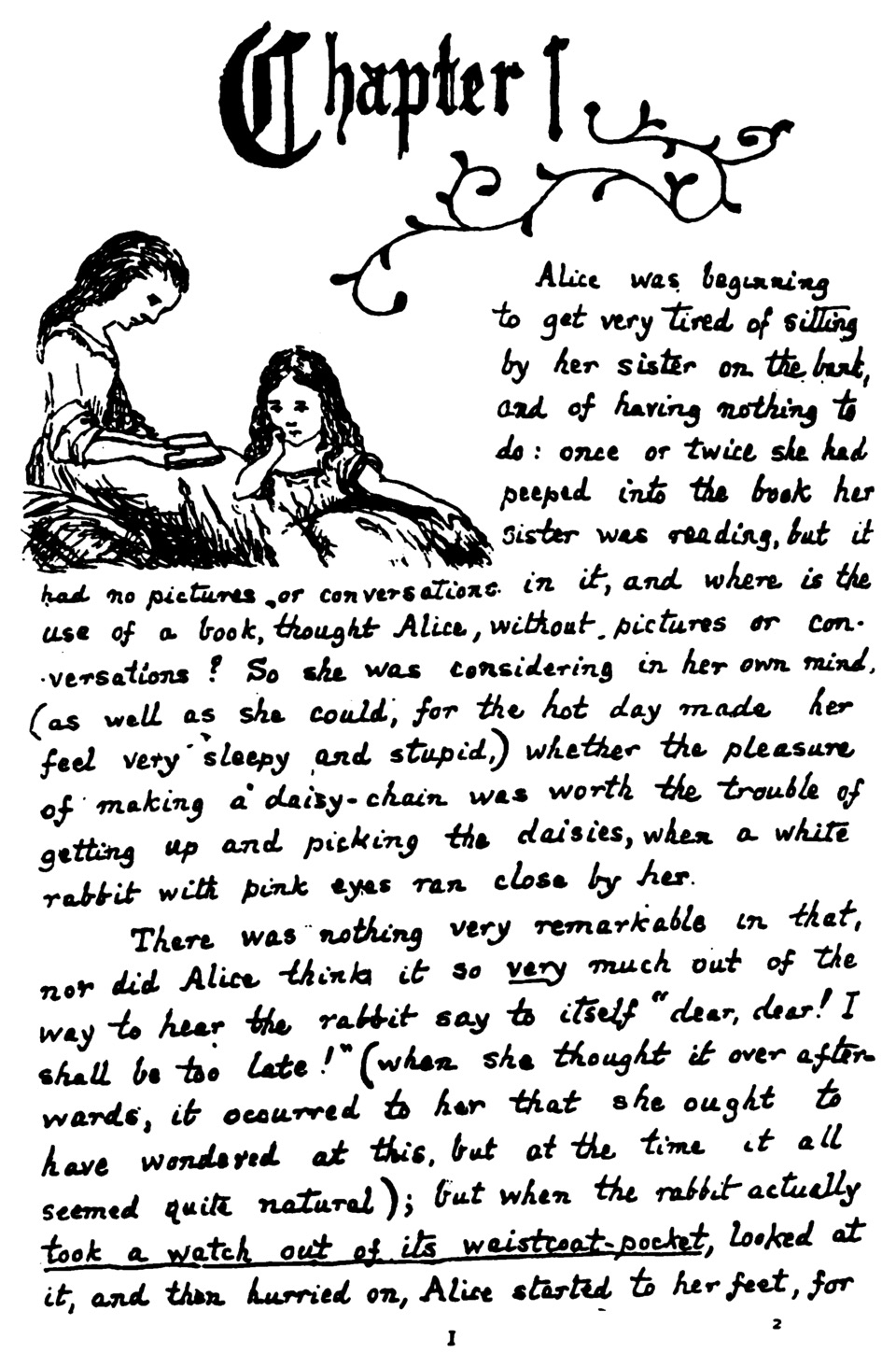
Visual AidA blank book somebody filled
Photograph of the first page of a real filled book: Alice’s Adventures Under Ground [Alice’s Adventures Under Ground], written out and illustrated by hand by Lewis Carroll (author) between 1862 and 1864 as a gift for one child, and later grown into a famous published novel. This is the move The Blank Book Filled at Last Knowledge Bank celebrates, performed in the real world: pages that began empty, filled by one voice, becoming a book that millions hold. Nothing here belongs to Freak the Mighty — Max’s filled book is invented and its pages are never shown — so notice instead what filling looks like: every line handwritten, and the pictures drawn by the storyteller himself.
First page of Alice’s Adventures Under Ground, handwritten and illustrated by Lewis Carroll, 1862–1864; British Library, Add MS 46700. Source: Wikimedia Commons, File:Alice’s adventures under ground, p 1.png, public domain.
Theme
The book’s deepest message: love outlasts loss when it is remembered, and writing can both mourn and heal.
Symbol (fulfilled)
The blank book’s empty pages finally fill — the novel we hold IS that book, Kevin’s gift completed.
Frame narrative
The whole story turns out to be Max writing in Kevin’s book after his death.
🧠Knowledge Bank question
1According to the Knowledge Bank, when Max fills the blank book, the reader realizes that ___.Ch.25
2Fill in each blank with the correct literary term.Ch.25
Word choices:frame narrativethemerhymefootnote- some words will not be used
That love outlasts loss when remembered is the .
A story that is really about its own writing is a .
3A theme is the deeper message or big idea a story leaves with the reader.Ch.25
4The blank book’s empty pages finally filling completes its work as a ___.Ch.25
5A story that turns out to be about its own creation is a ___.Ch.25
6The frame is revealed only at the end, when we learn Max is writing the book.Ch.25
7Fill in each blank with the correct literary term.Ch.25
Word choices:symbolthemenarratorclimax- some words will not be used
The blank book that finally fills is a .
That love outlasts loss is the story’s .
8The frame turns a sad story into a more hopeful one.Ch.25
9The frame quietly answers the book’s opening by proving Max has a ___.Ch.25
10Kevin’s gift of the blank book turns out to be a kind of ___.Ch.25
Part 4
Think Deeper
Four deeper challenges — no single-word recall. Read, weigh the evidence, and reason it out.
🧠Knowledge Bank · Grief, Memory, and Writing to Heal
Healing Through Story · Grief, Memory, and Writing to Heal
The end of the book gives the reader something precious: an honest, gentle picture of grief and how people slowly heal from it. Grief is the deep sorrow we feel when we lose someone we love, and it is not a problem to be solved quickly or a sign of weakness — it is the price of having loved. People who study grief describe it not as a straight line from sadness to recovery but as a long, uneven journey, with hard days and better ones, that no one should have to rush. Max’s first response — shutting himself away, unable even to open Kevin’s book — is a true and human picture of that early, frozen pain. What breaks it is the blank book itself. Kevin left Max a dictionary and an empty volume, and the boy who was told he could not read fills the whole thing. The novel does not claim that writing cures grief. It claims that grief, given somewhere to go, stops being only silence.
Visual AidTwo pictures of grief
Structure diagram contrasting two shapes: the straight line people imagine grief to be, and the uneven path the Grief, Memory, and Writing to Heal Knowledge Bank describes — hard days and better ones, with no schedule and no straight road. The zigzag is a pattern, not a chart: nothing is measured, no feeling is plotted, and the only true direction is time moving left to right. The drawing makes one claim, the Knowledge Bank’s own: the frozen early days, like Max’s in the down under, are part of the path and not a failure to walk it.
The uneven course of grief as described in the Grief, Memory, and Writing to Heal Knowledge Bank and in standard accounts of bereavement. Drawn for Garden Heights Academy.
Picture the emptiest room in the book: the down under, with one boy in it and one boy gone. Kevin has died, and Max learns that the shining bionic future was never coming — it was a story Kevin told to make the unbearable bearable, for himself and for the friend he was leaving. For a long time Max cannot move, cannot speak of it, cannot even open the blank book waiting in the dark. And then a few plain words from an unlikely person reach him: that as long as the story is told, the friend is not entirely gone. So the boy who believed he had no brain worth using picks up the empty book, and begins to write — the daycare, the shoulders, the quests, the rescue, the loss — until the pages are full. The last quest was the hardest, and Max finishes it: he remembers, and by remembering, he keeps Kevin alive.
Original passage written for Garden Heights — not a quotation from the novel.
1Claim: “Part 8 shows that writing the story becomes Max’s way of healing and of keeping Kevin alive.” — choose the two details that best prove it.Claim & Evidence
2Max’s grief and loss, or Max’s healing and hope? Tap each detail to sort it — tap again to switch sides. You can keep tapping to change your answer.Sort into two
◄ Max’s grief and lossMax’s healing and hope ►
3Match each cause to its result. For each cause, pick its result.Cause & Effect
Kevin dies of his condition→
Max learns the bionic dream was a fantasy→
Loretta Lee’s words reach Max→
Max fills the blank book→
🧠Knowledge Bank question
4Fill both blanks to complete the reasoning.Build the Argument
The Knowledge Bank argues that Max's frozen early grief is not weakness because , and the blank book finally helps because .
Part 5
Standardized Test
Reading passage · Grief, Memory, and Writing as a Way to Heal · SAT & TOEFL-style practice
Read the passage — the highlighted words are tested — then answer. Tap an answer, then tap it again to confirm.
SATCentral Ideas — the passage's main point
SATDetail — a fact stated in the passage
SATWords in Context — a word's meaning in this passage
TOEFLFactual Information — a fact stated in the passage
TOEFLNegative Factual — the statement the passage does NOT support
TOEFLVocabulary — a tested word's meaning here
TOEFLInsert Text — where a sentence best fits
How Grief Really Works
At the end of Max’s story, he faces the hardest thing a person can: the loss of someone he loves. Grief is the deep sorrow we feel when someone we love is gone, and it is important to say clearly what grief is not. It is not a weakness, not a problem to be solved in a hurry, and not something anyone should be ashamed of. Grief is, in a real sense, the price of love — we mourn deeply because we loved deeply.
People who study grief have learned that it does not follow a neat, straight path from sadness to recovery, finished on a schedule. Instead, grief tends to come in waves, with hard days and easier ones mixed together, and it takes as long as it takes. Max’s first response — shutting himself away in the down under, unable even to open the book his friend gave him — is a true and human picture of early grief. No one should be rushed through that stage, and quiet company brings more comfort, a gentle easing of pain, than advice can.
What finally helps Max is one of the oldest healing tools human beings have: telling the story. For as long as people have existed, they have made sense of loss by putting it into words, and researchers today find that carefully writing about a painful experience really can lighten its weight over time. When Max at last fills the blank pages, he is not erasing his grief; he is transforming it, turning unbearable absence into a story that can be kept and shared. The filled pages become a legacy, something left behind for others to keep. Love does not simply vanish when someone dies; when it is remembered, and especially when it is written down, it lasts.
Original passage written for Garden Heights — not a quotation from the novel.
1What is the passage mainly about?SAT · Central Ideas
2The passage says grief is, in a real sense, the price of ___.TOEFL · Factual Information
3According to the passage, grief is NOT ___.TOEFL · Negative Factual
4Grief tends to come in ___ rather than a straight line.SAT · Detail
5Max’s first response to the loss is to ___.TOEFL · Factual Information
6One of the oldest human healing tools is ___.SAT · Detail
7Researchers find that writing about a painful experience can ___ its weight.TOEFL · Factual Information
8In the passage, comfort most nearly means ___.SAT · Words in Context
9In the passage, legacy most nearly means ___.TOEFL · Vocabulary
10Insert Text (TOEFL). Look at the four squares [1]–[4] in the excerpt below. They show where this sentence could be added: “It is a real tool, not a magic cure, and it works slowly.”
What finally helps Max is telling the story, one of the oldest healing tools people have. [1] Researchers today find that carefully writing about pain can lighten its weight over time. [2] When Max fills the blank pages, he is not erasing his grief but transforming it. [3] Love does not vanish when someone dies; remembered and written down, it lasts. [4]
Where would the sentence fit best?TOEFL · Insert Text
Part 6 · Optional
Creative Writing
A bonus challenge to practice your English. Take your time and have fun with it.
About This Section
This writing task is optional and is not part of your auto-graded score. The feedback below checks only the basics — length, spelling, and grammar — not whether your ideas are right or wrong. It is meant for classroom discussion and creative practice, so feel free to use your imagination!
Writing Task — Part 8 “Keeping a Memory Alive”
Max heals by writing down the story of his friend, keeping Kevin alive in memory. Write about a person, place, or time you never want to forget, and set it down so it lasts. Who or what is it, what made it special, and why do you want to remember it? 6–10 sentences. End with the one memory you most want to keep.
You can start with: “I never want to forget...”
0 / 40 words minimum
🗣 Teach It · Just for Fun (optional)
No right or wrong — tell someone nearby what happened in this part. Can’t find anyone? Tell yourself out loud. The moment you teach it, you truly understand it.
Part 8 Complete — You Finished the Book! 🎉
You finished Chapters 23–25 — the final part of Freak the Mighty.
Here are your auto-graded results:
-
points out of 100
Teach it to someone
The best last step is to teach it. In your own words, explain what happened — retell a favorite scene, teach a character’s big choice, or sum up the main idea for a parent, friend, or classmate. When you can teach it clearly, you truly own it.
Independent study guide by Garden Heights. Not affiliated with or endorsed by Rodman Philbrick. Contains original analysis only; no text from the novel is reproduced. Reference text: This workbook follows Rodman Philbrick’s classic text (the standard Puffin edition sold worldwide). Revised 2023 UK editions change some wording and may not match the vocabulary studied here.
SAT® is a registered trademark of College Board, which is not affiliated with, and does not endorse, these materials. TOEFL® is a registered trademark of ETS. These materials are not endorsed or approved by ETS. Garden Heights is an independent provider of test-style reading practice.