New here? Just sign up with Google — your account includes Matilda, our gift book, forever.
The Giver · Garden Heights Academy
Part 8
for The Giver · Part 8 · Chapters 21–23
a novel by Lois Lowry
35 min5 Parts
This workbook is built on a solid pedagogical foundation, effectively integrating content and language learning based on the CLIL framework (Content and Language Integrated Learning), elevated by our unique 5th C — Connection — and an integrated Standardized Test section that weaves every SAT & TOEFL question type right into the novel, so learners build real test skills easily, naturally, and with fun.
What Happens in Part 8
Gabriel is to be released in the morning, so Jonas flees that night, carrying him toward Elsewhere.
Leaving earlyThe plan collapses before it begins. At dinner Jonas learns that Gabriel will be released the next morning. That night he takes his father's bicycle and the child and goes, without the hidden food, the head start, or any of the preparation the plan had depended on.
Hunted from aboveSearch planes sweep overhead with heat-seeking equipment. Jonas hides under trees and uses remembered snow to cool himself and Gabriel below the machines' notice. Past the last of the communities the land stops being flat and becomes real: hills, a river, weather, rain.
Hunger and coldStarvation and exhaustion set in. Shelter is whatever they can find, and the memories Jonas carries are thinning as the Community falls further behind. He gives Gabriel warmth drawn from a remembered sunshine, spending what he has left to keep the child alive.
The hill and lightsSnow stops the bicycle, so Jonas carries Gabriel up a hill he recognizes from his very first memory. At the summit he finds a sled and rides down toward lights and music below. The ending is deliberately ambiguous, left for the reader to decide.
What We Will Learn
Focus
What It Means
Plot (Resolution)
Jonas’s daring escape with Gabriel
Survival & Courage
Using memory and love to keep going
Theme
Hope, freedom, and the open ending
Chapter Summary
Chapter
Key Events
Ch.21
Jonas learns Gabriel will be released, so he flees that night, carrying the baby on a bicycle
Ch.22
The journey is hard — hills, rain, hunger, and cold; Jonas uses memories to keep Gabriel alive
Ch.23
Atop a snowy hill, Jonas finds a sled and rides toward lights and music, in an ambiguous, hopeful ending
💭 Before You Read · Warm-Up (not scored)
There are no wrong answers here — just think, guess, and talk:
What is the longest journey you have ever made? What was the hardest part — and what kept you going?
Predict: when Jonas leaves, what will he take with him — and what will he have to leave behind?
Do you prefer endings that answer everything, or endings that let YOU decide? Why?
Copyright Notice
This is an independent study guide created by Garden Heights Academy to support reading comprehension and literary analysis. It contains original analysis questions and does not reproduce any text from the novel. The Giver is a work by Lois Lowry. This guide is not affiliated with, authorized by, or endorsed by the author or any associated rights holders. Students should read the original book, available from libraries and booksellers.
Part 1
Vocabulary
Study 10 key words from Chapters 21–23, then answer each question.
🧠Knowledge Bank · What the Body Does Without Shelter
Survival Physiology · Cold and Hunger
A human body defends its core temperature before almost anything else. As cold deepens, blood vessels in the skin narrow to protect the organs, muscles begin the involuntary contractions we call shivering, and fingers lose dexterity long before the person feels endangered. Hypothermia begins when the core drops a few degrees, and its cruelest feature is confusion: judgment fails early, so the sufferer stops making good decisions exactly when good decisions matter. Hunger works on a slower clock. The body burns stored glycogen within a day, shifts to fat, and produces ketones the brain can use, which is why thinking survives longer than strength. Wilderness medicine teaches the order of priorities that follows from this physiology — shelter, then warmth, then water, then food — because a person can last weeks without eating and only hours without protection from wind and wet.
fleev.Ch.21
To run away from danger
“Jonas had to flee the Community.”
journeyn.Ch.22
A long trip from one place to another
“Their journey was long and hard.”
exhaustedadj.Ch.22
Extremely tired
“Jonas grew exhausted and hungry.”
starvationn.Ch.22
Suffering caused by having no food
“They faced cold and starvation.”
sheltern.Ch.22
Protection from weather or danger
“They searched for food and shelter.”
glimpsev.Ch.23
To see something briefly
“Jonas could glimpse lights below.”
summitn.Ch.23
The very top of a hill or mountain
“He reached the snowy summit.”
ambiguousadj.Ch.23
Having more than one possible meaning
“The ending is ambiguous.”
determinationn.Ch.22
A firm purpose that keeps you going
“Jonas pushed on with determination.”
hopen.Ch.23
A feeling that good things may come
“The lights filled him with hope.”
ⓘ The vocabulary words in this list are selected to help you understand and complete this workbook. Some may not appear verbatim in the original novel.
🧠Knowledge Bank question
1According to the Knowledge Bank, why does wilderness medicine put shelter ahead of food?Ch.21
2True or False: Someone “exhausted” is full of energy.Ch.22
3The very top of a hill or mountain is the ___.Ch.23
4True or False: To “glimpse” something is to see it briefly.Ch.23
5Fill in each blank with the correct word.Ch.21–22
Word choices:fleejourneyexhaustedshelter- some words will not be used
Jonas had to on a long until he was .
6True or False: “Starvation” is suffering caused by having no food.Ch.22
7Having more than one possible meaning means being ___.Ch.23
8True or False: “Shelter” is protection from weather or danger.Ch.22
9Fill in the blanks with the correct words.Ch.23
Word choices:summitglimpsehopeambiguous- some words will not be used
From the Jonas caught a of lights, filling him with .
10A firm purpose that keeps you going is ___.Ch.22
Part 2
Comprehension
How well do you understand Chapters 21–23?
🧠Knowledge Bank · Rivers, Ridges and Which Way Is Down
Physical Geography · Reading the Land
Travelers without maps have always navigated by the shape of the land itself. Water obeys gravity, so following a stream downhill reliably leads toward larger rivers, and rivers historically led toward settlements, because people built where boats and fish and flat ground were. The high line between two drainage basins is a watershed, and crossing one means every stream now runs a different way — the clearest signal that you have left one region for another. Terrain also gives direction without instruments: in northern latitudes, snow lingers on slopes that face away from the sun, and trees grow denser where light and moisture collect. None of this is precise. It is a set of probabilities that reduce error over long distances, which is exactly what a traveler needs, and it works only for someone who has learned to read a landscape as a system rather than as scenery.
Visual AidReading the land without a map
Structure diagram of the rules the Knowledge Bank gives a traveler with no instruments: water obeys gravity, so a stream followed downhill joins larger rivers, and rivers led to settlements because boats, fish and flat ground were there. The ridge is a single jagged line and the distances are invented — a real watershed can be a broad soft rise you cross without noticing. These are probabilities that reduce error over long distances, not directions. Notice that the whole method depends on reading a landscape as a system, which is a thing a person raised on flat, planned ground would never have learned.
Navigation by terrain, watersheds and drainage, as set out in the Knowledge Bank and in standard physical-geography references. Drawn for Garden Heights Academy.
🧠Knowledge Bank question
1The Knowledge Bank explains that crossing a watershed tells a traveler that —Ch.21
2Who does Jonas take with him?Ch.21
3How do Jonas and Gabriel travel at first?Ch.21
4True or False: Search planes look for Jonas and Gabriel.Ch.22
5Write the numbers 1–5 in the boxes to show the correct order of events in Part 8.Ch.21–23
Jonas flees that night, taking Gabriel on a bicycle.
They journey through real hills, rivers, and cold weather.
Jonas uses memories of warmth to keep Gabriel alive.
Jonas learns Gabriel will be released in the morning.
At a hilltop, Jonas finds a sled and rides toward lights and music.
6True or False: Jonas uses memories to help him and Gabriel survive.Ch.22
7What does Jonas find at the top of the snowy hill?Ch.23
8What does Jonas see and hear at the very end?Ch.23
9True or False: Lowry clearly states that Jonas and Gabriel are safe forever.Ch.23
10Fill in the blanks.Ch.21–23
Word choices:sledlightscandywar- some words will not be used
Jonas rode a down the hill toward warm .
Part 3
Literary Elements
Understanding HOW and WHY Lois Lowry creates certain feelings across Chapters 21–23.
🧠Knowledge Bank · Endings That Refuse to Close
Literary Craft · The Ambiguous Ending
Some novels stop without settling what happened, and the choice is structural rather than lazy. Critics distinguish a closed ending, which answers its questions, from an open one, which hands the last decision to the reader. An open ending works only if the book has earned it: the evidence must genuinely support more than one reading, and the final images must be specific enough that the reader has something to reason with. Writers achieve this by keeping the narration tight to a character whose own perception is failing or uncertain, so the limits of the account are the limits of the ending. Readers often resist, and the resistance is the point — an unresolved close keeps a book alive in argument for decades. Ask of any ambiguous ending whether the ambiguity is earned, and the test is simple: whether both readings are supported by details the author deliberately planted.
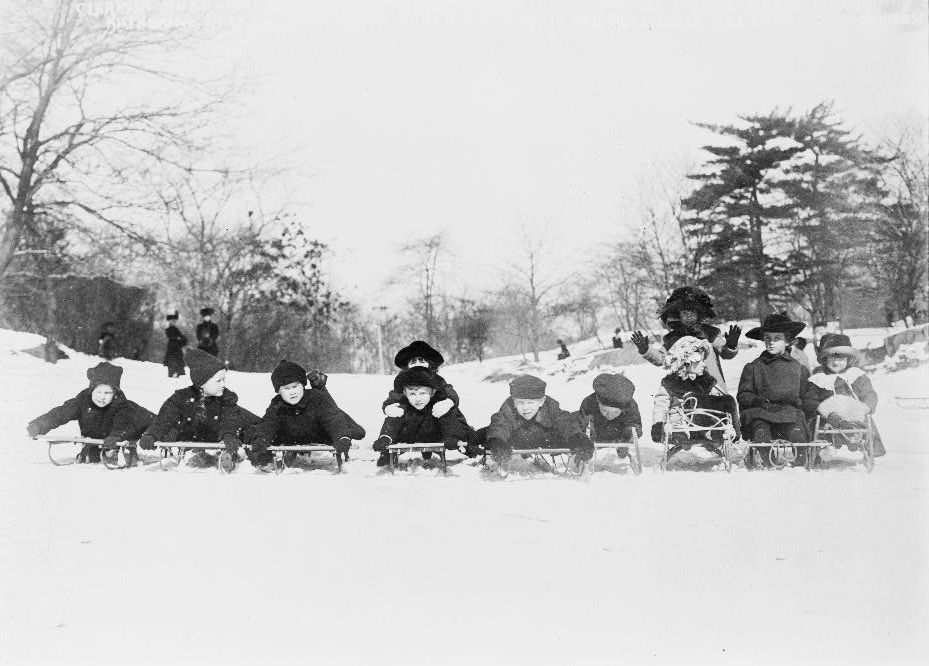
Visual AidSleds, and the run not taken yet
Photograph by the Bain News Service of children with sleds in Central Park, New York, in the early twentieth century. It is here for the shape of the thing rather than as an illustration of the last chapter: snow, wooden sleds, children ready to go. They are posed for the photographer, lined up and looking at the lens, so nobody has set off yet and no slope is visible in the frame. That is what makes it useful. The Knowledge Bank asks whether an ambiguous ending is earned, and the test is whether both readings rest on details the author planted. Notice that this picture stops before the run does — which is exactly where Lowry stops.
Bain News Service, children on sleds in Central Park, New York City, early twentieth century; George Grantham Bain Collection, Library of Congress. Source: Wikimedia Commons, public domain.
📚 Literary Devices in This Part · definitions & examples
The ending is ambiguous — it can be read as hopeful or tragic.The sled, lights, and music are symbols of love, warmth, and home.The book’s themes — freedom, memory, and hope — come together here.
The questions below are mixed — not grouped by device. Decide which device each one is about.
🧠Knowledge Bank question
1According to the Knowledge Bank, an ambiguous ending is earned only when —Ch.21–23
2A symbol is an object that stands for a bigger idea.Ch.21–23
3Fill in each blank with the correct word.Ch.21–23
Word choices:ambiguitysymbolthemesetting- some words will not be used
An ending open to hope or tragedy shows
The sled, lights, and music stand for love and home — each is a .
4The sled, lights, and music mainly work as —Ch.21–23
5A theme is a big idea a whole book explores.Ch.21–23
6Fill in each blank with the correct word.Ch.21–23
Word choices:themesymbolambiguitymood- some words will not be used
Freedom, memory, and hope woven through the book form its central
An ending you can read two ways has .
7Freedom, memory, and hope coming together are the book’s —Ch.21–23
8That the ending can be read as hopeful or tragic makes it —Ch.21–23
9Fill in each blank with the correct word.Ch.21–23
Word choices:symbolthemeambiguityplot- some words will not be used
The warm lights that stand for home are a
An ending open to two readings has .
10Lowry leaving the ending open mainly makes readers —Ch.21–23
Part 4
Think Deeper
Four deeper challenges — no single-word recall. Read, weigh the evidence, and reason it through.
🧠Knowledge Bank · Why People Leave and Who Takes Them
Human Geography · Flight and Refuge
International law defines a refugee as someone outside their own country who cannot return because of a well-founded fear of persecution, a definition set by the 1951 Refugee Convention after the displacements of the Second World War. The core obligation it created is non-refoulement: a state may not send such a person back into danger. Geographers separate the pressures that start a journey into push factors — war, persecution, drought — and pull factors such as safety, work or family already arrived. Most flight is short; the majority of the world’s displaced people remain within their own country or in a neighboring one, not in wealthy states. What the research shows consistently is that leaving is rarely a free decision and never a light one, because it means abandoning every network a person has and arriving somewhere that owes them nothing but a hearing.
1Claim: “Jonas risks everything to save Gabriel’s life.” — choose the two details that best prove it.Claim & Evidence
2A danger of the escape, or an act of hope? Tap each item to sort it — tap again to switch sides. You can keep tapping to change your answer.Sort into two
◄ A danger of the escapeAn act of hope ►
3Match each cause to its result. For each cause, pick its result.Cause & Effect
Gabriel is to be released next morning→
Jonas takes his father’s bicycle→
Search planes sweep overhead→
Gabe grows cold and afraid→
🧠Knowledge Bank question
4Fill both blanks to complete the reasoning.Build the Argument
The Knowledge Bank argues that leaving home is rarely a free decision because , which shows that .
Part 5
Standardized Test
Mixed Practice & Prose Summary — SAT & TOEFL-style practice
Read the passage — the highlighted words are tested — then answer. Tap an answer, then tap it again to confirm.
SATWords in Context — a word's meaning in this passage
SATInference — a conclusion the passage implies
SATRhetorical Purpose — why the author put a sentence there
TOEFLFactual Information — a fact stated in the passage
TOEFLInsert Text — where a sentence best fits
The Arctic Tern's Epic Migration
Every year, a small seabird called the Arctic tern makes the longest journey on Earth. It nests near the North Pole in the northern summer; when the days shorten, it sets off for the Antarctic — the other end of the planet — and returns the following year, a round trip of roughly 70,000 kilometers (43,498 miles). This yearly migration means a tern may see more daylight than any other creature alive, chasing summer from pole to pole. And no one shows the young bird the way: it hatches with the instinct to go, and learns the route by going.
How does a bird navigate an entire planet? Terns steer by the sun and stars, sense the Earth's magnetic field like a built-in compass, and follow coastlines they have never been taught. The journey is brutal — storms, hunger, aching wings — and a tern may arrive exhausted, yet it presses on toward a destination it cannot yet see, trusting that the far shore is real. A tern may live more than thirty years, and over such a long life its travels can add up to roughly the distance of three trips to the Moon and back. Few creatures push their bodies so far, so faithfully, for so long, and few show such plain determination.
Most terns survive the crossing, and return year after year for decades. Scientists still argue about exactly how they manage it. The tern does not argue. It opens its wings, and it goes.
Original passage written for Garden Heights — not a quotation from the novel.
1Where does the Arctic tern nest in the northern summer?TOEFL · Factual Information
2In the passage, “determination” most nearly means —SAT · Words in Context
3About how long is the tern’s round trip?TOEFL · Factual Information
4In the passage, “exhausted” most nearly means —SAT · Words in Context
5To “navigate” is to —SAT · Words in Context
6Why may a tern see “more daylight than any other creature alive”?SAT · Inference
7Which tools does the passage say the tern uses to steer?TOEFL · Factual Information
8The passage suggests the tern’s yearly trip is mainly driven by —SAT · Inference
9The author ends with ‘it opens its wings, and it goes’ mainly to show the tern acts by —SAT · Rhetorical Purpose
10Insert Text (TOEFL). Look at the four squares [1]–[4] in the excerpt below. They show where this sentence could be added: “Guided only by instinct, it needs no map and no teacher for the journey.”
The Arctic tern makes the longest migration on Earth. [1] It flies from pole to pole and back each year. [2] No parent bird shows it the route. [3] Somehow it still finds its way across the open ocean. [4]
Where would the sentence fit best?TOEFL · Insert Text
Part 6 · Optional
Creative Writing
A bonus challenge to practice your English. Take your time and have fun with it.
About This Section
This writing task is optional and is not part of your auto-graded score. The feedback below checks only the basics — length, spelling, and grammar — not whether your ideas are right or wrong. It is meant for classroom discussion and creative practice, so feel free to use your imagination!
Writing Task — Part 8 “How Does It End?”
The Giver has a famous open ending. Write what you think happens to Jonas and Gabriel, using clues from the story to support your idea. Do they reach a safe, loving place, or not? Explain your thinking. Write at least 40 words.
You can start with: “I think that at the end of the story, Jonas and Gabriel…”
0 / 40 words minimum
🗣 Teach It · Just for Fun (optional)
No right or wrong — close the screen and tell someone nearby what happened in this part. Can’t find anyone? Tell yourself out loud. The moment you teach it, you truly understand it.
Part 8 Complete!
You finished Chapters 21–23 of The Giver.
Here are your auto-graded results:
-
points out of 100
Teach it to someone
The best last step is to teach it. In your own words, explain what happened — retell a favorite scene, teach a character’s big choice, or sum up the main idea for a parent, friend, or classmate. When you can teach it clearly, you truly own it.
Independent study guide by Garden Heights Academy. Not affiliated with or endorsed by the author or any rights holders. Contains original analysis only; no text from the novel is reproduced.
SAT® is a registered trademark of College Board, which is not affiliated with, and does not endorse, these materials. TOEFL® is a registered trademark of ETS. These materials are not endorsed or approved by ETS. Garden Heights is an independent provider of test-style reading practice.