New here? Just sign up with Google — your account includes Matilda, our gift book, forever.
Hatchet · Garden Heights
Part 8
for Hatchet · Part 8 · Chapter 19 + Epilogue
8 Parts40 min
What Happens in Part 8
After fifty-four days a pilot hears the transmitter and rescues Brian, and the Epilogue shows how the wilderness changed him forever.
The rescueBrian sits by his fire, marveling over the riches of the survival pack, when the impossible happens: a bush plane flown by a fur buyer drops out of the sky and lands on his lake. The pilot picked up the signal from the emergency transmitter Brian was sure had failed. After fifty-four days alone, the ordeal is over; he is rescued and carried back to the world he lost.
The EpilogueGary Paulsen (author) refuses to end with the rescue plane. The Epilogue steps outside the story to tell what became of Brian: his time in the wilderness changed him permanently and for the better. He grew serious and watchful, careful with food, aware of things most people never notice, and far less troubled by the small worries that consume other kids. Some effects faded; the deep ones stayed.
What staysCrucially, Brian never tells his father the Secret — some things are his alone to carry — and in the book's honest, unsentimental way, his parents do not get back together; the divorce is permanent. Brian returns not to his old, easy life but to a new self, forged in the north and unable to be unmade: a boy who went in soft and frightened and came out quiet, capable, and grown.
The satisfying resolution, the epilogue device, and the theme of coming of age
Cross-Curricular
Resilience and post-traumatic growth — how hardship can change a person for good
Chapter Summary
Ch.
What happens
Chapter 19
Rescue — a fur buyer’s plane, guided by the transmitter’s signal, lands on the lake and rescues Brian after fifty-four days alone.
Epilogue
What It Meant — the wilderness changed Brian for good; he keeps the Secret from his father, and his parents do not reunite.
Part 1
Vocabulary
Study 10 key words from Chapter 19 + Epilogue, then answer each question.
🛬Knowledge Bank · How Rescue Reaches the North
Northern Life · Bush Pilots and the Fur TradeBrian is not saved by an official rescue team but by an ordinary working pilot — a fur buyer whose plane happens to catch his signal. That detail is true to life in the far north, where a thin web of bush pilots keeps remote country connected. For generations the northern economy has run partly on the fur trade: trappers spend the long winter far from any road, and buyers fly in by float plane to trade for pelts, carry supplies, and bring news. These pilots are among the few people who cross this empty land at all, navigating by rivers and lakes and their own hard-won memory. It is fitting that such a pilot finds Brian, because in the north survival has always depended on this human network as much as on any single person’s skill. The wilderness that isolated Brian for so long is, in the end, threaded through by the quiet, constant work of the people who make their living flying its skies.
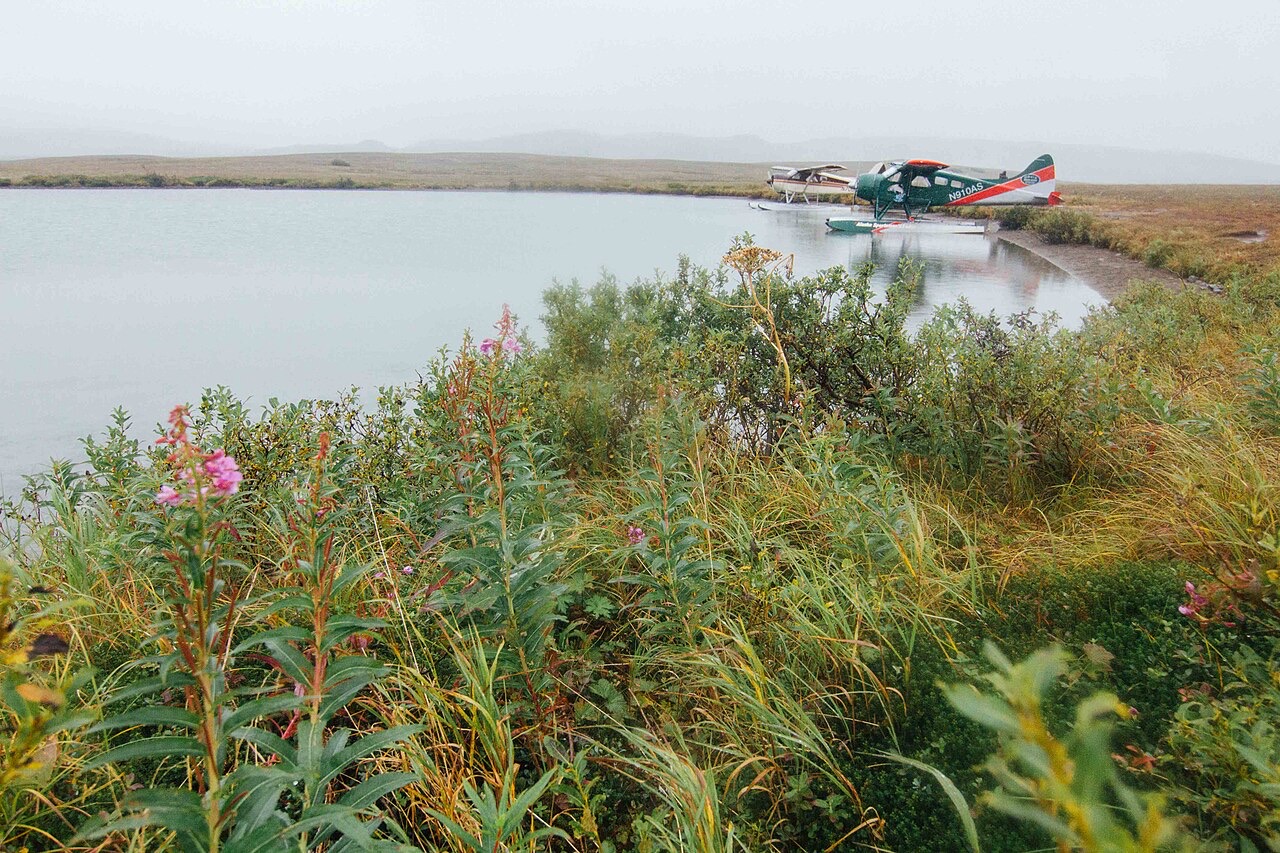
Visual AidFloat planes where roads never reach
Photograph of two float planes drawn up on the shore of Crosswinds Lake in Katmai National Park, Alaska, in August 2017. There is no dock, no runway, no road anywhere in the frame: the lake itself is the airport, which is the whole geography the Knowledge Bank describes. Planes like these are the thin web that keeps the roadless north connected — carrying supplies, passengers, news, and for generations the fur buyers who flew winter’s pelts out of trapping country. These two were flying park crews and visitors, not pelts, and the fur buyer who finds Brian is invented; what is real, and worth noticing, is how naturally a float plane and an empty shore fit together.
Float planes on the shore of Crosswinds Lake, Katmai National Park and Preserve, Alaska, August 2017; National Park Service photograph. Source: Wikimedia Commons, File:20170824-crosswinds-crosswindlake-amrnps-1 (38263416992).jpg, public domain.
resiliencen.Ch.19
The power to recover from hardship
“Brian’s resilience carried him through the ordeal.”
transformv.Epilogue
To change completely
“The wilderness had transformed him for good.”
permanentadj.Epilogue
Lasting and unchanging
“The deepest changes in Brian were permanent.”
maturityn.Epilogue
The quality of being grown-up
“He came home with a new maturity.”
endurev.Ch.19
To bear hardship and last
“He had learned to endure almost anything.”
watchfuladj.Epilogue
Alert and observant
“Brian stayed watchful long after the rescue.”
rescuen.Ch.19
The act of saving from danger
“The rescue came from a fur buyer’s plane.”
signaln.Ch.19
A sign that carries a message
“The transmitter’s signal guided the pilot in.”
reunitev.Epilogue
To bring together again
“His parents did not reunite after all.”
burdenn.Epilogue
A heavy load to carry
“The Secret became a burden he chose to keep.”
ⓘ The vocabulary words in this list are selected to help you understand and complete this workbook. Some may not appear verbatim in the original novel.
🧠Knowledge Bank question
1According to the Knowledge Bank, Brian's rescue is true to northern life because ___.Ch.19
2To ‘transform’ is to stay exactly the same.Epilogue
3Something ‘permanent’ is ___.Epilogue
4‘Maturity’ is the quality of being grown-up.Epilogue
5Fill in each blank with the correct word.Epilogue
Word choices:reuniteburdensignalthrottle- some words will not be used
His parents did not after his return.
He chose to keep the Secret as his own .
6To ‘endure’ is to ___.Ch.19
7Someone ‘watchful’ is ___.Epilogue
8A ‘rescue’ is the act of ___.Ch.19
9Fill in each blank with the correct word.Epilogue
Word choices:transformpermanentenduresignal- some words will not be used
The ordeal came to Brian completely.
The change it left in him was .
10To ‘reunite’ people is to bring them together again.Epilogue
Part 2
Comprehension
Show you understood what happens in Chapter 19 + Epilogue.
🦋Knowledge Bank · How Surviving Changes a Person
Psychology · Post-Traumatic GrowthThe Epilogue is really a short lesson in what psychologists call post-traumatic growth — the way some people, after living through something terrible, come out changed in lasting and even positive ways. Brian does not return home as his old self. He has become watchful and observant, noticing details most people miss, a habit the wilderness burned into him. He no longer wastes worry on small troubles that once seemed enormous, and he values simple things — food, warmth, safety — with an intensity most people never feel. Researchers find these exact patterns in real survivors: a sharper appreciation for life, a stronger sense of one’s own strength, and deeper, quieter priorities. Not every scar is a wound; some hardship reshapes a person into someone stronger and more aware. The boy who was afraid to be alone above the forest comes back knowing, in his bones, that he can face almost anything — and that certainty is a permanent part of who he now is.
🧠Knowledge Bank question
1According to the Knowledge Bank, researchers find that real survivors often show ___.Ch.19
2The transmitter that saves Brian is the one he thought was ___.Ch.19
3Brian is rescued after about fifty-four days alone.Ch.19
4Instead of ending at the rescue, Paulsen adds an ___.Epilogue
5Write the numbers 1–5 in the boxes to show the correct order of events. Number 1 = what happens first.Chapter 19 + Epilogue
A fur buyer’s plane lands on his lake.
The pilot reveals the transmitter’s signal led him there.
The Epilogue tells how the ordeal changed him for good.
Brian marvels over the survival pack by his fire.
Brian is rescued and returns home.
6The Epilogue says the wilderness left no lasting mark on Brian.Epilogue
7According to the Epilogue, Brian comes home more ___.Epilogue
8What does Brian decide about the Secret?Epilogue
9Brian’s parents get back together after his rescue.Epilogue
10The Epilogue’s main point about Brian is that he is ___.Epilogue
Part 3
Literary Elements
Understanding HOW and WHY Gary Paulsen (author) tells the story across Chapter 19 + Epilogue.
🎓Knowledge Bank · Growing Up: The Coming-of-Age Theme
Literary Craft · ThemeEvery strong story carries a theme — a central idea or meaning that runs beneath the events — and the theme of Hatchet is coming of age: the passage from childhood toward adulthood through hard experience. On the surface the book is about surviving in the wilderness, but underneath it is about a boy growing up. Notice that Brian’s outer journey and his inner one move together. As he masters fire, food, and shelter, he also masters himself — his fear, his self-pity, his helpless waiting for someone else to fix things. The wilderness is the hard teacher that forces this growth, stripping away everything easy until only a tougher, wiser Brian remains. A coming-of-age story is not about a young person simply getting older; it is about earning a more grown-up way of seeing the world. By the final page Brian has done exactly that, which is why the novel ends not with the rescue but with the quiet truth of who he has become.
Visual AidTwo journeys, one boy
Structure diagram of the pairing the Knowledge Bank points to: the outer journey of staying alive and the inner journey of growing up, drawn as parallel tracks that advance together toward one end — a more grown-up way of seeing. Only three pairs are drawn where Gary Paulsen (author) builds many, and the tidy one-to-one matching is a simplification: in the novel the two lines tangle, stall, and drag each other forward. The diagram ranks neither row. Its claim is only the Knowledge Bank’s: in a coming-of-age story, neither journey can move without the other.
The paired outer and inner journeys of the coming-of-age novel, as described in standard introductions to the Bildungsroman. Drawn for Garden Heights Academy.
Resolution
The ending that settles the story — the transmitter works, the plane lands, and Brian is rescued.
Epilogue
A closing section set after the main action, telling what the ordeal meant for Brian’s life.
Theme (coming of age)
The book’s deep meaning — a boy grows up by surviving, mastering himself as he masters the wild.
🧠Knowledge Bank question
1According to the Knowledge Bank, a coming-of-age story is really about ___.Ch.19
2Fill in each blank with the correct literary term.Epilogue
Word choices:epilogueresolutionrhymeindex- some words will not be used
The closing section after the rescue is an .
The rescue that settles the story is the .
3An epilogue is a closing section set after the main action of a story.Epilogue
4The idea that Brian grows up by surviving is the book’s ___.Epilogue
5The resolution feels satisfying partly because the silent transmitter finally ___.Ch.19
6The theme of a story is its deeper meaning or message.Epilogue
7Paulsen keeps the divorce unhealed in the epilogue to make Brian’s growth feel ___.Epilogue
8Fill in each blank with the correct literary term.Epilogue
Word choices:themeepiloguenarratorclimax- some words will not be used
Growing up through survival is the book’s .
The section after the rescue is the .
9In a coming-of-age story, a young person matures through a hard experience.Epilogue
10The clearest sign of Brian’s coming of age is that he now ___.Epilogue
Part 4
Think Deeper
Four deeper challenges — no single-word recall. Read, weigh the evidence, and reason it out.
🔒Knowledge Bank · The Weight He Chooses to Carry
Psychology · Maturity and the SecretThe most telling choice Brian makes in the Epilogue is a quiet one: he decides not to tell his father the Secret. Early in the book, the sight of his mother with another man was a wound that ruled him, intruding on his thoughts even when his life depended on paying attention. Now he chooses to carry that painful knowledge himself, without letting it poison him or his family. This is a real sign of maturity. Growing up does not mean every problem gets solved — his parents do not reunite, and the divorce does not heal — it means learning to hold hard truths steadily instead of being controlled by them. Paulsen refuses an easy, everything-fixed ending on purpose, because that would be a lie about how growth actually works. Brian has not gotten his old, simple life back. He has earned something harder and more valuable: the strength to face a painful reality honestly and still choose how he will live.
Imagine the last afternoon: a boy who has learned to expect nothing sits by his fire, turning cans and matches over in his hands like jewels, when an engine hums out of the empty sky and a plane settles onto his lake. The transmitter he was sure had failed has been calling for him all along. And then he is lifted out of the north and set back down in the world he came from — except he is not the boy who left it. He is quieter now, and steadier; he notices everything; small troubles that once loomed enormous have shrunk to nothing. He does not tell his father the Secret; he has grown strong enough to carry it alone. His parents do not come back together, and he does not pretend they will. He has not been given back his old life. He has been given a new self, made in the wilderness and impossible to lose.
Original passage written for Garden Heights — not a quotation from the novel.
1Claim: “Part 8 shows that Brian’s deepest rescue is not from the wilderness but into a new, grown-up self.” — choose the two details that best prove it.Claim & Evidence
2The old Brian of Chapter 1, or The new Brian of the Epilogue? Tap each detail to sort it — tap again to switch sides. You can keep tapping to change your answer.Sort into two
◄ The old Brian of Chapter 1The new Brian of the Epilogue ►
3Match each cause to its result. For each cause, pick its result.Cause & Effect
Brian switched on the transmitter→
The plane lands after fifty-four days→
Paulsen adds an epilogue→
Brian keeps the Secret to himself→
🧠Knowledge Bank question
4Fill both blanks to complete the reasoning.Build the Argument
Keeping the Secret shows real maturity because , so the story ends without .
Part 5
Standardized Test
Reading passage · Resilience and Growing Through Hardship · SAT & TOEFL-style practice
Read the passage — the highlighted words are tested — then answer. Tap an answer, then tap it again to confirm.
SATCentral Ideas — the passage's main point
SATDetail — a fact stated in the passage
SATCommand of Evidence — the detail that best supports a claim
SATWords in Context — a word's meaning in this passage
SATInference — a conclusion the passage implies
TOEFLFactual Information — a fact stated in the passage
TOEFLVocabulary — a tested word's meaning here
TOEFLNegative Factual — the statement the passage does NOT support
TOEFLInsert Text — where a sentence best fits
Growth After Surviving Trauma
The Epilogue of Hatchet is about more than Brian's rescue; it is about what his ordeal did to him, and it rests on an idea psychologists study: resilience. Resilience is the ability to recover from difficulty — to bend under pressure without breaking, and rise again. Everyone must endure hardship, but people differ in how they respond, and researchers have long asked why. They have found that resilience is not rare magic but a set of skills that can be built: staying calm, solving problems patiently, and keeping hope alive.
But the Epilogue points at something deeper than simply bouncing back, something scientists call post-traumatic growth. This is the well-documented fact that a terrible experience can transform some who live through it: instead of returning to who they were, they come back changed in lasting, positive ways. Survivors often describe a new maturity, a deeper gratitude for ordinary things like food, warmth, and safety, and a new calm about worries that once felt enormous. This is the Brian of the Epilogue: watchful, patient, grateful, and no longer ruled by the fears of the boy who boarded the plane.
It is important, though, to see what post-traumatic growth is not. It is not a happy ending where every wound heals and every problem is solved, and Gary Paulsen (author) is honest about that: Brian's parents do not reunite, and the divorce is permanent. Growth does not erase the hard things; it changes the person who must live with them. Brian is not given back his old, easy life; he is given a stronger, wiser self to meet a life that is still hard. That is why Hatchet is finally not only a tale of survival but a story of growing up.
Original passage written for Garden Heights — not a quotation from the novel.
1What is the passage mainly about?SAT · Central Ideas
2‘Resilience’ is the ability to ___.TOEFL · Factual Information
3Researchers say resilience is best described as ___.SAT · Detail
4The deeper idea the Epilogue points at is called ___.TOEFL · Factual Information
5In the passage, endure most nearly means ___.TOEFL · Vocabulary
6The passage says this kind of growth is NOT ___.TOEFL · Negative Factual
7Which detail shows Paulsen’s honesty about Brian’s life?SAT · Command of Evidence
8In the passage, transform most nearly means ___.SAT · Words in Context
9Growth, the passage says, changes ___ rather than erasing the hard things.SAT · Inference
10Insert Text (TOEFL). Look at the four squares [1]–[4] in the excerpt below. They show where this sentence could be added: “In that sense, survival and growing up turn out to be the same journey.”
Brian is not given back his old, easy life. [1] Instead, he is given a stronger, wiser self to meet a life that is still hard. [2] He has mastered the wilderness, and in doing so he has mastered himself. [3] That is why the book is finally a story of growing up, not only of survival. [4]
Where would the sentence fit best?TOEFL · Insert Text
Part 6 · Optional
Creative Writing
A bonus challenge to practice your English. Take your time and have fun with it.
About This Section
This writing task is optional and is not part of your auto-graded score. The feedback below checks only the basics — length, spelling, and grammar — not whether your ideas are right or wrong. It is meant for classroom discussion and creative practice, so feel free to use your imagination!
Writing Task — Part 8 “How a Hard Time Changed Me”
The Epilogue says Brian came home permanently changed — more serious, watchful, and grateful. Write about a hard experience that changed you for the better. What did you go through, and how are you different now because of it? 6–10 sentences. End with the most important way you grew.
You can start with: “I would not want to repeat it, but it made me...”
0 / 40 words minimum
🗣 Teach It · Just for Fun (optional)
No right or wrong — tell someone nearby what happened in this part. Can’t find anyone? Tell yourself out loud. The moment you teach it, you truly understand it.
Part 8 Complete — You Finished the Book! 🎉
You finished Chapter 19 + Epilogue — the final part of Hatchet.
Here are your auto-graded results:
-
points out of 100
Teach it to someone
The best last step is to teach it. In your own words, explain what happened — retell a favorite scene, teach a character’s big choice, or sum up the main idea for a parent, friend, or classmate. When you can teach it clearly, you truly own it.
Independent study guide by Garden Heights. Not affiliated with or endorsed by Gary Paulsen. Contains original analysis only; no text from the novel is reproduced. Reference text: This workbook follows Gary Paulsen’s classic text (the standard Puffin edition sold worldwide). Revised 2023 UK editions change some wording and may not match the vocabulary studied here.
SAT® is a registered trademark of College Board, which is not affiliated with, and does not endorse, these materials. TOEFL® is a registered trademark of ETS. These materials are not endorsed or approved by ETS. Garden Heights is an independent provider of test-style reading practice.