New here? Just sign up with Google — your account includes Matilda, our gift book, forever.
📚
Garden Heights Academy
Members sign in to continue.
Holes · Garden Heights Academy
Part 8
for Holes · Part 8 · Chapter 50 · Book Part Three: “Filling in the Holes”
a novel by Louis Sachar
35 min5 Parts
This workbook is built on a solid pedagogical foundation, effectively integrating content and language learning based on the CLIL framework (Content and Language Integrated Learning), elevated by our unique 5th C — Connection — and an integrated Standardized Test section that weaves every SAT & TOEFL question type right into the novel, so learners build real test skills easily, naturally, and with fun.
💭 Before You Read · Just for Fun
No right or wrong answers — just think or chat about it: Think about a story you love that ended by tying up every loose end. Why does a satisfying ending feel so good? And do you believe that kindness can truly change a person’s luck or fate?
What Happens in Part 8
The last chapter fills in every hole the story has dug.
Two families richStanley and Zero go home with the treasure, and it makes both families wealthy.
Hector ZeroniZero’s real name is Hector Zeroni, a descendant of Madame Zeroni. By carrying him up the mountain, Stanley truly broke the family curse.
Rain on Green LakeHector is reunited with his lost mother, the Warden’s camp is shut down and sold, and after more than a hundred years it finally rains again on Green Lake.
What We Will Learn
Literary Element
What It Means
Theme
The big idea of the whole book — loyalty, kindness, and justice win in the end
Resolution
The ending where every storyline is finally tied up
Poetic Justice
When characters get exactly what they deserve
Chapter Summary
Chapter
Key Events
Ch.50
Filling in the Holes — the epilogue ties up every storyline: the curse is broken, Hector (Zero) finds his mother, the treasure makes both families rich, Camp Green Lake closes, and rain finally returns
Copyright Notice
Independent study guide by Garden Heights Academy. Not affiliated with or endorsed by Louis Sachar or the publisher. No text from the novel is reproduced. Students should read the original book.
Part 1
Vocabulary
Study 10 key words from Chapter 50, then answer each question.
🧠Knowledge Bank · When the Rain Returns
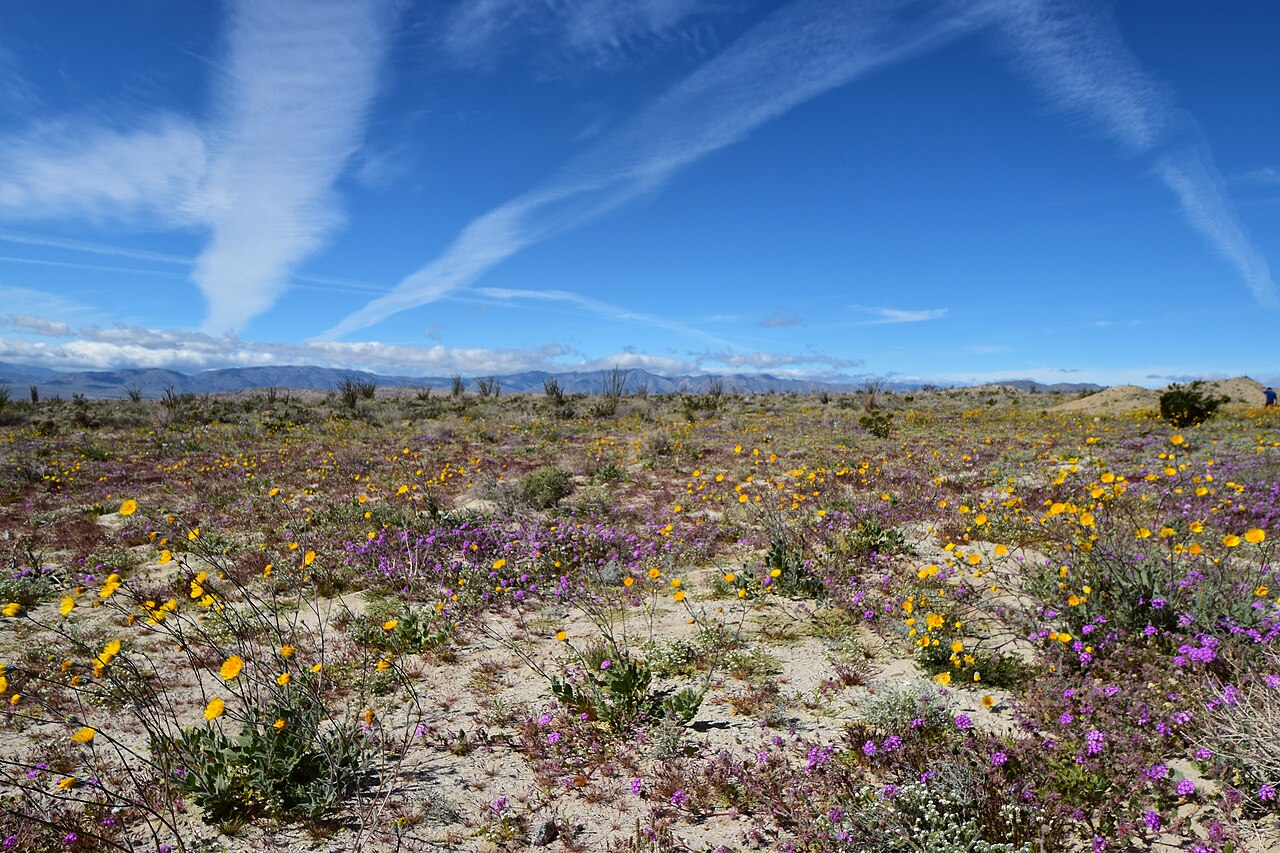
Earth Science · The Water CycleRain falls on Green Lake in the final pages, and the closing image is a working piece of earth science. Water moves in a loop: it evaporates from oceans and soil, rises, cools, condenses into cloud, and returns as precipitation. A drought is not a break in that cycle so much as a long local failure of its last step, and when the step resumes, dry country can change with startling speed. Desert soils hold a seedbank — dormant seeds waiting years for enough moisture — and a single wet season can green a basin that looked permanently dead. Playa lakes refill the same way, shallow and temporary at first. Sachar’s ending is therefore not magic dressed up as weather. It is the one consequence in the book that needed no human to grant it, and it arrives only once the humans have finally done what they should have done.
Visual AidWhat one wet season can wake
Photograph of a desert basin in flower after a wet season, the recovery the Knowledge Bank describes. The seeds were already in this ground, dormant, waiting for enough rain; nothing was planted. This is Anza-Borrego in California, not Green Lake, and a bloom like it is not guaranteed by any single storm. Notice how thin the soil still looks between the plants. The desert did not stop being a desert; it simply got the one thing it had been missing.
Wildflower bloom, Anza-Borrego Desert State Park, California, USA; US Bureau of Land Management. Source: Wikimedia Commons, file "2019 wildflower bloom at Anza Borrego State Park, California" (40319157043).jpg, public domain.
ⓘ Vocabulary words are selected to help you understand and complete this workbook. Some may not appear verbatim in the novel.
epiloguen.Ch.50
A final section that tells what happens after the main story
“The epilogue shows how the boys’ lives turned out.”
fortunen.Ch.50
A very large amount of money
“The treasure was a fortune worth nearly a million dollars.”
descendantn.Ch.50
A person related to someone who lived long ago
“Zero is a descendant of Madame Zeroni.”
reunitev.Ch.50
To bring people back together after being apart
“Hector is able to reunite with his mother.”
prosperv.Ch.50
To become successful and do well
“Both families went on to prosper.”
justicen.Ch.50
Fairness; people getting what they deserve
“In the end there is justice for everyone.”
gratefuladj.Ch.50
Thankful
“The boys were grateful to be free at last.”
concludev.Ch.50
To bring to an end
“The story concludes with rain on Green Lake.”
faten.Ch.50
The power thought to decide what happens to us
“It was as if fate had brought the two boys together.”
redeemv.Ch.50
To make up for past wrongs; to put things right
“Stanley’s courage seemed to redeem his whole family.”
🧠Knowledge Bank question
1According to the Knowledge Bank, how can a basin turn green after a single wet season?Ch.50
2A “fortune” is a very small amount of money.Ch.50
3Zero is a relative of Madame Zeroni from long ago. He is her —Ch.50
4Fill in each blank with the correct word.Ch.50
Word choices:reuniteprosperfortunefate- some words will not be used
Hector is able to with his mother.
Both families go on to .
5To be “grateful” means to be thankful.Ch.50
6Fairness, with people getting what they deserve, is called —Ch.50
7To bring the whole story to an end is to —Ch.50
8A “descendant” is someone related to a person who lived long ago.Ch.50
9Fill in each blank with the correct word.Ch.50
Word choices:gratefuljusticedescendantredeem- some words will not be used
In the end there is for everyone.
The boys are to be free.
10The power some believe decides what happens to us is called —Ch.50
Part 2
Comprehension
How well do you understand Chapter 50?
🧠Knowledge Bank · A Title With Two Meanings
Language · Puns and TitlesA pun uses one word in two senses at once, and this novel’s title is a pun the reader cannot fully hear until the last chapter. All book long the holes are literal: five feet (about 1.5 meters) deep and just as wide, cut into baked dirt, one per boy per day. The final part fills a different kind of hole. Every gap the story left open — the curse, the suitcase, the initials on the tube, Zero’s real name, the reason the rain stopped — is closed in sequence, and the last chapter is openly about filling in. The two senses turn out to be a single idea. The digging was never about dirt. The boys were excavating a plot, and a title chosen this well is a small argument about the book that most readers finish hearing only on the final page.
Visual AidOne title, two meanings
Diagram for the Knowledge Bank on the title pun, splitting one word into the two senses the novel uses. It gives three examples of each and leaves the rest of the plot out. It does not claim that every title hides a pun, only that this one was chosen to work twice. Notice that the second meaning cannot be checked until the book is finished. A reader hears the full title only on the last page.
Senses taken from the digging in Parts 1 to 7 and the closing chapter. Drawn for Garden Heights Academy.
🧠Knowledge Bank question
1According to the Knowledge Bank, what second meaning does the title carry?Ch.50
2Zero’s real name is Hector Zeroni.Ch.50
3Why does carrying Zero up the mountain matter so much in the end?Ch.50
4Hector is reunited with his long-lost mother.Ch.50
5Put these ending events in the correct order. Write 1–4 (1 = first).Ch.50
Hector is reunited with his mother.
Rain finally begins to fall on Green Lake again.
Both families become wealthy.
Stanley and Zero go home with the treasure.
6What happens to Camp Green Lake?Ch.50
7After more than a hundred years, it finally begins to rain on Green Lake again.Ch.50
8How is the Warden punished in the end?Ch.50
9The ending shows that the family curse has finally been broken.Ch.50
10Why does the title ‘Holes’ fit the whole book so well?Ch.50
Part 3
Literary Elements
Understanding HOW and WHY Sachar writes Chapter 50 the way he does.
🧠Knowledge Bank · Paying an Inherited Debt
Literary Craft · Resolution and RedemptionThe three-timeline structure is not decoration. It is the book’s argument. By braiding Elya, Katherine Barlow, and Stanley into a single story, Sachar claims that people inherit consequences from strangers they will never meet. A broken promise in a Latvian village and a murder in a Texas town both reach a boy digging in a modern desert, and neither wrong was his. That is the uncomfortable half. The hopeful half is that inheritance runs in both directions: a debt can be paid by someone who never incurred it, and Stanley pays this one without knowing. Resolution means gathering threads, not just stopping: the curse lifts, the camp closes, both families are made whole. Critics call it braided plotting — every object that pays off was planted chapters earlier. The book’s last claim is that an unpaid wrong outlasts everyone who caused it, and closes only when someone with no share in the blame agrees to settle the debt.
Visual AidThree strands, one mountain
Diagram for the Knowledge Bank on resolution. It sets the three timelines side by side, draws an arrow from each to the single place they meet, then lists what each strand handed forward and why braiding them this way is difficult. The dates are approximate and the map is not to scale. It does not claim every novel with flashbacks is built this way — most are not, which is the point. Notice the middle row: God’s Thumb is where the first Stanley Yelnats survived after Kate Barlow robbed him, and it is the same mountain Stanley climbs carrying Zero. One place, two centuries, both strands.
Timeline positions follow the novel’s own account, cross-checked against published summaries. Drawn for Garden Heights Academy.
📚 Literary Devices in This Part · definitions & examples
Theme is the big idea of the whole book. Holes shows that loyalty, kindness, and justice win in the end.Resolution is the ending where all the problems are sorted out. The final chapter ties up every storyline at once.Poetic justice is when characters get exactly what they deserve. The cruel Warden loses everything; the kind boys are rewarded.
The questions below are mixed — not grouped by device. Decide which device each one is about.
🧠Knowledge Bank question
1According to the Knowledge Bank, what is the hopeful half of the novel's claim about inheritance?Ch.50
2The resolution of Holes ties up the curse, the treasure, and every character’s fate.Ch.50
3Fill in the blanks with the correct words.Ch.50
Word choices:justicedeserverhymefate- some words will not be used
In poetic , characters get what they .
4The final chapter sorts out every storyline at once. This tidy ending is called the —Ch.50
5Poetic justice means the cruel are punished and the good are rewarded.Ch.50
6Fill in the blanks with the correct words.Ch.50
Word choices:themekindnessrhymehole- some words will not be used
The big idea of a book is its . Here it is that wins.
7The cruel Warden loses everything while the kind boys are rewarded. When characters get just what they deserve, it is called —Ch.50
8A central theme of Holes is that kindness and loyalty are rewarded in the end.Ch.50
9Fill in the blanks with the correct words.Ch.50
Word choices:resolutionendingrhymecase- some words will not be used
The part that ties up every storyline is the . It is the story’s .
10The final chapter, which ties up every loose end after the climax, is the story’s —Ch.50
Part 4
Think Deeper
Four deeper challenges — no single-word recall. Read, weigh the evidence, and reason it through.
🧠Knowledge Bank · Justice Arriving Late
Ethics · Correcting the RecordThe novel ends with records being corrected, and that is a narrower thing than justice. Stanley’s conviction is erased, the camp is closed and sold, Hector finds his mother, and both families receive the money. Each repair is real. None of them reaches Sam, or Katherine, or the town that let a murder stand, and Sachar does not pretend otherwise. This is worth arguing about, because stories that tie off every thread can teach a comfortable falsehood — that wrongs are eventually settled if you only wait. The novel’s own evidence says something harder. This debt took more than a century, required an accident of friendship, and was closed by people who had not caused it. Ask whether that ending is earned or merely generous, and whether young readers are owed the version in which the accounting finally balances.
1Claim: “In the end, every thread of the story is tied together and justice is done.” — choose the two details that best prove it.Claim & Evidence
2A wrong being set right, or just a detail of the ending? Tap each item to sort it — tap again to switch sides. You can keep tapping to change your answer.Sort into two
◄ A wrong set rightJust a detail ►
3Match each cause to its result. For each cause, pick its result.Cause & Effect
Zero is really Hector Zeroni→
The old promise was finally kept→
The treasure bore Stanley’s name→
The wrong is set right at last→
🧠Knowledge Bank question
4Fill both blanks to complete the reasoning.Build the Argument
The Knowledge Bank warns that the ending corrects records rather than delivering full justice because , which shows that .
Part 5
Standardized Test · Mixed Review & Summary
This final round is a mixed practice test — a little of everything you have learned, plus Prose Summary and Synthesis (choosing and combining what matters most). Read the passage (the highlighted words are reviewed below), then choose the answer best supported by the text.
Read the passage — the highlighted words are tested — then answer. Tap an answer, then tap it again to confirm.
SATWords in Context — a word's meaning in this passage
SATCommand of Evidence — the detail that best supports a claim
SATCentral Ideas — the passage's main point
SATSynthesis — putting information together
SATText Structure & Purpose — how the passage is built, and why
TOEFLVocabulary — a tested word's meaning here
TOEFLFactual Information — a fact stated in the passage
TOEFLInsert Text — where a sentence best fits
Bringing a Dead Lake Back
When a lake dries up, the damage can seem permanent — but not always. Lakes can shrink for many reasons: a long drought, rivers diverted for farming, or a climate that turns hotter and drier. When the water is gone, wind lifts the exposed dust and salt, and the land around it grows harder to live in. For a long time, many people assumed a lost lake was simply gone for good. Around the world, scientists and communities have worked to restore lakes that had shrunk to dust. With careful planning, a barren lakebed can slowly be brought back to life.
Restoration is a gradual process. Workers may replant native grasses, redirect streams, and protect the area from pollution. Over years, water returns, plants take root, and animals come back. Little by little, a distinct ecosystem is revived, able once again to sustain life. The rewards can be immense: a restored lake cools the land, supports abundant wildlife, and lets nearby communities prosper again. Such projects show that with deliberate effort, people can redeem even badly damaged places — a hopeful reminder that harm is not always the end of the story.
Original passage written for Garden Heights — not a quotation from the novel.
1As used in the passage, the word “restore” most nearly means —SAT · Words in Context
2In the passage, “prosper” most nearly means ___.TOEFL · Vocabulary
3According to the passage, to restore a lake, workers may —TOEFL · Factual Information
4In the passage, “redeem” most nearly means ___.SAT · Words in Context
5According to the passage, a restored lake can —TOEFL · Factual Information
6Which detail best supports the idea that a dried lakebed can be brought back to life?SAT · Command of Evidence
7Which statement best expresses the central idea of the passage?SAT · Central Ideas
8Insert Text (TOEFL). Look at the four squares [1]–[4] in the passage excerpt below. They show where the following sentence could be added: “None of these steps works overnight, and many take whole seasons to show any change at all.”
Restoration is a gradual process. [1] Workers may replant native grasses, redirect streams, and protect the area from pollution. [2] Over years, water returns, plants take root, and animals come back. [3] Little by little, a distinct ecosystem is revived, able once again to sustain life. [4]
Where would the sentence fit best?TOEFL · Insert Text
9Taken together, the passage suggests that restoring a lake requires both —SAT · Synthesis
10Why does the author end with “harm is not always the end of the story”?SAT · Text Structure & Purpose
Part 6 · Optional
Creative Writing
A bonus challenge to practice your English.
About This Section
This writing task is optional and not part of your auto-graded score. Feedback checks length, spelling, and grammar only.
Writing Task — Part 8 “Filling in the Holes”
The last chapter ties up every storyline. Write about how Holes ends, and explain why it feels fair and satisfying. What is the main lesson Sachar leaves us with? Write at least 40 words.
You can start with: “By the end of the story, every hole has been filled, because…”
0 / 40 words minimum
🗣 Teach It · Just for Fun (optional)
No right or wrong — close the screen and tell someone nearby what happened in this part. Can’t find anyone? Tell yourself out loud. The moment you teach it, you truly understand it.
🏆
Part 8 Complete!
You finished Chapter 50 of Holes.
Here are your auto-graded results:
-
points out of 100
Teach it to someone
The best last step is to teach it. In your own words, explain what happened — retell a favorite scene, teach a character’s big choice, or sum up the main idea for a parent, friend, or classmate. When you can teach it clearly, you truly own it.
SAT® is a registered trademark of College Board, which is not affiliated with, and does not endorse, these materials. TOEFL® is a registered trademark of ETS. These materials are not endorsed or approved by ETS. Garden Heights is an independent provider of test-style reading practice.