New here? Just sign up with Google — your account includes Matilda, our gift book, forever.
Hoot · Garden Heights
Part 7
for Hoot · Part 7 · Chapters 19–20
8 Parts40 min
What Happens in Part 7
At the groundbreaking, Roy speaks up for the owls — and Mullet Fingers rises out of a burrow before the cameras.
Notes and CamerasRoy's parents let him miss part of school; Mr. Eberhardt writes the dismissal note on condition he behaves sensibly. At school Beatrice shows Roy her own note and slips him his mother's digital camera — Mullet Fingers got the pictures. At the fenced lot, Officer Delinko surprises Curly by asking whether the owls could simply be moved somewhere safe.
The CeremonyAt a quarter to eleven a limousine delivers Chuck Muckle and Kimberly Lou Dixon, the actress who plays Mother Paula on television. By noon the tent, podium, and news cameras are ready — and so is a crowd nobody invited: Mr. Ryan's history class, parents, Beatrice's teammates with hand-lettered signs. Muckle hands out gold-painted shovels; the officials scoop their ceremonial dirt.
Head in the BurrowRoy speaks up about the owls, but his photographs prove nothing. Then a head rises out of the ground: Mullet Fingers has wedged himself into a burrow, a kite string in his teeth, beside a bucket he says holds cottonmouths. Delinko looks inside, sees rubber, and stays quiet. Muckle swings a shovel; Roy and Beatrice step in front of the boy, and a ring of singing students closes around the burrow while the cameras run.
What We Will Learn
Section
What you will practice
Vocabulary
Ceremony and evidence words: dignitary, corroborate, bluff, inconclusive…
Literary Elements
Climax, dramatic irony, and gold paint as a symbol
Cross-Curricular
How a reporter checks a story: sources, records, and a missing file
Chapter Summary
Ch.
What happens
19
Loading the Stage — a signed note, a borrowed camera, a limousine. Roy and Beatrice arrange to be released from school for the groundbreaking; out at the fenced lot Officer Delinko quietly asks whether the owls could be moved somewhere safe; at a quarter to eleven Chuck Muckle arrives with the actress who plays Mother Paula on television.
20
Gold Shovels and a Buried Boy — the ceremony opens before an uninvited crowd of students and parents, Roy’s photographs fail to prove anything, and Mullet Fingers rises out of a burrow with a bucket he says holds cottonmouths. When a shovel swings, the students close a singing circle around him while the news cameras run.
Part 1
Vocabulary
Study 10 key words from Chapters 19–20, then answer each question.
📚Knowledge Bank · Words for Checking a Story
Journalism · Language of VerificationNewsrooms keep a working vocabulary for deciding what is true enough to publish. A source is any person, document, or dataset that supplies information, and reporters rank sources by how directly they know what they describe. An eyewitness and the friend of an eyewitness are not equally useful. When a second source who could not have learned the fact from the first one confirms it, the newsroom has achieved corroboration. A record is different again: a permit, an inspection sheet, or a signed application produced by an office in the course of ordinary business, before anyone thought to argue about it. Editors also insist on attribution, the short phrase that tells a reader exactly where a statement came from. Learning these terms changes how you read a page. Instead of asking whether a claim sounds convincing, you begin asking who said it, what that person could actually see, and whether any paperwork would confirm.
dignitaryn.Ch.19–20
An important official invited to a public event
“Each dignitary was handed a shovel for the photographs.”
ceremonialadj.Ch.19–20
Done as part of a formal public ritual
“The first scoop of dirt was purely ceremonial.”
spectaclen.Ch.20
A striking public display that draws onlookers
“The standoff turned the empty lot into a spectacle.”
corroboratev.Ch.19–20
To support a statement with added, independent evidence
“Nothing in the blurry pictures could corroborate Roy’s warning.”
bluffn.Ch.20
A bold pretense meant to make others back down
“The covered bucket was a bluff, and it worked for a while.”
defusev.Ch.20
To make a tense situation calmer and less dangerous
“Delinko tried to defuse the standoff with a quiet suggestion.”
brandishv.Ch.20
To wave an object about in a threatening way
“An angry executive should never brandish a shovel at a child.”
solidarityn.Ch.20
Unity among people who share a cause
“Linked arms around the burrow were a picture of solidarity.”
inconclusiveadj.Ch.20
Not settling a question one way or the other
“The photographs were inconclusive, so the crowd stayed unconvinced.”
composuren.Ch.19–20
Calm control of your feelings in front of others
“Muckle lost his composure the moment the cameras turned.”
ⓘ The vocabulary words in this list are selected to help you understand and complete this workbook. Some may not appear verbatim in the original novel.
🧠Knowledge Bank question
1According to the Knowledge Bank, reporters have truly managed to corroborate a fact only when the second source ___.Ch.19–20
2To support a statement with added, independent evidence is to ___.Ch.19–20
3‘Inconclusive’ evidence settles a question beyond any doubt.Ch.20
4A bold pretense meant to make others back down is a ___.Ch.20
5Fill in each blank with the correct word.Ch.19–20
Word choices:ceremonialcomposurespectaclebrandish- some words will not be used
The officials kept their until the shouting started.
Gold paint turned plain shovels into a prop.
6To wave an object about in a threatening way is to ___.Ch.20
7‘Solidarity’ means unity among people who share a cause.Ch.20
8Keeping your ‘composure’ means feeling no emotion at all.Ch.19–20
9Fill in the blanks with the correct words.Ch.19–20
Word choices:dignitarydefuseinconclusivecorroborate- some words will not be used
The officer tried to the standoff with a quiet suggestion.
Three ruined frames left the argument .
10A striking public display that draws a crowd of onlookers is a ___.Ch.20
Part 2
Comprehension
Show you understood what happens in Chapters 19–20.
📋Knowledge Bank · How a Records Request Works
Civics · Open Government FilesMost government files in the United States belong to the public, not to the officials who store them. Federal agencies answer to the Freedom of Information Act of 1966, and every state has its own version; Florida’s is unusually broad and is known as the Sunshine Law. A citizen makes a request in writing, names the documents wanted as precisely as possible, and delivers it to the office that holds them. The agency must reply within a set period, may charge for copying, and may withhold narrow categories such as medical or active law-enforcement material. What it may not do is demand to know why you want the file. Building permits, zoning applications — requests under the rules for what may be built where —, and environmental reviews are ordinary examples, which is why a construction project leaves a paper trail that anyone may follow. If a document the law requires is absent from the folder, that absence is itself a public fact, and a patient reader can press the office to explain the gap.
Visual AidFollow the paper
Sequence diagram of the request the Knowledge Bank walks through under Florida’s Sunshine Law and the federal FOIA: write down precisely which documents you want, deliver the request to the office that holds them, wait out the set reply period, and read what comes back, with narrow categories withheld. Fees, deadlines, and appeal rules vary by state and are trimmed away here, and the drawing does not claim the process is always this smooth. Two things to notice, both the Knowledge Bank’s: the office may not demand to know why you want the file — and if a paper the law requires is missing, that absence is itself a public fact a patient reader can press on.
Request steps per the Florida Sunshine Law and the federal Freedom of Information Act of 1966, as summarized in standard open-government guides. Drawn for Garden Heights Academy.
🧠Knowledge Bank question
1The Knowledge Bank explains that when a citizen requests a public file, the agency may NOT ___.Ch.19
2What does Beatrice hand Roy before class?Ch.19
3Who steps out of the limousine with Chuck Muckle?Ch.19
4Officer Delinko asks Curly whether the owls could be moved somewhere safe.Ch.19
5Write the numbers 1–5 in the boxes to show the correct order of events in Chapters 19–20. Number 1 = what happens first.Ch.19–20
Beatrice slips Roy the camera with Mullet Fingers’ pictures.
Students link arms around the burrow and begin to sing.
Roy’s father signs the note that releases him from school.
The officials scoop ceremonial dirt with gold-painted shovels.
A limousine delivers Chuck Muckle and Kimberly Lou Dixon.
6Roy’s photographs clearly show the burrowing owls to the crowd.Ch.20
7How does Mullet Fingers stop the ceremony?Ch.20
8What does Mullet Fingers claim is inside the bucket?Ch.20
9Officer Delinko tells the crowd at once that the snakes are only rubber toys.Ch.20
10What happens at the very end of the standoff scene?Ch.20
Part 3
Literary Elements
Understanding HOW and WHY Carl Hiaasen (author) tells the story across Chapters 19–20.
🧠Knowledge Bank · Staging a Climax in Public
Literary Craft · Climax and IronyA climax works best when the author has quietly arranged every requirement in advance. Hiaasen spends these chapters assembling an audience: notes signed by parents, classmates released from a history lesson, a limousine, a company hungry for photographs. By the time the shovels appear, the lot holds nearly everyone who has wanted something for twenty chapters, so one boy in a hole can force all of them to react at once. The author also splits what characters know from what readers know, which is irony of the dramatic kind: we can see that the bucket is a bluff while the executive cannot. Notice, too, that the proof arrives in the wrong order. Blurry pictures fail, a live bird appears only after the children have already committed themselves, and the chapter refuses any tidy verdict. Comedy and real danger share the same paragraph, a mixture that keeps a serious argument from hardening into a lecture.
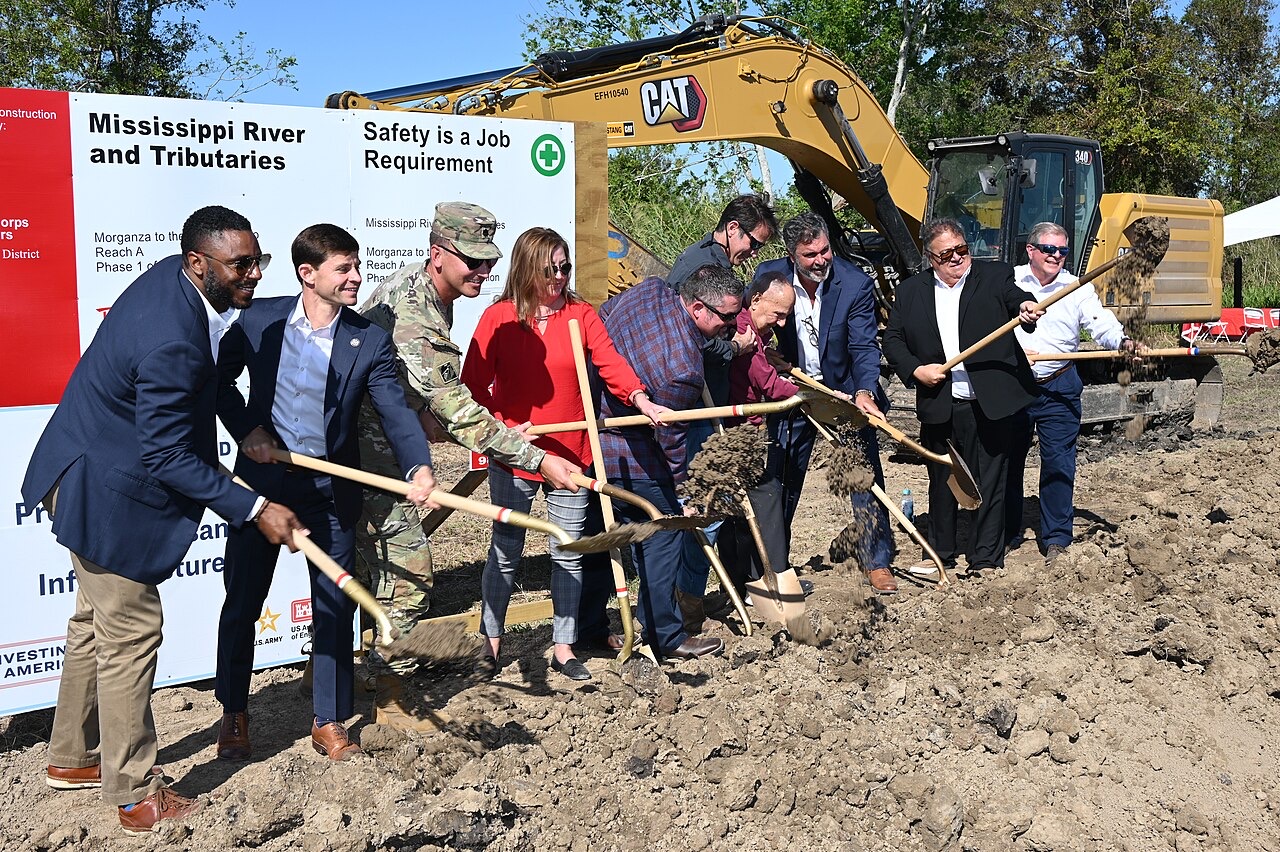
Visual AidThe ritual the climax borrows
Photograph of a real groundbreaking ceremony, held by the U.S. Army Corps of Engineers in Louisiana in October 2024: dignitaries in a row, polished shovels, dirt caught in mid-air for the cameras, and a machine parked behind as scenery. This is the public ritual the Knowledge Bank shows Carl Hiaasen (author) assembling for his climax — an event that exists in order to be photographed, which is exactly why one boy in a hole can seize it. The ceremony here launched a flood-protection project, not a restaurant; nobody in it is a character, and nothing about the picture is satire. Notice how the shovels shine: they are props, and the digging that counts belongs to the machine behind.
Groundbreaking ceremony for Reach A of the Morganza-to-the-Gulf hurricane protection system, Houma, Louisiana, October 23, 2024; photograph by Team New Orleans, U.S. Army Corps of Engineers. Source: Wikimedia Commons, File:Morganza to the Gulf Reach A Groundbreaking Ceremony 23 Oct 2024 - 1.jpg, public domain.
Climax
Twenty chapters of separate wanting collide on one roped-off lot — nothing can stay private now.
Dramatic irony
Delinko and the reader know the bucket holds rubber; the man with the shovel does not.
Symbolism
Gold paint on ordinary shovels: publicity dressed as progress, and it flakes.
🧠Knowledge Bank question
1According to the Knowledge Bank, the irony in these chapters is 'dramatic' because ___.Ch.19–20
2Fill in the blanks with the correct literary terms.Ch.19–20
Word choices:climaxironysequelpreface- some words will not be used
The groundbreaking scene is the novel’s .
Readers know the bucket is a bluff, which creates dramatic .
3Letting readers and Delinko see through the bucket while Muckle rages is ___.Ch.20
4Hiaasen keeps comedy and real danger inside the same scene.Ch.20
5The gold-painted shovels work in the scene as a symbol of ___.Ch.20
6The failure of Roy’s photographs lowers the tension in the scene.Ch.20
7Why does Hiaasen let the students, not an adult, break up the ceremony?Ch.20
8Fill in the blanks with the correct literary terms.Ch.20
Word choices:symbolsatiresonnetsimile- some words will not be used
The gold-painted shovels are a of publicity.
Hiaasen mocks the company with steady .
9Hiaasen tells these two chapters through one character only.Ch.19–20
10Chapters 19–20 mainly work to ___.Ch.19–20
Part 4
Think Deeper
Four deeper challenges — no single-word recall. Read, weigh the evidence, and reason it out.
💡Knowledge Bank · Documents Against Denials
Media Ethics · Weighing EvidenceWhen a company and a critic disagree, a careful reader does not simply pick the friendlier voice. Weigh the kinds of evidence instead. A denial is cheap to produce and can be rewritten tomorrow, while a filed document is dated, signed, and hard to alter after the fact. That is why investigators prefer paperwork to statements, and why a file that cannot be produced troubles them more than an angry press release does. Yet absence demands care as well. A folder can be incomplete because a clerk misplaced pages, because the law never required the item, or because someone removed it, and honest reporting keeps those three possibilities separate until one of them can be shown. Responsible journalists publish the document, describe plainly what it does not contain, and let readers judge. Ethics here is mostly discipline: name your sources, admit what remains unsettled, and never let a strong suspicion stand in for proof.
Think back over these chapters. A striped tent, a podium, a row of folding chairs, reporters checking their light — and then a crowd nobody put on the guest list: middle-schoolers, their parents, a soccer team carrying hand-lettered signs. Gold paint flakes off the shovels as the officials pose above a square of roped-off dirt. A boy stands up and says there are birds living under this lot, then holds out a camera that proves almost nothing. And the ground answers: a head, a kite string, a bucket, a company man with a shovel lifted over a child. Two friends step into that gap, hands find other hands, and the circle holds while the cameras keep running.
Original passage written for Garden Heights — not a quotation from the novel.
1Claim: “The ceremony collapses because Mother Paula’s invited an audience it could not control.” — choose the two details that best prove it.Claim & Evidence
2Evidence anyone could check, or Bluff or performance? Tap each detail to sort it — tap again to switch sides. You can keep tapping to change your answer.Sort into two
◄ Evidence anyone could checkBluff or performance ►
3Match each cause to its result. For each cause, pick its result.Cause & Effect
Roy’s father signs a note releasing him from class→
The pictures taken at the burrows turn out blurry→
Mullet Fingers wedges himself into a burrow with a bucket→
Delinko looks inside the bucket and says nothing→
🧠Knowledge Bank question
4Fill both blanks to complete the reasoning.Build the Argument
Investigators trust a filed document more than a company's denial because , which shows that .
Part 5
Standardized Test
Reading passage · How a Reporter Checks a Story · Evidence & Words in Context · SAT & TOEFL-style practice
Read the passage — the highlighted words are tested — then answer. Tap an answer, then tap it again to confirm.
SATCentral Ideas — the passage's main point
SATInference — a conclusion the passage implies
SATWords in Context — a word's meaning in this passage
TOEFLFactual Information — a fact stated in the passage
TOEFLVocabulary — a tested word's meaning here
How Reporters Verify a Claim
A reporter who hears a striking claim does not simply print it. The first job is sourcing: finding out who says the thing, how that person could know it, and what interest they might have in being believed. A careful journalist then tries to corroborate the claim, which means looking for a second, independent source that confirms the same fact. Two people repeating a rumor they both picked up at the same meeting are not independent. Confirmation counts only when it arrives from somewhere the first source could not have supplied.
Documents are the strongest kind of confirmation, because they were created before the argument began. In the United States, public-records laws let any citizen ask a government office for files it keeps: permits, inspection reports, budgets, and letters. Such a request needs no stated reason, no lawyer, and no press badge, and the office must answer within a set number of days. Reporters file these requests constantly, since a signed permit outlasts any spokesperson's memory. When the paperwork and the press release disagree, the confident denial may prove to be a bluff — certainty with nothing behind it — and the disagreement itself becomes the story.
Sometimes the most telling document is the one that is absent. If a file an agency is required to keep cannot be produced, that gap alone is inconclusive: it might reflect careless filing or deliberate concealment, and a reporter must weigh both possibilities before printing either. Careful attribution keeps that difference visible: readers should always be able to tell whether a sentence rests on a record, an interview, or a writer's guess. A quotation proves only that somebody said something. A paper trail shows what was actually filed, approved, and signed.
Original passage written for Garden Heights — not a quotation from the novel.
1What is the passage mainly about?SAT · Central Ideas
2According to the passage, sourcing means finding out ___.TOEFL · Factual Information
3Why are two people repeating the same rumor NOT independent sources?SAT · Inference
4In the passage, corroborate means ___.SAT · Words in Context
5What do public-records laws let a citizen do?TOEFL · Factual Information
6The passage says a records request does NOT require ___.TOEFL · Factual Information
7In the passage, bluff most nearly means ___.TOEFL · Vocabulary
8Why does the passage call documents the strongest confirmation?SAT · Central Ideas
9In the passage, inconclusive most nearly means ___.SAT · Words in Context
10The passage suggests a paper trail beats a quotation because ___.SAT · Inference
Part 6 · Optional
Creative Writing
A bonus challenge to practice your English. Take your time and have fun with it.
About This Section
This writing task is optional and is not part of your auto-graded score. The feedback below checks only the basics — length, spelling, and grammar — not whether your ideas are right or wrong. It is meant for classroom discussion and creative practice, so feel free to use your imagination!
Writing Task — Part 7 “The Circle”
At the groundbreaking, a ring of students closes around one boy while the grown-ups stand and watch. Write about a time you either stepped in for someone — or stood still and did not. What decided it: the people beside you, the risk, or something else? 6–10 sentences. End with what you would do if the same moment came around again.
You can start with: “The moment when I had to decide was much shorter than I expected...”
0 / 40 words minimum
🗣 Teach It · Just for Fun (optional)
No right or wrong — tell someone nearby what happened in this part. Can’t find anyone? Tell yourself out loud. The moment you teach it, you truly understand it.
Part 7 Complete!
You finished Chapters 19–20 of Hoot.
Here are your auto-graded results:
-
points out of 100
Teach it to someone
The best last step is to teach it. In your own words, explain what happened — retell a favorite scene, teach a character’s big choice, or sum up the main idea for a parent, friend, or classmate. When you can teach it clearly, you truly own it.
Independent study guide by Garden Heights. Not affiliated with or endorsed by Carl Hiaasen. Contains original analysis only; no text from the novel is reproduced. Reference text: This workbook follows Carl Hiaasen’s classic text (the standard Puffin edition sold worldwide). Revised 2023 UK editions change some wording and may not match the vocabulary studied here.
SAT® is a registered trademark of College Board, which is not affiliated with, and does not endorse, these materials. TOEFL® is a registered trademark of ETS. These materials are not endorsed or approved by ETS. Garden Heights is an independent provider of test-style reading practice.