
Part 4
Alone and in danger, Karana faces a hard truth: to survive she needs weapons, yet an old law of her people forbids women to make them, warning that the weapons may break or bring bad luck. After a long inner struggle, she decides that survival matters more than the old rule, and she teaches herself to shape a bow, arrows, and a spear, stringing the bow with sinew. Once she can defend herself, a deeper longing takes hold: she cannot bear to stay on the island where her brother died and her people are gone. She finds a place where the tribe hid several canoes, works one free, and paddles east into the open ocean, following the direction the others sailed, hoping to reach the far land. But the sea is vast, the small canoe begins to leak badly, and she is many miles from any shore. As she bails and worries, a school of dolphins appears and swims alongside her, and their bright company steadies her spirit. Realizing the leaking canoe will never carry her across so much water, Karana turns back toward the island — and, to her own surprise, feels almost glad as its familiar shape rises again from the sea. The island, she begins to understand, is home.
| Section | What you will practice |
|---|---|
| Vocabulary | Self-reliance words: forbid, weapon, defy, horizon, retreat… |
| Literary Elements | The dolphin symbol, the theme of self-reliance, and a surprising irony |
| Cross-Curricular | Ocean currents and the vast Pacific |
| Ch. | What happens |
|---|---|
| Chapters 12–13 | Breaking the Law — Karana defies the old rule that forbids women to make weapons, and teaches herself to build a bow, arrows, and a spear. |
| Chapters 14–15 | Out to Sea and Back — she finds hidden canoes and paddles east; the canoe leaks and dolphins swim alongside; she turns back, almost glad to see her island home. |
Four words, and they are arranged as an argument. To forbid is to order that something not be done, and an old law forbade women to make weapons. A weapon is a tool made for hunting or fighting, and Karana makes one to defend herself. Sinew is a strong cord from an animal, used as string, and she strings the bow with it. To defy is to boldly go against a rule, and she chooses to defy the old law. Notice that the middle two words are practical and the outer two are moral. The bow is just a bow — wood, sinew, patience. What makes the scene matter is that Karana has to break something older than the dogs before she can build it, and there is nobody left on the island to give her permission.
ⓘ The vocabulary words in this list are selected to help you understand and complete this workbook. Some may not appear verbatim in the original novel.
Making Weapons and Trying the Sea is organized around a difficult decision, the risk it creates, and the eventual result. Alone and in danger, Karana faces a hard truth: to survive she needs weapons, yet an old law of her people forbids women to make them, warning that the weapons may break or bring bad luck. After a long inner struggle, she decides that survival matters more than the old rule, and she teaches herself to shape a bow, arrows, and a spear, stringing the bow with sinew. Once she can defend herself, a deeper longing takes hold: she cannot bear to stay on the island where her brother died and her people are gone. Once decision and result are joined, “Making Weapons and Trying the Sea” supplies narrative momentum.
- She makes a bow, arrows, and a spear.
- She paddles east, but the canoe begins to leak.
- Dolphins appear and she turns back to the island.
- She finds the tribe’s hidden canoes.
- Karana decides to defy the old law about weapons.
Scott O’Dell makes the midpoint turn through symbolism, theme, and irony rather than through explanation alone. The dolphins that swim beside Karana’s canoe give the whole book its name, and they work as symbolism — more than animals, they carry meaning. Alone and afraid on a leaking boat far from land, Karana finds her fear ease when the bright dolphins appear and travel with her. They are companionship in a place with no people, a flash of life and beauty in an empty sea, and, in the old feeling of her people, a hopeful sign. Notice how O’Dell links them to home: it is with the dolphins around her that Karana turns back, and the island she returns to is the Island of the Blue Dolphins. That authorial design makes “The Blue Dolphins” a lesson in deliberate symbolism.
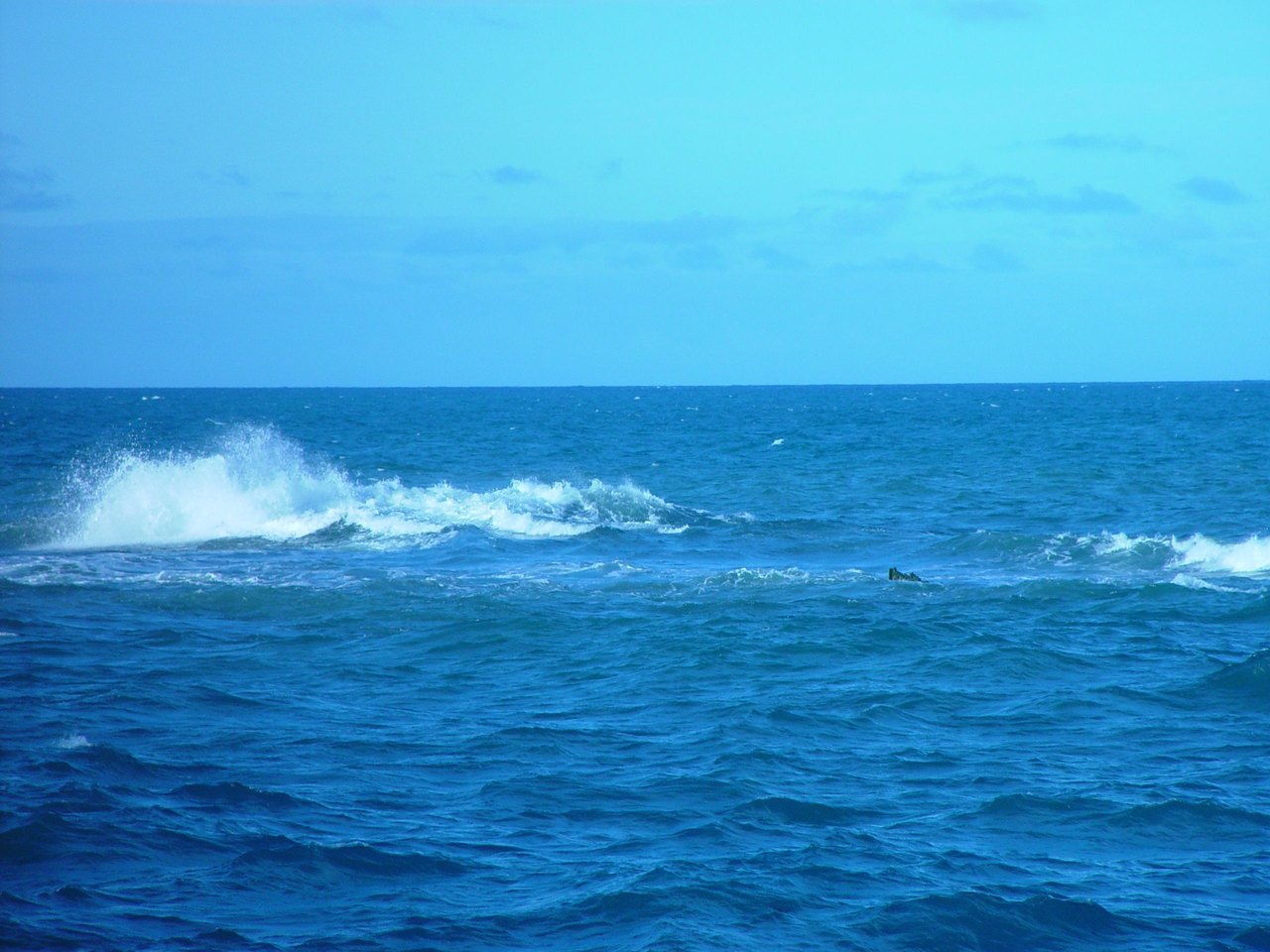
When Karana paddles east in a leaking canoe, she is testing herself against the largest ocean on Earth. The Pacific is so vast that all the world’s land could fit inside it with room to spare, and the stretch of open water between her island and the California mainland is many miles of nothing but sea. That water is never still. Great currents — rivers within the ocean — move constantly, driven by wind and by the turning of the Earth, and near California a cold current sweeps down the coast. A small canoe on such water is at the mercy of these forces: currents can push a boat far off its course, and a single leak, far from land, can turn a voyage into a disaster. Karana turns back, and the book treats that as a victory. She has measured the distance honestly, in a boat she made herself, and decided the island is survivable and the ocean is not — the first genuinely adult judgment anyone in this novel makes.
Think back over these chapters. A girl who was taught that women must not make weapons picks up wood and sinew anyway, because the alternative is death, and shapes herself a bow and a spear with her own hands. Then, still aching to be gone from the place where her brother died, she works a hidden canoe free and paddles east toward the land that swallowed her people. But the sea goes on forever, water begins to slip in through a crack, and she is a speck on a moving giant. Bright shapes rise around her — dolphins, keeping pace, easing her fear — and she understands the leaking boat will never make the crossing. She turns the canoe around, and when the little island lifts again out of the waves, her heart, to her own surprise, lifts too.
When Karana paddles east in her canoe, she is challenging the largest ocean on Earth. The Pacific is so vast that all the world’s land could fit inside it with room left over. Between her island and the California mainland lie many miles of open water. To a person in a small boat that emptiness is almost impossible to imagine: hour after hour there is nothing to see but sea meeting sky in every direction.
That water is never still. A great current moves through the ocean like a river within it, pushed along by steady winds and by the turning of the Earth, and near the coast of California a cold one sweeps down from the north. For a small canoe such moving water is a serious danger, because it can carry a boat far off the course its paddler intended. Add a single leak, far from any land, and a voyage can quickly become a fight for life. This is why Karana’s decision to turn back is wise rather than weak: she reads the sea honestly, and knowing when to retreat is part of staying alive.
“Judgment like this is not the opposite of bravery; it is part of it.”
This writing task is optional and is not part of your auto-graded score. The feedback below checks only the basics — length, spelling, and grammar — not whether your ideas are right or wrong. It is meant for classroom discussion and creative practice, so feel free to use your imagination!
Writing Task — Part 4 “Doing It Myself”
Karana breaks an old rule and learns to make her own weapons and shelter. Write about a time you had to do something difficult on your own, without help. What was it, how did you manage, and what did you learn about yourself? 6–10 sentences. End with how it felt to rely on yourself.
No right or wrong — close the screen and tell someone nearby what happened in this part. Can’t find anyone? Tell yourself out loud. The moment you teach it, you truly understand it.


Part 4 Complete!
You finished Chapters 12–15 of Island of the Blue Dolphins.
Here are your auto-graded results:
The best last step is to teach it. In your own words, explain what happened — retell a favorite scene, teach a character’s big choice, or sum up the main idea for a parent, friend, or classmate. When you can teach it clearly, you truly own it.
Independent study guide by Garden Heights. Not affiliated with or endorsed by Scott O'Dell. Contains original analysis only; no text from the novel is reproduced. Reference text: This workbook follows Scott O'Dell’s classic text (the standard Puffin edition sold worldwide). Revised 2023 UK editions change some wording and may not match the vocabulary studied here.