New here? Just sign up with Google — your account includes Matilda, our gift book, forever.
Julie of the Wolves · Garden Heights
Part 1
for Julie of the Wolves · Part 1 · Part I · Alone on the North Slope
8 Parts40 min
What Happens in Part 1
Lost on the tundra with no food, thirteen-year-old Miyax survives by studying the wolf pack her father taught her to read.
Already lostMiyax, thirteen, has walked for days; her food is gone and the flat tundra gives her nothing to steer by.
Studying the packThe one resource in sight is a wolf pack, so she does what her father taught her and studies them, sorting out the pack's order over two days.
Naming the wolvesShe names them — Amaroq the black leader, Silver, Nails, and low-ranking Jello — and works out that they speak almost entirely with their bodies. Still hungry, she is no longer helpless: she has learned what to look at.
What We Will Learn
Section
What you will practice
Vocabulary
Words for the tundra and for hunger: tundra, gaunt, wary, submission, forage…
Literary Elements
An opening that starts in the middle of the danger, and a pack drawn as a family
Cross-Curricular
Arctic biology — how a wolf pack is organized and how it talks without sound
Scene Summary
Scene
What happens
Opening
Amaroq, the Wolf — The novel begins with the trouble already happening. Miyax, thirteen years old, is lying on her stomach on the Alaskan North Slope, surrounded by nothing but grass and sky. She has no food left, no compass and no landmark to steer by, and the small pack of wolves a short distance away is the only thing in sight that can feed her. She is frightened of them, and at the same time she remembers what her father Kapugen taught her: that wolves are gentle brothers, and that a person who learns their language can ask them for help.
Watching the pack
For two days Miyax does nothing but watch. She works out who the wolves are and gives them names: the big black leader is Amaroq, the mother is Silver, the second-ranking male is Nails, and the nervous one at the bottom of the order is Jello. She notices that the pack is not a crowd of animals but a family with rules, and that almost everything they say to one another is said with the body — an ear, a tail, the angle of a shoulder. Learning to read those signals stops being interesting and starts being the only way she is going to eat.
Part 1
Vocabulary
Study 10 key words from Part I · Alone on the North Slope, then answer each question.
🧊Knowledge Bank · The Words of the Far North
Geography · Tundra WordsPart I runs on words that describe a landscape most readers have never stood in. The tundra is the flat Arctic plain where the ground stays frozen below the surface all year, so tree roots cannot get down and nothing grows tall — which is precisely why Miyax has no landmark to steer by. The horizon is the line where land seems to meet sky, and on ground this level it sits at the same distance in every direction at once, which is its own kind of trap. To call the place desolate is not to say it is ugly but that it offers nothing a person can use: no shelter, no firewood, no help within walking distance. To forage is to search across open ground for whatever food that ground does hold, which on the slope means roots, berries and birds rather than anything large. Notice how many of these words describe an absence rather than a thing. A person who has gone days without eating in a place like that becomes gaunt.
tundran.Pt.I
The flat, treeless Arctic plain, frozen below the surface all year
“Nothing on the tundra stands tall enough to steer by.”
gauntadj.Pt.I
Thin and hollow-looking from hunger or illness
“Days without food had left her gaunt.”
waryadj.Pt.I
Watchful, because something might be dangerous
“She stayed wary of the pack even while she needed it.”
submissionn.Pt.I
Showing that you accept somebody else’s authority
“A lowered tail is a signal of submission.”
posturen.Pt.I
The way a body is held and carried
“Wolves settle most arguments with posture alone.”
ruffn.Pt.I
The thick collar of longer fur around an animal’s neck
“Amaroq’s ruff made him look larger than he was.”
foragev.Pt.I
To search over open ground for food
“She began to forage for roots and berries.”
horizonn.Pt.I
The line where the land appears to meet the sky
“The horizon was the same in every direction.”
desolateadj.Pt.I
Empty, bare and without comfort
“The slope was desolate for as far as she could see.”
gaitn.Pt.I
The particular way a person or animal walks or runs
“She learned each wolf by its gait.”
ⓘ The vocabulary words in this list are selected to help you understand and complete this workbook. Some may not appear verbatim in the original novel.
🧠Knowledge Bank question
1According to the Knowledge Bank, nothing grows tall on the tundra because ___.Pt.I
2Someone who is thin and hollow-looking from hunger is ___.Pt.I
3To be wary is to be watchful because something might be dangerous.Pt.I
4Showing that you accept somebody else’s authority is ___.Pt.I
5Fill in each blank with the correct word.Pt.I
Word choices:foragehorizonshelterposture- some words will not be used
To is to search over open ground for food.
The line where land seems to meet sky is the .
6A ruff is the thick collar of longer fur around an animal’s neck.Pt.I
7A place that is empty, bare and without comfort is ___.Pt.I
8Your gait is the color of your hair.Pt.I
9Fill in each blank with the correct word.Pt.I
Word choices:gauntwaryeagersubmission- some words will not be used
Hunger had left her thin and .
She stayed of the wolves even while she needed them.
10The way a body is held and carried is its ___.Pt.I
Part 2
Comprehension
Show you understood what happens in Part I · Alone on the North Slope.
🐺Knowledge Bank · How a Wolf Pack Is Arranged
Zoology · Pack StructureA wolf pack is not a gang of strangers; it is usually a family. A breeding pair leads, and most of the others are their grown or half-grown young, which is why the group cooperates instead of fighting for control. Rank decides who eats first and who moves aside, and it is settled far more often by posture than by teeth — an ear laid flat, a tail carried low, a shoulder turned away. Biologists once used the word alpha for the leader and then largely dropped it, because in the wild the leaders are simply the parents rather than animals that fought their way up. A low-ranking wolf lives under real pressure: it eats last, it gives way constantly, and it is the one most likely to leave the pack altogether. All of this matters to Miyax for a plain reason. Working out which wolf is which, before doing anything at all, is what keeps her alive.
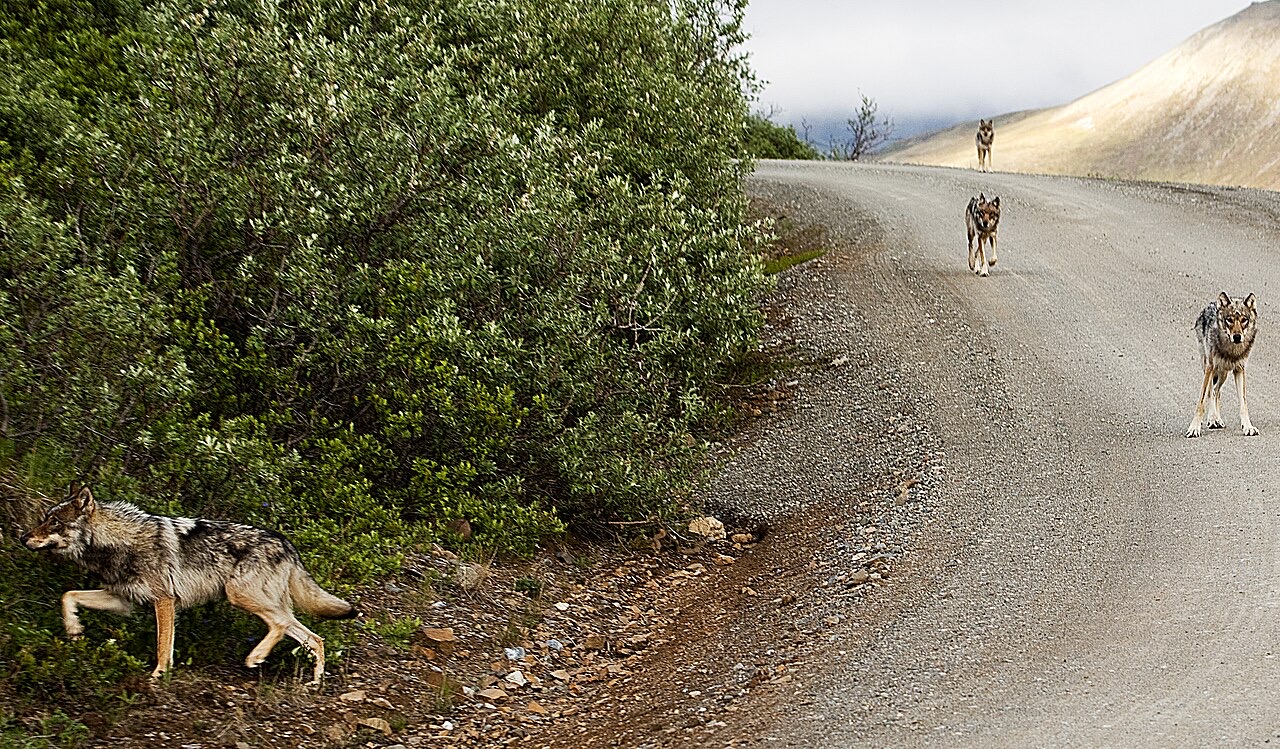
Visual AidA real pack on the move
Photograph of four gray wolves of one pack traveling a park road in Denali National Park, Alaska, in 2010. A pack like this is usually a family — a breeding pair and their grown young — which is what the Knowledge Bank on how a wolf pack is arranged means by cooperation without constant fighting. The picture shows real Alaskan wolves and nothing more: none of these animals is Amaroq, and no rank can be read from a single photograph.
Gray wolf pack on the park road, Denali National Park and Preserve, Alaska; National Park Service photograph by Nathan Kostegian, 2010. Source: Wikimedia Commons, File:Wolf Pack (5301825012).jpg, public domain.
🧠Knowledge Bank question
1The Knowledge Bank explains that biologists largely dropped the word alpha because ___.Pt.I
2How old is Miyax?Pt.I
3What has her father Kapugen taught her about wolves?Pt.I
4What does Miyax name the big black leader of the pack?Pt.I
5Write the numbers 1–5 in the boxes to show the correct order of events in this part. Number 1 = what happens first.Pt.I
She notices a small pack of wolves a short distance away.
She remembers Kapugen’s teaching that wolves are gentle brothers.
She spends two days watching the pack instead of approaching it.
Miyax finds herself lost on the North Slope with her food gone.
She sorts out their ranks and gives each wolf a name.
6Miyax has a compass and a map with her.Pt.I
7Which wolf sits at the bottom of the pack’s order?Pt.I
8Miyax decides the wolves are simply a crowd of animals with no order among them.Pt.I
9How do the wolves say most of what they say to one another?Pt.I
10Miyax approaches the pack immediately on the first day.Pt.I
Part 3
Literary Elements
Understanding HOW and WHY Jean Craighead George (author) tells the story across Part I · Alone on the North Slope.
📖Knowledge Bank · Starting in the Middle of the Trouble
Literary Craft · In Medias ResJean Craighead George (author) opens with a thirteen-year-old lying on the tundra with no food and no way home, and explains none of it. Beginning inside the trouble like this has an old name, in medias res — into the middle of things. It buys a writer two things at once. The first is urgency: a reader who does not yet know why Miyax is out here still knows she is starving, and that alone is enough to keep the pages turning. The second is a debt. Every unexplained fact — why she ran, who Kapugen is, what happened to her mother — becomes a question the book has quietly promised to answer, and holding those questions open is a kind of suspense that costs the author nothing. That is exactly what Part II is for, and it is why the flashback sits in the middle rather than at the start. The order of the telling is doing the work.
Opening in the middle
The book starts with Miyax already lost and already starving. Nothing is explained first; the danger arrives before the background does.
A pack drawn as a family
Amaroq, Silver, Nails and Jello are given ranks and personalities, so the reader meets them the way Miyax does — as individuals, not as wildlife.
Naming as a way of knowing
Miyax cannot speak to the wolves until she can tell them apart, so giving them names is the first real step of her survival, not a decoration.
🧠Knowledge Bank question
1According to the Knowledge Bank, the unexplained facts in the opening act as a debt because ___.Pt.I
2Fill in each blank with the correct term.Pt.I
Word choices:settingconflictrhymechapter- some words will not be used
The time and place a story happens in is its .
A struggle a character has to face is a .
3Giving each wolf a name matters to the story because ___.Pt.I
4The reader is told what Amaroq is thinking.Pt.I
5Describing the wolves with ranks and personalities makes them feel like a family.Pt.I
6The emptiness of the tundra works in the story mainly as ___.Pt.I
7Fill in the blank with the correct term.Pt.I
Word choices:suspenserhymenarratorstanza- some words will not be used
The uneasy waiting an author builds while danger holds off is .
8Miyax’s fear disappears as soon as she decides to approach the wolves.Pt.I
9Kapugen is not present in these scenes, yet he matters because ___.Pt.I
10This opening section mostly works to ___.Pt.I
Part 4
Think Deeper
Four deeper challenges — no single-word recall. Read, weigh the evidence, and reason it out.
🧭Knowledge Bank · Knowing Which Way to Go
Survival Skills · OrientationGetting lost is a navigation problem before it is anything else. Most people find their way by landmarks — a hill, a road, a river — and the Arctic plain supplies none of them, which is why Miyax can walk for days and arrive nowhere in particular. Traditional Arctic travelers solved this with what the land does offer: the direction of the wind-carved snow ridges, the position of the sun through the day, the drift of the coastline, and a memorized chain of place names passed down by people who had already walked it. A magnetic compass is far less help this far north than most people assume, because the magnetic pole is close enough to pull the needle sideways rather than northward. Every one of those traditional methods has to be learned from somebody who knows the ground. Out here, knowing your country is the real instrument.
Visual AidWhy a compass fails at the top of the world
Map-style diagram, not to scale. A compass needle points at the magnetic pole, and in 1972 that pole sat among Canada’s Arctic islands, far from the true North Pole — so at Barrow the needle settles well to the east of true north. This is the Knowledge Bank on knowing which way to go made visible: the instrument most travelers trust is pulled sideways exactly where Miyax is lost. The diagram shows directions only; no route of hers is drawn, and the novel never gives her a compass.
Position of the north magnetic pole in the early 1970s from Natural Resources Canada’s pole-tracking records; declination at Barrow from NOAA’s historical declination calculator. Drawn for Garden Heights Academy.
Think back over this section. A girl of thirteen lies flat on an Arctic plain with her food gone and no landmark in any direction. A short distance away, five wolves go about their day. She is afraid of them and she needs them, and those two facts do not cancel each other out. So she does the only useful thing available: she stops, she watches for two days, and she learns who is who.
Original passage written for Garden Heights — not a quotation from the novel.
1Claim: “This opening section argues that survival depends on knowledge rather than courage.” — choose the two details that best prove it.Claim & Evidence
2Something Miyax observes, or Something Miyax decides? Tap each detail to sort it — tap again to switch sides. You can keep tapping to change your answer.Sort into two
3Match each cause to its result. For each cause, pick its result.Cause & Effect
Miyax has no compass and no landmark→
Her food has run out→
Kapugen taught her that wolves can be spoken to→
She learns each wolf's rank and gait→
🧠Knowledge Bank question
4Fill both blanks to complete the reasoning.Build the Argument
The Knowledge Bank argues that a magnetic compass is little help on the Arctic plain because , which shows that .
Part 5
Standardized Test
Reading passage · How a Wolf Pack Talks Without Sound · Words in Context & Central Ideas · SAT & TOEFL-style practice
Read the passage — the highlighted words are tested — then answer. Tap an answer, then tap it again to confirm.
SATCentral Ideas — the passage's main point
SATWords in Context — a word's meaning in this passage
SATInference — a conclusion the passage implies
TOEFLFactual Information — a fact stated in the passage
How Wolves Talk With Their Bodies
Wolves howl, but howling is the smallest part of what they say to one another. Most of a pack's communication is visual, carried in the posture of the whole animal. A wolf that is confident stands tall, holds its tail high and looks straight ahead, and even its gait gives its rank away, because a high-ranking animal moves at a stiff, deliberate, almost strutting walk. A wolf lower in the order does the reverse, folding its ears back and dropping its tail.
Biologists reading these signals watch four places at once: the ears, the tail, the lips and the angle of the back. A raised ruff across the shoulders makes an animal look larger and usually means it intends to hold its ground. Ears rotated forward signal attention, while ears pinned flat signal the opposite. A newcomer approaching a strange pack must stay wary, watching each of these signals for the smallest hint of trouble, because one misread gesture can turn a calm meeting into a dangerous one. The reason so much gets said this way is simple: an argument settled by posture costs the pack nothing, and an argument settled by teeth can cost it a hunter.
The gestures a lower-ranking wolf uses are the clearest of all, because they have the most work to do. It crouches, it whines, and it may reach up to touch the leader under the chin, a gesture of open submission that pups use with adults and adults keep using all their lives. A pack that reads one another this precisely can hunt together across many kilometers (miles) of ground without a single command being given aloud.
Original passage written for Garden Heights — not a quotation from the novel.
1What is the main idea of the passage?SAT · Central Ideas
2In the passage, wary most nearly means ___.SAT · Words in Context
3According to the passage, a confident wolf ___.TOEFL · Factual Information
4The passage says a raised ruff usually means the wolf ___.TOEFL · Factual Information
5Why does the passage say so much gets settled by posture?SAT · Inference
6In the passage, gait most nearly means ___.SAT · Words in Context
7The chin-touch gesture is described as one that ___.TOEFL · Factual Information
8Which places does the passage say biologists watch?TOEFL · Factual Information
9The last sentence suggests that reading one another precisely lets a pack ___.SAT · Inference
10The passage would be most useful to a reader who wanted to ___.SAT · Inference
Part 6 · Optional
Creative Writing
A bonus challenge to practice your English. Take your time and have fun with it.
About This Section
This writing task is optional and is not part of your auto-graded score. The feedback below checks only the basics — length, spelling, and grammar — not whether your ideas are right or wrong. It is meant for classroom discussion and creative practice, so feel free to use your imagination!
Writing Task — Part 1 “Watching Before Acting”
Miyax spends two whole days watching the wolves before she goes anywhere near them, even though she is starving. Write about a time you had to watch and wait before acting, or about a time you acted too quickly. What did watching teach you that acting straight away would not have? 5–8 sentences. End with one piece of advice about when it is worth waiting.
You can start with: “One time it was worth watching before I acted was...”
0 / 40 words minimum
🗣 Teach It · Just for Fun (optional)
No right or wrong — close the screen and tell someone nearby what happened in this part. Can’t find anyone? Tell yourself out loud. The moment you teach it, you truly understand it.
Part 1 Complete!
You finished Part I · Alone on the North Slope of Julie of the Wolves.
Here are your auto-graded results:
-
points out of 100
Teach it to someone
The best last step is to teach it. In your own words, explain what happened — retell a favorite scene, teach a character’s big choice, or sum up the main idea for a parent, friend, or classmate. When you can teach it clearly, you truly own it.
Independent study guide by Garden Heights. Not affiliated with or endorsed by Jean Craighead George. Contains original analysis only; no text from the novel is reproduced. Reference text: This workbook follows Jean Craighead George’s classic text (the standard Puffin edition sold worldwide). Revised 2023 UK editions change some wording and may not match the vocabulary studied here.
SAT® is a registered trademark of College Board, which is not affiliated with, and does not endorse, these materials. TOEFL® is a registered trademark of ETS. These materials are not endorsed or approved by ETS. Garden Heights is an independent provider of test-style reading practice.