New here? Just sign up with Google — your account includes Matilda, our gift book, forever.
Julie of the Wolves · Garden Heights
Part 4
for Julie of the Wolves · Part 4 · Part II · Seal Camp
8 Parts40 min
What Happens in Part 4
Part II flashes back to Miyax's childhood at seal camp, where Kapugen taught her everything she now knows.
Back to seal campAfter her mother's death, Miyax is raised by Kapugen at a seal camp; he has returned to hunting after quitting a wage job in Mekoryuk.
Learning the old waysShe learns the year by ice and animals, joins the Bladder Feast, is taught by the elder called the bent woman, and is given an i'noGo tied to keep.
Wolves in songsKapugen teaches her about wolves in songs and dances rather than lessons — exactly why the knowledge stays with her years later, answering the question Part I left open: where a thirteen-year-old learned all this.
What We Will Learn
Section
What you will practice
Vocabulary
Words for a life lived on the ice: subsistence, ceremony, amulet, elder, tradition…
Literary Elements
A flashback that answers Part I, and knowledge passed on without a lesson
Cross-Curricular
Inuit subsistence — how one seal feeds and clothes a whole community
Scene Summary
Scene
What happens
Kapugen and the camp
Miyax, the Girl — The book stops the tundra story mid-scene and goes back years. After her mother dies, Miyax is raised by her father Kapugen at a seal camp. He gave up a steady job and his possessions in Mekoryuk when his wife died and returned to hunting, and the child grows up sleeping under his sealskin parka and learning the year by what the sea and the ice are doing. Everything she later uses on the North Slope — how to read an animal, how to wait — she learns here, without a lesson ever being announced.
The Bladder Feast
Miyax takes part in the Bladder Feast, the winter ceremony of her community, and learns from an elder the villagers call the bent woman. She is given an i’noGo tied, a small amulet understood to hold the spirits of animals, and Kapugen teaches her about wolves through song, dance and story rather than instruction. When she tells him plainly that she is Inuit, he takes her in his arms. It is the last completely settled moment of her childhood.
Part 1
Vocabulary
Study 10 key words from Part II · Seal Camp, then answer each question.
🧊Knowledge Bank · The Words of a Life on the Ice
Culture · Words of Camp and CustomPart II needs a vocabulary for a way of living, not for a landscape. Subsistence means living directly on what you hunt, fish or gather, and it is worth being careful with the word: it describes an entire working economy, not poverty and not a hobby. A ceremony is a formal set of actions performed on an important occasion, and the Bladder Feast is the one this camp holds each winter. An elder is an older person respected for what they know, which in a community without written manuals is a genuinely practical role rather than an honorary one. An amulet is a small object kept for protection, and the i’noGo tied is hers. A tradition is a custom carried down the generations. Notice that almost every word here describes something held in common by a group rather than owned by a person, which is precisely what Miyax is about to lose when she is sent away to school.
subsistencen.Pt.II
Living directly on what you hunt, fish or gather
“A subsistence camp eats what it catches that week.”
ceremonyn.Pt.II
A formal set of actions performed on an important occasion
“The Bladder Feast is a winter ceremony.”
amuletn.Pt.II
A small object kept or worn for protection
“The i’noGo tied is an amulet, not a toy.”
eldern.Pt.II
An older person respected for what they know
“An elder taught her what the ceremony meant.”
ancestorn.Pt.II
A member of your family from long ago
“The songs carried what her ancestors had learned.”
carvev.Pt.II
To cut a shape out of wood, bone or stone
“Kapugen could carve a tool in an evening.”
parkan.Pt.II
A heavy hooded coat made for severe cold
“She slept under her father’s sealskin parka.”
reverencen.Pt.II
Deep respect for something
“The hunters treated the seal with reverence.”
traditionn.Pt.II
A custom or belief passed down over generations
“Tradition told them when to hold the feast.”
thrivev.Pt.II
To grow strong and do well
“A camp that shares its catch can thrive.”
ⓘ The vocabulary words in this list are selected to help you understand and complete this workbook. Some may not appear verbatim in the original novel.
🧠Knowledge Bank question
1According to the Knowledge Bank, the word subsistence describes ___.Pt.II
2A small object kept or worn for protection is an ___.Pt.II
3An elder is an older person respected for what they know.Pt.II
4A formal set of actions performed on an important occasion is a ___.Pt.II
5Fill in each blank with the correct word.Pt.II
Word choices:traditionancestorstrangerreverence- some words will not be used
A custom passed down over generations is a .
A member of your family from long ago is an .
6To carve is to cut a shape out of wood, bone or stone.Pt.II
7A heavy hooded coat made for severe cold is a ___.Pt.II
8Reverence means treating something without any respect at all.Pt.II
9Fill in each blank with the correct word.Pt.II
Word choices:thrivesubsistencestruggleelder- some words will not be used
To is to grow strong and do well.
A camp that lives on what it catches is a camp.
10Deep respect for something is ___.Pt.II
Part 2
Comprehension
Show you understood what happens in Part II · Seal Camp.
🦭Knowledge Bank · How One Seal Feeds a Village
Culture · Subsistence HuntingIn a subsistence community a seal is not a meal; it is a warehouse. The meat feeds people and sled dogs, the blubber renders into oil that burns in a lamp for light and heat, the skin makes boot soles, rope, and the waterproof cover of a boat, and sinew becomes thread strong enough to sew a seam that keeps water out. Bone and ivory are carved into tools, and even the gut is dried into a translucent waterproof material once used for rain parkas and window panes. Almost nothing is discarded, and that is a matter of engineering rather than sentiment: there is no shop to replace anything with. Just as important is what happens after the kill. The catch is shared across the community by long-standing rules rather than sold, so a hunter who has a poor season still eats and a lucky one gains standing rather than wealth. It is an insurance system built out of obligation, and it is why Kapugen could walk away from a wage job and still expect his family to thrive.
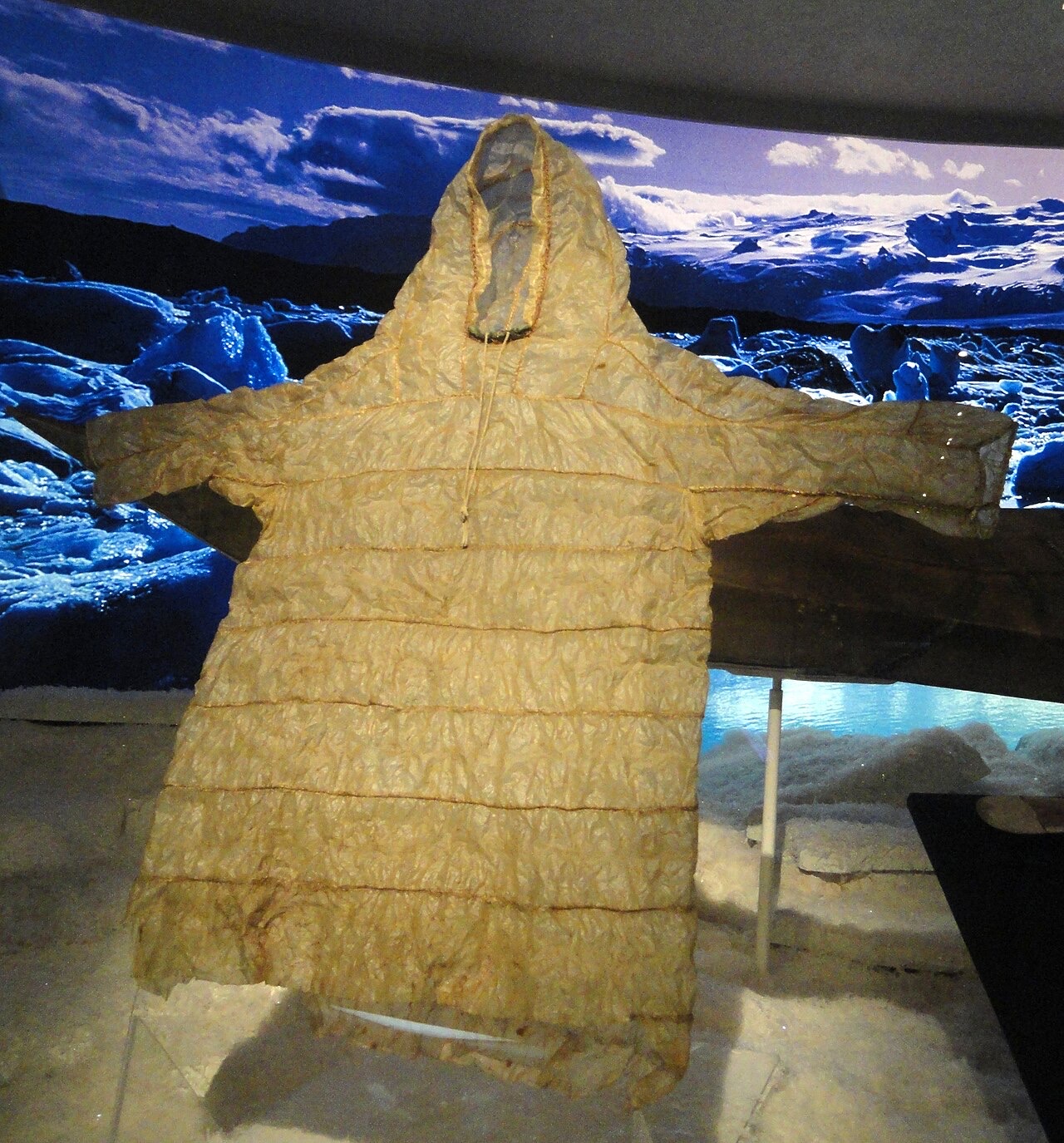
Visual AidA parka sewn from seal gut
Photograph of a child’s parka from Alaska, sewn in the early 1900s from strips of dried seal intestine — the translucent, waterproof material the Knowledge Bank on how one seal feeds a village lists among a seal’s many products. It is now displayed at the Houston Museum of Natural Science. Notice the horizontal seams: each band is a single strip of gut. The garment is a real museum object that belonged to no one in the story, and the icy scene behind it is a printed exhibit panel, not the Arctic.
Child’s seal-gut parka, Inuit, Alaska, early 1900s; Houston Museum of Natural Science, Texas; photograph by Daderot, 2012. Source: Wikimedia Commons, File:Child's Seal Gut Parka, early 1900s, Inuit, Alaska - Houston Museum of Natural Science - DSC02089.JPG, CC0.
🧠Knowledge Bank question
1According to the Knowledge Bank, almost nothing from a seal is discarded because ___.Pt.II
2What does Miyax sleep under as a small child?Pt.II
3Who teaches Miyax about the Bladder Feast?Pt.II
4What is the i’noGo tied?Pt.II
5Write the numbers 1–5 in the boxes to show the correct order of events in this part. Number 1 = what happens first.Pt.II
Kapugen gives up his job in Mekoryuk and returns to hunting.
Miyax grows up at the seal camp learning the year by the ice.
She takes part in the Bladder Feast and is taught by the bent woman.
She tells Kapugen she is Inuit, and he takes her in his arms.
Miyax’s mother dies while Miyax is very young.
6Kapugen teaches Miyax about wolves by sitting her down for lessons.Pt.II
7How does the reader now understand Miyax’s skill with the wolves?Pt.II
8Kapugen was wealthy and comfortable before he went back to hunting.Pt.II
9Miyax telling Kapugen that she is Inuit matters because it shows ___.Pt.II
10Part II begins at the same moment where Part I stopped.Pt.II
Part 3
Literary Elements
Understanding HOW and WHY Jean Craighead George (author) tells the story across Part II · Seal Camp.
⏮Knowledge Bank · Why the Flashback Sits in the Middle
Literary Craft · StructureThe novel breaks off with Miyax about to lose the wolf pack and then spends its entire second part in the past. Told in plain order — childhood, marriage, escape, tundra — the book would be a different and weaker one, because the reader would arrive on the North Slope already knowing why she ran, and the opening would lose its urgency. Placed here, the flashback does three jobs at once. It answers the question the opening deliberately raised, it holds the tundra crisis suspended so the reader carries it through every page of the past, and it lets the two worlds comment on each other without the author explaining anything. Notice that nothing in Part II is suspenseful, because all of it has already happened. Its power comes from dramatic irony instead: we know where this childhood ends up, and the child does not.
Flashback
The story breaks off mid-crisis and goes back years. Everything here is already over by the time Part I begins, which is why it reads as explanation rather than suspense.
Withheld information paid back
Part I raised a question — how does a thirteen-year-old know all this? — and this section pays it off, which is the debt the opening deliberately took on.
Teaching without a lesson
Kapugen never sits her down. Songs, dances and stories carry the knowledge, so the reader sees how it survived years of school without being written down.
🧠Knowledge Bank question
1The Knowledge Bank explains that Part II draws its power from dramatic irony, meaning ___.Pt.II
2Fill in each blank with the correct term.Pt.II
Word choices:flashbackbackstoryrhymestanza- some words will not be used
A scene that jumps back to an earlier time is a .
Everything that happened before the story opened is its .
3Kapugen teaching through songs and dances rather than lessons shows that ___.Pt.II
4This section is written to create suspense about what will happen next.Pt.II
5The book gives Miyax two names, and uses them to mark two different worlds.Pt.II
6The sealskin parka Miyax sleeps under works in the writing as ___.Pt.II
7Fill in the blank with the correct term.Pt.II
Word choices:themerhymechaptersetting- some words will not be used
The big idea a whole book keeps returning to is its .
8The reader is meant to see the seal camp as a hard and joyless place.Pt.II
9Ending the section on Kapugen taking her in his arms is effective because ___.Pt.II
10This section mostly works to ___.Pt.II
Part 4
Think Deeper
Four deeper challenges — no single-word recall. Read, weigh the evidence, and reason it out.
🕯Knowledge Bank · The Bladder Feast: What It Is
Culture · Belief and PracticeThe Bladder Feast is a real winter ceremony, held historically by Yup’ik and related peoples of western Alaska, and this is a factual description of it rather than a recommendation of any belief. Hunters kept the inflated bladders of the seals taken during the year, because the bladder was understood to hold the animal’s spirit. During the festival the bladders were brought into the community house, honored with songs, dances and gifts across several days, and finally returned through a hole in the ice to the sea, so that the animals might choose to give themselves again. Underneath the belief sits a plain idea any reader can recognize: that the animals a community depends on are owed something, and that taking without respect is how a people ruin the thing they live on. Many such ceremonies were suppressed or abandoned under missionary and government pressure, and some are now being deliberately revived.
Visual AidThe Bladder Feast, start to finish
Sequence diagram of the ceremony as the Knowledge Bank on the Bladder Feast records it: bladders kept through the hunting year, brought into the community house at midwinter, honored for several days with songs, dances and gifts, and returned to the sea through a hole in the ice. The drawing is a factual record of a real Yup’ik winter ceremony simplified to four steps; it recommends no belief, and the exact order of events varied from village to village.
The Bladder Festival (Nakaciuq) as documented in ethnographies of the Yup’ik of western Alaska, notably the studies of Ann Fienup-Riordan. Drawn for Garden Heights Academy.
Think back over this section. A small girl grows up at a seal camp, sleeping under her father's parka and learning the shape of the year from the ice and the animals. She takes part in a winter ceremony, is given a small amulet by an old woman, and is taught about wolves in songs rather than lessons. Then she says out loud that she is Inuit, and her father holds her. Everything she will need later, she already has.
Original passage written for Garden Heights — not a quotation from the novel.
1Claim: “This section argues that Miyax's survival skills were inherited rather than invented.” — choose the two details that best prove it.Claim & Evidence
2Something Miyax is given, or Something Miyax is taught? Tap each detail to sort it — tap again to switch sides. You can keep tapping to change your answer.Sort into two
◄ Something Miyax is givenSomething Miyax is taught ►
3Match each cause to its result. For each cause, pick its result.Cause & Effect
Miyax's mother dies→
Kapugen raises her at a seal camp→
He teaches wolves through songs and stories→
She tells him plainly that she is Inuit→
🧠Knowledge Bank question
4Fill both blanks to complete the reasoning.Build the Argument
The Knowledge Bank explains that the seal bladders were returned to the sea because , which expresses the idea that .
Part 5
Standardized Test
Reading passage · Why a Catch Is Shared · Words in Context & Central Ideas · SAT & TOEFL-style practice
Read the passage — the highlighted words are tested — then answer. Tap an answer, then tap it again to confirm.
SATCentral Ideas — the passage's main point
SATWords in Context — a word's meaning in this passage
SATInference — a conclusion the passage implies
TOEFLFactual Information — a fact stated in the passage
TOEFLInsert Text — where a sentence best fits
Sharing the Catch in Arctic Hunts
In Arctic hunting communities that live by subsistence — feeding themselves directly from what they hunt, fish, and gather — the question of who owns a catch has a surprising answer: to a large extent, everybody does. A seal or a whale is divided according to long-standing rules that reach well beyond the household of the hunter who took it, so meat moves outward through the community rather than staying where it landed. To an outsider this can look like simple generosity. It is better understood as engineering.
Hunting is unreliable in a way farming is not. A skilled hunter can work for a week and come home with nothing, and the following week take more than one family could possibly eat before it spoiled. Sharing solves both halves of that problem at once. The surplus is stored in other people rather than in a cellar, and the debt it creates is repaid when the luck reverses, so the whole community is insured against the bad weeks that are certain to arrive.
The system also decides what success means. Because the catch cannot easily be turned into private wealth, a hunter who does well gains standing and obligation instead of property, and generosity becomes the thing worth having. It is why such communities thrive in a country where a single family, hoarding its own catch, would go hungry. Anthropologists studying such arrangements have found them across the world wherever food arrives unpredictably and cannot be kept for long. The rule is not a moral decoration laid over the economy; it is the economy.
Original passage written for Garden Heights — not a quotation from the novel.
1What is the main idea of the passage?SAT · Central Ideas
2According to the passage, a catch is divided ___.TOEFL · Factual Information
3In the passage, subsistence most nearly means ___.SAT · Words in Context
4The passage says hunting is unreliable in a way that ___ is not.TOEFL · Factual Information
5Insert Text (TOEFL). Look at the four squares [1]–[4] in the excerpt below. They show where this sentence could be added: “A cellar can be robbed or spoiled, but an obligation cannot.”
Sharing solves both halves of that problem at once. [1] The surplus is stored in other people rather than in a cellar, [2] and the debt it creates is repaid when the luck reverses, [3] so the whole community is insured against the bad weeks that are certain to arrive. [4]
Where would the sentence fit best?TOEFL · Insert Text
6It can be inferred that a hunter who shares a large catch ___.SAT · Inference
7In the passage, thrive most nearly means ___.SAT · Words in Context
8The passage says such sharing arrangements are found ___.TOEFL · Factual Information
9The final sentence mainly argues that the sharing rule ___.SAT · Inference
10The passage would be most useful to a reader trying to understand ___.SAT · Inference
Part 6 · Optional
Creative Writing
A bonus challenge to practice your English. Take your time and have fun with it.
About This Section
This writing task is optional and is not part of your auto-graded score. The feedback below checks only the basics — length, spelling, and grammar — not whether your ideas are right or wrong. It is meant for classroom discussion and creative practice, so feel free to use your imagination!
Writing Task — Part 4 “Something Somebody Taught You”
Everything that keeps Miyax alive on the tundra was taught to her years earlier, mostly without anybody calling it a lesson. Write about something useful you learned from a person rather than from a book or a screen. Who taught you, how did they teach it, and when did you find out it mattered? 5–8 sentences. End with one thing you would want to pass on to somebody else.
You can start with: “One thing I would want to pass on to somebody else is...”
0 / 40 words minimum
🗣 Teach It · Just for Fun (optional)
No right or wrong — close the screen and tell someone nearby what happened in this part. Can’t find anyone? Tell yourself out loud. The moment you teach it, you truly understand it.
Part 4 Complete!
You finished Part II · Seal Camp of Julie of the Wolves.
Here are your auto-graded results:
-
points out of 100
Teach it to someone
The best last step is to teach it. In your own words, explain what happened — retell a favorite scene, teach a character’s big choice, or sum up the main idea for a parent, friend, or classmate. When you can teach it clearly, you truly own it.
Independent study guide by Garden Heights. Not affiliated with or endorsed by Jean Craighead George. Contains original analysis only; no text from the novel is reproduced. Reference text: This workbook follows Jean Craighead George’s classic text (the standard Puffin edition sold worldwide). Revised 2023 UK editions change some wording and may not match the vocabulary studied here.
SAT® is a registered trademark of College Board, which is not affiliated with, and does not endorse, these materials. TOEFL® is a registered trademark of ETS. These materials are not endorsed or approved by ETS. Garden Heights is an independent provider of test-style reading practice.