
Julie of the Wolves cover
Garden Heights

Julie of the Wolves

This workbook is for Garden Heights members. Sign in to continue.

Sign in with Google →
New here? Just sign up with Google — your account includes Matilda, our gift book, forever.
Julie of the Wolves · Garden Heights

Part 8

for Julie of the Wolves · Part 8 · Part III · Kangik, and the Last Line
8 Parts40 min
What Happens in Part 8

Miyax finds Kapugen alive but changed, loses Tornait, and turns back to the village — answering at last to Julie.

Father, aliveAtik and Uma mention a hunter at Kangik — and the hunter is Kapugen. Her father is alive, and she travels to him.

A changed manShe finds a man who now owns a stove, a radio, an aircraft, and a helmet with goggles, married to a woman named Ellen. She leaves without announcing herself.

The last songThen Tornait, the plover, dies. She buries the bird, sings that the hour of the wolf and the Inuit is over, and turns back toward the village. In the final sentence the novel calls her Julie.

What We Will Learn
SectionWhat you will practice
VocabularyWords for change and ending: prosperous, compromise, relic, reconcile, lament…
Literary ElementsAn ending that reverses its own symbol; a last line that turns on one name
Cross-CurricularHow Arctic villages changed, and the migration of the golden plover
Scene Summary
SceneWhat happens
Kapugen is aliveAn Inuit family — Atik and Uma and their child — camp near Miyax, and in conversation they mention a hunter at a village called Kangik. The name is Kapugen. Her father did not die on that seal hunt after all. Everything she has believed since childhood turns over at once, and she sets out for the village with the plover Tornait traveling with her.
The house, the bird, and the choiceShe finds Kapugen, and finds him changed: a house with a stove and a radio, a wife named Ellen who is white, and — hung on the wall — an airman’s helmet and goggles. She leaves without telling him who she is. Outside, Tornait dies, and she buries him and sings that the hour of the wolf and the Inuit is over. Then she turns back toward her father’s house. The last sentence of the novel does not call her Miyax. It calls her Julie.
Part 1
Vocabulary
Study 10 key words from Part III · Kangik, and the Last Line, then answer each question.
🧊Knowledge Bank · Words for an Ending That Hurts
Language · Words of an EndingThe last part needs words for a loss that is nobody’s fault. A compromise is a settlement where each side gives something up, and it is the fairest word for what Kapugen has made of his life: not a betrayal exactly, but not the life he taught his daughter either. A relic is something left over from an earlier time, which is what the old ways are in danger of becoming. To reconcile is to bring two things back together, and the ending turns on Miyax being unable to do it. A lament is a song of grief, which is what she sings over the bird. And bittersweet names the feeling the last page leaves you with: she survives, she is not rescued, and something real is gone. Hold that word ready before you reach the final line. None of these words blames anybody, and that is deliberate: the ending is built out of change rather than villainy.
prosperousadj.Pt.III
Doing well, with money and possessions
“Kangik has become a prosperous village.”
compromisen.Pt.III
A settlement in which each side gives something up
“Kapugen’s new life is a compromise she did not expect.”
reconcilev.Pt.III
To bring two things, or two people, back together
“She cannot reconcile the father she remembers with the man she finds.”
relicn.Pt.III
Something left over from an earlier time
“The old ways begin to look like a relic.”
thresholdn.Pt.III
The entrance of a house; the point of going in
“She stops at the threshold and does not go in.”
lamentn.Pt.III
A song or poem expressing grief
“Her song over the bird is a lament.”
betrayv.Pt.III
To break somebody’s trust
“The helmet on the wall feels like a betrayal.”
plovern.Pt.III
A small shorebird that migrates enormous distances
“Tornait is a golden plover.”
inheritancen.Pt.III
What is handed down to you by those who came before
“Her real inheritance is what Kapugen taught her.”
bittersweetadj.Pt.III
Happy and sad at the same time
“The ending of this novel is bittersweet.”

ⓘ The vocabulary words in this list are selected to help you understand and complete this workbook. Some may not appear verbatim in the original novel.
🧠Knowledge Bank question
1The Knowledge Bank explains that compromise is the fairest word for Kapugen's life because ___.Pt.III
2A settlement in which each side gives something up is a ___.Pt.III
3To reconcile two things is to bring them back together.Pt.III
4Something left over from an earlier time is a ___.Pt.III
5Fill in each blank with the correct word.Pt.III
Word choices:thresholdlamentwelcomebetray- some words will not be used
The entrance of a house is its .
A song expressing grief is a .
6To betray somebody is to break their trust.Pt.III
7A small shorebird that migrates enormous distances is a ___.Pt.III
8Something bittersweet is entirely happy with nothing sad about it.Pt.III
9Fill in each blank with the correct word.Pt.III
Word choices:inheritanceprosperouswealthyreconcile- some words will not be used
What is handed down to you by those before you is your .
A village doing well, with money and possessions, is .
10To bring two people or two ideas back together is to ___ them.Pt.III
Part 2
Comprehension
Show you understood what happens in Part III · Kangik, and the Last Line.
🏘Knowledge Bank · How an Arctic Village Changed
History · The North in One LifetimeKapugen’s house is not a personal failing; it is a photograph of what happened across the Arctic within a single lifetime. Through the middle of the twentieth century, coastal communities gained schools, clinics, radios, imported food, wage work and eventually snow machines and aircraft, and each of those things solved a genuine hardship. Children stopped dying of illnesses that once killed them. Travel became survivable in weather that had killed people for centuries. But the same changes pulled families off the land, put English between grandparents and grandchildren, and made subsistence skills optional for the first time in thousands of years. Communities have spent the decades since trying to keep both — the clinic and the hunt, the school and the language. That is the pressure Miyax walks into, and it is why the novel refuses to make her father a simple villain.
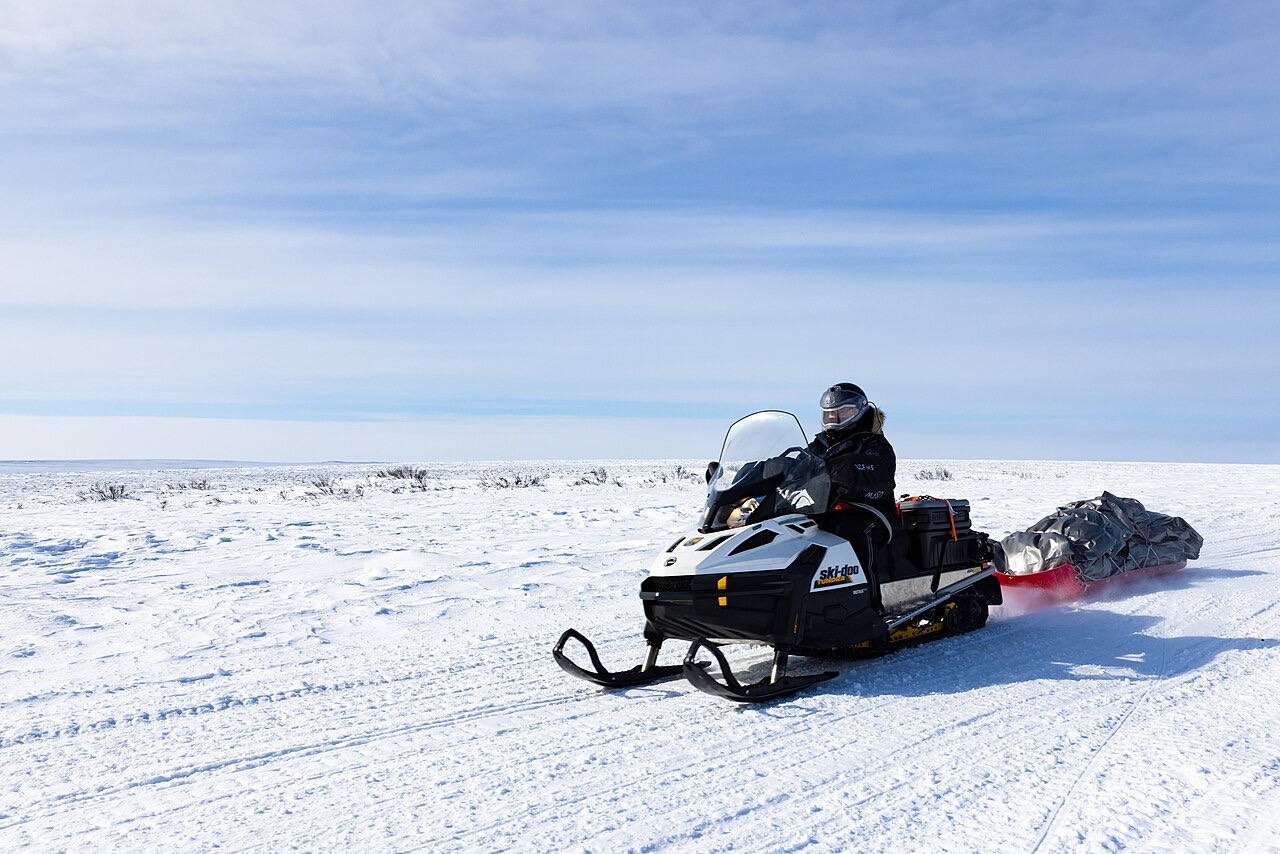
Visual AidThe machine that replaced the dog team
A rider in a helmet on a snowmachine pulling a loaded sled across flat white tundra under a blue sky
Photograph of a snowmachine hauling a loaded sled along a winter trail across the Selawik National Wildlife Refuge, Alaska, in April 2022. Snowmachines are now the main way people travel between villages in Alaska’s northwest Arctic in winter — exactly the kind of modern arrival the Knowledge Bank on how an Arctic village changed weighs, solving real hardships while pulling life off the dog team and the trail skills that went with it. The picture records one ordinary trip, half a century after the novel; nothing in it is Kapugen’s.
Snowmachine and sled on a winter trail, Selawik National Wildlife Refuge, Alaska, April 2022; U.S. Fish and Wildlife Service photograph. Source: Wikimedia Commons, File:Snowmachine travel on Selawik National Wildlife Refuge (52828339264).jpg, public domain.
🧠Knowledge Bank question
1According to the Knowledge Bank, the novel refuses to make Kapugen a simple villain because ___.Pt.III
2What does Miyax find at Kapugen’s house?Pt.III
3Why does the helmet and goggles matter so much to Miyax?Pt.III
4What does Miyax do when she sees the house?Pt.III
5Write the numbers 1–5 in the boxes to show the correct order of events in this part. Number 1 = what happens first.Pt.III
  • She finds Kapugen’s house, with Ellen and the helmet on the wall.
  • She leaves without telling him who she is, and Tornait dies.
  • Atik and Uma mention a hunter named Kapugen at Kangik.
  • Miyax travels toward the village with Tornait.
  • She buries the bird and turns back toward Kapugen.
6Kapugen died on the seal hunt, exactly as Miyax had been told.Pt.III
7What happens to Tornait?Pt.III
8Miyax sings that the hour of the wolf and the Inuit is over.Pt.III
9How does the novel end?Pt.III
10The last sentence of the book calls her Miyax.Pt.III
Part 3
Literary Elements
Understanding HOW and WHY Jean Craighead George (author) tells the story across Part III · Kangik, and the Last Line.
🔄Knowledge Bank · A Name That Turns the Whole Book Over
Literary Craft · The Reversed SymbolFor seven parts the two names have been a running argument. Miyax is who she is at seal camp and on the tundra; Julie is what school and Barrow made her, and the narration switches between them to report which world has hold of her. A reader who has been paying attention expects the book to end on Miyax. It ends on Julie. That single word does what a paragraph of explanation could not: it says the life that made her Miyax is no longer available, and she knows it. This is a symbol being reversed rather than fulfilled, and it is much braver than the ending most books would take. Notice that nothing is stated. The technique asks the reader to remember the pattern, notice the break, and supply the grief themselves, which is why the last sentence is only six words long.
A symbol that reverses
For the whole novel, Miyax is the true name and Julie the borrowed one. The final sentence uses Julie, and the meaning of the pattern flips in a single word.
The bittersweet ending
She is not rescued and she has not won. She goes back because the life that made her Miyax is no longer available to live.
An accusation never confirmed
The helmet and goggles suggest Kapugen may shoot from aircraft. The book never says so. The reader is left holding a suspicion rather than a fact.
🧠Knowledge Bank question
1The Knowledge Bank explains that ending the book on the name Julie works because ___.Pt.III
2Fill in each blank with the correct term.Pt.III
Word choices:symbolresolutionrhymestanza- some words will not be used
Something standing for a larger idea is a .
The settling of a story at its end is the .
3The book never confirms that Kapugen shot Amaroq. That choice ___.Pt.III
4This ending is best described as bittersweet rather than happy.Pt.III
5Tornait’s death is included simply to make the reader sad.Pt.III
6Kapugen’s stove, radio and aircraft work in the story as ___.Pt.III
7Fill in the blank with the correct term.Pt.III
Word choices:ironyrhymechapternarrator- some words will not be used
A gap between what is expected and what happens is .
8Miyax argues with Kapugen about the helmet before she leaves.Pt.III
9Ending on a decision rather than a rescue makes the novel ___.Pt.III
10This part mostly works to ___.Pt.III
Part 4
Think Deeper
Four deeper challenges — no single-word recall. Read, weigh the evidence, and reason it out.
Knowledge Bank · Judging Kapugen Fairly
Ethics · The Charge That Is Never ProvedIt is tempting to read the helmet and goggles as a confession, and the novel is careful never to let a reader do that comfortably. What Miyax actually sees is equipment, and what she actually knows is that men in an aircraft killed Amaroq. Between those two facts sits an inference, not a proof. Working out how much weight that inference can carry is the sharpest thinking this book asks for: circumstantial evidence can be strong, but it can also convict the wrong person, and the ache of the scene comes precisely from Miyax not asking him. There is also a second, kinder reading available. A man who once left a wage job to hunt has taken up an aircraft, and the same modernity that saved his village may have cost him the thing his daughter loved most, which is a tragedy rather than a crime.
Visual AidTwo facts, one gap
Two facts, one gapTwo fact boxes — men in an aircraft shot Amaroq, and his house holds a helmet and goggles — send arrows into a central box: the inference, was he in that plane? A note beneath it reads: an inference, not a proof. Arrows lead to two reading boxes: he pulled the trigger, or modernity took its toll. Notes say circumstantial evidence can convict the wrong person, and that she never asks him — the novel leaves the gap open on purpose.TWO FACTS, ONE GAP — WHAT MIYAX ACTUALLY KNOWSFACT · men in an aircraftshot AmaroqFACT · his house holds ahelmet and gogglesthe INFERENCE:was he in that plane?an inference, not a proofone reading:he pulled the triggera kinder reading:modernity took its tollcircumstantial evidence can be strong — and can convict the wrong personshe never asks him; the novel leaves the gap open on purpose
Structure diagram of the evidence as the Knowledge Bank on judging Kapugen fairly lays it out: two facts Miyax actually has, an inference sitting in the space between them, and the two readings that inference will bear. Nothing in the drawing settles which reading is true — that is the point, and it is why the middle is drawn as a question. The novel keeps the gap open on purpose: she never asks him, and the reader is left to weigh what an inference can and cannot carry.
Evidence and readings as set out in the Knowledge Bank, from Julie of the Wolves (1972), final part. Drawn for Garden Heights Academy.

Think about how this book ends. A girl learns that the father she has mourned for years is alive in a village a few days away. She walks there. She finds a warm house, a stove, a radio, a wife she has never heard of, and a flying helmet hanging on the wall. She says nothing and leaves. Her bird dies. She buries him, sings that an age is over, and turns her boots back toward the house — and the book, for the first time in many pages, calls her Julie.

Original passage written for Garden Heights — not a quotation from the novel.
1Claim: “The novel ends on a loss rather than a rescue, and the final name is how it says so.” — choose the two details that best prove it.Claim & Evidence
2Something Miyax loses, or Something Miyax gains? Tap each detail to sort it — tap again to switch sides. You can keep tapping to change your answer.Sort into two
◄ Something Miyax losesSomething Miyax gains ►
3Match each cause to its result. For each cause, pick its result.Cause & Effect
Atik and Uma mention a hunter at Kangik
She sees the helmet and goggles on the wall
Tornait dies on the tundra
She sings that the hour is over
🧠Knowledge Bank question
4Fill both blanks to complete the reasoning.Build the Argument
The Knowledge Bank warns that the helmet and goggles prove less than they seem because , which shows that the fairest verdict on Kapugen is .
Part 5
Standardized Test
Reading passage · The Bird That Inherits Its Route · Words in Context & Central Ideas · SAT & TOEFL-style practice
The Golden Plover's Solo Migration

The American golden plover nests on Arctic tundra and winters in southern South America, and the journey between the two is among the longest made by any land bird. The round trip runs to roughly twenty-five thousand kilometers (fifteen thousand miles) in a year. A long southbound stretch is flown over the open Atlantic, where there is nowhere to land at all. Birds that misjudge that crossing do not get a second attempt.

What makes the feat strange is who does it. Plover chicks are precocial: they leave the nest within a day of hatching and feed themselves almost immediately. Barely a day old, a chick already stands at the threshold of independent life, its hardest test just beginning. The adults commonly set off south weeks before the young birds are ready, so the juveniles make their first crossing without a single experienced bird to follow. Nothing about the arrangement looks survivable on paper.

They find their way regardless. Experiments suggest young migrants navigate using an inherited sense of direction and timing, checked against the sun, the pattern of polarized light and the Earth's magnetic field. That inherited compass does not betray them; a young bird can trust it across a featureless ocean. The route is not taught and not copied; it is innate, carried in the bird before it has seen any of the ground it will cross. Researchers describe such a journey as a piece of inherited knowledge, which is an odd phrase until you watch a bird that has never flown anywhere set off in exactly the right direction.

Original passage written for Garden Heights — not a quotation from the novel.
1What is the main idea of the passage?SAT · Central Ideas
2According to the passage, the round trip is roughly ___.TOEFL · Factual Information
3As used in the passage, precocial most nearly means ___.SAT · Words in Context
4The passage says the adults usually ___.TOEFL · Factual Information
5Insert Text (TOEFL). Look at the four squares [1][4] in the excerpt below. They show where this sentence could be added:
“No older bird is available to correct a mistake.”
The adults commonly set off south weeks before the young birds are ready, [1] so the juveniles make their first crossing [2] without a single experienced bird to follow. [3] They find their way regardless. [4]
Where would the sentence fit best?
TOEFL · Insert Text
6It can be inferred that a young plover's route is ___.SAT · Inference
7In the passage, threshold most nearly means ___.SAT · Words in Context
8Which of these does the passage list as a navigational check?TOEFL · Factual Information
9The final sentence suggests the author finds the phrase 'inherited knowledge' ___.SAT · Inference
10In the passage, betray most nearly means ___.SAT · Words in Context
Part 6 · Optional
Creative Writing
A bonus challenge to practice your English. Take your time and have fun with it.
About This Section

This writing task is optional and is not part of your auto-graded score. The feedback below checks only the basics — length, spelling, and grammar — not whether your ideas are right or wrong. It is meant for classroom discussion and creative practice, so feel free to use your imagination!

Writing Task — Part 8 “Going Back Changed”

Julie turns back toward her father knowing he is not the man she remembers, and knowing she is not the girl who left. Write about going back to a person or place after you had changed, or about something you outgrew and still valued. What was the same, and what could not be? 5–8 sentences. End with one thing worth carrying forward from a life you cannot return to.

You can start with: “One thing worth carrying forward from a life you cannot return to is...”
0 / 40 words minimum
🗣 Teach It · Just for Fun (optional)

No right or wrong — tell someone nearby what happened in this part. Can’t find anyone? Tell yourself out loud. The moment you teach it, you truly understand it.


Garden Heights

Part 8 Complete — You Finished the Book! 🎉

You finished Part III · Kangik, and the Last Line — the final part of Julie of the Wolves.

Here are your auto-graded results:

-
points out of 100
Teach it to someone

The best last step is to teach it. In your own words, explain what happened — retell a favorite scene, teach a character’s big choice, or sum up the main idea for a parent, friend, or classmate. When you can teach it clearly, you truly own it.

Explore the next book →📊 See Your Full Report Card

Independent study guide by Garden Heights. Not affiliated with or endorsed by Jean Craighead George. Contains original analysis only; no text from the novel is reproduced. Reference text: This workbook follows Jean Craighead George’s classic text (the standard Puffin edition sold worldwide). Revised 2023 UK editions change some wording and may not match the vocabulary studied here.

SAT® is a registered trademark of College Board, which is not affiliated with, and does not endorse, these materials. TOEFL® is a registered trademark of ETS. These materials are not endorsed or approved by ETS. Garden Heights is an independent provider of test-style reading practice.