New here? Just sign up with Google — your account includes Matilda, our gift book, forever.
📚
Garden Heights Academy
Members sign in to continue.
Matilda · Garden Heights Academy · Final Part
Part 8
for Matilda · Part 8 · Chapters 20–21
a novel by Roald Dahl (author)
40 min6 Parts🎉 Final Workbook
This workbook is built on a solid pedagogical foundation, effectively integrating content and language learning based on the CLIL framework (Content and Language Integrated Learning), elevated by our unique 5th C — Connection — and an integrated Standardized Test section that weaves every SAT & TOEFL question type right into the novel, so learners build real test skills easily, naturally, and with fun.
✨ You Made It to the Final Part
This is the last workbook in the 8-part Matilda novel study. Here, Matilda’s story reaches its conclusion — the Third Miracle and a new home. Well done for coming this far.
💭 Before You Read · Just for Fun
No right or wrong answers — just think or chat about it: Who counts as family to you — is it only about blood? If you could write one anonymous sentence on a board for someone powerful to read, what would it say? And what would you happily give up, if it meant you finally had everything you truly needed?
What Happens in Part 8
Matilda drives the Trunchbull away and finds a home with Miss Honey.
The chalk messageIn Chapter 20, Matilda uses her power in front of the Trunchbull, the whole class, and Miss Honey. She guides the chalk across the board, writing a message from Magnus, Miss Honey's dead father, that only the Trunchbull understands.
The Trunchbull fleesThe Trunchbull collapses in terror. In Chapter 21, everything changes quickly: the Trunchbull disappears for good, and Miss Honey moves back into her cottage. The Wormwoods are leaving the country in a hurry, in a way that suggests serious trouble.
Matilda asks to stayWith her family rushing away, Matilda understands that she belongs with Miss Honey. She makes one simple, brave request: she asks to stay with her. And Miss Honey says yes.
What We Will Study
Chapter
Title & Key Events
Ch.20
The Third Miracle — Matilda guides the chalk in front of the class and writes a message from Magnus; the Trunchbull collapses and flees; justice is finally delivered
Ch.21
A New Home — The Trunchbull vanishes; Miss Honey recovers her cottage; the Wormwoods leave hastily; Matilda asks to stay with Miss Honey; Miss Honey says yes
Copyright Notice
This is an independent study guide created by Garden Heights Academy. It contains original analysis questions and does not reproduce any text from the novel. Matilda is a work by Roald Dahl (author). Not affiliated with or endorsed by Roald Dahl or the Roald Dahl Story Company. Students should read the original book. Reference text: This workbook follows Roald Dahl’s classic text (the standard Puffin edition sold worldwide). Revised 2023 UK editions change some wording and may not match the vocabulary studied here.
Part 1
Vocabulary
Study 10 key words from Chapters 20–21, then answer each question.
🧠Knowledge Bank · When a Mind Finds Its Level
Cognitive Science · Matched ChallengeAt the end, Matilda loses her strange power, and Dahl (author) gives a clever reason: once she moves up to a hard class with real work, her mind no longer has spare energy boiling over. This echoes a genuine idea in cognitive science. A brilliant mind that is under-stimulated — bored, unchallenged, starved of difficulty — grows restless, and that pent-up energy can spill into trouble or daydreams. Give the same mind work that truly stretches it, and the energy pours into learning instead. Psychologists find that children thrive when a task sits at just the right level: hard enough to demand full effort, not so hard it defeats them. Matilda’s fading power is a graceful way of showing this truth — her hungry brain, at last fed with real challenge, no longer needs to invent miracles to burn off its unused fire.
Visual AidThe right level of challenge
Chart, an illustration. The line across the bottom is how demanding the work is; the line up the side is how capable the mind is. The pale band is where the two agree — hard enough to take everything a student has, but not so hard that it defeats them. Everything here depends on the vertical distance from that band, not on where a dot sits. In Part 1 Matilda’s dot floats high above it: her mind is extraordinary, her schoolwork is trivial, and the dotted gap between them is energy with nowhere to go. Dahl (author) turns that gap into telekinesis. By Part 8 the work has caught up, the dot settles into the band, the gap closes, and the power has nothing left to burn. The region below the band is the one Matilda never visits: there the work outruns the skill, which produces anxiety, not surplus power — so lower does not mean weaker. The chart has no numbers because the novel gives none.
After the challenge–skill model in Mihaly Csikszentmihalyi, Flow (1990). Drawn for Garden Heights Academy.
ⓘ The vocabulary words in this list are selected to help you understand and complete this workbook. Some may not appear verbatim in the original novel.
apparitionn.Ch.20
A ghost or ghostly appearance; something strange and frightening that seems to appear from nowhere
“The chalk moved like an apparition — no one was holding it, yet it wrote clearly across the board.”
recoilv.Ch.20
To suddenly move back or shrink away in fear, horror, or disgust
“The Trunchbull recoiled from the blackboard as if the words themselves could harm her.”
vanishv.Ch.21
To disappear suddenly and completely, leaving no trace
“The Trunchbull vanished from the school and the village overnight, and no one ever saw her again.”
reclaimv.Ch.21
To take back something that was previously yours; to recover what was lost or stolen
“Miss Honey was finally able to reclaim her cottage — the home that had been taken from her years ago.”
hastilyadv.Ch.21
Quickly and with little thought or preparation, often suggesting something is being done carelessly or to escape
“The Wormwoods packed hastily — bags thrown in the car, barely a word to anyone, and they were gone.”
resignationn.Ch.21
Calm acceptance of something unpleasant or unavoidable; giving up without fighting
“Matilda watched her family leave with a strange sense of resignation — this was simply how things were.”
sanctuaryn.Ch.21
A place of safety, protection, and peace; a refuge from the outside world
“Miss Honey’s cottage, small and simple as it was, became a sanctuary — a place where Matilda finally felt completely safe.”
consentn./v.Ch.21
Permission; to agree to something or give permission for something to happen
“Her parents gave their consent for Matilda to stay — quickly, almost without thinking, as if they were relieved to go.”
retributionn.Ch.20
Punishment inflicted as revenge for a wrong or a crime; deserved consequences for bad actions
“The Trunchbull’s sudden collapse and flight from the school felt like retribution — her cruelty had finally caught up with her.”
resolvev.Ch.21
To bring something to a conclusion; to settle or find an answer to a problem
“By the final chapter, every difficulty in the story had resolved — not perfectly, but honestly.”
🧠Knowledge Bank question
1According to the Knowledge Bank, why does Matilda's strange power vanish at the end of the story?Ch.20
2True or False: To “recoil” means to step forward confidently toward something surprising or frightening.Ch.20
3The Trunchbull disappeared completely overnight. The next day, she was simply gone. Which word means to disappear suddenly and completely?Ch.21
4True or False: “Retribution” means a reward given to someone who has behaved well and done something admirable.Ch.20
5Fill in each blank with the correct word.Ch.21
Word choices:reclaimconsentsanctuaryhastilyvanish— some words will not be used
Miss Honey could finally her cottage and her life — the home that the Trunchbull had stolen from her.
The Wormwoods packed , bundled everything into the car, and drove away without looking back.
6True or False: A “sanctuary” is a place of safety and peace — somewhere a person feels protected from the difficulties of the outside world.Ch.21
7Matilda’s parents gave their permission for her to stay with Miss Honey, and they left the country. Which word means permission or agreement for something to happen?Ch.21
8True or False: “Resignation” in the emotional sense means fighting back strongly and refusing to accept a difficult situation.Ch.21
9Fill in the blanks with the correct words.Ch.20–21
Word choices:retributionresolveapparitionresignationrecoil— some words will not be used
The Trunchbull’s terror and sudden flight from the school felt like — her cruelty had finally caught up with her.
By the final chapter, Dahl (author) had managed to every major problem in the story — not perfectly, but honestly and satisfyingly.
10Taking back something that was previously yours — recovering what was lost or stolen — is called __________.Ch.21
Part 2
Comprehension
How well do you understand Chapters 20–21?
🧠Knowledge Bank · Tying the Threads Together
Reading Skill · ResolutionA story’s resolution is where loose threads are tied and we learn how things settle. Skilled readers use it to synthesize — to gather every earlier event into one whole understanding. As the Trunchbull flees and Matilda goes to live with Miss Honey, pause and connect the ending back to the beginning: the neglected child now cherished, the robbed teacher now free, the tyrant now gone. Ask how each thread was prepared, and whether the ending feels earned by all that came before. Synthesizing means seeing the book as a single shape rather than a pile of separate scenes, and noticing the big ideas that run from the first page to the last. A satisfying resolution rewards the careful reader, because everything planted along the way finally blooms into one clear and complete picture.
🧠Knowledge Bank question
1The Knowledge Bank explains that synthesizing a story means ___.Ch.20
2True or False: The Trunchbull remains calm when she sees the chalk writing on the board, and she correctly realizes it must be Matilda using some kind of trick.Ch.20
3What happens to the Trunchbull after Chapter 20?Ch.21
4True or False: After the Trunchbull disappears, Miss Honey is able to move back into her own cottage and begin a new life.Ch.21
5Write the numbers 1–4 to show the correct order of events in Chapters 20–21. Number 1 = first.Ch.20–21
Miss Honey reclaims her cottage and Miss Honey and Matilda learn that the Wormwoods are leaving the country.
Matilda asks Miss Honey if she can stay; Miss Honey says yes; the Wormwoods drive away.
Matilda guides the chalk to write a message from Magnus on the blackboard in front of the whole class.
The Trunchbull collapses, screams, and flees the classroom and eventually the village entirely.
6True or False: The Wormwoods take a long time to leave and have a proper, emotional farewell with Matilda before they go abroad.Ch.21
7Why does Matilda choose to write a message that appears to come from Magnus rather than just from herself?Ch.20
8At the end of the novel, Matilda loses her telekinetic power. What does Dahl (author) suggest is the reason?Ch.21
9True or False: After the message appears on the blackboard, the Trunchbull leaves and is never seen at the school again.Ch.21
10Who does Matilda go to live with at the end of the novel?Ch.21
Part 3
Literary Elements
Understanding HOW and WHY Dahl (author) creates certain effects in the final two chapters.
🧠Knowledge Bank · Climax, Resolution & Theme
Literary Craft · Climax & ResolutionThe story reaches its climax — the peak of tension — when Matilda’s ghostly chalk message drives the Trunchbull away for good. Everything the rising action built now bursts in this single, thrilling turn. What follows is the resolution, the calm after the peak, where the Wormwoods flee, Miss Honey reclaims her home, and Matilda finds a family at last. Threading through it all is the book’s central theme: that goodness, courage, and cleverness should triumph over cruelty and greed. Notice how neatly Dahl (author) rewards the kind and punishes the wicked — the shape of a fairy tale, deliberately chosen. A strong ending does more than stop the action; it delivers the meaning the whole story was reaching toward. When you finish, look back and name the idea the climax and resolution together prove, because that is the story’s lasting message.
Visual AidThe shape of the ending
Diagram of the story’s shape as the Knowledge Bank describes it: rising action climbing through the practice and the gathering class, the climax at the chalk message, and the resolution falling to a new home. The heights are not measurements of anything; the peak simply marks the moment of greatest tension.
Plot structure after Gustav Freytag, Die Technik des Dramas (1863), applied to Matilda, Chapters 18–21. Drawn for Garden Heights Academy.
📚 Literary Devices in This Part · definitions & examples
Climax is the moment of greatest tension and the turning point of a story. In Chapter 20 Matilda uses her power publicly — the chalk writes its ghostly message, the Trunchbull collapses in terror, and everything the story has built toward finally breaks open.Resolution is the part of a story where the conflicts are settled and loose ends tied up. In Chapter 21 the Trunchbull vanishes, Miss Honey gets her house and money back, and Matilda finds a new home — Dahl (author) wraps it all up swiftly and happily.Theme is the central idea a story explores. Matilda leaves her uncaring biological parents to live with Miss Honey, who truly loves her. Dahl’s theme is clear: real family is built from love and care, not from blood ties.
The questions below are mixed — not grouped by device. Decide which device each one is about.
🧠Knowledge Bank question
1According to the Knowledge Bank, Roald Dahl (author) rewards the kind and punishes the wicked so that the ending has ___.Ch.20
2True or False: In Chapter 21 the resolution unfolds slowly and in great detail, giving each event a long chapter of its own.Ch.21
3Fill in the blanks with the correct words.Ch.21
Word choices:themeloverhymeclimaxresolution- some words will not be used
The central idea a story explores is its . Matilda’s ending shows that true family is built from , not blood.
4Chapter 21 — the Trunchbull gone, Miss Honey restored, Matilda settled — is best described as the story’s —Ch.21
5True or False: One of the central themes of Matilda is that family is defined by biology — you can only truly belong with blood relatives.Ch.21
6Fill in the blanks with the correct words.Ch.20
Word choices:climaxpowerrhymeresolution- some words will not be used
The moment of greatest tension and the turning point of a story is the . It comes when Matilda uses her in front of the whole class.
7Matilda leaves her biological parents to live with Miss Honey. What theme does this ending express?Ch.21
8True or False: The climax is the moment of greatest tension and the turning point of a story.Ch.20
9Fill in the blanks with the correct words.Ch.21
Word choices:resolutionhomerhymeclimax- some words will not be used
The part of a story where conflicts are settled and loose ends tied up is the . Matilda finds a loving new with Miss Honey.
10The CLIMAX of this novel is not a battle — it is a sentence writing itself on a blackboard. Why is WRITING the perfect weapon for this particular story’s peak?Ch.20
Part 4
Think Deeper
These questions have only one correct answer. Think carefully about the whole novel!
🧠Knowledge Bank · What an Ending Means
Ethics · Just EndingsMatilda closes with a deeply satisfying ending: the cruel are driven off and the kind are rewarded. Dahl (author) gives us poetic justice — the idea that people should reap what they sow, whether good or bad. But a thoughtful reader asks what such an ending truly means. It is a wish, a fairy tale’s promise, offered because real life is not always so fair. Notice that Matilda’s happiness comes not from her powers, which fade, but from love and belonging with Miss Honey. Dahl (author) quietly argues that the greatest reward is not magic or riches but being cherished by someone who sees your worth. Endings carry a story’s deepest values, showing what the author believes ought to happen. As you close the book, ask what Dahl (author) is telling you to hope for, and why an ending this just still feels so richly deserved.
Visual AidThe author who chose this ending
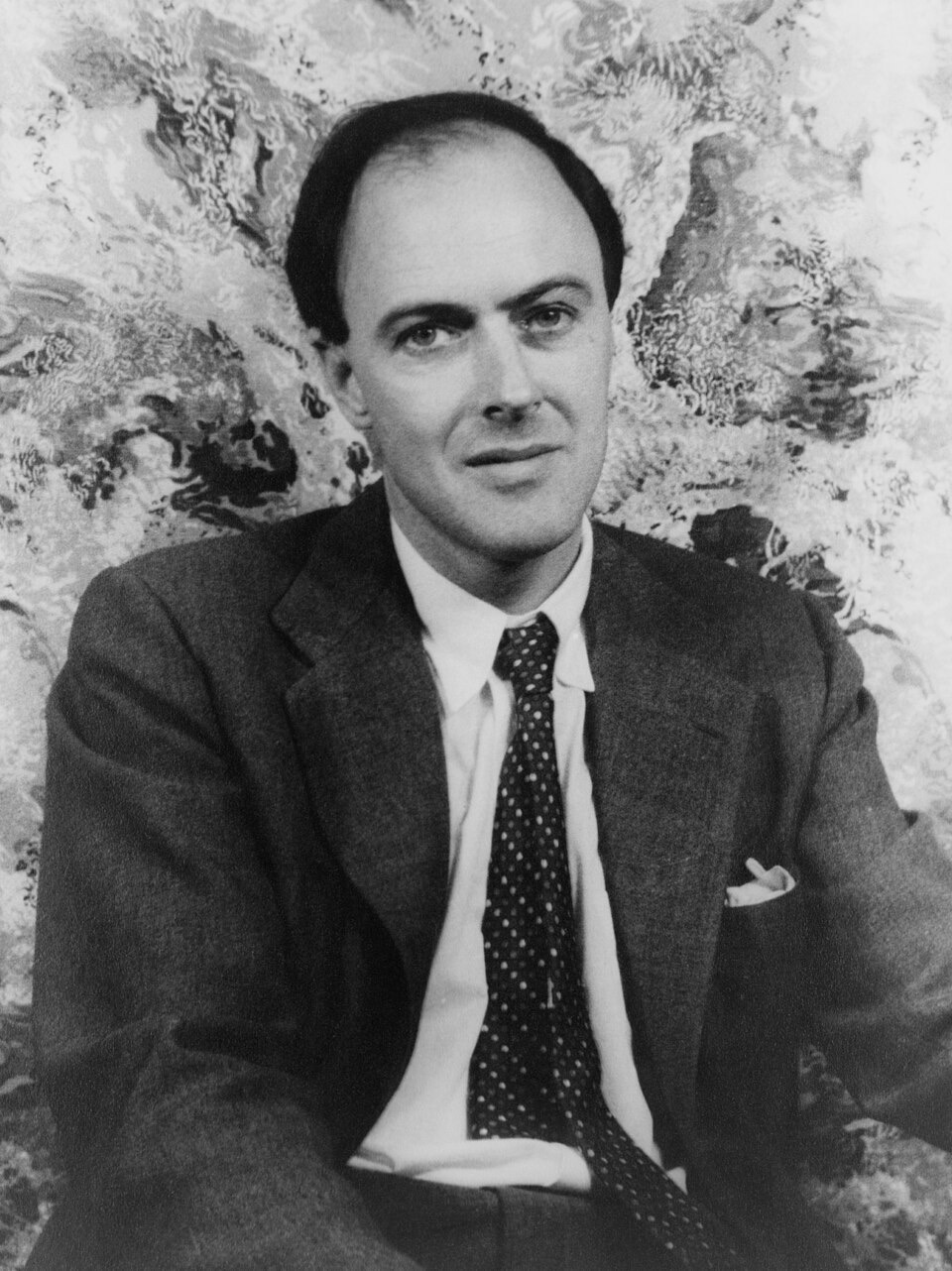
Photograph of Roald Dahl (author) in 1954, more than thirty years before he wrote Matilda. The Knowledge Bank says an ending shows what its author believes ought to happen; this is the man who decided that the kind would be rewarded. The picture shows the writer, not the book — nothing of Matilda exists in it.
Roald Dahl, 20 April 1954; photograph by Carl Van Vechten, Library of Congress. Source: Wikimedia Commons, File:Roald Dahl.jpg, public domain.
1Claim: “Matilda uses her power to right a wrong, not to bully.” — choose the two details that best prove it.Claim & Evidence
2Sort each event. Tap each item to sort it — tap again to switch sides. You can keep tapping to change your answer.Sort into two
◄ The Trunchbull’s downfallMatilda & Jenny’s new life ►
3Match each cause to its result. For each cause, pick its result.Cause & Effect
The chalk writes in Magnus’s voice→
The Trunchbull flees for good→
The Wormwoods are caught cheating→
Matilda is left behind by her parents→
🧠Knowledge Bank question
4Fill both blanks to complete the reasoning.Build the Argument
Matilda's happiness at the end of the book comes from , which shows that .
Part 5
Standardized Test · Synthesis & Mixed Practice Test
Part 8 is your mixed practice test: every question family from Parts 1–7 can appear — Vocabulary in Context, Factual Detail, Command of Evidence, Inference, Central Ideas and the TOEFL Prose Summary — in the styles the SAT and TOEFL use. Read the passage (the highlighted words are tested below), then choose the answer best supported by the text.
Read the passage — the highlighted words are tested — then answer. Tap an answer, then tap it again to confirm.
SATWords in Context — a word's meaning in this passage
SATInference — a conclusion the passage implies
SATCentral Ideas — the passage's main point
TOEFLFactual Information — a fact stated in the passage
TOEFLVocabulary — a tested word's meaning here
TOEFLProse Summary — the three sentences that sum it up
TOEFLInsert Text — where a sentence best fits
Families Built Through Adoption
Families are not only born; some are chosen. The practice is ancient: Roman emperors adopted their heirs, and across the world’s cultures children have always been raised by grandparents, aunts, and trusted family friends when their parents could not raise them. History suggests something many people find surprising: the chosen family is not a modern invention but one of humanity’s oldest institutions. Modern adoption is a formal legal process, and its care is deliberate. A court examines the home, the adults are chosen carefully, and wherever possible everyone — including the child — gives consent, agreeing willingly to the new family.
Once the papers are signed, the arrangement is permanent: the adopting parent takes on every responsibility of a birth parent, and the child gains every right of a birth child — the same name on the school forms, the same claim on the family home, the same place at the table, a sanctuary where the child is safe and protected. And the research delivers a clear verdict: children flourish where they feel secure, seen, and loved — and it is the strength of the daily bond, not the blood connection, that builds that feeling. A child read to every night by an adoptive mother is, in every way that can be measured, better rooted than one ignored under her birth parents’ roof. As adoption workers like to say: the family that chooses you has, in one sense, chosen you twice.
Original passage written for Garden Heights — not a quotation from the novel.
1As used in the passage, the word “ancient” most nearly means —SAT · Words in Context
2The passage most strongly suggests that what makes a child feel secure is —SAT · Inference
3According to the passage, what did Roman emperors do?TOEFL · Factual Information
4In the passage, consent most nearly means ___.SAT · Words in Context
5According to the passage, what does the adopted child gain once the papers are signed?TOEFL · Factual Information
6In the passage, sanctuary most nearly means ___.TOEFL · Vocabulary
7Prose Summary. Which detail is MOST important to include in a short summary of the passage?TOEFL · Prose Summary
8Insert Text (TOEFL). Look at the four squares [1]–[4] in the passage excerpt below. They show where the following sentence could be added: “Nothing about the bond, in other words, depends on how the family began.”
[1] And the research delivers a clear verdict: children flourish where they feel secure, seen, and loved — and it is the strength of the daily bond, not the blood connection, that builds that feeling. [2] A child read to every night by an adoptive mother is, in every way that can be measured, better rooted than one ignored under her birth parents’ roof. [3] As adoption workers like to say: the family that chooses you has, in one sense, chosen you twice. [4]
Where would the sentence fit best?TOEFL · Insert Text
9The passage most strongly suggests that a child moving from neglectful birth parents to a loving adoptive home would —SAT · Inference
10Which statement best expresses the central idea of the passage?SAT · Central Ideas
Part 6 · Optional
Creative Writing
A bonus challenge to practice your English. Take your time and make it your own.
About This Section
This writing task is optional and is not part of your auto-graded score. The feedback below checks only the basics — length, spelling, and grammar — not whether your ideas are right or wrong. It is meant for classroom discussion and creative practice.
Writing Task — Part 7 “A New Home”
Imagine you are Matilda, looking out the window as your family’s car disappears around the corner. Describe what you feel. Are you sad? Relieved? Both? Then describe what you feel when you turn back and see Miss Honey’s face. Write at least 40 words.
You can start with: “I stood at the gate and watched the car go. For a moment, I didn’t move…”
0 / 40 words minimum
🗣 Teach It · Just for Fun (optional)
No right or wrong — close the screen and tell someone nearby what happened in this part. Can’t find anyone? Tell yourself out loud. The moment you teach it, you truly understand it.
🎉
Novel Study Complete!
You finished all 8 parts of the Matilda novel study.
Here are your auto-graded results:
-
points out of 100
Teach it to someone
The best last step is to teach it. In your own words, explain what happened — retell a favorite scene, teach a character’s big choice, or sum up the main idea for a parent, friend, or classmate. When you can teach it clearly, you truly own it.
What’s Next
You have finished Matilda! Return to the library to explore another novel study, or revisit any earlier part to check your understanding.
SAT® is a registered trademark of College Board, which is not affiliated with, and does not endorse, these materials. TOEFL® is a registered trademark of ETS. These materials are not endorsed or approved by ETS. Garden Heights is an independent provider of test-style reading practice.