
The Mouse and the Motorcycle cover
Garden Heights

The Mouse and the Motorcycle

This workbook is for Garden Heights members. Sign in to continue.

Sign in with Google →
New here? Just sign up with Google — your account includes Matilda, our gift book, forever.
The Mouse and the Motorcycle · Garden Heights

Part 3

for The Mouse and the Motorcycle · Part 3 · Chapter 5
8 Parts40 min
What Happens in Part 3

One ride across a carpet is not enough. Ralph talks Keith into the real thing: the whole second-floor corridor, after the hotel sleeps. Out in the great open hallway, twisting the throttle of pure sound, Ralph is the fastest, freest mouse alive — a nocturnal knight on a red steed. The night is full of encounters: his Aunt Sissy, scandalized to see a mouse on a machine; a late-arriving guest with a dog that catches one glimpse of him and lunges; and Matt, the old bellboy, who turns out to be that rare thing — a grown-up who knows about the hotel’s mice and wishes them well. But when Ralph putters home at dawn, disaster: the door of Room 215 has blown shut. It is Matt who scoops up mouse and motorcycle and slips them inside — just as Keith’s mother opens her eyes and sees a mouse in her son’s room.

What We Will Learn
SectionWhat you will practice
VocabularyWords of the night ride: nocturnal, corridor, throttle, venture, glimpse, dawn…
Literary ElementsSensory imagery, suspense, and the helper character
Cross-CurricularHow night animals find their way, and what a bellboy’s night shift holds
Chapter Summary
Ch.What happens
5aThe Bargain — Ralph wins permission to ride the second-floor corridor after dark.
5bThe Open Road — full speed down the hallway: Aunt Sissy scandalized, a guest’s dog lunging, and Matt the bellboy quietly amused.
5cLocked Out at Dawn — the door of 215 has blown shut; Matt slips mouse and machine inside — and Keith’s mother sees.
Part 1
Vocabulary
Study 10 key words from Chapter 5, then answer each question.
🧠Knowledge Bank · Why Wheels Beat Feet
Biology · Animal Senses · Why Wheels Beat FeetThe motorcycle carries Ralph faster than his own four feet (1.2 m) ever could, and the secret is one of the oldest simple machines: the wheel. A wheel turns sliding into rolling, and rolling wastes far less energy because only a small edge touches the ground at a time. When you drag a heavy box across the floor you fight a force called friction, the rub between two surfaces; put that box on wheels and most of the rubbing disappears, so it glides. That is exactly why Ralph, who normally scurries and tires quickly, can suddenly zoom down a hotel hallway with hardly any effort. His tiny legs never changed — the machine simply traded his exhausting scramble for a smooth, spinning ride. A good wheel does not add strength; it saves it, turning hard work into an easy glide.
Visual AidWhy wheels beat feet
Why wheels beat feetTwo side-by-side sketches over a floor line. Sliding: a box whose whole underside rubs the floor, marked in red, with the note lots of friction, hard work. Rolling: the same box on two wheels, where only a tiny red point touches the floor, with the note little friction, easy glide. A line defines friction as the rub between two surfaces. A closing line says a wheel does not add strength but saves it; Ralph's legs never changed, the machine traded his scramble for a glide.WHY WHEELS BEAT FEETSLIDINGa whole face rubs the floor= lots of friction, hard workROLLINGonly a small edge touches= little friction, easy glidefriction: the rub between two surfacesA wheel does not add strength; it saves it. Ralph's legs never changed — the machine traded his scramble for a glide.
Diagram for the Knowledge Bank on the wheel. The left sketch drags a box so that its whole underside rubs the floor, the rub the Knowledge Bank calls friction; the right sketch puts the same box on wheels, where only a small edge touches at a time. It is a schematic, and the boxes stand for any load, not for Ralph. Notice the red marks on the floor line — a long smear on the left, two tiny points on the right — that is the whole saving.
Sliding, rolling and friction as described in the Knowledge Bank. Drawn for Garden Heights Academy.
nocturnaladj.Ch.5
Active mainly at night
“Mice are nocturnal by nature.”
corridorn.Ch.5
A long hallway in a building
“The second-floor corridor stretched like a highway.”
throttlen.Ch.5
The control that sets a machine’s speed
“Ralph twisted the throttle of pure sound.”
bellboyn.Ch.5
A hotel worker who carries bags and runs errands
“Matt the bellboy kept the night lobby.”
venturev.Ch.5
To go somewhere despite the risk
“Ralph ventured into the open hallway.”
glimpsen.Ch.5
A very quick look
“The dog caught one glimpse of the rider.”
swervev.Ch.5
To turn aside sharply
“Ralph swerved around the slippers.”
daringadj.Ch.5
Bold; willing to take risks
“It was a daring ride for so young a mouse.”
dawnn.Ch.5
The first light of morning
“He putt-putted home at dawn.”
alarmn.Ch.5
Sudden fear, or a warning of danger
“Aunt Sissy squeaked in alarm.”

ⓘ The vocabulary words in this list are selected to help you understand and complete this workbook. Some may not appear verbatim in the original novel.

🧠Knowledge Bank question
1According to the Knowledge Bank, rolling wastes less energy because ___.Ch.5
2A ‘corridor’ is a long hallway inside a building.Ch.5
3The control that sets a machine’s speed is the ___.Ch.5
4To ‘venture’ somewhere means to refuse to go there.Ch.5
5Fill in each blank with the correct word.Ch.5
Word choices:glimpsedawnbellboyswerve- some words will not be used
The dog caught one of the tiny rider.
Ralph headed home at .
6A hotel worker who carries bags and runs errands is a ___.Ch.5
7‘Dawn’ is the last darkness before midnight.Ch.5
8To turn aside sharply while moving is to ___.Ch.5
9Fill in the blanks with the correct words.Ch.5
Word choices:alarmdaringnocturnalthrottle- some words will not be used
Aunt Sissy squeaked in at the sight.
It was a ride for so young a mouse.
10A very quick look at something is a ___.Ch.5
Part 2
Comprehension
Show you understood what happens in Chapter 5.
🧠Knowledge Bank · One Night, Beginning to End
Reading Science · Viewpoint · One Night, Beginning to EndChapter 5 covers a single night, which makes it perfect for practicing how to summarize — to boil many events down to the ones that truly matter. A good summary is not everything that happened; it is the handful of moments a reader would need to understand the rest. Try telling this chapter in order: Ralph sets out, meets dangers in the dark hotel, has a narrow escape, and returns a little wiser. Naming events in the right sequence keeps cause and effect clear, because a night ride only makes sense if you know what came first. If your retelling skips a step, the ending stops adding up. Learning to trim a story down to its key beats, without losing the thread, is a skill you will use with every book you ever read.
🧠Knowledge Bank question
1The Knowledge Bank says a good summary is ___.Ch.5
2Which relative sees Ralph riding and is scandalized?Ch.5
3A late-arriving guest’s dog notices Ralph when its owner does not.Ch.5
4Who is Matt?Ch.5
5Write the numbers 1–5 in the boxes to show the correct order of events in Chapter 5. Number 1 = what happens first.Ch.5
  • Matt slips Ralph inside — and Keith’s mother sees a mouse.
  • Ralph persuades Keith to allow a night ride.
  • A guest’s dog lunges at the tiny rider.
  • At dawn Ralph finds himself locked out of the room.
  • Ralph roars down the empty corridor at full speed.
6Matt the bellboy screams and sets a trap the moment he sees Ralph.Ch.5
7What disaster waits for Ralph at dawn?Ch.5
8How does Ralph finally get back into the room?Ch.5
9Ralph’s return goes completely unnoticed by the Gridley family.Ch.5
10How does the corridor feel to Ralph during the ride?Ch.5
Part 3
Literary Elements
Understanding HOW and WHY Beverly Cleary tells the story across Chapter 5.
🧠Knowledge Bank · Riding at Mouse Height
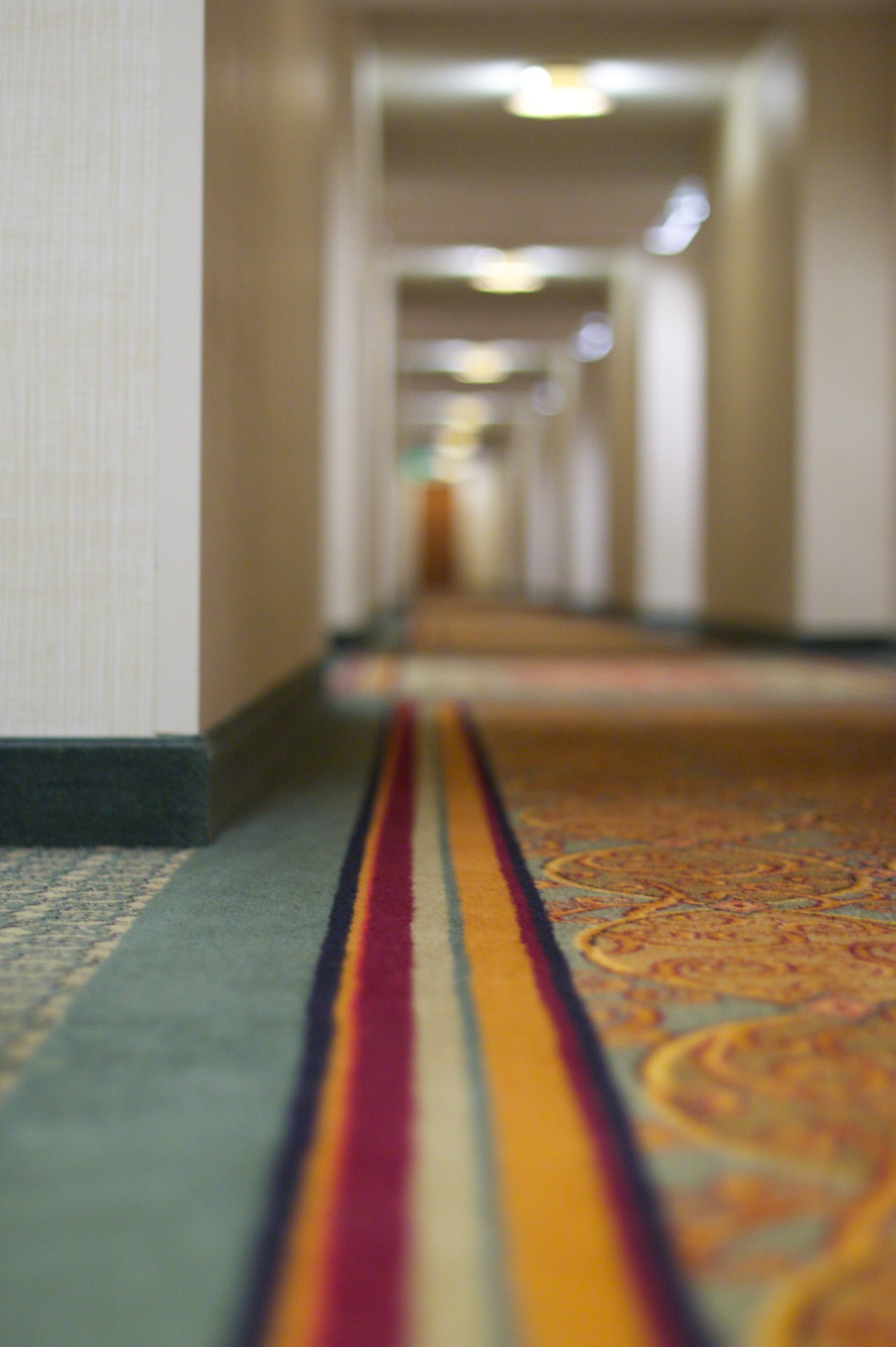
Literary Craft · Character Motivation · Riding at Mouse HeightCleary tells much of this ride from down at mouse height, and that choice changes everything you feel. A carpet becomes a wide field, a fallen crumb becomes a boulder, and a house cat or a dog swells into a monster. This low, close view is a kind of point of view — the exact spot from which a story is seen. Because we ride along at Ralph’s level instead of looking down like a human, ordinary hotel objects turn thrilling and terrifying at once. The author never simply says the hallway is scary; she shows it the way a four-inch traveler would meet it, and our own stomachs tighten. When a writer lowers the camera to a character’s eyes, distance shrinks and danger grows, and a plain corridor becomes a genuine adventure.
Visual AidA corridor seen from carpet height
A hotel hallway photographed from down at carpet level: a long patterned carpet with a red-and-gold stripe runs away toward a bright far end, with doors along the walls blurring into the distance
Photograph of a hotel hallway in San Francisco in 2009, taken with the camera resting almost on the carpet. From down here the corridor runs off like a road, the carpet pattern turns into a landscape, and the far end is a long way away. The Knowledge Bank explains that the author tells much of the ride from mouse height, a low, close point of view where a carpet becomes a wide field and distance shrinks while danger grows. This picture puts your eye where Ralph’s would be. It is a modern hotel, not the Mountain View Inn, and there is no mouse in it. Notice how much longer the hall looks from the floor than it would from a grown-up’s height.
Hotel hallway from carpet level, San Francisco, 2009; photograph by Alan Levine (cogdogblog). Source: Wikimedia Commons, CC0.
Sensory Imagery
Descriptions that reach the senses at mouse scale — slipper-boulders, carpet racetracks, a dragon on a leash.
Suspense
Danger raised in steps — aunt, dog, locked door — each one steeper than the last.
The Helper
A minor character whose aid changes everything — Matt’s quiet kindness saves the night.
🧠Knowledge Bank question
1According to the Knowledge Bank, telling the ride at mouse height makes ___.Ch.5
2Fill in the blank with the correct literary term.Ch.5
Word choices:suspensehelpersettingmoral- some words will not be used
Danger raised in steps through the night builds .
Matt, whose one kindness saves the plot, is the story’s .
3Cleary orders the night’s encounters — aunt, then dog, then locked door — so that ___.Ch.5
4Making the night’s greatest danger a closed door — not a monster — fits the book’s mouse-scale world.Ch.5
5Matt knowing about the mice and staying silent makes him ___.Ch.5
6Ending the chapter on the mother’s open eyes gives the reader ___.Ch.5
7A ‘helper’ character must appear in every chapter of a book to matter.Ch.5
8Fill in the blank with the correct literary term.Ch.5
Word choices:imagerysuspensedialoguetheme- some words will not be used
Description that reaches the reader’s senses is .
9Aunt Sissy’s horror at the motorcycle marks Ralph, within his own family, as ___.Ch.5
10The ride’s joy and the dawn’s disaster sit side by side to show that ___.Ch.5
Part 4
Think Deeper
Four deeper challenges — no single-word recall. Read, weigh the evidence, and reason it out.
🧠Knowledge Bank · Weighing the Night Ride
Psychology · Scale and Desire · Weighing the Night RideBefore Ralph rolls into the dark hotel, he is really making a decision every brave person faces: is the reward worth the risk? The thrill of riding is enormous, but so is the danger — cats, traps, feet, and a dog all wait beyond the room. Weighing one against the other is not cowardice; it is the very beginning of true courage, which means acting carefully in spite of fear, not pretending the fear is gone. Because Ralph chooses to ride anyway, yet stays alert and ready to flee, we see a mouse growing into responsibility rather than recklessness. It is a useful question to carry out of the book: when something you want badly also frightens you, do you rush in blindly, or weigh the danger honestly and then choose with real wisdom?

Think back over the night. A mouse argues his way onto the open road and gets everything he dreamed: speed, freedom, the corridor unrolling like a highway. The night answers with a scandalized aunt, a lunging dog, and — cruelest of all — a door that simply blew shut. An old bellboy’s cupped hands undo the disaster. A mother’s opening eyes begin the next one.

Original passage written for Garden Heights — not a quotation from the novel.
1Claim: “The night ride changes Ralph’s standing in both his worlds.” — choose the two details that best prove it.Claim & Evidence
2Helped Ralph through the night, or Endangered Ralph in the night? Tap each detail to sort it — tap again to switch sides. You can keep tapping to change your answer.Sort into two
◄ Helped Ralph through the nightEndangered Ralph in the night ►
3Match each cause to its result. For each cause, pick its result.Cause & Effect
Ralph pleads for the open corridor
A guest arrives late with a dog
The dawn wind blows the door shut
Matt keeps the mice’s secret
🧠Knowledge Bank question
4Fill both blanks to complete the reasoning.Build the Argument
The Knowledge Bank says true courage means , which is why Ralph .
Part 5
Standardized Test
Creatures of the Night · SAT & TOEFL-style practice
Senses Built for the Night Shift

While the hotel sleeps, another shift clocks in. Nocturnal animals — mice, owls, moths, raccoons — are built for the dark hours. A mouse's large eyes trade sharp color for light-gathering power; its whiskers reach out like fingertips, brushing walls and furniture to read the shape of a corridor it cannot quite see; its ears catch the creak of a footstep a floor away. Darkness that blinds us is, to these specialists, a room with the lights on. Night work has its reasons. The dark hides small animals from the day's hunters, the competition for food thins out, and crumbs dropped at dinner lie unguarded by midnight — until dawn brings the daytime world back. But the night keeps its own predators — owls above, cats below — so a wise mouse hugs the walls, memorizes every escape hole, and treats open floors as a desert to be crossed at a run. Speed, in the night world, is not a luxury. It is the whole game.

Original passage written for Garden Heights — not a quotation from the novel.
1In the passage, “nocturnal” animals are those that ___.SAT · Words in Context
2What do a mouse’s large eyes trade away for light-gathering power?SAT · Detail
3In the passage, a corridor is ___.TOEFL · Vocabulary
4What can a mouse’s ears detect, according to the passage?TOEFL · Factual Information
5Why is night work safer for small animals?SAT · Inference
6What food advantage does midnight offer?SAT · Detail
7In the passage, dawn is ___.SAT · Words in Context
8How does a wise mouse treat an open floor?TOEFL · Inference
9How does the passage connect to Chapter 5?SAT · Text Connections
10The passage’s last line calls speed ‘the whole game’ because ___.TOEFL · Rhetorical Purpose
Part 6 · Optional
Creative Writing
A bonus challenge to practice your English. Take your time and have fun with it.
About This Section

This writing task is optional and is not part of your auto-graded score. The feedback below checks only the basics — length, spelling, and grammar — not whether your ideas are right or wrong. It is meant for classroom discussion and creative practice, so feel free to use your imagination!

Writing Task — Part 3 “When the House Falls Asleep”

Imagine your home at midnight from the floor’s point of view — you are small, quick, and the halls are yours. Describe one full journey: your route, the giant obstacles, the treasure you seek, and the close call on the way back. Write at least 40 words.

You can start with: “The last light clicked off, and the hallway became mine…”
0 / 40 words minimum
🗣 Teach It · Just for Fun (optional)

No right or wrong — close the screen and tell someone nearby what happened in this part. Can’t find anyone? Tell yourself out loud. The moment you teach it, you truly understand it.

Garden Heights

Part 3 Complete!

You finished Chapter 5 of The Mouse and the Motorcycle.

Here are your auto-graded results:

-
points out of 100
Teach it to someone

The best last step is to teach it. In your own words, explain what happened — retell a favorite scene, teach a character’s big choice, or sum up the main idea for a parent, friend, or classmate. When you can teach it clearly, you truly own it.

Move on to Part 4 →

Independent study guide by Garden Heights. Not affiliated with or endorsed by Beverly Cleary. Contains original analysis only; no text from the novel is reproduced. Reference text: This workbook follows Beverly Cleary’s classic text (the standard Puffin edition sold worldwide). Revised 2023 UK editions change some wording and may not match the vocabulary studied here.

SAT® is a registered trademark of College Board, which is not affiliated with, and does not endorse, these materials. TOEFL® is a registered trademark of ETS. These materials are not endorsed or approved by ETS. Garden Heights is an independent provider of test-style reading practice.