New here? Just sign up with Google — your account includes Matilda, our gift book, forever.
Mr. Popper’s Penguins · Garden Heights
Part 2
for Mr. Popper’s Penguins · Part 2 · Chapters 4–6
8 Parts40 min
What Happens in Part 2
Mrs. Popper comes home to find a penguin in her house — and after the first shock, she cannot help warming to the curious bird… right up until Captain Cook eats the goldfish out of their bowl and earns himself a scolding. To give the penguin a properly cold home, Mr. Popper decides to convert the icebox: a bewildered service man is talked into drilling ventilation holes and fitting a handle on the inside of the door, while Mr. Popper cheerfully spends his last ten dollars on the job. Captain Cook masters his new front door at once. Then comes a knock: a policeman, summoned by the rattled service man’s wild stories. The children fear an arrest, but the officer, charmed and baffled in equal measure, finds no law against penguins. Mr. Popper dutifully telephones the city about a license — and is transferred from office to office by officials who are sure someone ELSE must handle penguins. Mrs. Popper, surrendering completely, comes home with a treat: shrimp for the newest member of the family.
What We Will Learn
Section
What you will practice
Vocabulary
Words of repairs and rules: convert, ventilation, interior, license, official…
Literary Elements
Escalation, running gags, and satire of bureaucracy
Cross-Curricular
How iceboxes became refrigerators, and how city offices really work
Chapter Summary
Ch.
What happens
4
Captain Cook Settles In — Mrs. Popper warms to the penguin; the goldfish are eaten; the icebox plan is born.
5
Troubles with a Penguin — the service man drills air holes and fits an inside handle; the last ten dollars are spent.
6
More Troubles — a policeman investigates, the license phone-calls go in circles, and Mrs. Popper brings home shrimp.
Part 1
Vocabulary
Study 10 key words from Chapters 4–6, then answer each question.
🧠Knowledge Bank · The Cost of Keeping a Cold Bird
Content · Animal CareA penguin is built for freezing water, so keeping one in a warm town home is not simple — and it is not cheap. Because the bird needs cold air, the Poppers must rethink their whole house, and real animal keepers face the very same puzzle. A creature suited to ice must be given a chilled space, fresh fish to eat, and constant watching, and every one of those things costs money. In these chapters the family drills holes in the refrigerator door and reshapes their daily life around one small penguin. This mirrors a true fact of caring for animals: the more unusual the creature, the harder its needs pull on a family’s time and budget. Loving a pet, it turns out, always comes with the steady work of upkeep.
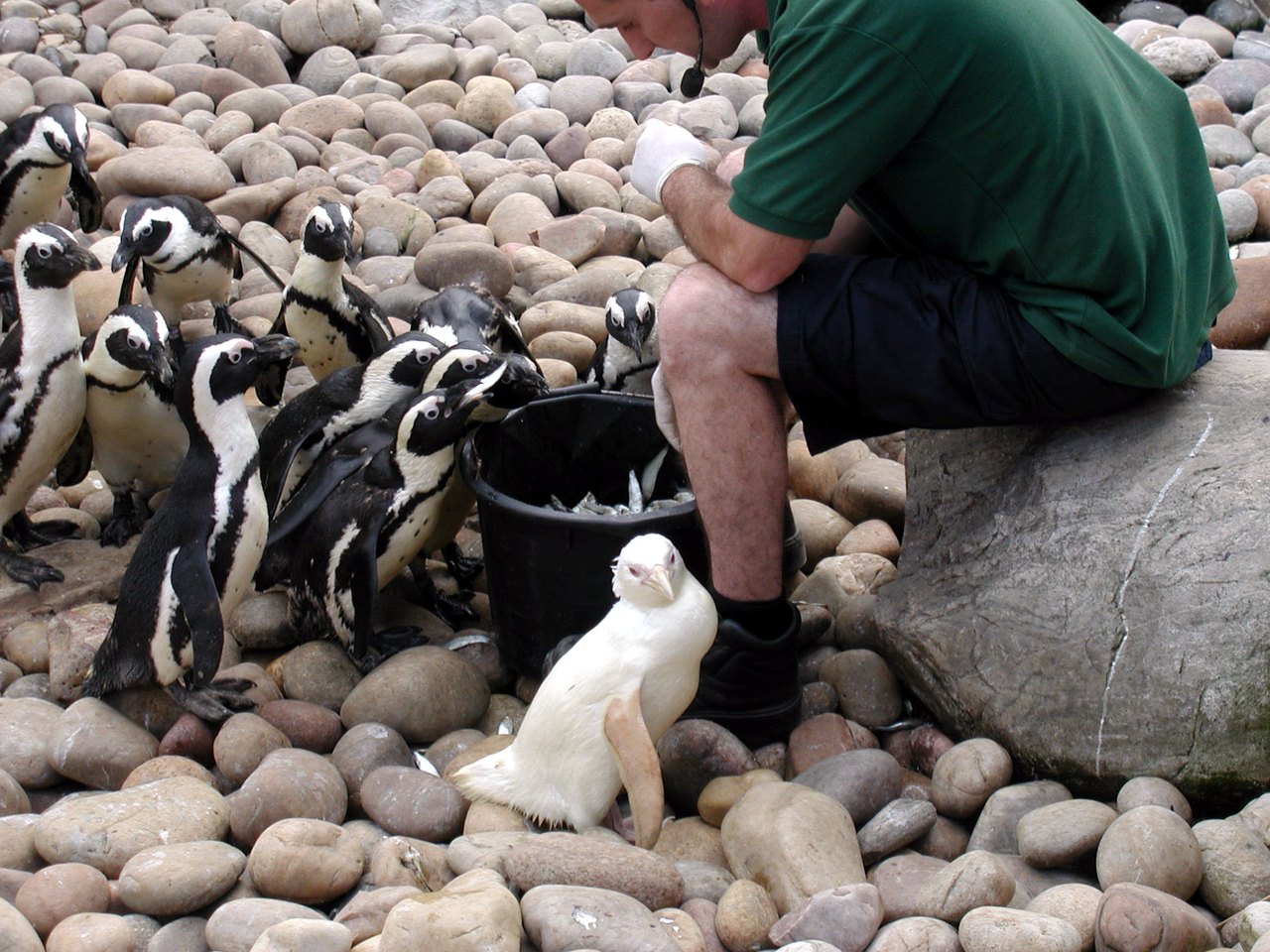
Visual AidFeeding time: a keeper and a bucket of fish
Photograph of feeding time at Bristol Zoo in England in 2003. A keeper sits with a bucket of fish while African penguins crowd around it; the white bird in front is Snowdrop, a rare albino penguin born at the zoo. The Knowledge Bank explains that a penguin must be given fresh fish and constant watching, and that every one of those things costs money. This is that daily work, seen once. These are African penguins from warm coasts, not Antarctic birds, and no one here is drilling holes in a refrigerator. Notice how many beaks point at one bucket — the appetite a family budget has to feed.
African penguins at feeding time, Bristol Zoo, 2003; photograph by Adrian Pingstone, released to the public domain. Source: Wikimedia Commons, public domain.
scoldv.Ch.4
To speak angrily to someone who has done wrong
“Mrs. Popper had to scold the penguin over the goldfish.”
convertv.Ch.4
To change something so it can be used a new way
“They decided to convert the icebox into a penguin home.”
ventilationn.Ch.5
The flow of fresh air into a space
“Air holes gave the icebox proper ventilation.”
interioradj.Ch.5
On the inside
“An interior handle let the bird open the door himself.”
operatev.Ch.5
To make a machine or device work
“Captain Cook learned to operate the new handle in minutes.”
licensen.Ch.6
An official paper giving permission for something
“No city office seemed to issue a penguin license.”
officialn.Ch.6
A person who holds a position of authority
“Each official passed the question to a different office.”
transferv.Ch.6
To pass someone or something from one place to another
“The clerk would transfer the call yet again.”
expensen.Ch.5
Money spent on something; a cost
“The icebox repairs were an expense the family could barely afford.”
mischiefn.Ch.4
Playful behavior that causes small trouble
“The goldfish incident was the penguin’s first real mischief.”
ⓘ The vocabulary words in this list are selected to help you understand and complete this workbook. Some may not appear verbatim in the original novel.
🧠Knowledge Bank question
1According to the Knowledge Bank, the more unusual a creature is, ___.Ch.4
2‘Ventilation’ means keeping all fresh air out of a space.Ch.5
3An official paper giving permission for something is a ___.Ch.6
4An ‘interior’ handle is on the outside of a door.Ch.5
5Fill in each blank with the correct word.Ch.4–6
Word choices:scoldexpenseoperateofficial- some words will not be used
Mrs. Popper had to Captain Cook about the goldfish.
The repairs were an the thin family budget dreaded.
6A person who holds a position of authority is an ___.Ch.6
7‘Mischief’ is playful behavior that causes small trouble.Ch.4
8To make a machine or device work is to ___ it.Ch.5
9Fill in the blanks with the correct words.Ch.5–6
Word choices:transferventilationlicenseconvert- some words will not be used
Every clerk chose to the call to another office.
The drilled holes provided for the sleeping bird.
10Money spent on something is an ___.Ch.5
Part 2
Comprehension
Show you understood what happens in Chapters 4–6.
🧠Knowledge Bank · When One Thing Leads to Another
Reading Skill · Cause & EffectStories move because one event causes the next, like a row of falling dominoes. The cause is why something happens; the effect is what happens as a result. In Part 2 you can trace a neat chain: because Captain Cook needs cold air, the Poppers change the refrigerator; because a penguin now lives in the house, a puzzled service man arrives; because the town has never seen such a pet, the family must visit City Hall for a license. Each effect becomes the cause of the next surprise. As you read, quietly ask why did that happen, and what will this cause now? Following those links helps you understand not just what occurs in a story, but the reason every event is joined by one unbreakable chain.
Visual AidBecause this, therefore that
Diagram for the Knowledge Bank on cause and effect. It shows the three links the Knowledge Bank names, each as a cause on the left and its effect on the right. It does not add events from later chapters. Notice that every effect on the right becomes the cause of the row below it — the chain the Knowledge Bank calls unbreakable.
Links named in the Knowledge Bank. Drawn for Garden Heights Academy.
🧠Knowledge Bank question
1The Knowledge Bank says the Poppers must visit City Hall for a license because ___.Ch.4
2What TWO changes does Mr. Popper order for the icebox?Ch.5
3The service man immediately understands why a penguin needs an icebox bedroom.Ch.5
4How much money does Mr. Popper spend on the icebox conversion?Ch.5
5Write the numbers 1–5 in the boxes to show the correct order of events in Chapters 4–6. Number 1 = what happens first.Ch.4–6
The service man converts the icebox with holes and a handle.
A policeman knocks at the back door.
Mrs. Popper meets the penguin and slowly warms to him.
Mr. Popper’s license phone-calls go around in circles.
Captain Cook eats the goldfish and is scolded.
6The policeman arrests Mr. Popper for keeping a wild bird.Ch.6
7Why does the policeman come to the Popper house at all?Ch.6
8What happens when Mr. Popper telephones the city about a penguin license?Ch.6
9Mrs. Popper ends these chapters by bringing home shrimp for Captain Cook.Ch.6
10How does Captain Cook handle his converted icebox door?Ch.5
Part 3
Literary Elements
Understanding HOW and WHY Richard & Florence Atwater tells the story across Chapters 4–6.
🧠Knowledge Bank · A Joke That Keeps Growing
Literary Craft · The Running GagA running gag is a joke an author returns to again and again, and each time it grows a little bigger and funnier. It works through escalation — a small silliness that keeps building. Captain Cook is a walking running gag: first he explores the house, then he gathers odd household objects into a nest, then he causes fresh trouble the family never expected. Because we remember his last piece of mischief, each new one lands harder and makes us laugh more. The humor rises like a staircase instead of staying flat. Writers use this trick to keep a light story bouncing forward with energy. As you read, watch how one mischievous penguin turns ordinary chores into a comedy that keeps climbing higher and getting funnier.
Escalation
Each scene raises the stakes a notch — goldfish, then renovation, then police, then city hall: one penguin, ever-bigger ripples.
Running gag
A joke repeated with variations — every sensible professional who meets Captain Cook leaves slightly unhinged.
Satire
Comedy aimed at a real-world target — the license runaround teases every bureaucracy that cannot process the unexpected.
🧠Knowledge Bank question
1According to the Knowledge Bank, a running gag works through ___.Ch.4–6
2Fill in the blank with the correct literary term.Ch.5–6
Word choices:satireescalationsimileflashback- some words will not be used
Comedy aimed at bureaucracy’s love of forms is .
Stakes rising scene by scene is called .
3The service man and the policeman play the same comic role: they are ___.Ch.5–6
4A running gag is a joke that appears only once in a story.Ch.4–6
5The license phone-calls satirize bureaucracies’ habit of ___.Ch.6
6Spending the last ten dollars on the penguin’s comfort characterizes Mr. Popper as ___.Ch.5
7The satire in Chapter 6 works because readers recognize the runaround from real life.Ch.6
8Fill in the blank with the correct literary term.Ch.5
Word choices:running gagcliffhangermoraltheme- some words will not be used
Sensible professionals repeatedly unhinged by one penguin is a .
9Mrs. Popper’s arc in these chapters — shock, scolding, then shrimp — shows her ___.Ch.4–6
10The Atwaters keep the penguin entirely innocent while chaos grows around him. This choice keeps the comedy ___.Ch.4–6
Part 4
Think Deeper
Four deeper challenges — no single-word recall. Read, weigh the evidence, and reason it out.
🧠Knowledge Bank · Caring for a Living Thing
Social-Emotional · ResponsibilityBringing an animal into a home is exciting, but it is also a promise. The Poppers quickly learn that a penguin cannot care for itself in a human town, so its comfort, its food, and its safety now rest on them. Because a living creature depends on you, you cannot simply enjoy the fun parts and ignore the hard ones. Notice how the family reshapes their days and even their refrigerator to meet Captain Cook’s needs, and rarely complains. That steady, unglamorous work is the true heart of responsibility. In your own life, a pet, a plant, or a younger sibling asks the same of you: not grand gestures, but faithful daily attention. Real caring is measured less in words and far more in quiet, dependable action.
Think back over the chapters. A goldfish bowl stands suddenly empty, and a penguin looks innocently at the ceiling. A service man drills breathing holes in a perfectly good icebox while muttering about madness. A policeman stands in a kitchen doorway, staring at a bird that stares politely back. And somewhere in city hall, a telephone call about a penguin license is being transferred, for the ninth time, to somebody else’s desk.
Original passage written for Garden Heights — not a quotation from the novel.
1Claim: “By the end of Chapter 6, the whole Popper family has accepted Captain Cook as one of their own.” — choose the two details that best prove it.Claim & Evidence
2How the Poppers treat the penguin, or How outsiders treat the penguin? Tap each detail to sort it — tap again to switch sides. You can keep tapping to change your answer.Sort into two
◄ How the Poppers treat the penguinHow outsiders treat the penguin ►
3Match each cause to its result. For each cause, pick its result.Cause & Effect
Captain Cook eats the goldfish out of their bowl→
A penguin needs cold air and his own front door→
The service man leaves telling wild stories→
No city form has a box for ‘penguin’→
🧠Knowledge Bank question
4Fill both blanks to complete the reasoning.Build the Argument
The Knowledge Bank says bringing an animal home is also a promise because , which means .
Part 5
Standardized Test
Reading passage · The Ice Man and the Humming Box · SAT & TOEFL-style practice
Read the passage — the highlighted words are tested — then answer. Tap an answer, then tap it again to confirm.
SATCentral Ideas — the passage's main point
SATDetail — a fact stated in the passage
SATWords in Context — a word's meaning in this passage
TOEFLFactual Information — a fact stated in the passage
TOEFLRhetorical Purpose — why the author included a detail
TOEFLProse Summary — the three sentences that sum it up
The Vanishing Icebox and Ice Man
For half a century, keeping food fresh in an American home meant one thing: the icebox — a heavy wooden cabinet with a tin-lined interior, cooled by a real block of ice. The ice came from the ice man, who drove his wagon — and later his truck — down every street a few times a week, hauling dripping fifty-pound (twenty-three-kilogram) blocks with iron tongs. Families left a card in the window saying how many pounds they needed, and children chased the wagon on hot days begging for chips of ice. Then, in the 1920s and 1930s, the electric refrigerator began humming its way into American kitchens. It needed no deliveries, no drip pan, and no card in the window — just electricity. By 1938 nearly half of American homes had made the switch, though for many families, like a fictional house painter's, the new machine was too great an expense, and the trusty old icebox stayed. Within another twenty years the ice wagons were gone, and a whole trade — and the sound of ice tongs on a summer street — passed quietly into memory.
Original passage written for Garden Heights — not a quotation from the novel.
1What is this passage mainly about?SAT · Central Ideas
2According to the passage, what did the ice man do?TOEFL · Factual Information
3How did families tell the ice man how much ice they needed?SAT · Detail
4In the passage, the icebox's interior is its ___.SAT · Words in Context
5According to the passage, about how many American homes had refrigerators by 1938?TOEFL · Factual Information
6In the passage, the refrigerator was too great an expense, meaning it ___.SAT · Words in Context
7What advantages of the refrigerator does the passage list?TOEFL · Factual Information
8Children chased the ice wagon on hot days because ___.SAT · Detail
9The passage’s last sentence — a trade passing ‘quietly into memory’ — strikes a tone of ___.TOEFL · Rhetorical Purpose
10Prose Summary (TOEFL).The passage describes a great change in American kitchens. This TOEFL task lists six sentences; choose the THREE that best capture the passage’s main ideas. The other three do not belong — they state minor details or ideas the passage does not present.TOEFL · Prose Summary
Part 6 · Optional
Creative Writing
A bonus challenge to practice your English. Take your time and have fun with it.
About This Section
This writing task is optional and is not part of your auto-graded score. The feedback below checks only the basics — length, spelling, and grammar — not whether your ideas are right or wrong. It is meant for classroom discussion and creative practice, so feel free to use your imagination!
Writing Task — Part 2 “The Visitor’s Report”
The service man leaves the Popper house convinced something impossible is going on. Write HIS report of the visit — in his voice — describing what he was asked to do to the icebox, what he saw waddling through the kitchen, and what he thinks of the whole family. Keep it funny but let him stay completely serious. Write 6–10 sentences.
You can start with: “I have been fixing iceboxes for twenty years, but today...”
0 / 40 words minimum
🗣 Teach It · Just for Fun (optional)
No right or wrong — close the screen and tell someone nearby what happened in this part. Can’t find anyone? Tell yourself out loud. The moment you teach it, you truly understand it.
Part 2 Complete!
You finished Chapters 4–6 of Mr. Popper’s Penguins.
Here are your auto-graded results:
-
points out of 100
Teach it to someone
The best last step is to teach it. In your own words, explain what happened — retell a favorite scene, teach a character’s big choice, or sum up the main idea for a parent, friend, or classmate. When you can teach it clearly, you truly own it.
Independent study guide by Garden Heights. Not affiliated with or endorsed by Richard & Florence Atwater. Contains original analysis only; no text from the novel is reproduced. Reference text: This workbook follows Richard & Florence Atwater’s classic text (the standard Puffin edition sold worldwide). Revised 2023 UK editions change some wording and may not match the vocabulary studied here.
SAT® is a registered trademark of College Board, which is not affiliated with, and does not endorse, these materials. TOEFL® is a registered trademark of ETS. These materials are not endorsed or approved by ETS. Garden Heights is an independent provider of test-style reading practice.