New here? Just sign up with Google — your account includes Matilda, our gift book, forever.
My Side of the Mountain · Garden Heights
Part 6
for My Side of the Mountain · Part 6 · Chapters 16–18
8 Parts40 min
What Happens in Part 6
Winter is coming, and Sam knows it will be the true test of everything he has learned. He prepares with the seriousness of a life depending on it. He obtains deer — taking them from hunters who leave them — and wastes nothing: he tans the hides into leather and sews himself a warm deerskin suit, boots, and mittens; he preserves meat to last the frozen months; he renders the fat into tallow for candles and grease; he carves tools and needles from the bones. His hollow tree, banked against the cold, becomes a snug den. Then the real winter arrives — blinding snow, howling ice storms, cold that could kill an unprepared person in hours. But Sam, warm in his deerskins and his tree, well-fed from his stores, with Frightful for company, does not merely survive the winter; he masters it. Still, the deep of winter is hard. The world shrinks to white silence, the days are short and dark, and for long stretches Sam feels the loneliness press in. He misses Bando, misses people, misses the sun. He learns that survival is not only about food and warmth but about keeping one’s spirit alive through the long, dark, solitary months — and that even a master of the wild can grow weary of being alone.
The great test, mastery earned, and loneliness in the dark
Cross-Curricular
Surviving winter — how people and animals endure the cold
Chapter Summary
Ch.
What happens
Chapters 16–17
Ready for Winter — Sam prepares fiercely: deerskin clothes and boots, preserved meat, tallow candles, bone tools; he turns his tree into a snug winter den.
Chapter 18
The Long Dark — a harsh winter of snow and ice comes; warm and well-fed, Sam masters it — yet the deep of winter brings loneliness and a longing for people and sun.
Part 1
Vocabulary
Study 10 key words from Chapters 16–18, then answer each question.
🧠Knowledge Bank · Storing a Harvest Without a Fridge
Food Science · Keeping Food
Preserving food means denying microbes what they need. Drying removes the water bacteria and moulds require, and it is the oldest method, which is why dried fish, fruit and thin strips of meat appear in almost every traditional cuisine. Smoking adds antimicrobial compounds and a drying heat at once. Salting and sugaring work by osmosis, drawing water out of any cell that touches them, including microbial ones. Cold slows everything down, so a stream-cooled hollow or a pit dug below the frost line acts as a natural larder, and a root cellar keeps vegetables for months at a steady low temperature. Fermentation is the clever exception: it lets one harmless organism take over so that harmful ones cannot. Anyone facing a northern winter has to think in these terms by late summer, because the season of gathering ends long before the season of eating.
Visual AidKeeping food without a cold place
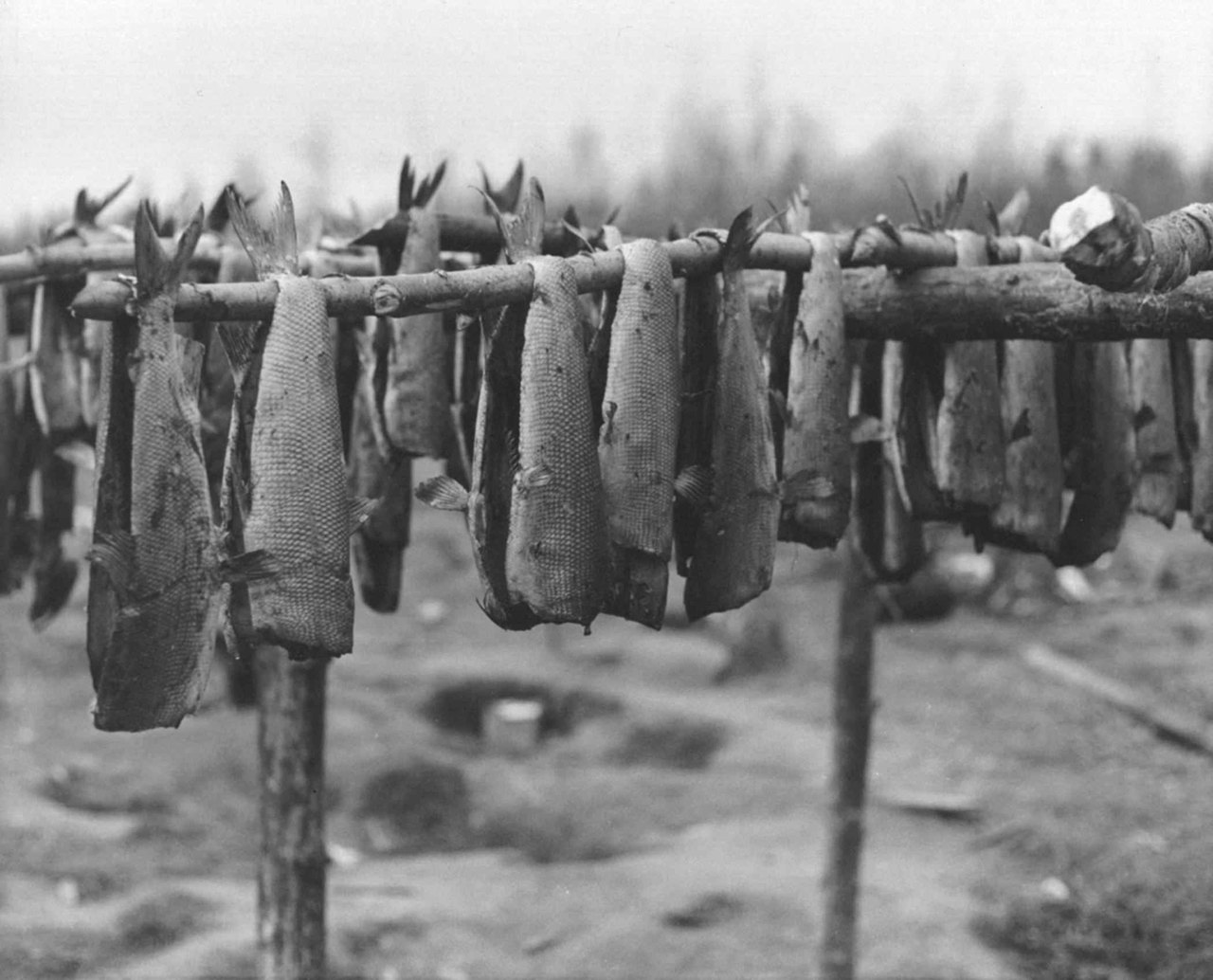
Fish split and hung on a drying rack. The Knowledge Bank explains that preserving food means denying microbes what they need, and that drying — removing the water bacteria and moulds require — is the oldest method of all, which is why dried fish, fruit and thin strips of meat appear in almost every traditional cuisine. Notice how thin each piece is and how much air reaches it. That is the entire technique. Nothing here is being cooked; the water is simply being taken away faster than anything can grow in it.
Fish drying on racks. Source: Wikimedia Commons, public domain.
preservev.Ch.16
To keep food from spoiling
“Sam had to preserve meat for winter.”
tanv.Ch.16
To turn animal hide into leather
“He learned to tan the deer hides.”
insulatev.Ch.17
To keep heat from escaping
“He banked snow to insulate his tree.”
endurev.Ch.18
To bear hardship over time
“Sam had to endure the long dark.”
provisionsn.Ch.16
Stored supplies of food
“He built up provisions for the frozen months.”
harshadj.Ch.18
Severe and hard to bear
“The winter was harsh and long.”
renderv.Ch.16
To melt fat into a usable form
“He would render deer fat into tallow.”
snugadj.Ch.17
Warm and cozy
“His tree home was snug against the cold.”
wearyadj.Ch.18
Tired and worn down
“The long dark left him weary of being alone.”
spiritn.Ch.18
A person’s inner strength or mood
“Winter tested his spirit as much as his body.”
ⓘ The vocabulary words in this list are selected to help you understand and complete this workbook. Some may not appear verbatim in the original novel.
🧠Knowledge Bank question
1According to the Knowledge Bank, how does salting preserve food?Ch.16
2To ‘tan’ a hide is to turn it into leather.Ch.16
3To ‘insulate’ a shelter is to keep ___ from escaping.Ch.17
4To ‘endure’ is to give up quickly under hardship.Ch.18
5Fill in each blank with the correct word.Ch.16
Word choices:provisionstanpreservesneer- some words will not be used
He built up for the frozen months.
He learned to the deer hides into leather.
6Something ‘harsh’ is ___.Ch.18
7To ‘render’ fat is to melt it into a usable form.Ch.16
8A ‘snug’ home is ___.Ch.17
9Fill in each blank with the correct word.Ch.18
Word choices:wearyspiritendureharsh- some words will not be used
The long dark left him of being alone.
Winter tested his as much as his body.
10A person’s ‘spirit’ is their inner strength or ___.Ch.18
Part 2
Comprehension
Show you understood what happens in Chapters 16–18.
🧠Knowledge Bank · What a Northern Winter Does
Meteorology · Winter Weather
Winter in the northeastern United States is shaped by cold continental air meeting moisture from the Atlantic. When a low-pressure system tracks up the coast it can pull enormous amounts of water vapor over that cold air and produce the heavy snowfalls called nor’easters, named for the winds that arrive with them. Snow itself is a mixed blessing on the ground: it makes travel exhausting, and it also insulates, trapping enough still air that the space beneath a deep drift stays far warmer than the exposed air above. Small animals exploit this, living out the winter in the gap between snow and soil, a zone biologists call the subnivean layer. Cold snaps are most severe on clear, calm nights, when heat escapes upward with nothing to hold it, which is why the coldest hours arrive just before dawn.
Visual AidA roof made of snow
Section drawing for the Knowledge Bank on a northern winter. The four bands are what a winter hillside is made of from the air down to the soil, and the arrow is the snow depth at which band 3 begins to hold steady. Compare band 1 with band 3: on one clear night the air is far below freezing and the gap under the snow is not. The snow is not being measured here as weather but as shelter, which is why a boy in this book digs in rather than out.
The subnivean space beneath a winter snowpack, as described in the Knowledge Bank. Drawn for Garden Heights Academy.
🧠Knowledge Bank question
1The Knowledge Bank explains that a nor'easter is named for ___.Ch.16
2Sam makes tools and needles from ___.Ch.16
3Sam is caught unprepared when the harsh winter arrives.Ch.17
4When the real winter comes, Sam ___.Ch.18
5Write the numbers 1–5 in the boxes to show the correct order of events. Number 1 = what happens first.Chapters 16–18
He turns his tree into a snug winter den.
Warm and fed, Sam masters it — but feels the loneliness.
He makes deerskin clothes and preserves meat.
Sam prepares hard for winter.
A harsh winter of snow and ice arrives.
6The deep of winter is easy and cheerful for Sam.Ch.18
7During the long dark, Sam most misses ___.Ch.18
8Winter teaches Sam that survival is also about keeping alive one’s ___.Ch.18
9Even a master of the wild can grow weary of being alone.Ch.18
10The winter section fulfills the book’s opening image of Sam ___.Ch.18
Part 3
Literary Elements
Understanding HOW and WHY Jean Craighead George tells the story across Chapters 16–18.
🧠Knowledge Bank · Chapters Written to Be Hard
Literary Craft · The Low Point
Long narratives usually contain a stretch designed to be bleak. Structurally it exists to test whether the protagonist’s new competence holds when conditions are worst, and readers accept it because a skill demonstrated only in good weather proves nothing. Writers manage the risk of losing the reader by keeping the low point short relative to the rest, by giving the character small concrete tasks that keep the prose moving, and by placing one detail of beauty or comfort inside it. That single contrasting detail is what separates hardship writing from misery. Notice also the tense and pace: passages of endurance are often written in shorter sentences and plainer vocabulary, because a narrator who is cold and tired does not reach for elaborate description. The prose itself is being asked to sound depleted.
Visual AidThe stretch built to be hard
Diagram for the Knowledge Bank on the low point. The four numbered points follow the line the Knowledge Bank describes: skills learned, good weather, the worst of it, and then the skills holding. Card 5 gives the reason such a stretch exists at all. Notice that point 4 is not higher than point 1. Nothing new is gained; what the low point proves is that what was already learned survives being tested.
Why a long story includes a deliberately bleak stretch, as described in the Knowledge Bank. Drawn for Garden Heights Academy.
Character arc payoff
The helpless boy now masters killing winter — his growth reaches its height.
Frame closure
We catch up to the opening scene — Sam snug in his tree in a blizzard.
Theme
Survival of the body is not a full life — the long dark tests Sam’s lonely spirit.
🧠Knowledge Bank question
1According to the Knowledge Bank, why do long narratives include a deliberately bleak stretch?Ch.17
2Fill in each blank with the correct literary term.Ch.18
Word choices:frame closurecharacter arc payoffsettingrhyme- some words will not be used
Catching up to the opening blizzard scene is .
Sam mastering winter is his .
3Frame closure is when a story catches up to the moment it opened with.Ch.18
4Sam’s winter loneliness deepens the theme that survival of the body is not a full ___.Ch.18
5The opening frame promised a bridge; the winter section is the bridge’s ___.Ch.18
6A character arc payoff shows the full result of a hero’s growth.Ch.17
7George refuses to make mastery a simple triumph by adding Sam’s ___.Ch.18
8Fill in each blank with the correct literary term.Ch.18
Word choices:themeframe closurenarratorrhyme- some words will not be used
That survival of the body is not a full life is a .
Reaching the opening blizzard scene is .
9Sam’s loneliness makes the human contact coming next feel like a rescue.Ch.18
10The winter section is deeply satisfying mainly because Sam’s competence feels ___.Ch.17
Part 4
Think Deeper
Four deeper challenges — no single-word recall. Read, weigh the evidence, and reason it out.
🧠Knowledge Bank · What Cold and Hunger Really Do
Health Science · The Body in Winter
Surviving winter is a physiological problem before it is a practical one. A body maintains its core temperature by burning fuel, so calorie needs rise sharply in the cold, and someone both underfed and exposed loses ground on two fronts at once. Frostbite arrives first at the extremities, because the body sacrifices fingers, toes, ears and nose to protect the core, and the danger is that freezing tissue stops hurting. Damp is the multiplier: wet clothing conducts heat away many times faster than dry, which is why wilderness medicine treats staying dry as a higher priority than staying warm. Diet matters too, since a winter of lean meat alone causes illness without the fat that supplies energy and certain vitamins. All of it argues for the same discipline — do the hard preparation in autumn, because winter removes the strength required to improvise.
Think back over these chapters. A boy who once could not make a fire now moves through his tasks like an old woodsman: scraping hides soft, stitching a suit of deerskin, smoking meat, melting fat into candles, carving needles from bone, banking his tree against the coming cold. And when the great winter falls — snow to the branches, ice storms screaming through the trees, a cold that kills — he is ready, warm, and fed, and we finally understand the snug scene the book opened with. But mastery is not the same as joy. In the long white silence, the short dark days, the boy who wanted so badly to be alone feels the aloneness settle on him like the snow, and misses, with a real ache, the sound of another human voice.
Original passage written for Garden Heights — not a quotation from the novel.
1Claim: “Part 6 shows that mastering survival of the body is not the same as a full and happy life.” — choose the two details that best prove it.Claim & Evidence
2Challenges Sam beats, or The challenge that remains? Tap each detail to sort it — tap again to switch sides. You can keep tapping to change your answer.Sort into two
◄ Challenges Sam beatsThe challenge that remains ►
3Match each cause to its result. For each cause, pick its result.Cause & Effect
Sam sews a deerskin suit→
A killing winter arrives→
He masters cold and hunger→
Loneliness presses in→
🧠Knowledge Bank question
4Fill both blanks to complete the reasoning.Build the Argument
The Knowledge Bank argues that frostbite reaches the fingers and toes first because , which shows that .
Part 5
Standardized Test
Reading passage · Surviving Winter: Enduring the Cold · SAT & TOEFL-style practice
Read the passage — the highlighted words are tested — then answer. Tap an answer, then tap it again to confirm.
SATCentral Ideas — the passage's main point
SATDetail — a fact stated in the passage
SATWords in Context — a word's meaning in this passage
TOEFLFactual Information — a fact stated in the passage
TOEFLProse Summary — the three sentences that sum it up
Three Ways Animals Survive Winter
Sam’s fierce winter preparations reflect one of nature’s greatest tests: surviving the cold. For a warm-bodied creature, the central problem of winter is heat. The body must keep making and holding warmth faster than the freezing air can steal it away, or the creature dies of the cold. Every animal that lives where winters are harsh has to solve this problem somehow, and life has evolved three broad strategies to do it.
The first is to MIGRATE — to flee the cold entirely, as many birds do, traveling thousands of miles to warmer lands. The second is to HIBERNATE — to drop the body’s temperature and heartbeat and sleep through the worst months, as bears do, living off fat stored during the plentiful seasons. The third is to RESIST — to stay awake and active through the winter by growing a thick coat of fur or feathers, storing food ahead of time, and sheltering in an insulated den. Sam, who can neither migrate nor hibernate, does exactly what a resisting animal does: he grows a thick coat by sewing warm deerskin clothes, stores fat as preserved meat, and insulates his den — his hollow tree — against the killing cold. By skill and planning, he applies the same survival logic that evolution wrote into the animals around him. Enduring a hard winter is also a test of the spirit: the long dark and the deep silence weigh on the heart.
Original passage written for Garden Heights — not a quotation from the novel.
1What does the passage mainly explain?SAT · Central Ideas
2For a warm-bodied creature, the central problem of winter is ___.TOEFL · Factual Information
3Life has evolved ___ broad strategies against the cold.SAT · Detail
4To ___ is to flee the cold entirely, as many birds do.TOEFL · Factual Information
5To ___ is to drop body temperature and sleep through winter.SAT · Detail
6To ___ is to stay active with a thick coat, stored food, and a den.TOEFL · Factual Information
7In the passage, Sam’s warm deerskin clothes act like an animal’s ___.SAT · Detail
8Sam’s preserved meat acts like an animal’s stored ___.SAT · Detail
9Prose Summary (TOEFL).The passage explains how creatures survive winter, and how Sam does the same. This TOEFL task lists six sentences; choose the THREE that best capture the passage’s main ideas. The other three do not belong — they state minor details or ideas the passage does not present.TOEFL · Prose Summary
10In the passage, harsh most nearly means ___.SAT · Words in Context
Part 6 · Optional
Creative Writing
A bonus challenge to practice your English. Take your time and have fun with it.
About This Section
This writing task is optional and is not part of your auto-graded score. The feedback below checks only the basics — length, spelling, and grammar — not whether your ideas are right or wrong. It is meant for classroom discussion and creative practice, so feel free to use your imagination!
Writing Task — Part 6 “The Long Dark”
Sam masters winter’s cold but struggles with its loneliness and darkness. Write about getting through a long, hard stretch — a tough season, a difficult time — when you had to keep your spirit up, not just get by. What was hard, and what kept you going? 6–10 sentences. End with what helped your spirit survive.
You can start with: “Getting through the days was one thing, but keeping my spirits up...”
0 / 40 words minimum
🗣 Teach It · Just for Fun (optional)
No right or wrong — close the screen and tell someone nearby what happened in this part. Can’t find anyone? Tell yourself out loud. The moment you teach it, you truly understand it.
Part 6 Complete!
You finished Chapters 16–18 of My Side of the Mountain.
Here are your auto-graded results:
-
points out of 100
Teach it to someone
The best last step is to teach it. In your own words, explain what happened — retell a favorite scene, teach a character’s big choice, or sum up the main idea for a parent, friend, or classmate. When you can teach it clearly, you truly own it.
Independent study guide by Garden Heights. Not affiliated with or endorsed by Jean Craighead George. Contains original analysis only; no text from the novel is reproduced. Reference text: This workbook follows Jean Craighead George’s classic text (the standard Puffin edition sold worldwide). Revised 2023 UK editions change some wording and may not match the vocabulary studied here.
SAT® is a registered trademark of College Board, which is not affiliated with, and does not endorse, these materials. TOEFL® is a registered trademark of ETS. These materials are not endorsed or approved by ETS. Garden Heights is an independent provider of test-style reading practice.