New here? Just sign up with Google — your account includes Matilda, our gift book, forever.
📚
Garden Heights
Members sign in to continue.
Narnia: The Lion, the Witch and the Wardrobe · Garden Heights
Part 8
for Narnia: The Lion, the Witch and the Wardrobe · Part 8 · Chapters 15–17
a novel by C.S. Lewis
35 min6 Parts
This workbook is built on a solid pedagogical foundation, effectively integrating content and language learning based on the CLIL framework (Content and Language Integrated Learning), elevated by our unique 5th C — Connection — and an integrated Standardized Test section that weaves every SAT & TOEFL question type right into the novel, so learners build real test skills easily, naturally, and with fun.
💭 Before You Read · Just for Fun
No right or wrong answers — just think or chat about it: If you could win a special title like “the Brave” or “the Kind,” which would you most want to earn, and why? Do you think people can truly change for the better?
What Happens in Part 8
At dawn the Stone Table cracks and Aslan is alive again — raised by the Deeper Magic from Before the Dawn of Time: when a willing, innocent victim dies in a traitor’s place, death itself works backwards. After a joyful romp with the girls, Aslan races to the Witch’s castle and breathes on the stone statues, bringing them back to life as an army. They join the great battle, where Edmund bravely smashes the Witch’s wand but is badly wounded; Aslan kills the Witch, and Lucy’s cordial heals Edmund. The four children are crowned Kings and Queens at Cair Paravel — Peter the Magnificent, Susan the Gentle, Edmund the Just, and Lucy the Valiant. Years later, grown up, they hunt the White Stag, reach the lamp-post, and tumble back out of the wardrobe as children, with no time having passed.
What We Will Learn
Literary Element
What It Means
Resolution
The part of a story where problems are solved
Circular structure
When a story ends where it began
Theme
The deeper message a whole story leaves us with
Chapter Summary
Chapter
Key Events
Ch.15
Deeper Magic from Before the Dawn of Time — the Stone Table breaks and Aslan returns to life; he explains the Deeper Magic to Susan and Lucy
Ch.16
What Happened About the Statues — Aslan revives the stone creatures, who join the battle; Edmund breaks the Witch’s wand and is wounded
Ch.17
The Hunting of the White Stag — the Witch is defeated, the children are crowned, and years later they return through the wardrobe as children
Copyright Notice
Independent study guide by Garden Heights. Not affiliated with or endorsed by C.S. Lewis or HarperCollins. No text from the novel is reproduced. Students should read the original book.
Part 1
Vocabulary
Study 10 key words from Chapters 15–17, then answer each question.
🧠Knowledge Bank · The Legend of the White Stag
Lexicology · The Legend of the White Stag
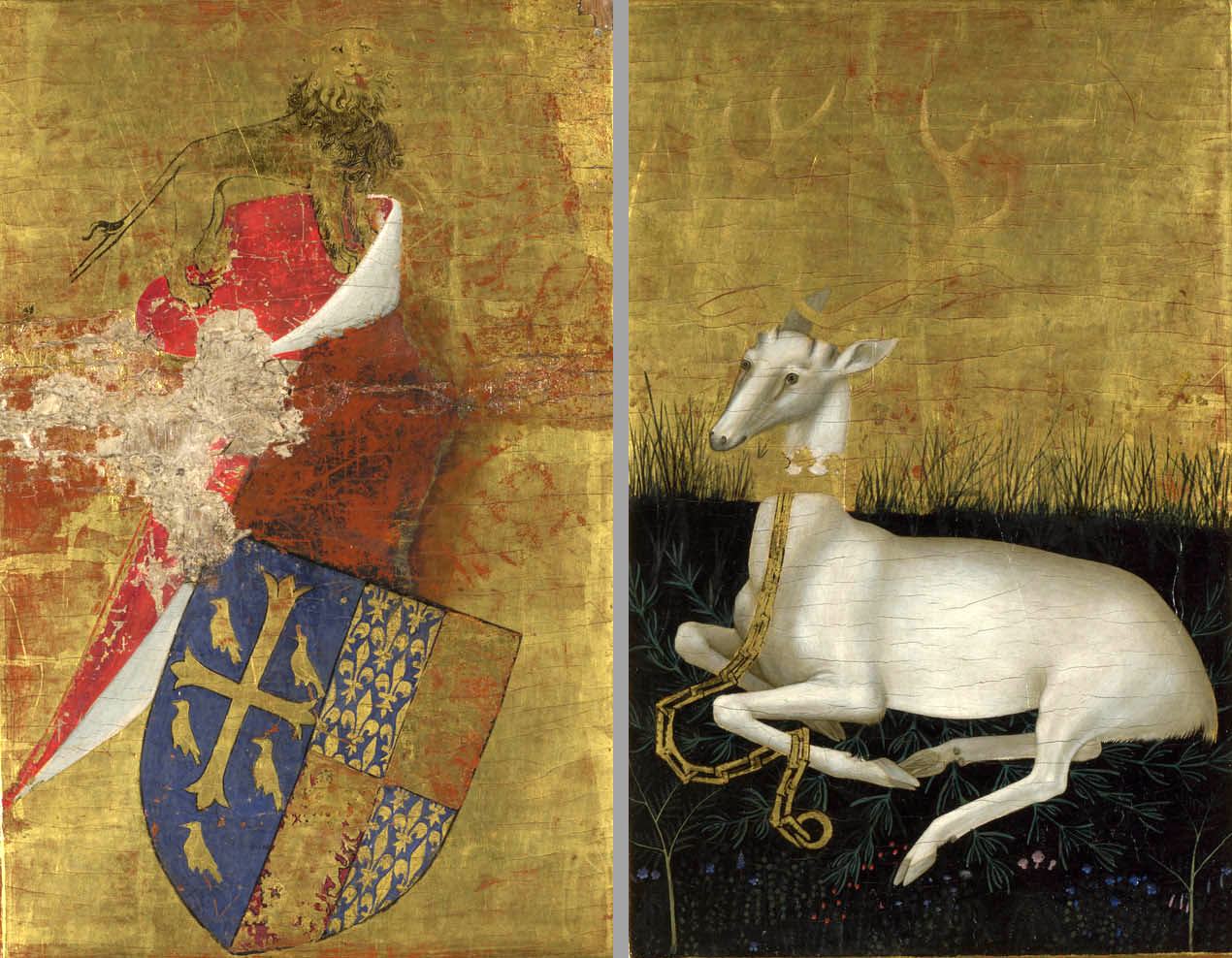
At the very end, the grown-up monarchs hunt a White Stag said to grant wishes to whoever catches it. This comes from a real old legend: in medieval European and Celtic tales, a pure-white deer was a rare, almost magical creature that often led hunters into adventure or into another world. That is exactly what it does here — the hunt leads the kings and queens back to the lamp-post and home. The children’s crowning follows the real ritual of coronation — crown, throne and solemn vows — that has marked monarchs for centuries. Their closing hunt for the White Stag taps a classic European legend, in which a magical white deer lures heroes toward a threshold and a new adventure. The Stag closes the circle it opened. The children ride out chasing a wish and ride straight back into the lamp-post, the wardrobe and their own childhood — the legend’s threshold working in both directions.
Visual AidThe white hart in real art
Photograph of the two outer panels of the Wilton Diptych, painted for King Richard II of England around 1395–99 and now in the National Gallery in London. The Knowledge Bank explains that the White Stag comes from a real old legend, a rare, almost magical creature in medieval tales. Here is proof of how real that legend was: a king chose a white hart, crowned and chained, as his personal badge, and had it painted on the back of his own altarpiece. The left panel shows his coat of arms. Neither panel illustrates the novel. Notice the gold antlers and the crown collar — nobody paints an ordinary deer that way.
The Wilton Diptych, reverse panels: arms of Richard II and his white hart badge, c. 1395–99; National Gallery, London. Source: Wikimedia Commons, public domain.
ⓘ Vocabulary words are selected to help you understand and complete this workbook. Some may not appear verbatim in the novel.
restorev.Ch.16
To bring back to a former, better state
“Aslan’s breath restored the statues to life.”
rompn.Ch.15
Lively, playful fun
“Aslan gave the girls a wild, joyful romp across the hilltop.”
coronationn.Ch.17
The ceremony of crowning a king or queen
“The coronation at Cair Paravel was full of music and joy.”
nobleadj.Ch.17
Having fine qualities; of high rank
“The four rulers grew wise and noble over the years.”
magnificentadj.Ch.17
Wonderfully grand and impressive
“Peter became known as Peter the Magnificent.”
gentleadj.Ch.17
Mild and kind
“Susan the Gentle was loved for her kindness.”
justadj.Ch.17
Fair and right
“Edmund became a just judge, known as Edmund the Just.”
valiantadj.Ch.17
Very brave
“Lucy the Valiant was famous for her bold heart.”
questn.Ch.17
A long search or journey to achieve something
“Their quest after the White Stag led them home.”
wondrousadj.Ch.15
Wonderful; amazing
“It was a wondrous sight to see Aslan alive again.”
🧠Knowledge Bank question
1According to the Knowledge Bank, what did a white stag do in old legends?Ch.16
2A “romp” is lively, playful fun.Ch.15
3A “coronation” is —Ch.17
4Fill in each blank with the correct word.Ch.17
Word choices:noblecoronationrestoreromp- some words will not be used
Having fine qualities and high rank means
The ceremony of crowning a ruler is a
5“Magnificent” means small and plain.Ch.17
6A person who is “gentle” is —Ch.17
7Edmund becomes known as “the Just,” because he is —Ch.17
8“Valiant” means very brave.Ch.17
9Fill in each blank with the correct word.Ch.15–17
Word choices:questwondrousvaliantjust- some words will not be used
A long search or journey to achieve something is a
Wonderful and amazing means
10A “quest” is —Ch.17
Part 2
Comprehension
How well do you understand Chapters 15–17?
🧠Knowledge Bank · Reading a Resolution
Narrative Logic · Reading a Resolution
The end of a story resolves its problems. A good resolution leaves no important question unanswered. Chapter 15 covers Deeper Magic from Before the Dawn of Time — the Stone Table breaks and Aslan returns to life; he explains the Deeper Magic to Susan and Lucy. Chapter 16 covers What Happened About the Statues — Aslan revives the stone creatures, who join the battle; Edmund breaks the Witch’s wand and is wounded. Chapter 17 covers The Hunting of the White Stag — the Witch is defeated, the children are crowned, and years later they return through the wardrobe as children. At dawn the Stone Table cracks and Aslan is alive again — raised by the Deeper Magic from Before the Dawn of Time: when a willing, innocent victim dies in a traitor’s place, death itself works backwards.
🧠Knowledge Bank question
1The Knowledge Bank explains what a good resolution does. What is it?Ch.15
2By what power does Aslan return to life?Ch.15
3Aslan explains that when a willing, innocent victim dies for a traitor, death itself works backwards.Ch.15
4How does Aslan bring the stone statues back to life?Ch.16
5What brave thing does Edmund do in the battle?Ch.16
6Put these events from Part 8 in the correct order. Write 1–4 (1 = first).Ch.15–17
Aslan revives the statues, who help win the battle.
The children are crowned Kings and Queens at Cair Paravel.
Years later, the hunt for the White Stag leads them home.
Aslan rises again and the Stone Table splits.
7Lucy uses her cordial to heal the badly wounded Edmund.Ch.16
8Who finally kills the White Witch?Ch.16
9What title is given to Edmund at the coronation?Ch.17
10When the grown-up rulers return through the wardrobe, years have passed back at the Professor’s house.Ch.17
Part 3
Literary Elements
Understanding HOW and WHY C.S. Lewis writes Chapters 15–17 the way he does.
🧠Knowledge Bank · The ‘Deeper Magic’ Twist and Circular Structure
Literary Technique · The ‘Deeper Magic’ Twist and Circular Structure
Lewis surprises us with the DeeperMagic — a law older still than the Witch’s, which undoes death itself. He also gives the book a circular structure: it ends where it began, at the lamp-post and the wardrobe, with the children turned young again. Ending where you started gives a story a satisfying sense of completeness. The finale ties to history and ideas. Language — royal by-names: rulers earn epithets like “the Just” or “the Great” (Alfred the Great, Richard the Lionheart, Ivan the Terrible). Science — renewal: winter turning to spring is a real seasonal cycle of death and new growth in nature. After a joyful romp with the girls, Aslan races to the Witch’s castle and breathes on the stone statues one by one. Everything she ever froze stands up again, and the courtyard of her victories empties itself out behind him as an army.
Visual AidA story that ends where it began
Diagram for the Knowledge Bank on the Deeper Magic twist and circular structure. It draws the book’s shape as a ring: the lamp-post, the years as kings and queens, the White Stag hunt, and the lamp-post again, with the wardrobe and the children turned young again at the center. It leaves the Deeper Magic to the Knowledge Bank itself. Notice that the last stop and the first stop are the same place. That is what the Knowledge Bank means by completeness.
Structure described in the Knowledge Bank. Drawn for Garden Heights Academy.
📚 Literary Devices in This Part · definitions & examples
The resolution is the part of a story where the problems are solved. Part 8 resolves the war, Edmund’s guilt, and the prophecy.Circular structure is when a story ends where it began. Narnia’s tale ends back at the lamp-post and the wardrobe.A theme is the deeper message of a whole story. Two big themes here are redemption (Edmund forgiven) and renewal (winter to spring).
The questions below are mixed — not grouped by device. Decide which device each one is about.
🧠Knowledge Bank question
1According to the Knowledge Bank, what makes the book's structure circular?Ch.17
2Circular structure means a story finishes where it started.Ch.17
3Fill in the blanks with the correct words.Ch.17
Word choices:thememessagesnowstag- some words will not be used
The deeper idea a whole story explores is its
A theme is a kind of deeper
4The story ending at the same lamp-post and wardrobe where it began is an example of —Ch.17
5Go beyond the definition: which pair of themes best sums up the whole book?Ch.17
6Fill in the blanks with the correct words.Ch.17
Word choices:resolutionproblemsstagcrown- some words will not be used
The part where problems are solved is the
A resolution ties up the story’s
7Edmund the traitor becoming ‘the Just’ reflects the story’s theme of —Ch.17
8The resolution is where a story’s main problems are finally solved.Ch.17
9Fill in the blanks with the correct words.Ch.17
Word choices:circularbeganbattlecrown- some words will not be used
A story that ends where it started has a
Circular structure returns us to where the story
10Which sentence best combines resolution, circular structure, and theme from Part 8?Ch.15–17
Part 4
Think Deeper
Four deeper challenges — no single-word recall. Read, weigh the evidence, and reason it through.
🧠Knowledge Bank · Redemption and Renewal
Ethical Reasoning · Redemption and Renewal
The whole book’s themes come together here: redemption and renewal. Edmund the traitor becomes “the Just”; the dead Lion lives; winter gives way to spring and then to a long, golden reign of peace. Lewis leaves us with the hope that wrongs can be put right and that even the worst mistakes can be forgiven. The four children are crowned at Cair Paravel with grand titles: Peter the Magnificent, Susan the Gentle, Edmund the Just, and Lucy the Valiant. Real medieval rulers were given by-names just like these — think of Alfred the Great or Richard the Lionheart. A coronation, with crowns and thrones, was the ceremony that made a ruler official before all the people. Part 8 opens on the story’s great turning point, which many readers tie to the Christian account of resurrection — coming back to life after death.
1Claim: “A Deeper Magic overturns the Witch’s claim on Edmund.” — choose the two details that best prove it.Claim & Evidence
2Old or new? Tap each item to sort it — tap again to switch sides. You can keep tapping to change your answer.Sort into two
◄ Death & winter (the old)Life & spring (the new) ►
3Match each cause to its result. For each cause, pick its result.Cause & Effect
A willing victim dies for a traitor→
Aslan breathes upon the statues→
Aslan overcomes the Witch in battle→
The ancient prophecy comes true→
🧠Knowledge Bank question
4Fill both blanks to complete the reasoning.Build the Argument
The Knowledge Bank argues that the ending is about redemption because , which shows that .
Part 5
Standardized Test · Mixed Review & Summary
This final round is a mixed practice test — a little of everything you have learned, plus Prose Summary (choosing what matters most). Take your time and enjoy showing what you know!
Read the passage — the highlighted words are tested — then answer. Tap an answer, then tap it again to confirm.
SATWords in Context — a word's meaning in this passage
SATInference — a conclusion the passage implies
SATCentral Ideas — the passage's main point
SATSynthesis — putting information together
SATText Structure & Purpose — how the passage is built, and why
TOEFLFactual Information — a fact stated in the passage
TOEFLProse Summary — the three sentences that sum it up
TOEFLInsert Text — where a sentence best fits
The Meaning of a Coronation
When a story ends by crowning its heroes, it draws on a real tradition thousands of years old: the coronation. A coronation is a formal ceremony in which a new king or queen is officially given power. The moment that makes it official is the placing of a crown upon their head before a watching crowd. Such ceremonies have been held, in one form or another, on almost every continent.
Coronations are rich with symbols. A crown stands for authority, a throne for the seat of power, and special robes for the dignity of the office. In many countries the new ruler also makes a solemn promise, or oath, to serve and protect the people. In this way a coronation turns raw power into responsibility: the ruler publicly accepts not only a title but a duty. Across history, these ceremonies remind everyone watching that leadership is a privilege and a burden at once. That is why a crowning at a story’s close can feel so fitting and satisfying: each new ruler accepts not just a shining crown, but a noble promise to lead with the very qualities — courage, gentleness, justice — that earned them the throne.
Original passage written for Garden Heights — not a quotation from the novel.
1In the passage, “coronation” most nearly means —SAT · Words in Context
2The passage most strongly suggests that a crowning feels satisfying because the new ruler —SAT · Inference
3As used in the passage, “oath” most nearly means —SAT · Words in Context
4In the passage, “noble” most nearly means —SAT · Words in Context
5According to the passage, what does placing a crown on the ruler’s head officially do?TOEFL · Factual Information
6Which choice best states the central idea of the passage?SAT · Central Ideas
7Prose Summary. Which detail is MOST important to include in a short summary of the passage?TOEFL · Prose Summary
8Insert Text (TOEFL). Look at the four squares [1]–[4] in the passage excerpt below. They show where the following sentence could be added: “Many of these traditions are still followed today, almost unchanged, when a new monarch is crowned.”
Coronations are rich with symbols. [1] A crown stands for authority, a throne for the seat of power, and special robes for the dignity of the office. [2] In many countries the new ruler also makes a solemn promise, or oath, to serve and protect the people. [3] In this way a coronation turns raw power into responsibility: the ruler publicly accepts not only a title but a duty. [4]
Where would the sentence fit best?TOEFL · Insert Text
9The story crowns Edmund ‘the Just’ and Lucy ‘the Valiant.’ Based on the passage, these titles mainly work to —SAT · Synthesis
10The author most likely explains coronations to help a reader see that a story’s crowning scene —SAT · Text Structure & Purpose
Part 6 · Optional
Creative Writing
A bonus challenge to practice your English.
About This Section
This writing task is optional and not part of your auto-graded score. Feedback checks length, spelling, and grammar only.
Writing Task — Part 8 “Crowned at Cair Paravel”
Describe the coronation of the four children as Kings and Queens of Narnia. Use imagery to show the scene, and explain why each child’s title — Magnificent, Gentle, Just, or Valiant — suits them. Write at least 40 words.
You can start with: “Trumpets rang out over the sea at Cair Paravel as Aslan placed the crowns upon our heads, and in that moment…”
0 / 40 words minimum
🗣 Teach It · Just for Fun (optional)
No right or wrong — close the screen and tell someone nearby what happened in this part. Can’t find anyone? Tell yourself out loud. The moment you teach it, you truly understand it.
🏆
Part 8 Complete!
You finished Chapters 15–17 of Narnia: The Lion, the Witch and the Wardrobe.
Here are your auto-graded results:
-
points out of 100
Teach it to someone
The best last step is to teach it. In your own words, explain what happened — retell a favorite scene, teach a character’s big choice, or sum up the main idea for a parent, friend, or classmate. When you can teach it clearly, you truly own it.
SAT® is a registered trademark of College Board, which is not affiliated with, and does not endorse, these materials. TOEFL® is a registered trademark of ETS. These materials are not endorsed or approved by ETS. Garden Heights is an independent provider of test-style reading practice.