New here? Just sign up with Google — your account includes Matilda, our gift book, forever.
Number the Stars · Garden Heights
Part 1
for Number the Stars · Part 1 · Chapters 1–2
8 Parts40 min
What Happens in Part 1
Copenhagen, 1943. Ten-year-old Annemarie Johansen races her best friend Ellen Rosen down the sidewalk — and runs straight into two German soldiers on the corner, rifles and tall boots and cold questions. The girls answer carefully, collect little sister Kirsti, and walk home shaken: after three years of occupation, soldiers stand on every corner of Denmark, and even a footrace can turn dangerous. At home the mothers trade worry over ersatz coffee, and the chapter quietly lays out the war’s small print: shortages, curfews, cracked shoes that cannot be replaced. Chapter 2 turns to bedtime stories and to Denmark’s own story: old King Christian X, who rode out alone on horseback each morning while his people guarded him with their bodies; a country too small to fight, whose king — the story goes — answered that every Dane was his bodyguard. And beneath the stories lies a grief the family rarely touches: Lise, Annemarie’s older sister, dead two weeks before her wedding — and the war, somehow, tangled in it.
Small-print war, the king story, and a buried grief
Cross-Curricular
Denmark under occupation, 1940–43
Chapter Summary
Ch.
What happens
1–2
A Race, and a King — a sidewalk footrace ends at two soldiers’ boots; three years of occupation show in shortages and fear; bedtime brings the story of King Christian X riding unguarded among his people — and the shadow of Lise, the sister who died.
Part 1
Vocabulary
Study 10 key words from Chapters 1–2, then answer each question.
📚Knowledge Bank · The Language of Occupation
History & Civics · Wartime RulesWhen one country controls another by military force, historians call it an occupation. German forces invaded Denmark on April 9, 1940, and the Danish government surrendered within hours, fearing that longer fighting would bring devastating bombing. Soldiers then appeared in streets that still looked ordinary. New rules made power visible: a curfew limited movement, a blackout kept light from guiding enemy aircraft, and rationing required coupons for scarce goods. Coffee, sugar, fuel, and clothing became harder to obtain because war disrupted trade and redirected supplies. Sabotage meant secretly damaging railways, factories, or equipment used by the occupying power; it grew more common as Danish resistance increased in 1943. These words are not merely definitions. Each names a way war enters daily life: who may walk, what families may buy, what must remain dark, and whether a citizen obeys or chooses resistance.
occupationn.Ch.1–2
Foreign military control of a country
“Three years of occupation had emptied the shops.”
lankyadj.Ch.1–2
Tall, thin, and a little awkward
“Lanky Annemarie outran everyone on the block.”
sneerv.Ch.1–2
To smile or speak with mocking contempt
“The soldier seemed to sneer at the girls’ answers.”
rationn.Ch.1–2
A fixed, limited share of scarce goods
“The butter ration had shrunk to nothing at all.”
curfewn.Ch.1–2
A rule requiring people indoors by a set hour
“The curfew emptied the streets by nightfall.”
sabotagen.Ch.1–2
Secret damage done to resist an enemy
“Whispers told of sabotage against German factories.”
obstinateadj.Ch.1–2
Stubbornly refusing to change
“Kirsti could be obstinate about the smallest things.”
ersatzadj.Ch.1–2
Being an inferior substitute
“Ersatz coffee, brewed from herbs, fooled nobody.”
bodyguardn.Ch.1–2
A person who protects someone important
“Every Dane, the story said, was the king’s bodyguard.”
griefn.Ch.1–2
Deep sorrow after a loss
“Grief for Lise lived quietly in the apartment.”
ⓘ The vocabulary words in this list are selected to help you understand and complete this workbook. Some may not appear verbatim in the original novel.
🧠Knowledge Bank question
1According to the Knowledge Bank, why did the Danish government surrender within hours when the occupation began on April 9, 1940?Ch.1–2
2A ‘ration’ is an unlimited supply of goods.Ch.1–2
3Tall, thin, and a little awkward is ___.Ch.1–2
4‘Sabotage’ is secret damage done to resist an enemy.Ch.1–2
5Fill in each blank with the correct word.Ch.1–2
Word choices:curfewersatzgriefsneer- some words will not be used
The emptied the streets by nightfall.
coffee, brewed from herbs, fooled nobody.
6A rule requiring people indoors by a set hour is a ___.Ch.1–2
7Someone ‘obstinate’ changes their mind easily.Ch.1–2
8To smile or speak with mocking contempt is to ___.Ch.1–2
9Fill in the blanks with the correct words.Ch.1–2
Word choices:bodyguardsabotageoccupationlanky- some words will not be used
Every Dane, the story said, was the king’s .
Whispers told of against German factories.
10Deep sorrow after a loss is ___.Ch.1–2
Part 2
Comprehension
Show you understood what happens in Chapters 1–2.
📋Knowledge Bank · Copenhagen Under German Control
History · Daily Life Under OccupationOccupied Denmark was neither fully free nor governed exactly like every other country held by Nazi Germany. From 1940 until August 1943, Denmark kept its king, parliament, courts, and much of its police system, while German authorities controlled foreign policy and stationed troops in the country. Historians call this uneasy arrangement a policy of cooperation. It allowed schools, shops, and family routines to continue, but daily normality had strict limits. Closed borders, shortages, air-raid warnings, blackouts, and armed patrols reminded civilians who held military power. By the summer of 1943, strikes and acts of sabotage had increased. When Danish leaders refused German demands for harsher punishment, the government resigned and the occupiers imposed martial law. The opening street encounter belongs to this turning point: an ordinary childhood unfolds inside a tightening system. To comprehend such a setting, readers must track both what continues and what has been taken away—a condition called occupation.
Visual AidOccupied, but not like everywhere else
Diagram for the Knowledge Bank on daily life under occupation. It puts the three dates the Knowledge Bank gives on one line, then splits the years between them into what Denmark kept and what the occupiers held. It does not claim the arrangement was fair or freely chosen. Notice that the left column is full of ordinary life and the right column is full of limits on it — the two things a reader must track at the same time.
Dates and arrangements named in the Knowledge Bank. Drawn for Garden Heights Academy.
🧠Knowledge Bank question
1The Knowledge Bank explains that from 1940 until August 1943, occupied Denmark ___.Ch.1–2
2How long has Denmark been occupied when the story begins?Ch.1–2
3The soldiers on the corner speak kindly to the girls.Ch.1–2
4What do the mothers drink while they talk?Ch.1–2
5Write the numbers 1–5 in the boxes to show the correct order of events in Chapters 1–2. Number 1 = what happens first.Ch.1–2
The shaken girls walk Kirsti home.
Two soldiers stop and question the girls.
The mothers trade worry over ersatz coffee.
Annemarie and Ellen race down the sidewalk.
Bedtime brings the story of King Christian X.
6King Christian X rode through Copenhagen surrounded by armed guards.Ch.1–2
7Why, in the story, did Denmark surrender quickly in 1940?Ch.1–2
8What happened to Lise, Annemarie’s older sister?Ch.1–2
9The Johansens talk openly and often about Lise’s death.Ch.1–2
10What feeling do Chapters 1–2 build about life in Copenhagen?Ch.1–2
Part 3
Literary Elements
Understanding HOW and WHY Lois Lowry tells the story across Chapters 1–2.
🧠Knowledge Bank · History Through One Child’s View
Literary Craft · Limited ViewpointHistorical fiction must explain a real era without turning the novel into a textbook. Lowry solves that problem through viewpoint: the narrator stays close to what Annemarie notices, understands, and misunderstands. This is third-person limited narration. Readers see soldiers through a child’s attention to boots, voices, food, shoes, and adult silences rather than through military reports. The method creates two layers of knowledge. Annemarie can observe a ration card or a guarded corner, while an older reader may infer the larger political system behind it. Lowry also uses withholding, delaying facts about Lise and the adults’ fears until Annemarie is ready to receive them. That delay produces suspense without inventing constant action. In historical fiction, a narrow perspective can make a vast event more understandable because the reader learns history at human scale. What the narrator cannot yet explain becomes as important as what she can see—a purposeful gap called silence.
Limited viewpoint
We know only what Annemarie knows — the adults’ fears stay just out of view.
Withheld truth
Lise’s death is carried in silence — the gap between said and unsaid drives the book.
Embedded legend
The king-on-horseback story: a tale inside the tale that defines courage as standing together.
🧠Knowledge Bank question
1According to the Knowledge Bank, Lowry's use of 'withholding' means that she ___.Ch.1–2
2Fill in the blank with the correct literary term.Ch.1–2
Word choices:legendviewpointrhymesequel- some words will not be used
The king story is an embedded .
Lowry keeps a strictly limited .
3Opening with a footrace instead of a battle shows Lowry’s method of ___.Ch.1–2
4The reader learns immediately exactly how Lise died.Ch.1–2
5The king story defines courage in this book as ___.Ch.1–2
6The detail of Kirsti’s cracked shoes works as ___.Ch.1–2
7The soldiers’ corner questioning foreshadows greater dangers to come.Ch.1–2
8Fill in the blank with the correct literary term.Ch.1–2
Word choices:withheldspokeninventedborrowed- some words will not be used
Lise’s story is a truth.
9The contrast between bedtime stories and rifles on corners creates ___.Ch.1–2
10Chapters 1–2 mainly work to ___.Ch.1–2
Part 4
Think Deeper
Four deeper challenges — no single-word recall. Read, weigh the evidence, and reason it out.
💡Knowledge Bank · A King as a Public Symbol
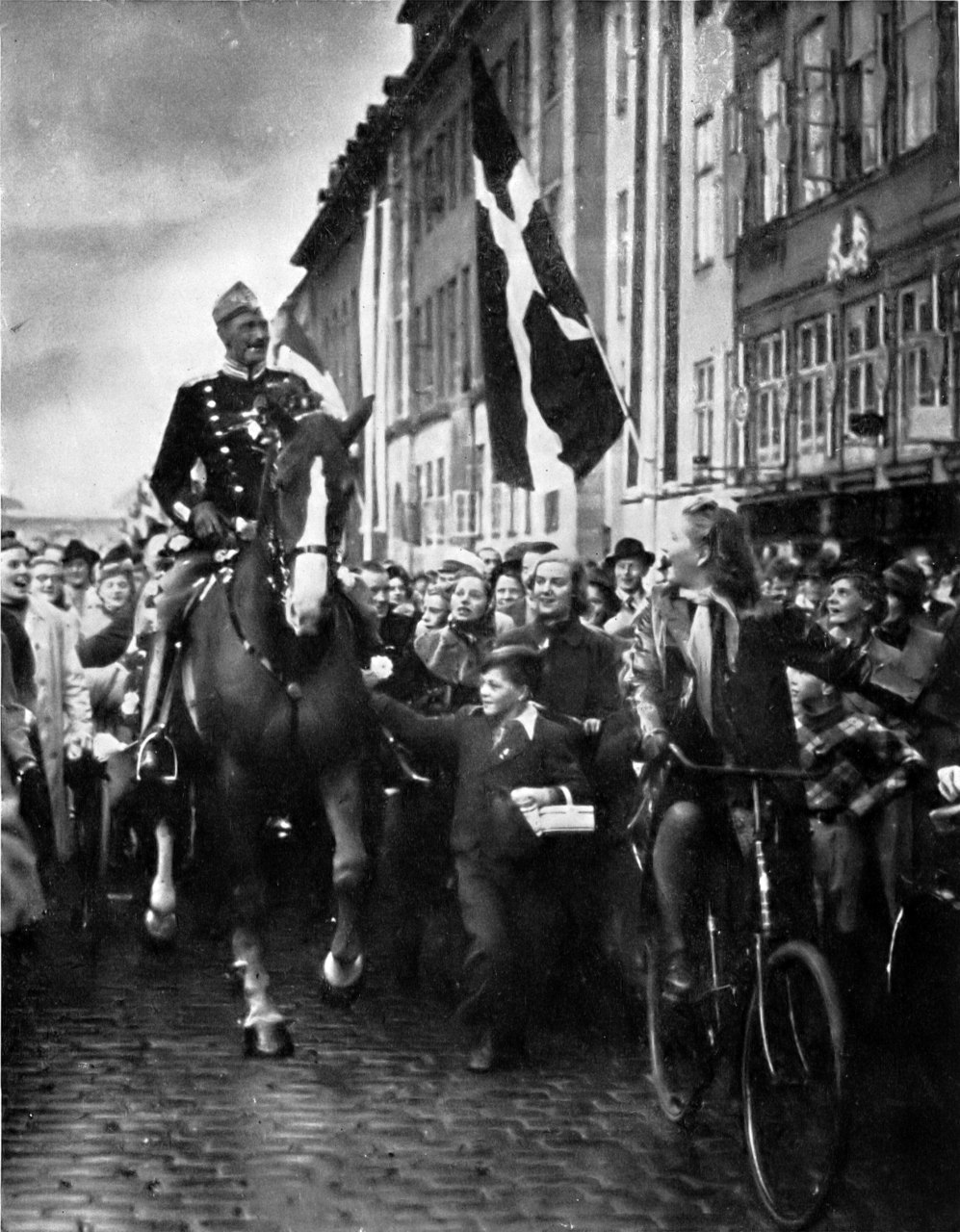
History & Civics · Leadership and LegendKing Christian X remained in Denmark during the occupation and rode through Copenhagen without a military escort, making his familiar figure a public sign that the Danish nation still existed. A popular wartime story claimed that a bystander told a German soldier that all Denmark guarded the king. Historians treat the exact exchange as legend, not verified dialogue, but the rides themselves were real. This distinction matters: a legend can express a community’s values even when every detail cannot be proved. The stronger historical evidence is that the king opposed persecution of Danish Jews and that Danish authorities refused to impose anti-Jewish registration or a yellow badge. Lowry places the horseback story beside armed patrols to create contrast: the occupiers possess weapons, while the king’s power is symbolic. Critical reading asks two questions at once: What can evidence confirm, and why did people need this story? The answer to both lies in the civic strength created when ordinary people imagine themselves bound by solidarity.
Visual AidThe ride the legend grew around
Photograph of King Christian X riding through Copenhagen on September 26, 1940, his seventieth birthday, five months into the German occupation. The Knowledge Bank explains that the king’s unescorted rides were real, even though the famous exchange about all Denmark guarding him is a legend. This is one of those rides: no soldiers around him, only a crowd and the Danish flag. It does not show any scene from the novel. Notice what the king has instead of weapons — a horse, a uniform, and people who came to look at him.
King Christian X in Copenhagen on his 70th birthday, 26 September 1940. Source: Wikimedia Commons, public domain.
Think back over these chapters. Two girls pound down a Copenhagen sidewalk, schoolbags banging — and stop dead at a corner where two soldiers stand like gray statues with cold eyes. Questions, careful answers, a little sister’s hand gripped tight. That night, in a warm apartment made smaller by rationing, a father tells of a king who rides out alone every morning because an entire nation has appointed itself his guard. And in the hallway hangs a photograph nobody discusses: a laughing young woman who will never be married now.
Original passage written for Garden Heights — not a quotation from the novel.
1Claim: “Lowry’s opening argues that occupation is felt most truly in small things.” — choose the two details that best prove it.Claim & Evidence
2Life before the war (remembered), or Life under occupation (now)? Tap each detail to sort it — tap again to switch sides. You can keep tapping to change your answer.Sort into two
◄ Life before the war (remembered)Life under occupation (now) ►
3Match each cause to its result. For each cause, pick its result.Cause & Effect
Two girls race down an ordinary sidewalk→
Three years of occupation grind on→
A father tells the story of the riding king→
A photograph hangs in the quiet hallway→
🧠Knowledge Bank question
4Fill both blanks to complete the reasoning.Build the Argument
The Knowledge Bank treats the story of the bystander and the German soldier as a legend rather than verified dialogue because , which shows that .
Part 5
Standardized Test
Reading passage · A City Under Occupation · Words in Context & Central Ideas · SAT & TOEFL-style practice
Read the passage — the highlighted words are tested — then answer. Tap an answer, then tap it again to confirm.
SATCentral Ideas — the passage's main point
SATWords in Context — a word's meaning in this passage
SATInference — a conclusion the passage implies
TOEFLFactual Information — a fact stated in the passage
TOEFLVocabulary — a tested word's meaning here
Denmark Under Nazi Occupation
On the morning of April 9, 1940, Danes woke to a sky full of German planes and streets already filling with foreign troops. Denmark — small, flat, and bordering Germany — judged resistance hopeless and surrendered within hours, accepting a strange arrangement historians call the ‘model protectorate’: the king stayed on his throne, the Danish government and police kept working, and in exchange the country supplied food and goods to Germany. For three years, life continued in an uneasy half-freedom. But the occupation showed itself daily in the scarcity of ordinary things: coffee and tea vanished, replaced by bitter ersatz brews of roasted herbs; butter, sugar, and cloth were strictly rationed; new shoes became a memory. Soldiers stood on street corners, and a nighttime curfew ruled the clock.
By the late summer of 1943 the arrangement was breaking down. Danish workers, obstinate under threats, struck; saboteurs wrecked factories and rail lines serving the occupiers; and in August the government resigned rather than punish its own people, prompting Germany to seize direct control under martial law. It was in exactly this tense season that the danger to Denmark’s Jewish citizens became acute — sharp, urgent, and impossible to ignore — setting the stage for the events this novel follows. Understanding the occupation’s texture — the rations, the corner guards, the watched streets — explains why even a children’s footrace could end at a rifle, and why courage in Denmark would have to wear everyday clothes.
Original passage written for Garden Heights — not a quotation from the novel.
1What is the main idea of the passage?SAT · Central Ideas
2Why did Denmark surrender within hours in 1940?TOEFL · Factual Information
3Under the ‘model protectorate,’ Denmark kept ___.TOEFL · Factual Information
4In the passage, ersatz brews are ___.SAT · Words in Context
5In the passage, a curfew is ___.TOEFL · Vocabulary
6What happened in August 1943?TOEFL · Factual Information
7In the passage, obstinate workers are ___.SAT · Words in Context
8What did saboteurs target?TOEFL · Factual Information
9The passage says courage in Denmark would have to ‘wear everyday clothes’ because ___.SAT · Inference
10Which Part 1 event does this passage BEST explain?SAT · Inference
Part 6 · Optional
Creative Writing
A bonus challenge to practice your English. Take your time and have fun with it.
About This Section
This writing task is optional and is not part of your auto-graded score. The feedback below checks only the basics — length, spelling, and grammar — not whether your ideas are right or wrong. It is meant for classroom discussion and creative practice, so feel free to use your imagination!
Writing Task — Part 1 “The Small Things”
Lowry shows the war through small things: a cup of bitter coffee, cracked shoes, a stopped footrace. Write about a time when a BIG change in your life showed itself in small, everyday details. What were your ‘cracked shoes’? 6–10 sentences. End with the small detail you remember most clearly.
You can start with: “Nobody announced that things had changed; I noticed it first in something small...”
0 / 40 words minimum
🗣 Teach It · Just for Fun (optional)
No right or wrong — close the screen and tell someone nearby what happened in this part. Can’t find anyone? Tell yourself out loud. The moment you teach it, you truly understand it.
Part 1 Complete!
You finished Chapters 1–2 of Number the Stars.
Here are your auto-graded results:
-
points out of 100
Teach it to someone
The best last step is to teach it. In your own words, explain what happened — retell a favorite scene, teach a character’s big choice, or sum up the main idea for a parent, friend, or classmate. When you can teach it clearly, you truly own it.
Independent study guide by Garden Heights. Not affiliated with or endorsed by Lois Lowry. Contains original analysis only; no text from the novel is reproduced. Reference text: This workbook follows Lois Lowry’s classic text (the standard Puffin edition sold worldwide). Revised 2023 UK editions change some wording and may not match the vocabulary studied here.
SAT® is a registered trademark of College Board, which is not affiliated with, and does not endorse, these materials. TOEFL® is a registered trademark of ETS. These materials are not endorsed or approved by ETS. Garden Heights is an independent provider of test-style reading practice.