
Number the Stars cover
Garden Heights

Number the Stars

This workbook is for Garden Heights members. Sign in to continue.

Sign in with Google →
New here? Just sign up with Google — your account includes Matilda, our gift book, forever.
Number the Stars · Garden Heights

Part 3

for Number the Stars · Part 3 · Chapters 5–6
8 Parts40 min
What Happens in Part 3

Deep in the night, fists pound on the Johansens’ door: soldiers, hunting the vanished Rosens. In the girls’ bedroom Ellen freezes — she is still wearing her golden Star of David necklace, the one thing that would betray her instantly. Annemarie rips it from her friend’s neck a heartbeat before the door opens and holds it clenched in her fist through the whole inspection — so hard that afterward the star’s shape is pressed into her palm. The officer studies the dark-haired ‘Lise’ among her blonde sisters and does not believe; Papa, thinking fast, tears three baby photographs from the family album — each labeled with a daughter’s name — and the infant Lise’s dark curls answer the question. The soldiers leave. By morning the adults have a plan: Mama will take the three girls north to Uncle Henrik’s house by the sea, announced to the world through a coded telephone call about a carton of cigarettes. On the train, soldiers stalk the aisles and Kirsti’s innocent chatter skates near the edge of disaster — but by afternoon the girls are running toward salt air, a gray kitten, and a coastline where, on clear days, you can see Sweden across the water.

What We Will Learn
SectionWhat you will practice
VocabularyNight-search words: pound, imprint, album, code, chatter…
Literary ElementsThe clenched star, the fast lie, and coded language
Cross-CurricularThe Star of David — story of a symbol
Chapter Summary
Ch.What happens
5–6The Night Search, and the Train North — soldiers raid the apartment hunting the Rosens; Annemarie tears off Ellen’s star necklace and hides it in her fist; Papa’s labeled baby photos save the lie; a coded phone call about cigarettes sends Mama and the girls north by train to Henrik’s seaside house, within sight of Sweden.
Part 1
Vocabulary
Study 10 key words from Chapters 5–6, then answer each question.
Knowledge Bank · The Vocabulary of Secret Communication
History & Communication · Resistance CodesUnderground groups survive by controlling information. A code gives an agreed hidden meaning to an ordinary word, while a courier carries a message or object between people who may never meet. During World War II, resistance networks assumed that telephones could be monitored and letters opened. They therefore used harmless subjects—weather, food, appointments, or family news—as verbal cover. The listener needed to know the key: a question about fishing might mean that a boat or passenger route was ready. Radio broadcasts also used apparently personal phrases to signal resistance cells without naming a mission. Good coded language is brief, natural, and deniable; if an enemy overhears it, the words still have an innocent explanation. The chapters’ phone call and invented errands show why terms such as suspicious, imprint, and chatter matter. In a watched society, survival may depend not only on what people say, but on disciplined secrecy.
poundv.Ch.5–6
To strike heavily again and again
“Fists began to pound on the apartment door.”
imprintn.Ch.5–6
A mark pressed into a surface
“The star left its imprint on Annemarie’s palm.”
suspiciousadj.Ch.5–6
Doubting that something is honest
“The officer grew suspicious of the dark-haired sister.”
albumn.Ch.5–6
A book for keeping photographs
“Papa tore three baby pictures from the album.”
coden.Ch.5–6
Words with hidden, arranged meanings
“The cigarette talk was a family code.”
chattern.Ch.5–6
Quick, careless little talk
“Kirsti’s chatter nearly said too much.”
aislen.Ch.5–6
The walking passage between seats
“Soldiers moved slowly down the train aisle.”
coastlinen.Ch.5–6
The land along the edge of the sea
“The coastline curved away toward the ferry town.”
straitn.Ch.5–6
A narrow stretch of sea between lands
“Across the strait, Sweden lay in plain sight.”
freightn.Ch.5–6
Goods carried by train or ship
“A freight car rattled past the platform.”

ⓘ The vocabulary words in this list are selected to help you understand and complete this workbook. Some may not appear verbatim in the original novel.

1To strike heavily again and again is to ___.Ch.5–6
2An ‘imprint’ is a mark pressed into a surface.Ch.5–6
3Words with hidden, arranged meanings are a ___.Ch.5–6
4Someone ‘suspicious’ fully believes what they are told.Ch.5–6
5Fill in each blank with the correct word.Ch.5–6
Word choices:albumchatterstraitpound- some words will not be used
Papa tore three baby pictures from the .
Kirsti’s nearly said too much.
6A narrow stretch of sea between lands is a ___.Ch.5–6
7An ‘aisle’ is the walking passage between seats.Ch.5–6
8The land along the edge of the sea is the ___.Ch.5–6
9Fill in the blanks with the correct words.Ch.5–6
Word choices:imprintsuspiciouscodefreight- some words will not be used
The star left its on Annemarie’s palm.
The cigarette talk was a family .
10Quick, careless little talk is ___.Ch.5–6
Part 2
Comprehension
Show you understood what happens in Chapters 5–6.
📋Knowledge Bank · How Occupiers Test an Identity
History & Reasoning · Hostile VerificationAn identity check under occupation is not a neutral search for truth. It is a hostile attempt to find a contradiction that can justify detention. A questioner can compare several evidence channels: the name a person gives, physical appearance, family members’ testimony, documents or photographs, and behavior under pressure. Each channel has limits. Names can be borrowed, appearances do not prove ancestry, relatives may coordinate, and photographs show resemblance rather than a complete history. Yet channels that support one another can make a claim harder to attack. During the apartment search in Chapters 5–6, the soldiers question whether Ellen belongs in the Johansen family. Papa produces a childhood photograph to explain her dark hair, while the adults’ testimony and Ellen’s place in the household reinforce the claim. Readers should separate evidence from certainty: the photograph does not prove who Ellen is, but it redirects suspicion by giving the searchers a plausible explanation. Her safety depends on controlling what they can interpret as identity.
1Why do the soldiers raid the Johansens’ apartment?Ch.5–6
2What does Annemarie do just before the bedroom door opens?Ch.5–6
3Annemarie holds the necklace so tightly that the star marks her palm.Ch.5–6
4Why does the officer doubt that Ellen is a Johansen daughter?Ch.5–6
5Write the numbers 1–5 in the boxes to show the correct order of events in Chapters 5–6. Number 1 = what happens first.Ch.5–6
  • Papa’s labeled baby photos answer the officer’s doubt.
  • Mama makes the coded call about cigarettes.
  • Annemarie hides the necklace in her clenched fist.
  • Fists pound on the door in the middle of the night.
  • The train carries the girls north to Henrik’s coast.
6Papa convinces the soldiers by shouting that they have no right to enter.Ch.5–6
7What saves the lie about dark-haired ‘Lise’?Ch.5–6
8What is the real message of the ‘carton of cigarettes’ call?Ch.5–6
9The train ride north passes without any German soldiers aboard.Ch.5–6
10What can be seen from Uncle Henrik’s stretch of coast?Ch.5–6
Part 3
Literary Elements
Understanding HOW and WHY Lois Lowry tells the story across Chapters 5–6.
🧠Knowledge Bank · The Star as Faith and Symbol
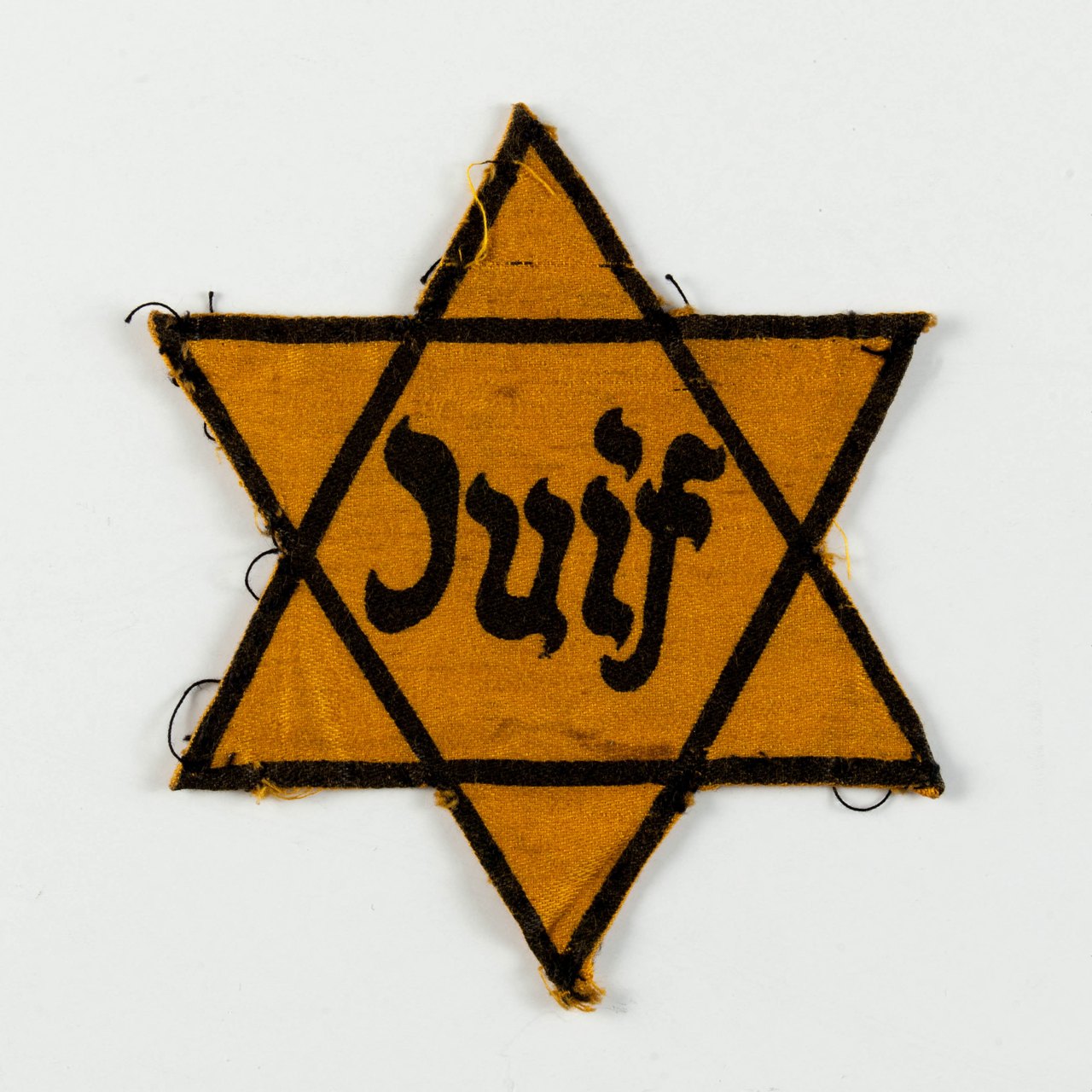
Judaism & Literary Craft · SymbolismThe six-pointed Star of David, or Magen David, became a widely recognized symbol of Jewish identity over centuries. Nazi authorities later distorted that symbol by forcing many Jews in occupied Europe to wear yellow badges, turning identity into a tool for exclusion and arrest. That requirement was never imposed in Denmark. The famous story that King Christian X wore a yellow star in protest is also a myth, although it reflects his documented opposition to anti-Jewish persecution. Lowry uses Ellen’s necklace differently: it is chosen and cherished, not imposed. When Annemarie hides it in her hand, the object carries several meanings at once—friendship, danger, faith, and the temporary concealment of identity. This is symbolism, the literary practice of letting a concrete object hold ideas larger than itself. The mark left on Annemarie’s skin makes solidarity physical: another person’s threatened identity has left an enduring imprint.
Charged object
Necklace, album, phantom cigarettes — ordinary things loaded with life-or-death meaning.
The imprint
The star pressed into Annemarie’s palm — a friend’s identity carried in her skin.
Near-miss suspense
Danger grazes but never strikes: a heartbeat’s margin at the door, a word’s margin on the train.
1The necklace, the album, and the ‘cigarettes’ are all ___.Ch.5–6
2Fill in the blank with the correct literary term.Ch.5–6
Word choices:near-missflashbackcliffhangermoral- some words will not be used
Lowry’s suspense works by the .
3The star’s imprint in Annemarie’s palm symbolizes ___.Ch.5–6
4Papa’s photo trick works because the lie is anchored to something true.Ch.5–6
5The coded phone call adds to the novel’s realism because ___.Ch.5–6
6Letting the reader decode the calls alongside Annemarie preserves ___.Ch.5–6
7In these chapters, the danger finally strikes the family directly.Ch.5–6
8Fill in the blank with the correct literary term.Ch.5–6
Word choices:chargedemptyborrowedcomic- some words will not be used
The necklace is a object.
9Kirsti’s train chatter functions as ___.Ch.5–6
10Ending Part 3 with Sweden visible across the water gives the story ___.Ch.5–6
Part 4
Think Deeper
Four deeper challenges — no single-word recall. Read, weigh the evidence, and reason it out.
💡Knowledge Bank · Building a Believable Cover Story
History & Reasoning · Resistance TradecraftA safe cover story is not an elaborate invention. Resistance workers learned that complicated lies create more details to forget and more chances for two people to disagree. The strongest deception often rests on verifiable truth: a real family relationship, an old photograph, a familiar routine, or a journey with an ordinary purpose. Psychologists call the mental effort of tracking invented details cognitive load. Under fear, that effort becomes harder because attention narrows and memory can falter. A simple story lowers the burden. It also helps if only one person answers while others avoid unnecessary additions. In the apartment search, physical evidence and confident roles matter as much as words; on the train, casual chatter makes the journey appear unremarkable. Critical readers should notice that these tactics do not make the characters fearless. They show practical reasoning under coercion: protect the vulnerable, reveal as little as possible, and anchor invention to something the questioner can recognize as truth.

Think back over these chapters. A dark bedroom; boots in the hallway; a golden chain snapping as a door swings open — and then an officer’s flashlight moving across three girls’ faces, one of them wearing a dead sister’s name. A father’s hands, steady, tearing three photographs from an album. In the morning: a telephone call about cigarettes that no shop has sold in years; a train aisle patrolled by gray uniforms; and at the end of the line, wind off the water, a gray kitten — and another country, shining across the strait.

Original passage written for Garden Heights — not a quotation from the novel.
1Claim: “Part 3 argues that quick thinking, not strength, is what saves people here.” — choose the two details that best prove it.Claim & Evidence
2What the soldiers see, or What is really happening? Tap each detail to send it left or right.Sort into two
◄ What the soldiers seeWhat is really happening ►
3Match each cause to its result. For each cause, pick its result.Cause & Effect
Fists pound on the door at 4 a.m.
A gold chain snaps in the dark
The officer doubts the dark-haired daughter
A phone call orders phantom cigarettes
4Fill both blanks to complete the reasoning.Build the Argument
Lowry has the star leave an IMPRINT in Annemarie’s palm because , which shows that .
Part 5
Standardized Test
Reading passage · The Star of David: The Story of a Symbol · Factual Information & Inference · SAT & TOEFL-style practice
🎯 You already have the skills from the sections above — this is just a fun way to meet real SAT & TOEFL-style questions. Read the passage (the highlighted words are tested below), then answer the questions below. Tap an answer to select it, then tap it again to confirm — you can change your choice until you confirm.

The six-pointed star — two overlapping triangles — is one of the world’s oldest geometric designs, found in art from many ancient cultures. Its special bond with Judaism grew over centuries. Known in Hebrew as the Magen David, or Shield of David, the symbol appeared on a Prague synagogue flag in the 1300s. It then spread across Jewish communities of Europe, and by the 1800s had become the faith’s most recognized emblem — a design that stands for a group — appearing on synagogues, books, and gravestones. In 1948 the new state of Israel placed the blue star at the center of its flag, where it flies today.

The star’s darkest chapter came under Nazi rule. Across much of occupied Europe, Nazi authorities forced Jews to wear a yellow cloth badge — not as an honor, but as a marker for isolation and arrest. Denmark stands out because the badge decree was never imposed there. Danes nevertheless spread the defiant (though historians class it as folklore, a story told rather than documented) tale that King Christian X had vowed to wear the star himself if his Jewish citizens ever had to. The novel’s necklace scene draws its power from this whole history: in a Europe where the star was being used to mark people for capture, one Danish girl hides it in her fist — guarding, at personal risk, exactly what the occupiers meant to turn into a target.

Original passage written for Garden Heights — not a quotation from the novel.
1What is the main idea of the passage?SAT · Central Ideas
2What is the star called in Hebrew?TOEFL · Factual Information
3In the passage, an emblem is ___.SAT · Words in Context
4Where did the star appear in the 1300s?TOEFL · Factual Information
5What happened to the star in 1948?TOEFL · Factual Information
6In the passage, the yellow badge was ___.TOEFL · Vocabulary
7How was Denmark different regarding the badge?TOEFL · Factual Information
8In the passage, folklore means ___.TOEFL · Vocabulary
9According to the tale, what did King Christian X vow?TOEFL · Factual Information
10The necklace scene ‘reverses’ the occupiers’ use of the star because ___.SAT · Inference
Part 6 · Optional
Creative Writing
A bonus challenge to practice your English. Take your time and have fun with it.
About This Section

This writing task is optional and is not part of your auto-graded score. The feedback below checks only the basics — length, spelling, and grammar — not whether your ideas are right or wrong. It is meant for classroom discussion and creative practice, so feel free to use your imagination!

Writing Task — Part 3 “The Thing in My Fist”

Annemarie held her friend’s star so hard it marked her palm. Write about protecting something — or someone — that mattered to you: a secret kept, a friend defended, a promise held onto. What was your ‘imprint’ — the mark the protecting left on you? 6–10 sentences. End with what the experience taught you about courage.

You can start with: “I closed my hand around it and decided that, no matter what happened next, I would not open my fingers...”
0 / 40 words minimum
πŸ—£ Teach It · Just for Fun (optional)

No right or wrong — close the screen and tell someone nearby what happened in this part. Can’t find anyone? Tell yourself out loud. The moment you teach it, you truly understand it.


Garden Heights

Part 3 Complete!

You finished Chapters 5–6 of Number the Stars.

Here are your auto-graded results:

-
points out of 100
Your Writing

Your writing was checked automatically for length, spelling, grammar, and whether you included the key parts of the scene. Scroll back to Part 5 anytime to read your feedback and improve your work.

Move on to Part 4 →

Independent study guide by Garden Heights. Not affiliated with or endorsed by Lois Lowry. Contains original analysis only; no text from the novel is reproduced. Reference text: This workbook follows Lois Lowry’s classic text (the standard Puffin edition sold worldwide). Revised 2023 UK editions change some wording and may not match the vocabulary studied here.