New here? Just sign up with Google — your account includes Matilda, our gift book, forever.
The One and Only Ivan · Garden Heights
Part 1
for The One and Only Ivan · Part 1 · Chapters 1–19
8 Parts40 min
What Happens in Part 1
Meet Ivan: a mighty silverback gorilla who lives, of all places, inside a shopping mall. For twenty-seven years his home has been a glass-walled domain at the Exit 8 Big Top Mall — a tire swing, a painted jungle wall, a little TV — where the highway billboard calls him ‘the One and Only Ivan, Mighty Silverback.’ Ivan tells his own story in short, careful chapters, because he finds humans wasteful with words. His world holds a small, odd family: Stella, a gentle old circus elephant with a bad foot and a long memory; Bob, a tiny stray dog who sleeps on Ivan’s chest and trusts no human; Mack, the mall’s owner; and Julia, the janitor’s daughter, who draws beside Ivan’s glass in the evenings. Julia gives Ivan crayons and paper — and it turns out the gorilla is an artist: he draws what he sees (a banana, mostly), and Mack sells the drawings in the gift shop for twenty dollars. Ivan does not remember much of the jungle. Remembering, he hints, is not always safe.
An animal narrator, spare language, and a home called by the wrong name
Cross-Curricular
What great apes really are, and what a silverback’s job is
Chapter Summary
Ch.
What happens
1–19
The domain — Ivan introduces his glass home at the Big Top Mall, his family of misfits — Stella, Bob, Julia — and his twenty-dollar art career; twenty-seven years have passed, and he tries not to remember the jungle.
Part 1
Vocabulary
Study 10 key words from Chapters 1–19, then answer each question.
🧠Knowledge Bank · The Silverback’s Job
Lexicology · The Silverback’s Job
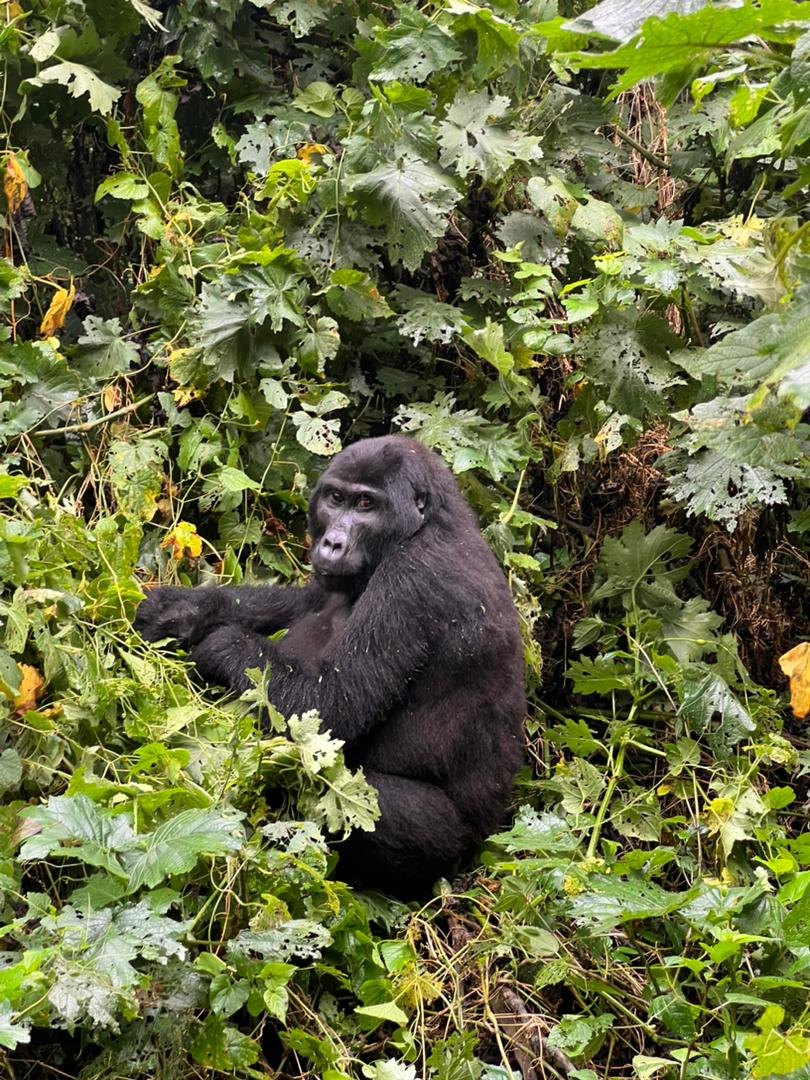
In a wild gorilla family, one older male leads, and the silver saddle of hair across his back earns him his name: the silverback. A grown western lowland male can weigh more than four hundred pounds (181.4 kg), yet he rarely fights. His real work is calm — he settles quarrels, chooses where the troop feeds, and shields the young from danger. Gorillas are among our closest animal relatives, sharing almost all of our DNA, and a silverback’s troop is a family held together by patience rather than force. He is a silverback with no troop to guide, no infants to guard, no forest to cross — only a glass box and a stuffed toy named Not-Tag. The very role his huge body was built for has been quietly taken from him, and that stolen purpose is the deepest source of his patient, hidden sadness.
Visual AidA gorilla where gorillas belong
Photograph taken in June 2024 of a wild gorilla in Bwindi Impenetrable Forest, Uganda. The Knowledge Bank explains that a silverback settles quarrels, chooses where the troop feeds, and shields the young, and that a troop is a family held together by patience rather than force. Notice how much of the animal the forest hides. A gorilla’s ordinary day happens inside cover like this, which is the measure against which a glass room beside a shopping arcade should be read.
Wild gorilla in Bwindi Impenetrable Forest, Uganda, June 2024; photograph by Rebeccananonof, released under CC0. Source: Wikimedia Commons, CC0.
domainn.Ch.1–19
The territory a creature calls its own
“Ivan calls his glass enclosure a domain, not a cage.”
silverbackn.Ch.1–19
A mature male gorilla who leads and protects a troop
“The billboard names him the Mighty Silverback.”
exhibitn.Ch.1–19
Something displayed for people to look at
“To shoppers, Ivan is the mall’s main exhibit.”
billboardn.Ch.1–19
A giant roadside advertising sign
“The billboard by the freeway promises a mighty gorilla.”
strayn.Ch.1–19
An animal without a home or owner
“Bob the stray answers to nobody at all.”
artistn.Ch.1–19
A person — or gorilla — who makes art
“Ivan has been an artist since his jungle days.”
gnawv.Ch.1–19
To chew on something steadily
“A crayon lasts longer if you do not gnaw it.”
memoryn.Ch.1–19
Something kept in the mind from the past
“Ivan keeps his jungle memories locked away.”
mightyadj.Ch.1–19
Very strong and powerful
“Mighty is the billboard’s word; Ivan is not so sure.”
observev.Ch.1–19
To watch closely
“From his glass, Ivan can observe every kind of human.”
ⓘ The vocabulary words in this list are selected to help you understand and complete this workbook. Some may not appear verbatim in the original novel.
🧠Knowledge Bank question
1According to the Knowledge Bank, a silverback’s real work is ___.Ch.1–19
2A ‘silverback’ is a mature male gorilla who leads and protects a troop.Ch.1–19
3A giant roadside advertising sign is a ___.Ch.1–19
4A ‘stray’ is a pet with a loving home and owner.Ch.1–19
5Fill in each blank with the correct word.Ch.1–19
Word choices:exhibitartistobservemighty- some words will not be used
Ivan has been an since his days in the jungle.
Shoppers stop to the gorilla behind the glass.
6Something displayed for people to look at is an ___.Ch.1–19
7To ‘gnaw’ something is to chew on it steadily.Ch.1–19
8Very strong and powerful is ___.Ch.1–19
9Fill in the blanks with the correct words.Ch.1–19
Word choices:domainstraybillboardmemory- some words will not be used
Bob the sleeps wherever he pleases.
Ivan keeps each jungle carefully locked away.
10To watch closely is to ___.Ch.1–19
Part 2
Comprehension
Show you understood what happens in Chapters 1–19.
🧠Knowledge Bank · Reading Between Ivan’s Lines
Narrative Logic · Reading Between Ivan’s Lines
Ivan is a narrator of few words. He tells us he does not remember much, and he almost never announces his feelings outright. That silence is your invitation to infer — to combine a small clue on the page with what you already know, and reach a conclusion the author never states. When Ivan says he keeps his memories in a neat, folded pile and does not look at them, a careful reader senses pain, not calm. Inferring is a kind of detective work: the writer leaves fingerprints, and you name the visitor. Because Ivan hides so much, this book rewards the reader who leans in and listens for what is left unsaid. Every quiet line is a door, and inference is the key that quietly opens the hidden room.
Visual AidA narrator who says very little
Diagram for the Knowledge Bank on inference. Card 1 is what Ivan actually puts on the page, card 2 is what a reader can work out from it, and card 3 names whose job that is. The Knowledge Bank says Ivan almost never announces his feelings, so his silence is the invitation. Notice the arrow runs only one way: he never comes back to explain himself.
Inference from a quiet narrator, as described in the Knowledge Bank. Drawn for Garden Heights Academy.
🧠Knowledge Bank question
1The Knowledge Bank says Ivan almost never ___.Ch.1–19
2Who is Stella?Ch.1–19
3Bob the dog was abandoned on the freeway as a puppy.Ch.1–19
4What does Julia give Ivan that changes his days?Ch.1–19
5Write the numbers 1–5 in the boxes to show the correct order of ideas as Part 1 unfolds. Number 1 = what Ivan shares first.Ch.1–19
Ivan hints that jungle memories are unsafe to keep.
Ivan introduces himself and his glass domain.
Ivan’s drawings go on sale in the gift shop.
We meet Stella, Bob, Mack, and the mall.
Julia begins drawing beside Ivan’s glass.
6Ivan says humans use words carefully and never waste them.Ch.1–19
7What happens to the drawings Ivan makes?Ch.1–19
8What does Ivan usually draw?Ch.1–19
9The billboard by the freeway calls Ivan ‘the One and Only Ivan, Mighty Silverback.’Ch.1–19
10Why does Ivan avoid remembering the jungle?Ch.1–19
Part 3
Literary Elements
Understanding HOW and WHY Katherine Applegate tells the story across Chapters 1–19.
🧠Knowledge Bank · A Gorilla Tells the Story
Literary Technique · A Gorilla Tells the Story
This whole book is told by Ivan himself, in the first person — and the author, Katherine Applegate, chose an animalnarrator on purpose. Because a gorilla is speaking, we notice things a human would miss: the smell of fear, the boredom of a long day, the insult of being stared at through glass. Ivan also sees people from the outside, puzzled by our habits, which quietly holds a mirror up to how humans treat animals. An animal narrator asks us to imagine our way into another mind and to feel that a caged creature has thoughts as real as our own. Applegate keeps his voice plain and honest, never cute, so that we trust him. By handing the story to a gorilla, she turns each reader into someone who can no longer look away from what a life behind glass truly costs.
Animal narrator
The story is told by a gorilla, in first person — we see humans from outside humanity.
Spare language
Short chapters, plain sentences, white space — a voice that spends words like treasure.
Renaming
Calling a cage a ‘domain’ — the narrator’s word hides a truth he cannot yet face.
🧠Knowledge Bank question
1According to the Knowledge Bank, an animal narrator lets us notice ___.Ch.1–19
2Fill in the blank with the correct literary term.Ch.1–19
Word choices:sparenarratorrhymeclimax- some words will not be used
A story told by an animal has an animal .
Short plain sentences with white space are language.
3Ivan calling his cage a ‘domain’ shows readers that he ___.Ch.1–19
4Ivan’s short, plain chapters match his belief that words should not be wasted.Ch.1–19
5The billboard’s grand title next to Ivan’s small glass life creates ___.Ch.1–19
6Applegate builds Ivan’s family from misfits — an old elephant, a stray, a janitor’s daughter — to show that ___.Ch.1–19
7Spare language means long, decorated sentences with many adjectives.Ch.1–19
8Fill in the blank with the correct literary term.Ch.1–19
Word choices:renamingsettingdialoguemeter- some words will not be used
Calling a cage a domain is an act of .
9Ivan hinting that memories are ‘not safe’ works as ___.Ch.1–19
10Part 1 ends with the artist drawing bananas while calling himself content. Readers should sense ___.Ch.1–19
Part 4
Think Deeper
Four deeper challenges — no single-word recall. Read, weigh the evidence, and reason it out.
🧠Knowledge Bank · Is a Mall a Home
Ethical Reasoning · Is a Mall a Home
The real Ivan spent twenty-seven years in a small cage at a shopping mall before people fought to move him to a zoo. That true story sits beneath this whole book and raises a hard, important question: what does an intelligent animal truly need in order to live well? A gorilla in the wild travels, forages, plays, and belongs to a family. A gorilla behind mall glass has food and safety but almost nothing to do and no one of his own kind. Comfort is not the same as a good life. Learning to feel that difference, even for a creature not your own species, is the beginning of real compassion.
Think back over these chapters. Behind glass, between a video arcade and a carousel, a four-hundred-pound artist watches the humans hurry past. An old elephant shifts her aching foot in the next stall. A small dog, who answers to no one, snores on the gorilla’s chest. In the evenings a girl sits cross-legged with her sketchbook on the other side of the glass, drawing things that do not exist yet. And high over the freeway, a billboard promises every passing car a Mighty Silverback — one and only, twenty-seven years running.
Original passage written for Garden Heights — not a quotation from the novel.
1Claim: “Ivan’s calm in Part 1 is a survival skill, not real contentment.” — choose the two details that best prove it.Claim & Evidence
2What the billboard promises, or What the glass contains? Tap each detail to sort it — tap again to switch sides. You can keep tapping to change your answer.Sort into two
◄ What the billboard promisesWhat the glass contains ►
3Match each cause to its result. For each cause, pick its result.Cause & Effect
Julia hands crayons through to Ivan→
Mack sees the drawings can sell→
Bob is thrown from a car on the freeway→
The jungle memories start to stir→
🧠Knowledge Bank question
4Fill both blanks to complete the reasoning.Build the Argument
The Knowledge Bank says a gorilla behind mall glass has food and safety but , which is why it insists that .
Part 5
Standardized Test
Reading passage · Not a Monkey: Meet the Great Apes · SAT & TOEFL-style practice
Read the passage — the highlighted words are tested — then answer. Tap an answer, then tap it again to confirm.
SATCentral Ideas — the passage's main point
SATWords in Context — a word's meaning in this passage
SATDetail — a fact stated in the passage
SATInference — a conclusion the passage implies
SATText Connections — how two parts of the text relate
TOEFLFactual Information — a fact stated in the passage
TOEFLVocabulary — a tested word's meaning here
Great Apes Versus Monkeys
Call Ivan a monkey, and any scientist will wince. Gorillas belong to the great apes, a small, remarkable family that also includes chimpanzees, bonobos, orangutans, and, yes, humans. The quickest way to tell an ape from a monkey is the tail: monkeys almost always have one, apes never do. But the deeper differences matter more. Great apes have large brains for their size, flexible shoulders built for swinging and reaching, and hands with thumbs that can hold a branch, or a crayon. They live long lives, learn from one another, and pass knowledge along, which is why scientists say apes have culture: ways of doing things that one generation teaches the next.
Gorillas are the largest of the great apes, and among the gentlest. Each family is led by a silverback, the older male whose graying saddle of hair marks his years, and a wild gorilla’s day is mostly peaceful: eating plants, napping, grooming relatives, and playing. Researchers who observe them for years describe thoughtful, watchful animals with distinct personalities and long memories. Which is worth knowing before you read a novel narrated by one. When a gorilla in a glass box studies humans for twenty-seven years and keeps his words few and careful, science suggests that is not fantasy. That is a great ape, doing what great apes do best: paying attention.
Original passage written for Garden Heights — not a quotation from the novel.
1What is the main idea of the passage?SAT · Central Ideas
2What is the quickest way to tell an ape from a monkey?TOEFL · Factual Information
3In the passage, a silverback is ___.SAT · Words in Context
4Why do scientists say apes have culture?TOEFL · Vocabulary
5According to the passage, a wild gorilla’s day is mostly ___.TOEFL · Factual Information
6In the passage, to observe animals is to ___.SAT · Words in Context
7Which of these is named as a great ape in the passage?TOEFL · Factual Information
8Researchers describe gorillas as having ___.SAT · Detail
10Which Part 1 detail does this passage BEST help explain?SAT · Text Connections
Part 6 · Optional
Creative Writing
A bonus challenge to practice your English. Take your time and have fun with it.
About This Section
This writing task is optional and is not part of your auto-graded score. The feedback below checks only the basics — length, spelling, and grammar — not whether your ideas are right or wrong. It is meant for classroom discussion and creative practice, so feel free to use your imagination!
Writing Task — Part 1 “Through the Glass”
Ivan watches humans for twenty-seven years and keeps his words few. Now trade places: write a scene where an animal you know — a pet, a zoo animal, a bird outside your window — watches YOU and describes what it sees, in the animal’s own voice. Keep the sentences short and careful, the way Ivan would. 6–10 sentences. End with one thing the animal decides NOT to say.
You can start with: “The human is back again, doing the strange thing humans do...”
0 / 40 words minimum
🗣 Teach It · Just for Fun (optional)
No right or wrong — close the screen and tell someone nearby what happened in this part. Can’t find anyone? Tell yourself out loud. The moment you teach it, you truly understand it.
Part 1 Complete!
You finished Chapters 1–19 of The One and Only Ivan.
Here are your auto-graded results:
-
points out of 100
Teach it to someone
The best last step is to teach it. In your own words, explain what happened — retell a favorite scene, teach a character’s big choice, or sum up the main idea for a parent, friend, or classmate. When you can teach it clearly, you truly own it.
Independent study guide by Garden Heights. Not affiliated with or endorsed by Katherine Applegate. Contains original analysis only; no text from the novel is reproduced. Reference text: This workbook follows Katherine Applegate’s classic text (the standard Puffin edition sold worldwide). Revised 2023 UK editions change some wording and may not match the vocabulary studied here.
SAT® is a registered trademark of College Board, which is not affiliated with, and does not endorse, these materials. TOEFL® is a registered trademark of ETS. These materials are not endorsed or approved by ETS. Garden Heights is an independent provider of test-style reading practice.