New here? Just sign up with Google — your account includes Matilda, our gift book, forever.
The One and Only Ivan · Garden Heights
Part 4
for The One and Only Ivan · Part 4 · Chapters 59–79
8 Parts40 min
What Happens in Part 4
To comfort a grieving Ruby, Ivan finally opens the locked door: he tells her about Africa. A perfect life in the rainforest — a father silverback as sturdy as a mountain, a gentle mother, and a twin sister named Tag, quick and fearless. Little Ivan drew even then, painting with mud on his mother’s back, and his family nicknamed him Mud. Then the humans came. Ivan and Tag were taken in a crate; Tag, who could not let go of their old life, did not survive the journey. Ivan survived the only way he could — by forgetting — and became a human’s pet: raised in Mack’s house like a strange child, wearing clothes, riding in cars, watching baseball, until he grew too big and too strong for a house, and the glass domain swallowed him. Now Ivan counts the marks he has scratched: 9,876 days. And at last he says the true word: not domain — cage. When Mack, on a bad day, threatens Ruby with the sharp claw-stick, something long-buried rises in Ivan — the memory of what humans did to his parents, and the discovery of another Ivan inside him, one capable of rage. Looking at red paint on his fingers, he suddenly understands how to keep his promise.
The backstory unlocked, and a narrator renaming his world truthfully
Cross-Curricular
Animals that make art, and what forgetting protects
Chapter Summary
Ch.
What happens
59–79
Mud remembers — Ivan opens his past for Ruby: the rainforest, his twin Tag, the nickname Mud, the crate, the years as Mack’s strange child; he counts 9,876 days, finally says ‘cage,’ and — when the claw-stick threatens Ruby — discovers the rage and the answer inside himself.
Part 1
Vocabulary
Study 10 key words from Chapters 59–79, then answer each question.
🧠Knowledge Bank · When Apes Make Art
Lexicology · When Apes Make Art
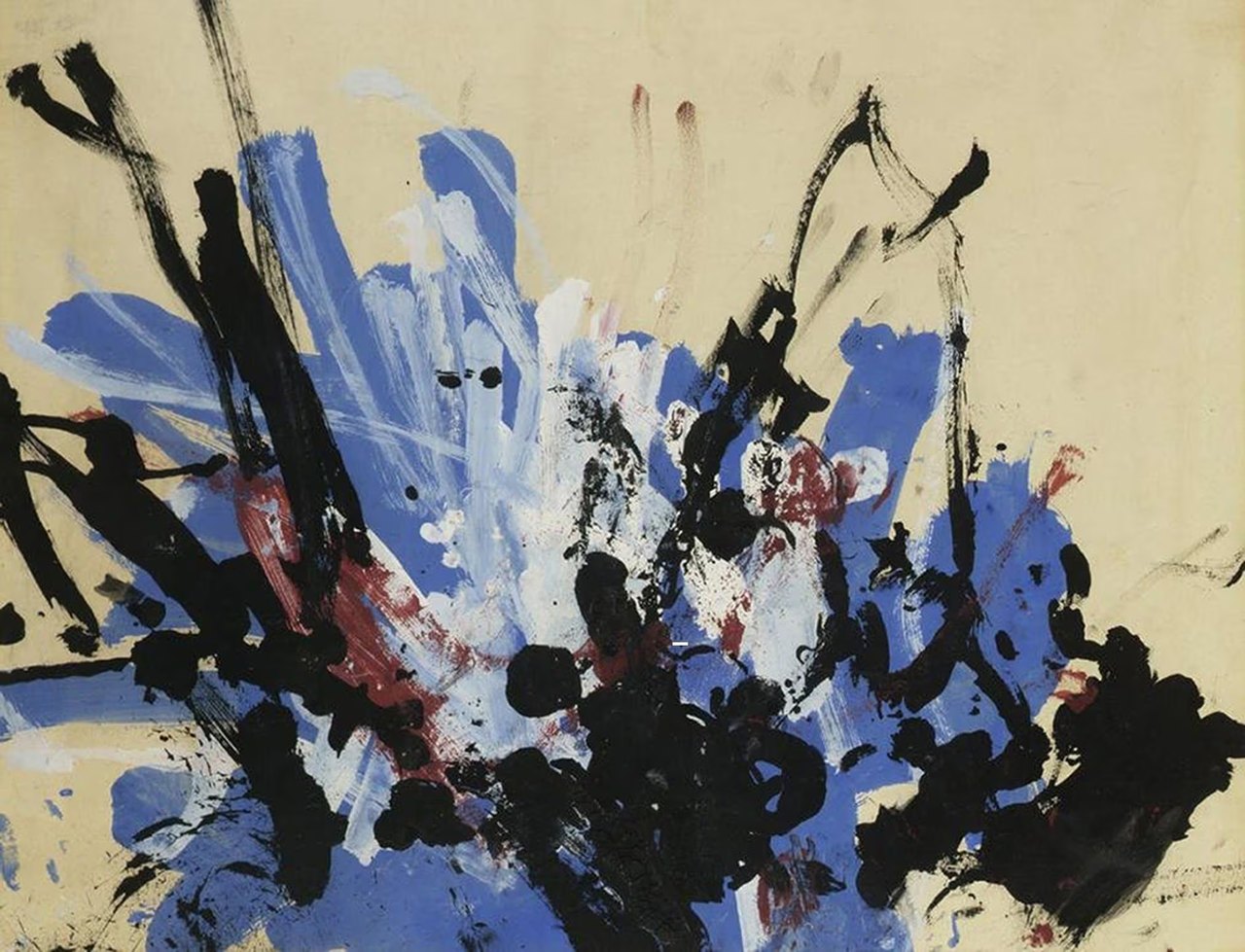
Ivan’s love of drawing is not invented. In real life, captive gorillas, chimpanzees, and orangutans have taken up brushes and crayons and made pictures on purpose, choosing colors and filling the paper with obvious care. A famous gorilla named Koko, who had learned hundreds of hand signs, painted images and even gave them names. Whether we call this true art or simply play, it reveals something important: great apes have restless, inventive minds that ache for something to think about and make. Seen this way, Ivan’s crayon drawings are far more than a charming habit; they are the sign of a mind too rich for the empty hours of a cage. Where the wild once gave a gorilla endless problems to solve, the glass box gives Ivan nothing — so he reaches for the one small tool that lets him create.
Visual AidA painting made by an ape
A painting made by Congo, a chimpanzee at London Zoo, in the 1950s. The Knowledge Bank explains that captive gorillas, chimpanzees, and orangutans have taken up brushes and made pictures on purpose, choosing colors and filling the paper with obvious care, and that a famous gorilla named Koko even gave her paintings names. This is one of those pictures. Look at where the strokes stop: the paper is not filled edge to edge, and the marks fan from a center rather than wandering.
Painting by Congo the chimpanzee, London Zoo, 1950s. Source: Wikimedia Commons, public domain.
rainforestn.Ch.59–79
A thick, wet forest full of life
“Ivan’s first home was a rainforest in Africa.”
capturev.Ch.59–79
To take a creature by force
“Humans came to capture the twin gorillas.”
craten.Ch.59–79
A rough wooden shipping box
“Two small gorillas were carried away in one crate.”
survivev.Ch.59–79
To stay alive through something terrible
“Ivan survived the journey; Tag did not.”
nicknamen.Ch.59–79
An affectionate extra name
“His family’s nickname for him was Mud.”
ragen.Ch.59–79
Overwhelming anger
“The claw-stick wakes a rage Ivan never knew he had.”
threatenv.Ch.59–79
To warn that you will cause harm
“On a bad day, Mack uses the claw-stick to threaten Ruby.”
countlessadj.Ch.59–79
Too many to count
“The domain has held countless quiet days — 9,876, in fact.”
confessv.Ch.59–79
To admit a difficult truth
“At last Ivan can confess the true word: cage.”
understandv.Ch.59–79
To finally see what something means
“Red paint on his fingers, and Ivan begins to understand.”
ⓘ The vocabulary words in this list are selected to help you understand and complete this workbook. Some may not appear verbatim in the original novel.
🧠Knowledge Bank question
1According to the Knowledge Bank, the gorilla Koko did what with her paintings?Ch.59–79
2To ‘capture’ a creature is to take it by force.Ch.59–79
3An affectionate extra name is a ___.Ch.59–79
4‘Rage’ means a calm and quiet happiness.Ch.59–79
5Fill in each blank with the correct word.Ch.59–79
Word choices:cratesurvivecountlessthreaten- some words will not be used
The twins were carried off in a wooden .
Ivan found a way to what Tag could not.
6To warn that you will cause harm is to ___.Ch.59–79
7To ‘confess’ is to admit a difficult truth.Ch.59–79
8Too many to count is ___.Ch.59–79
9Fill in the blanks with the correct words.Ch.59–79
Word choices:ragenicknameunderstandrainforest- some words will not be used
His family’s for him was Mud.
Red paint helps Ivan finally his path.
10To finally see what something means is to ___ it.Ch.59–79
Part 2
Comprehension
Show you understood what happens in Chapters 59–79.
🧠Knowledge Bank · Following a Memory Back in Time
Narrative Logic · Following a Memory Back in Time
In these chapters the story stops moving forward and travels backward, as Ivan finally remembers his life before the mall — his birth in a distant forest, his twin sister, and how he was captured. Good readers learn to tell a story’s present from its past, so the timeline does not tangle. Ask as you go: is this happening now, at the Big Top Mall, or is Ivan reaching into a memory? Once you know that Ivan lost his family and his home as a baby, his years of numb forgetting suddenly make sense — he buried those memories because they hurt too much to hold. A character’s history is the hidden root of how he behaves today, and reading it in order lets you trace exactly how a lively baby gorilla became a silent, guarded adult.
🧠Knowledge Bank question
1The Knowledge Bank says a reader should keep asking whether a scene is happening now or ___.Ch.59–79
2Who was Tag?Ch.59–79
3Ivan’s family nicknamed him Mud because he painted with mud on his mother’s back.Ch.59–79
4How did Ivan survive what Tag could not?Ch.59–79
5Write the numbers 1–5 in the boxes to show the correct order of Ivan’s life story. Number 1 = what happens first.Ch.59–79
Ivan is raised in Mack’s house like a child.
Ivan counts 9,876 days and says the word ‘cage.’
Grown too big, Ivan moves to the glass domain.
Humans capture Ivan and Tag in a crate.
A perfect life in the rainforest with his troop.
6Ivan spent his early years in Mack’s house — wearing clothes, riding in cars, watching baseball.Ch.59–79
7What do the 9,876 marks Ivan counts stand for?Ch.59–79
8What does Mack do that ignites Ivan’s buried rage?Ch.59–79
9When his rage rises, Ivan discovers there is ‘another Ivan’ inside him.Ch.59–79
10What does Ivan realize while looking at the red paint on his fingers?Ch.59–79
Part 3
Literary Elements
Understanding HOW and WHY Katherine Applegate tells the story across Chapters 59–79.
🧠Knowledge Bank · The Story Behind the Story
Literary Technique · The Story Behind the Story
An author often waits, then reveals a character’s hidden past at the moment it will land hardest — this earlier history is called backstory. Applegate holds Ivan’s origin until now, when we already love him, and only then shows us the baby gorilla stolen from an African forest and the twin sister, Tag, he could not save. Placed here, the backstory transforms everything we thought we understood. Ivan’s forgetting is no longer laziness but self-protection; his bond with a stuffed toy named Not-Tag suddenly aches with meaning. Good writers use backstory like a lamp carried into a dark room, throwing fresh light on choices we had already watched. Notice how much heavier the present feels once you know the past behind it. A well-timed backstory does not slow a story down; it deepens every scene that came before by finally revealing its source.
Visual AidWhen the past is finally shown
Diagram for the Knowledge Bank on backstory. The timeline carries three numbered points, and the long arrow is the author reaching back from the present to light up the earliest one. The Knowledge Bank says a writer holds a character’s history until the moment it will land hardest. Notice the arrow points backward while the timeline points forward, which is exactly what a flashback does to a reader.
Backstory placed late in a timeline, as described in the Knowledge Bank. Drawn for Garden Heights Academy.
Backstory
The history behind a character, revealed late — Ivan’s rainforest, crate, and house years.
Reversal of renaming
‘Domain’ becomes ‘cage’ — the narrator finally calls his world by its true name.
Internal conflict
‘Another Ivan’ — the gentle artist and the rising silverback, sharing one body.
🧠Knowledge Bank question
1According to the Knowledge Bank, backstory is a character’s hidden past revealed ___.Ch.59–79
2Fill in the blank with the correct literary term.Ch.59–79
Word choices:backstoryconflictsimilechorus- some words will not be used
A character’s late-revealed history is .
The artist and the rising silverback form an internal .
3Ivan finally saying ‘cage’ instead of ‘domain’ marks ___.Ch.59–79
4The rainforest chapters make the domain feel MORE bearable by comparison.Ch.59–79
5Tag and Ivan responded to loss in opposite ways, which the book uses to show ___.Ch.59–79
6The ‘another Ivan’ discovery matters because a protector needs ___.Ch.59–79
7Ivan’s answer to his rage is violence against Mack.Ch.59–79
8Fill in the blank with the correct literary term.Ch.59–79
Word choices:renamingflashbackmetersequel- some words will not be used
Domain becoming cage reverses the book’s earlier .
9The number 9,876 is more powerful than ‘twenty-seven years’ because ___.Ch.59–79
10Part 4 ends with understanding ‘how to keep his promise.’ Structurally, this is ___.Ch.59–79
Part 4
Think Deeper
Four deeper challenges — no single-word recall. Read, weigh the evidence, and reason it out.
🧠Knowledge Bank · Why We Bury What Hurts
Ethical Reasoning · Why We Bury What Hurts
For most of the book Ivan insists he is simply not good at remembering, and now we learn why: his earliest memories hold the loss of his family and his twin. This is a tender, true idea — that when something wounds us deeply, a part of the mind tries to fold the pain away and look elsewhere. By refusing to remember Tag, Ivan also loses a part of himself, and only by facing the pain can he grow whole enough to help Ruby. Healing often begins the very moment we stop running from what happened. Notice the quiet courage it takes for Ivan to unfold those memories at last. Choosing to look honestly at our own sorrow, instead of hiding from it forever, is one of the bravest and most healing acts of the heart.
Think back over these chapters. In the telling dark, a gorilla gives a grieving calf the only medicine he has: a story that costs him everything to tell. A green world. A twin who raced him through it. A crate. A house with a television. A wall with nine thousand scratches. And then, in the bright ugly present, a man raises a sharp stick toward a small elephant — and somewhere behind the artist’s quiet eyes, something twenty-seven years asleep opens one eye, looks at the red paint drying on his fingers, and knows exactly what to do with it.
Original passage written for Garden Heights — not a quotation from the novel.
1Claim: “Telling Ruby the story costs Ivan more than silence would — and gives him more, too.” — choose the two details that best prove it.Claim & Evidence
2Ivan the artist, or The other Ivan? Tap each detail to sort it — tap again to switch sides. You can keep tapping to change your answer.Sort into two
◄ Ivan the artistThe other Ivan ►
3Match each cause to its result. For each cause, pick its result.Cause & Effect
Ruby grieves for Stella→
Ivan remembers the rainforest→
Mack raises the claw-stick at Ruby→
Rage meets red paint on his fingers→
🧠Knowledge Bank question
4Fill both blanks to complete the reasoning.Build the Argument
The Knowledge Bank says that when something wounds us deeply, part of the mind tries to , and it adds that healing often begins .
Part 5
Standardized Test
Reading passage · The Art Instinct: Animals That Paint · SAT & TOEFL-style practice
Read the passage — the highlighted words are tested — then answer. Tap an answer, then tap it again to confirm.
SATCentral Ideas — the passage's main point
SATWords in Context — a word's meaning in this passage
SATCommand of Evidence — the detail that best supports a claim
SATDetail — a fact stated in the passage
TOEFLFactual Information — a fact stated in the passage
TOEFLVocabulary — a tested word's meaning here
TOEFLSentence Simplification — the shorter sentence that keeps the meaning
TOEFLInsert Text — where a sentence best fits
Congo the Painting Chimpanzee
In the 1950s, a London zoo chimpanzee named Congo picked up a brush, and shook the art world. Over two years he produced countless paintings: bold, balanced, fan-shaped designs he made with obvious care, choosing colors and placing strokes on purpose. Most striking of all, Congo knew when a painting was finished. Offered the brush again after he had stopped, he would refuse it, and if someone took an unfinished picture away, he protested loudly. Scientists who watched him tried to understand what he was doing, and concluded the work was intentional rather than random smearing.
Congo was not alone. Gorillas, orangutans, and elephants given art supplies have produced their own styles, and researchers note that ape artists paint without any reward: no treats are needed, because the making itself is the point. Some scientists call this the art instinct: a deep urge, shared by big-brained animals, to make marks that mean something. What an ape’s painting means, only the ape knows. But the real gorilla behind this novel painted for years at Zoo Atlanta, and his works were even sold to support conservation. When the novel makes art the tool that saves Ruby, it is not inventing a talent; it is aiming a real one.
Original passage written for Garden Heights — not a quotation from the novel.
1What is the main idea of the passage?SAT · Central Ideas
2In the passage, countless paintings are ___.SAT · Words in Context
3What did Congo do when offered the brush AFTER finishing a painting?TOEFL · Factual Information
4In the passage, to understand what he was doing is to ___.SAT · Words in Context
5What detail shows ape artists paint for the making itself?SAT · Command of Evidence
6In the passage, the art instinct is ___.TOEFL · Vocabulary
7How did Congo react if an UNFINISHED picture was taken away?TOEFL · Factual Information
8What happened to the real Ivan’s paintings at Zoo Atlanta?SAT · Detail
9The passage says the novel ‘is not inventing a talent’ — meaning ___.TOEFL · Sentence Simplification
10Insert Text (TOEFL). Look at the four squares [1]–[4] in the excerpt below. They show where this sentence could be added: “That refusal, small as it seems, is the strongest evidence of intention.”
Congo chose his colors and placed his strokes with visible care. [1] Offered the brush after finishing, he simply would not add another mark. [2] A random scribbler, after all, has no reason ever to stop. [3] So scientists concluded the chimpanzee knew what finished meant. [4]
Where would the sentence fit best?TOEFL · Insert Text
Part 6 · Optional
Creative Writing
A bonus challenge to practice your English. Take your time and have fun with it.
About This Section
This writing task is optional and is not part of your auto-graded score. The feedback below checks only the basics — length, spelling, and grammar — not whether your ideas are right or wrong. It is meant for classroom discussion and creative practice, so feel free to use your imagination!
Writing Task — Part 4 “The Two of Me”
Ivan discovers ‘another Ivan’ inside himself — and chooses where to aim him. Write about YOUR two selves: the everyday you, and the one who shows up when something you love is threatened. Describe one moment each self took charge, in 6–10 sentences. End with what you would want your stronger self to protect — and how, without becoming what it fights.
You can start with: “Most days I am one person, but there is another me, kept for emergencies...”
0 / 40 words minimum
🗣 Teach It · Just for Fun (optional)
No right or wrong — close the screen and tell someone nearby what happened in this part. Can’t find anyone? Tell yourself out loud. The moment you teach it, you truly understand it.
Part 4 Complete!
You finished Chapters 59–79 of The One and Only Ivan.
Here are your auto-graded results:
-
points out of 100
Teach it to someone
The best last step is to teach it. In your own words, explain what happened — retell a favorite scene, teach a character’s big choice, or sum up the main idea for a parent, friend, or classmate. When you can teach it clearly, you truly own it.
Independent study guide by Garden Heights. Not affiliated with or endorsed by Katherine Applegate. Contains original analysis only; no text from the novel is reproduced. Reference text: This workbook follows Katherine Applegate’s classic text (the standard Puffin edition sold worldwide). Revised 2023 UK editions change some wording and may not match the vocabulary studied here.
SAT® is a registered trademark of College Board, which is not affiliated with, and does not endorse, these materials. TOEFL® is a registered trademark of ETS. These materials are not endorsed or approved by ETS. Garden Heights is an independent provider of test-style reading practice.