New here? Just sign up with Google — your account includes Matilda, our gift book, forever.
The Lightning Thief · Garden Heights
Part 2
for The Lightning Thief · Part 2 · Chapters 4–6
a novel by Rick Riordan
40 min6 Parts
This workbook is built on a solid pedagogical foundation, effectively integrating content and language learning based on the CLIL framework (Content and Language Integrated Learning), elevated by our unique 5th C — Connection — and an integrated Standardized Test section that weaves every SAT & TOEFL question type right into the novel, so learners build real test skills easily, naturally, and with fun.
💭 Before You Read · Just for Fun
No right or wrong answers — just think or chat about it: If you suddenly learned that one of your parents was not who you thought, and that a hidden world had been kept secret from you your whole life, would you feel excited, angry, or afraid? Where — or with whom — do you feel truly safe?
What Happens in Part 2
The Minotaur takes Percy's mother, and Percy wakes at Camp Half-Blood learning the Greek gods are real.
The MinotaurA terrifying Minotaur chases Percy and his mother to the edge of camp. Squeezed by the monster, she dissolves in golden light; a furious Percy snaps off its horn and defeats it before collapsing.
Camp Half-BloodPercy wakes at Camp Half-Blood, a safe haven for demigods, and learns the shocking truth: the Greek gods are real and he is the child of one.
New FacesMr. Brunner is really the centaur Chiron, and grumpy director Mr. D is the god Dionysus. Placed in the crowded Hermes cabin, Percy meets friendly Luke and clever Annabeth — and makes an enemy of tough Clarisse.
What We Will Learn
Focus
What It Means
Greek Mythology
The Minotaur, Chiron, and the Olympian gods
Character
How Percy reacts to a world-changing truth
Setting (New York)
Camp Half-Blood’s secret home on Long Island
Chapter Summary
Chapter
Key Events
Ch.4
The Minotaur attacks; Percy’s mother dissolves in golden light; Percy breaks off its horn and defeats it, then passes out
Ch.5
Percy wakes at Camp Half-Blood; Mr. Brunner is really the centaur Chiron, and Mr. D is the god Dionysus
Ch.6
Percy is placed in the Hermes cabin; he meets Luke and Annabeth and clashes with Clarisse
Copyright Notice
This is an independent study guide created by Garden Heights to support reading comprehension and literary analysis. It contains original analysis questions and does not reproduce any text from the novel. The Lightning Thief is a work by Rick Riordan. This guide is not affiliated with, authorized by, or endorsed by Rick Riordan or any associated rights holders. Students should read the original book, available from libraries and booksellers.
Part 1
Vocabulary
Study 10 key words from Chapters 4–6, then answer each question.
🧠Knowledge Bank · Where Creature Words Come From
Etymology · Monsters and Names
Greek monster names are usually descriptions. Minotaur joins the name Minos to tauros, bull — literally the bull of Minos. Cerberus, the three-headed dog, may come from a root meaning spotted. Chimera meant she-goat before it named the lion-goat-serpent hybrid, and it now means any impossible combination, which is why biologists call an organism with two sets of cells a chimera. The habit of naming by feature is ancient and practical: a story travels better when its creatures announce what they are. Modern science kept the habit when it needed names for newly discovered things, drawing on Greek because the vocabulary was shared across European scholarship. This is why the anatomy of the human ear contains a cochlea, meaning snail shell, and why a spiral galaxy and a spiral staircase share a Greek root. The naming is a form of compression, packing a definition into a single word.
demigodn.Ch.5
A child of one human parent and one god
“Percy learns he is a demigod.”
centaurn.Ch.5
A creature that is half human, half horse
“Chiron is a centaur.”
immortaladj.Ch.5
Able to live forever, like a god
“The Olympian gods are immortal.”
sanctuaryn.Ch.4
A safe place of protection
“Camp Half-Blood is a sanctuary for demigods.”
nectarn.Ch.5
The drink of the gods that heals demigods
“Annabeth gave Percy nectar to heal.”
ambrosian.Ch.5
The food of the gods
“A few bites of ambrosia eased his pain.”
pavilionn.Ch.6
A large open shelter for gatherings
“Campers ate in the dining pavilion.”
determinedadj.Ch.4
Firm and not giving up
“Percy was determined to protect his mother.”
rivalryn.Ch.6
A strong competition between people
“A rivalry grew between Percy and Clarisse.”
bewilderedadj.Ch.5
Very confused
“Percy felt bewildered by the news.”
ⓘ The vocabulary words in this list are selected to help you understand and complete this workbook. Some may not appear verbatim in the original novel.
🧠Knowledge Bank question
1The Knowledge Bank explains that Greek monster names such as Minotaur — like the vocabulary word centaur — usually work as ___.Ch.5
2True or False: An “immortal” being can live forever.Ch.5
3A creature that is half human and half horse is a ___.Ch.5
4True or False: A “sanctuary” is a dangerous, unprotected place.Ch.4
5Fill in each blank with the correct word.Ch.5
Word choices:nectarambrosiacentaurdemigod- some words will not be used
To heal, Percy drank and ate . Chiron, a , watched over him.
6True or False: To feel “bewildered” is to feel very confused.Ch.5
7A strong competition between two people is a ___.Ch.6
8True or False: “Ambrosia” is the food of the gods.Ch.5
9Fill in the blanks with the correct words.Ch.4–6
Word choices:determinedimmortalpavilionsanctuary- some words will not be used
Percy was to save his mother and reach the at the hill.
10A large open shelter where campers gather to eat is a ___.Ch.6
Part 2
Comprehension
How well do you understand Chapters 4–6?
🧠Knowledge Bank · Places the Greeks Thought Sacred
Ancient History · Sanctuaries and Oracles
Greek religion had no single church, but it had places. A sanctuary was a marked precinct where a god was thought to be reachable, and the most famous, Delphi, drew visitors from across the Mediterranean for over a thousand years. There a priestess called the Pythia delivered answers that were famously ambiguous; the historian Herodotus records a king who was told he would destroy a great empire, went to war, and destroyed his own. Archaeologists have found that Delphi sits above faults that may have released gases, though the evidence is debated. What is certain is the social function. City-states consulted the oracle before founding colonies or fighting wars, which made Delphi a clearing-house for information about the whole Greek world. A sanctuary was therefore not only a religious site but a piece of political infrastructure, and its authority rested on being seen as belonging to no single city.
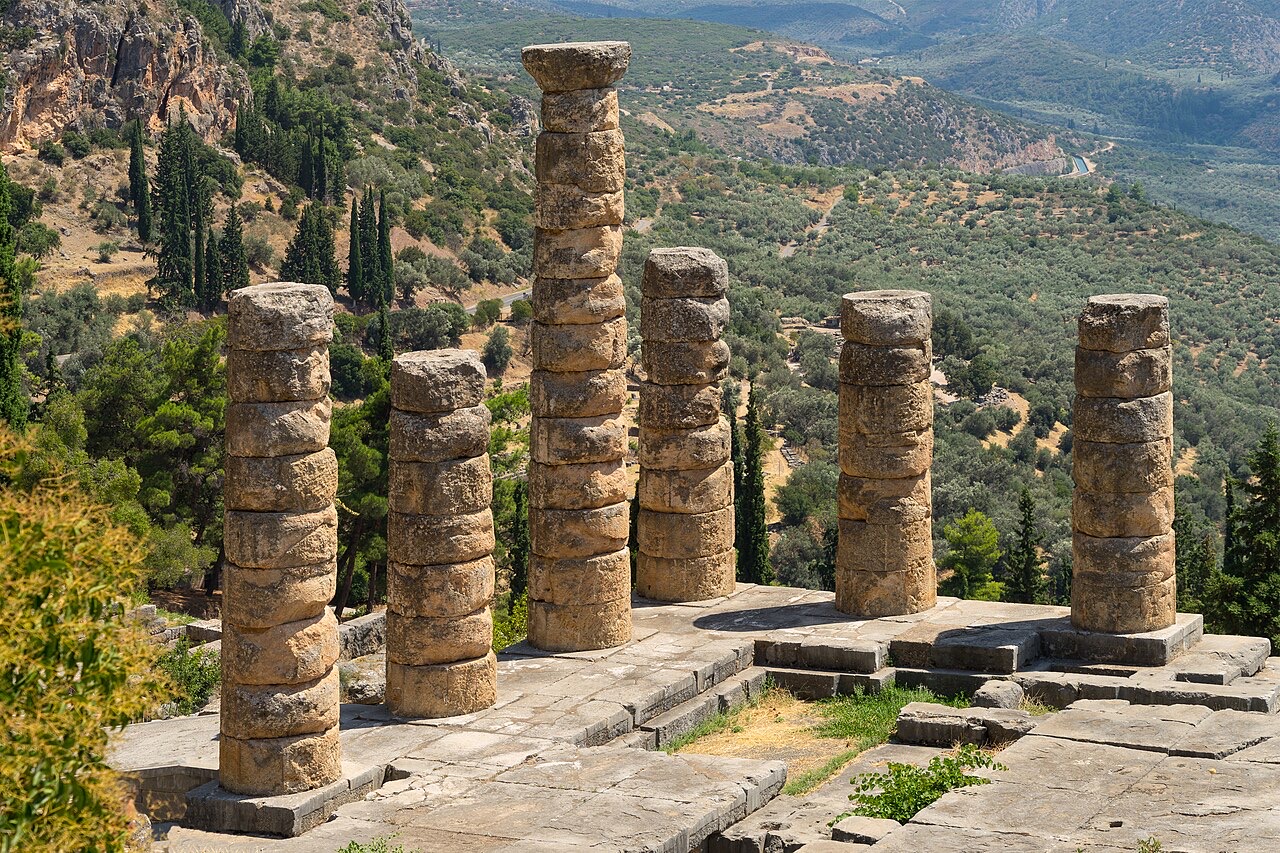
Visual AidWhat is left of the oracle’s home
Photograph of six columns of the Temple of Apollo at Delphi, on its mountain terrace above a valley of olives — the sanctuary the Knowledge Bank names as the most famous place a god was thought reachable. Inside this building the priestess called the Pythia delivered her famously ambiguous answers. What stands is a fraction, re-erected by archaeologists; the photograph shows no vapors and settles nothing about the debated gases beneath. Notice instead what the setting says: pilgrims climbed here from across the Mediterranean, which is the social function the Knowledge Bank calls certain.
Columns of the Temple of Apollo, Delphi, Greece; photograph by Jebulon. Source: Wikimedia Commons, File:Delphes, Grèce. Temple d’Apollon. Six colonnes.jpg, CC0.
🧠Knowledge Bank question
1According to the Knowledge Bank, the sanctuary at Delphi kept its authority because it ___.Ch.4
2What happens to Percy’s mother during the attack?Ch.4
3How does Percy defeat the Minotaur?Ch.4
4True or False: Mr. Brunner is really the centaur Chiron.Ch.5
5Write the numbers 1–5 in the boxes to show the correct order across Part 2. Number 1 = what happens first.Ch.4–6
Percy snaps off the Minotaur’s horn and then collapses.
Percy is placed in the Hermes cabin and meets Luke and Annabeth.
Percy learns the gods are real and Mr. Brunner is Chiron.
The Minotaur chases Percy and his mother to the camp border.
Percy’s mother dissolves in a flash of golden light.
6True or False: Mr. D, the camp director, is really the god Dionysus.Ch.5
7Which cabin is Percy first placed in?Ch.6
8Who is friendly and welcoming to Percy at camp?Ch.6
9True or False: Percy and Clarisse become instant best friends.Ch.6
10Fill in the blanks to complete the sentence.Ch.4–6
Word choices:MinotaurChironhorncamp- some words will not be used
Percy broke the off the and woke up safe at camp.
Part 3
Literary Elements
Understanding HOW and WHY Rick Riordan creates certain feelings across Chapters 4–6.
🧠Knowledge Bank · The Shape of a Hero Story
Literary Craft · The Call to Adventure
In 1949 the scholar Joseph Campbell argued that hero stories worldwide share a pattern he called the monomyth: an ordinary figure receives a call to adventure, refuses it, meets a mentor, crosses a threshold into a strange world, faces trials, and returns changed. Campbell’s claim that the pattern is universal has been heavily criticized — it fits Greek and European tales far better than many others, and it flattens real differences. But it remains useful as a description of one very durable structure, and modern adventure writers use it consciously. The threshold is the load-bearing part: once a character crosses into the other world, the rules change and the story can no longer return to normal life without cost. Watch for the mentor figure who explains those rules, because a story that hands the reader an explanation through dialogue is usually about to accelerate.
Visual AidThe monomyth, drawn as a route
Sequence diagram of the pattern the Knowledge Bank describes: Joseph Campbell’s monomyth, from ordinary world through call, refusal and mentor to the threshold, the trials and the changed return. Seven boxes compress a whole book of argument, and the diagram repeats the Knowledge Bank’s warning rather than hiding it: the pattern is not universal, and fits Greek-style tales far better than most of the world’s stories. Notice the highlighted stop. The threshold is the load-bearing step, because once a character crosses, the ordinary rules stop applying.
The hero’s journey after Joseph Campbell, The Hero with a Thousand Faces (1949), with the standard criticisms noted. Drawn for Garden Heights Academy.
📚 Literary Devices in This Part · definitions & examples
A retelling takes an old story and tells it in a new way, like setting Greek myths in modern America.Conflict is a struggle. Percy faces conflict with monsters, with the truth, and with Clarisse.A foil is a character who contrasts another. Kind Luke and harsh Clarisse highlight different sides of camp life.
The questions below are mixed — not grouped by device. Decide which device each one is about.
🧠Knowledge Bank question
1The Knowledge Bank explains that the threshold is the load-bearing part of a hero story because, once a character crosses it, ___.Ch.5–7
2A retelling takes an old story and tells it in a new way.Ch.5–7
3Fill in each blank with the correct word.Ch.5–7
Word choices:retellingconflictfoilsetting- some words will not be used
Putting Greek myths in modern America is a
Percy’s struggle with monsters is a .
4Percy’s struggle against the Minotaur and against the truth is —Ch.5–7
5A foil is a character who is exactly the same as the hero in every way.Ch.5–7
6Fill in each blank with the correct word.Ch.5–7
Word choices:foilconflictretellingmood- some words will not be used
Kind Luke set against harsh Clarisse makes each a
Percy’s fight to survive is a .
7Kind Luke and harsh Clarisse contrast each other. Each is the other’s —Ch.5–7
8Why does Riordan use a foil like Clarisse next to Luke?Ch.5–7
9Fill in each blank with the correct word.Ch.5–7
Word choices:foilretellingconflictplot- some words will not be used
Clarisse as Luke’s opposite makes her a
Modern Greek myths are a .
10The many struggles Percy faces at camp are mostly examples of —Ch.5–7
Part 4
Think Deeper
Four deeper challenges — no single-word recall. Read, weigh the evidence, and reason it through.
🧠Knowledge Bank · What Happens After a Diagnosis
Sociology · Belonging and Labels
Being given a category changes how others treat you and how you treat yourself. Sociologists call this labelling, and studies of schooling show it working in both directions: a label can unlock help, accommodations and a community of people with the same experience, and it can also lower what adults expect and become an explanation the young person reaches for first. Researchers who interviewed students after a diagnosis found the outcome hinged on framing. Where the label was presented as information about how someone learns, self-belief usually rose; where it was presented as a limit, it fell. Psychologists connect this to attribution: whether a person explains a setback by something changeable, like a method, or by something fixed, like themselves. The practical lesson is that a name for a difficulty is genuinely valuable, and that its value depends entirely on what the people around you do next.
1Claim: “Percy defeats the Minotaur through grief-fueled courage, not training.” — choose the two details that best prove it.Claim & Evidence
2Mortal world or Camp Half-Blood? Tap each item to sort it — tap again to switch sides. You can keep tapping to change your answer.Sort into two
◄ The mortal worldCamp Half-Blood ►
3Match each cause to its result. For each cause, pick its result.Cause & Effect
The Minotaur squeezes Percy’s mother→
Grief and rage flood through Percy→
Percy staggers across the camp’s border→
Percy collapses from his wounds→
🧠Knowledge Bank question
4Fill both blanks to complete the reasoning.Build the Argument
A label such as a diagnosis can raise a student's self-belief when adults present it as , which shows that .
Part 5
Standardized Test · Main Idea & Detail
Part 2 practices Main Idea and Detail reading — the way the SAT and TOEFL test whether you can find the central point and the exact facts that support it. Read the passage (the highlighted words are tested below), then choose the answer best supported by the text.
Read the passage — the highlighted words are tested — then answer. Tap an answer, then tap it again to confirm.
SATWords in Context — a word's meaning in this passage
SATCentral Ideas — the passage's main point
SATInference — a conclusion the passage implies
TOEFLFactual Information — a fact stated in the passage
TOEFLVocabulary — a tested word's meaning here
TOEFLProse Summary — the three sentences that sum it up
The Minotaur and the Labyrinth
In Greek myth the Minotaur — half man, half bull — was confined inside an elaborate maze called the Labyrinth, built for King Minos on the island of Crete. The maze was so vast and winding that no prisoner sent into it could ever find the way out again. Anyone who wandered its dark passages soon grew bewildered, too confused by the endless turns to tell one corridor from another. According to the tale, the inventor Daedalus designed its twisting passages so cleverly that even he nearly failed to escape them.
Archaeologists have uncovered an immense palace at Knossos on Crete, with hundreds of rooms joined by twisting corridors and stairways that double back on themselves. Its remote inner passages may have inspired the legend of the Labyrinth. Painted walls there show young athletes leaping over the horns of charging bulls — a deliberate, daring ritual rather than an accident. Such a leap demanded a determined athlete, one who would not lose courage halfway through the jump.
The story endures because it dramatizes a fear people still feel: being trapped and confronting a monster alone. Modern writers keep borrowing the Minotaur, so that when a hero must resist a beast to protect others, we sense the ancient tale beneath the new one. Novelists, filmmakers, and video-game designers have all placed the creature in fresh settings for new audiences in nearly every generation since. Each retelling keeps the core image of a hero and a monster meeting inside a maze, which helps explain why the ancient story never truly fades from the popular imagination even after thousands of years.
Original passage written for Garden Heights — not a quotation from the novel.
1According to the passage, who built the Labyrinth?TOEFL · Factual Information
2In the passage, bewildered most nearly means ___.TOEFL · Vocabulary
3According to the passage, the Labyrinth was built for —TOEFL · Factual Information
4In the passage, determined most nearly means ___.SAT · Words in Context
5According to the passage, the painted walls at Knossos show —TOEFL · Factual Information
6In the passage, the word “endures” is closest in meaning to —SAT · Words in Context
7According to the passage, the maze was so vast that —TOEFL · Factual Information
8Which statement best expresses the central idea of the passage?SAT · Central Ideas
9The passage most strongly suggests the Minotaur myth still grips readers because it echoes a fear of —SAT · Inference
10Prose Summary (TOEFL).The Minotaur myth has endured because it may echo real customs and a lasting human fear. This TOEFL task lists six sentences; choose the THREE that best capture the passage’s main ideas. The other three do not belong — they state minor details or ideas the passage does not present.TOEFL · Prose Summary
Part 6 · Optional
Creative Writing
A bonus challenge to practice your English. Take your time and have fun with it.
About This Section
This writing task is optional and is not part of your auto-graded score. The feedback below checks only the basics — length, spelling, and grammar — not whether your ideas are right or wrong. It is meant for classroom discussion and creative practice, so feel free to use your imagination!
Writing Task — Part 2 “A Brave Moment”
Percy is terrified but still fights the Minotaur to protect his mother. Write about a time you (or a character you invent) had to be brave even while scared. What gave you courage? Write at least 40 words.
You can start with: “I was scared, but I knew I had to…”
0 / 40 words minimum
🗣 Teach It · Just for Fun (optional)
No right or wrong — close the screen and tell someone nearby what happened in this part. Can’t find anyone? Tell yourself out loud. The moment you teach it, you truly understand it.
Part 2 Complete!
You finished Chapters 4–6 of The Lightning Thief.
Here are your auto-graded results:
-
points out of 100
Teach it to someone
The best last step is to teach it. In your own words, explain what happened — retell a favorite scene, teach a character’s big choice, or sum up the main idea for a parent, friend, or classmate. When you can teach it clearly, you truly own it.
Independent study guide by Garden Heights. Not affiliated with or endorsed by Rick Riordan. Contains original analysis only; no text from the novel is reproduced.
SAT® is a registered trademark of College Board, which is not affiliated with, and does not endorse, these materials. TOEFL® is a registered trademark of ETS. These materials are not endorsed or approved by ETS. Garden Heights is an independent provider of test-style reading practice.