New here? Just sign up with Google — your account includes Matilda, our gift book, forever.
The Lightning Thief · Garden Heights
Part 5
for The Lightning Thief · Part 5 · Chapters 13–14
a novel by Rick Riordan
35 min6 Parts
This workbook is built on a solid pedagogical foundation, effectively integrating content and language learning based on the CLIL framework (Content and Language Integrated Learning), elevated by our unique 5th C — Connection — and an integrated Standardized Test section that weaves every SAT & TOEFL question type right into the novel, so learners build real test skills easily, naturally, and with fun.
💭 Before You Read · Just for Fun
No right or wrong answers — just think or chat about it: Imagine that, through no fault of your own, the whole world suddenly believed you had done something terrible. How would you keep going toward your goal while being blamed and chased — and who would you want beside you?
What Happens in Part 5
Cornered atop the Gateway Arch, Percy leaps into the Mississippi — and Poseidon's son survives the fall.
Ambush at the ArchIn St. Louis, Percy is cornered atop the famous Gateway Arch by Echidna, the Mother of Monsters, and her fire-breathing Chimera.
Leap into the RiverPercy leaps from the Arch, plunging hundreds of feet into the Mississippi River — and is unharmed, because he is Poseidon's son. Underwater, a water spirit gives him a message and three magic pearls for later.
Hunted FugitiveOn land things worsen: mortal news reports now blame Percy for the explosion, making him a hunted fugitive as the heroes press on toward Los Angeles and the Underworld.
What We Will Learn
Focus
What It Means
Greek Mythology
Echidna and the fearsome Chimera
Character Power
How Percy’s sea powers grow
Rising Tension
How the stakes keep climbing
Chapter Summary
Chapter
Key Events
Ch.13
At the Gateway Arch, Echidna and her Chimera trap Percy; he leaps into the Mississippi and survives, receiving pearls and a message underwater
Ch.14
Now blamed by mortal news, Percy is a fugitive; the heroes keep heading west toward the Underworld
Copyright Notice
This is an independent study guide created by Garden Heights to support reading comprehension and literary analysis. It contains original analysis questions and does not reproduce any text from the novel. The Lightning Thief is a work by Rick Riordan. This guide is not affiliated with, authorized by, or endorsed by Rick Riordan or any associated rights holders. Students should read the original book, available from libraries and booksellers.
Part 1
Vocabulary
Study 10 key words from Chapters 13–14, then answer each question.
🧠Knowledge Bank · The Greek Word for Going Too Far
Classical Studies · Hubris and Nemesis
Greek has a precise word for the arrogance that invites disaster: hubris. In Athenian law it was an actual offense, meaning a deliberate humiliation of another person for the pleasure of it, and in tragedy it names a hero’s overreach against the limits set for mortals. The consequence had a name too. Nemesis was the goddess who restored balance by delivering what was deserved, which is why we still call an unavoidable downfall a nemesis. Between them sits a third term, ate, the ruinous blindness that stops a person from seeing the trap they are walking into. Together the three make a model of failure that is still borrowed by historians and business writers: success breeds overconfidence, overconfidence blinds, and the fall follows. It is worth noticing that the Greeks located the fault not in ambition itself but in the refusal to accept a limit.
Visual AidHubris, ate, nemesis
Sequence diagram of the three-part model the Knowledge Bank assembles: hubris, the arrogance that humiliates or overreaches; ate, the ruinous blindness that hides the trap; and nemesis, the balance restored. Three boxes flatten centuries of Greek thought, and the arrows claim no inevitability — this is a model for reading events, not a law of nature. The drawing names no character and convicts nobody in the novel. Notice the detail the Knowledge Bank leads with: in Athenian law, hubris was a real, prosecutable offense.
Hubris, ate and nemesis as treated in standard introductions to Greek tragedy and Athenian law. Drawn for Garden Heights Academy.
chimeran.Ch.13
A monster made of parts of different animals
“The Chimera breathed deadly fire.”
plungev.Ch.13
To fall or dive suddenly downward
“Percy had to plunge from the Arch.”
fugitiven.Ch.14
A person running from the law
“Percy became a hunted fugitive.”
venomn.Ch.13
Poison from a snake or monster
“The Chimera’s bite was full of venom.”
archn.Ch.13
A curved structure, like a monument
“The Gateway Arch towered over the city.”
currentn.Ch.13
Water moving in one direction
“The river’s current cradled Percy.”
accusev.Ch.14
To say someone has done something wrong
“The news began to accuse Percy.”
survivev.Ch.13
To stay alive through danger
“Only Poseidon’s son could survive the fall.”
desperateadj.Ch.13
Filled with fear and ready to do anything
“In a desperate move, Percy jumped.”
pursuedadj.Ch.14
Being chased or hunted
“The pursued heroes kept moving west.”
ⓘ The vocabulary words in this list are selected to help you understand and complete this workbook. Some may not appear verbatim in the original novel.
🧠Knowledge Bank question
1The Knowledge Bank explains that when a proud hero is pursued to ruin by nemesis, the Greeks located the real fault in ___.Ch.13
2True or False: To “plunge” means to fall or dive suddenly downward.Ch.13
3A person running from the law is a ___.Ch.14
4True or False: “Venom” is a healing medicine.Ch.13
5Fill in each blank with the correct word.Ch.13
Word choices:plungechimeravenomcurrent- some words will not be used
The breathed fire, so Percy had to into the river, where the saved him.
6True or False: To “survive” means to stay alive through danger.Ch.13
7To say someone has done something wrong is to ___ them.Ch.14
8True or False: Someone “desperate” is calm and carefree.Ch.13
9Fill in the blanks with the correct words.Ch.13–14
Word choices:fugitiveaccusevenomarch- some words will not be used
The news began to Percy, turning him into a .
10Water moving in one direction in a river is a ___.Ch.13
Part 2
Comprehension
How well do you understand Chapters 13–14?
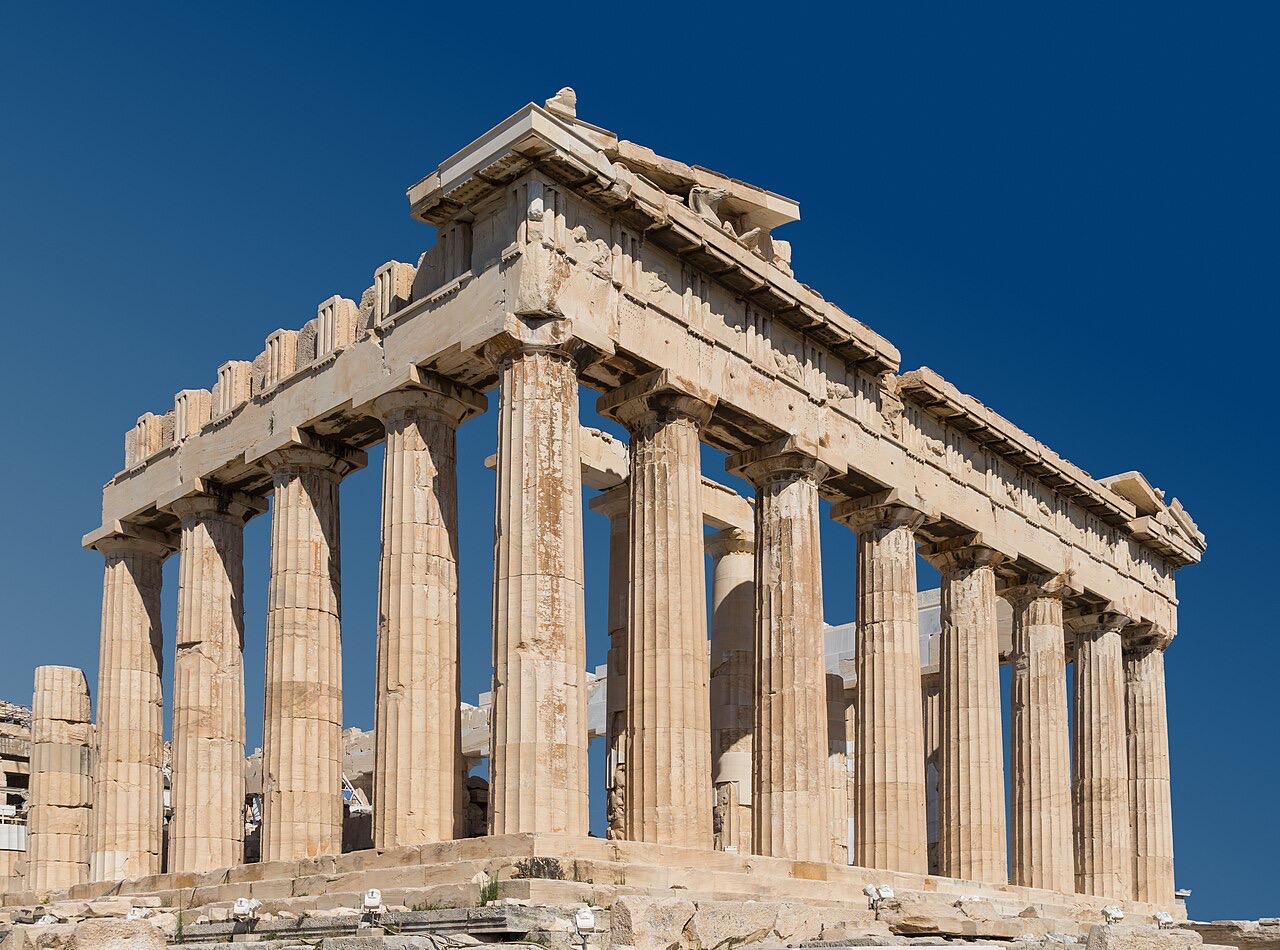
🧠Knowledge Bank · How the Parthenon Was Made
Ancient Engineering · Greek Building
Greek temples look simple and are not. The Parthenon, finished in 432 BCE, contains almost no straight lines: its columns swell slightly at the middle, a refinement called entasis, and its floor rises a few centimetres toward the center, corrections that make the building read as straight to a human eye that would otherwise see it sagging. The columns lean inward so slightly that their axes would meet over a kilometer above. Marble blocks were cut at the quarry, hauled sixteen kilometers, and joined without mortar using iron clamps set in lead. Modern restorers found that the ancient joints were accurate to fractions of a millimetre. The lesson architects draw is that classical proportion was never only mathematics; it was mathematics adjusted for perception. A building designed for how people actually see is a different problem from a building designed to be geometrically correct.
Visual AidAlmost no straight lines
Photograph of the Parthenon in Athens, finished in 432 BCE — the building whose refinements the Knowledge Bank measures. The trick of the photograph is that the tricks are invisible: the columns swell at the middle (entasis), the floor rises a few centimeters toward the center, and the column axes lean inward — corrections sized so a human eye reads the building as perfectly straight, which is why no picture can show them. The marble is bare and broken now; the temple was once painted and roofed. Notice the joints the Knowledge Bank describes: blocks cut so precisely they needed no mortar.
The Parthenon from the southeast, Acropolis, Athens; photograph by Jebulon. Source: Wikimedia Commons, File:Parthenon east side Acropolis Athens, Greece.jpg, CC0.
🧠Knowledge Bank question
1According to the Knowledge Bank, why do the Parthenon's columns swell slightly at the middle and its floor rise toward the center?Ch.13
2Who traps Percy at the top of the Arch?Ch.13
3How does Percy escape the Chimera?Ch.13
4True or False: Percy survives the huge fall because he is the son of Poseidon.Ch.13
5Write the numbers 1–5 in the boxes to show the correct order across Part 5. Number 1 = what happens first.Ch.13–14
Mortal news blames Percy, and he becomes a hunted fugitive.
The heroes visit the Gateway Arch in St. Louis.
Underwater, a water spirit gives Percy a message and three pearls.
Echidna and the Chimera corner Percy at the top of the Arch.
Percy plunges from the Arch into the Mississippi River and survives.
6True or False: Underwater, Percy receives three magic pearls.Ch.13
7What is Echidna known as in Greek myth?Ch.13
8Why does Percy become a fugitive?Ch.14
9True or False: The Chimera is part lion, part goat, and part serpent.Ch.13
10Fill in the blanks to complete the sentence.Ch.13–14
Word choices:Archriverpearlsfire- some words will not be used
Percy jumped from the into the , where the water saved him.
Part 3
Literary Elements
Understanding HOW and WHY Rick Riordan creates certain feelings across Chapters 13–14.
🧠Knowledge Bank · Jokes That Cut a Myth Down
Literary Craft · Comic Deflation
Retelling a solemn story in a modern comic voice is a technique with a long history. Classicists call the ancient version burlesque or mock-heroic: applying grand epic language to a trivial subject, or plain language to a grand one, so the mismatch produces the laugh. Alexander Pope built a whole poem out of treating a stolen lock of hair as if it were the Trojan War. The modern equivalent runs the other way, putting gods into shopping centers and giving monsters office jobs. The effect is not simply mockery. Deflation makes a mythic figure approachable, and once a reader is laughing, a serious moment lands harder because it arrives unannounced. Watch the sentence rhythm around the jokes: comic writers usually shorten sentences into the punchline and lengthen them again immediately afterward, and that lengthening is the signal that the book has stopped joking.
📚 Literary Devices in This Part · definitions & examples
Rising action builds tension toward the climax. The dangers grow sharply in these chapters.Symbolism uses objects to mean more. Water symbolizes Percy’s power and protection.External conflict is a struggle with outside forces — monsters and the mortal law now hunt Percy.
The questions below are mixed — not grouped by device. Decide which device each one is about.
🧠Knowledge Bank question
1The Knowledge Bank explains that when sentences lengthen again right after a joke, the signal is that ___.Ch.15–17
2Rising action builds tension as a story moves toward its climax.Ch.15–17
3Fill in each blank with the correct word.Ch.15–17
Word choices:symbolismrisingconflictsetting- some words will not be used
Water standing for Percy’s power is
Percy’s fight against monsters and the law is external .
4Water in the story stands for Percy’s power. Using an object to mean more is —Ch.15–17
5In symbolism, an object can only ever mean itself and nothing more.Ch.15–17
6Fill in each blank with the correct word.Ch.15–17
Word choices:conflictsymbolismrisingmood- some words will not be used
Monsters and the mortal law hunting Percy is external
Water as a sign of his power is .
7Percy’s struggle against monsters and the mortal law is —Ch.15–17
8Why might the author let water heal and strengthen Percy?Ch.15–17
9Fill in each blank with the correct word.Ch.15–17
Word choices:risingsymbolismconflictplot- some words will not be used
The sharply growing dangers are the story’s
Water as a sign of Percy’s strength is .
10The dangers growing sharper as the climax nears is called —Ch.15–17
Part 4
Think Deeper
Four deeper challenges — no single-word recall. Read, weigh the evidence, and reason it through.
🧠Knowledge Bank · When Friendship Meets Duty
Ethics · Loyalty and Betrayal
Philosophers treat loyalty as a genuine virtue with a genuine danger. Loyalty means giving a person or group a claim on you that strangers do not have, and almost everyone thinks that is right — a friend who weighs your interests exactly as they weigh a stranger’s is not much of a friend. The danger is that the same disposition can shield wrongdoing, which is why organizations that most prize loyalty are often the slowest to admit fault. Ethicists therefore ask where a loyalty’s limit lies, and the usual answer is that it ends where it requires you to harm an innocent third party. Research on whistleblowers shows how heavily this costs in practice: most report being treated as traitors by colleagues even when the disclosure was plainly justified. Judging a betrayal fairly therefore means asking what the betrayer was protecting, not only what they broke.
1Claim: “Percy learns to trust the water — and his father — to save him.” — choose the two details that best prove it.Claim & Evidence
2A danger Percy faces, or a power that saves him? Tap each item to sort it — tap again to switch sides. You can keep tapping to change your answer.Sort into two
◄ A danger he facesA power that saves him ►
3Match each cause to its result. For each cause, pick its result.Cause & Effect
Echidna and the Chimera trap Percy→
Percy leaps from the Arch→
Percy sinks beneath the water→
Percy survives the impossible fall→
🧠Knowledge Bank question
4Fill both blanks to complete the reasoning.Build the Argument
Ethicists argue that a loyalty reaches its limit because , which shows that .
Part 5
Standardized Test · Author’s Purpose, Structure & Vocabulary
Part 5 practices Author’s Purpose & Text Structure together with Vocabulary — asking why a passage is built the way it is, as the SAT and TOEFL do. Read the passage (the highlighted words are tested below), then choose the answer best supported by the text.
Read the passage — the highlighted words are tested — then answer. Tap an answer, then tap it again to confirm.
SATWords in Context — a word's meaning in this passage
SATInference — a conclusion the passage implies
SATText Structure & Purpose — how the passage is built, and why
TOEFLFactual Information — a fact stated in the passage
TOEFLVocabulary — a tested word's meaning here
Engineering the Gateway Arch
Rising 630 feet (192 m) above St. Louis, the Gateway Arch is the tallest arch in the world. Its immense stainless-steel curve was a deliberate tribute to the pioneers who once traveled west across America. Engineers designed it with great care so that it could endure strong winds without cracking. The Arch is not a simple half-circle; it follows a special shape called a catenary — the gentle curve a heavy chain makes when it hangs freely. This shape lets the vast weight press straight down through the structure, so the Arch can resist forces that would topple a weaker design.
Building it was a slow, gradual transition from ground to sky. The two legs were raised at the same time and had to meet at the very top within a tiny margin. Workers made the final precise join on a hot day, cooling the steel with water so the two sides would fit. Engineers calculated that the finished monument could survive earthquakes and gusts of wind far stronger than any storm yet seen on record. The elaborate plan worked, and the Arch has stood as a landmark ever since.
Visitors today can ride to the top in small tram cars that climb through the curved, hollow legs. From the windows at the summit, they look out for miles across the Mississippi River, whose wide current rolls steadily past the growing city below. The monument anchors a national park that honors the country's long westward expansion. Each year several million people still come to see the graceful steel curve that once seemed almost impossible to build.
Original passage written for Garden Heights — not a quotation from the novel.
1According to the passage, how were the two legs of the Arch joined?TOEFL · Factual Information
2In the passage, survive most nearly means ___.TOEFL · Vocabulary
3According to the passage, how tall is the Gateway Arch?TOEFL · Factual Information
4As used in the passage, the word “endure” most nearly means —SAT · Words in Context
5According to the passage, the special curve of the Arch is called a —TOEFL · Factual Information
6The passage most strongly suggests that building the Arch required —SAT · Inference
7Why does the author explain the catenary shape?SAT · Text Structure & Purpose
8In the passage, current most nearly means ___.TOEFL · Vocabulary
9According to the passage, the two legs of the Arch had to —TOEFL · Factual Information
10The second paragraph is organized mainly by —SAT · Text Structure & Purpose
Part 6 · Optional
Creative Writing
A bonus challenge to practice your English. Take your time and have fun with it.
About This Section
This writing task is optional and is not part of your auto-graded score. The feedback below checks only the basics — length, spelling, and grammar — not whether your ideas are right or wrong. It is meant for classroom discussion and creative practice, so feel free to use your imagination!
Writing Task — Part 5 “A Hidden Power”
Percy discovers that water protects him because of who his father is. If you had one special power connected to nature (water, wind, fire, earth), what would it be and how would you use it? Write at least 40 words.
You can start with: “My special power would be…”
0 / 40 words minimum
🗣 Teach It · Just for Fun (optional)
No right or wrong — close the screen and tell someone nearby what happened in this part. Can’t find anyone? Tell yourself out loud. The moment you teach it, you truly understand it.
Part 5 Complete!
You finished Chapters 13–14 of The Lightning Thief.
Here are your auto-graded results:
-
points out of 100
Teach it to someone
The best last step is to teach it. In your own words, explain what happened — retell a favorite scene, teach a character’s big choice, or sum up the main idea for a parent, friend, or classmate. When you can teach it clearly, you truly own it.
Independent study guide by Garden Heights. Not affiliated with or endorsed by Rick Riordan. Contains original analysis only; no text from the novel is reproduced.
SAT® is a registered trademark of College Board, which is not affiliated with, and does not endorse, these materials. TOEFL® is a registered trademark of ETS. These materials are not endorsed or approved by ETS. Garden Heights is an independent provider of test-style reading practice.