New here? Just sign up with Google — your account includes Matilda, our gift book, forever.
Pippi Longstocking · Garden Heights
Part 7
for Pippi Longstocking · Part 7 · Chapters 9–10
8 Parts40 min
What Happens in Part 7
Two chapters, two Pippis. First, Mrs. Settergren — Tommy and Annika’s mother — invites the children to a proper coffee party, and Pippi arrives determined to show fine manners. It goes beautifully wrong: she interrupts the ladies, helps herself to a whole cream pie, and spins an endless story about her grandmother’s servant Malin, until the hostess asks her not to come again. For once, Pippi walks home quiet and low. Then comes the fire. A tall house in town is ablaze, two small boys are trapped at the top window, and no ladder can reach them. While the town stands in panic, Pippi sends Mr. Nilsson up a tree with a rope, lays a plank from branch to window, walks across the gap, and lowers both boys to safety. The same crowd that clucked at her manners now cheers her to the sky.
What We Will Learn
Section
What you will practice
Vocabulary
Words of parlours and emergencies: hostess, manners, interrupt, blaze, panic, courage…
Literary Elements
Juxtaposition, story-within-a-story, and climax
Cross-Curricular
How towns fought fires before tall ladders, and what party manners are really for
The Malin Story — interruptions, a vanished cream pie, and an unstoppable tale about grandmother’s servant; the hostess asks Pippi not to return.
10a
Fire! — a tall house burns; two boys are trapped above the tallest ladder’s reach.
10b
The Rescue — Mr. Nilsson takes the rope up, Pippi crosses on a plank and lowers the boys; the town cheers its strange new hero.
Part 1
Vocabulary
Study 10 key words from Chapters 9–10, then answer each question.
🧠Knowledge Bank · Fire in a Wooden Town
Content · Fire & RescueWhen a house catches fire and two children are trapped upstairs, Pippi carries a plank up a tree and walks it across to their window. Old Swedish towns were built almost entirely of wood, close together, so a single flame could leap from roof to roof and swallow a street before help arrived. Fire needs three things to grow — fuel, heat, and air — and a timber town supplies endless fuel, which is why such rescues were desperately dangerous. Real firefighters used tall ladders and ropes because a person cannot simply reach a high window. Pippi’s strength lets her turn a tree and a board into an instant bridge, doing calmly what a whole fire brigade would struggle to do. The danger is real; only her rescue is effortless.
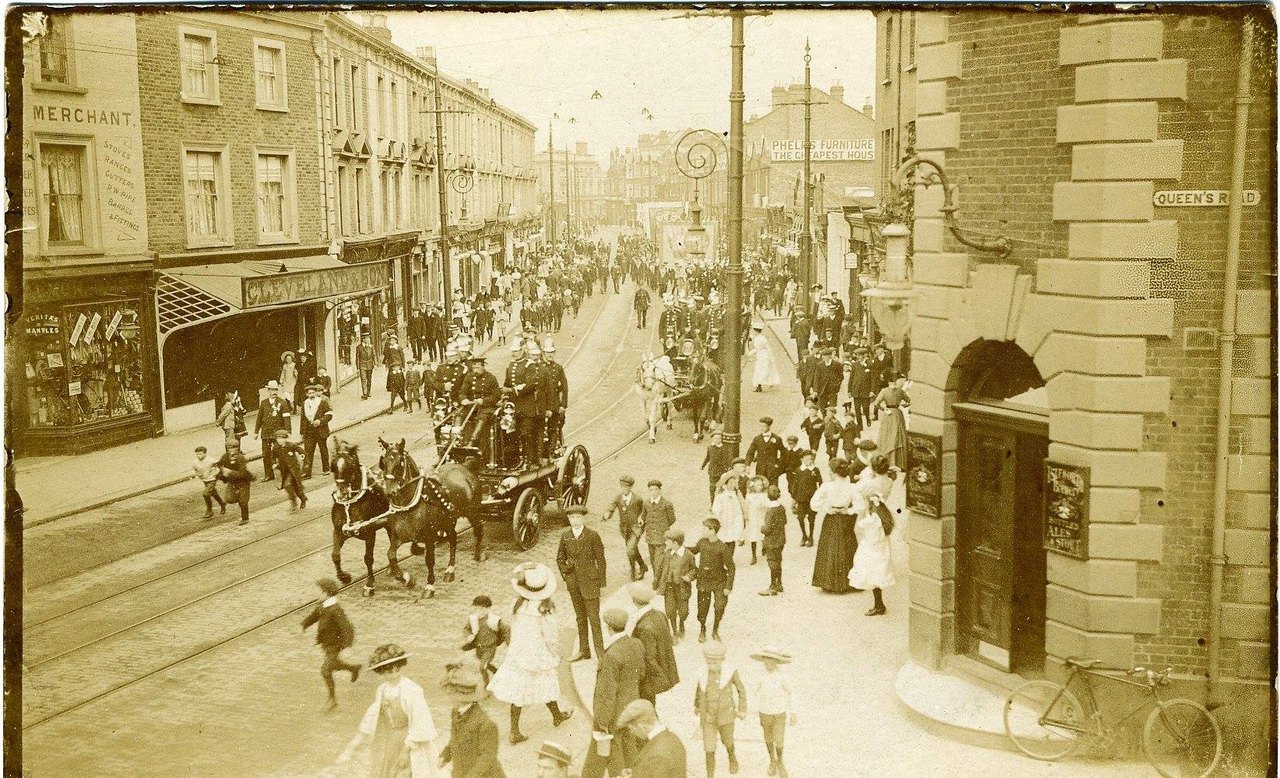
Visual AidA fire brigade of the horse-drawn age
Postcard photograph of a fire brigade parading down a street in Teddington, England, in the early 1900s. Firemen in polished helmets ride a horse-drawn engine while the whole town lines the pavements. The Knowledge Bank explains that old towns answered the danger of fire with trained crews who raced toward the very danger everyone else fled, using tall ladders and ropes because a person cannot simply reach a high window. This is such a crew on a proud day, not at a fire; the town is English, not Swedish, and its buildings here are brick. Notice the crowd — a brigade was something a town turned out to see, which is why a rescue by a girl with a plank would have been the talk of every street.
Fire brigade parade, Teddington, England, early 1900s; postcard, photographer unknown. Source: Wikimedia Commons, public domain.
hostessn.Ch.9
A woman who welcomes guests
“The hostess poured coffee for the ladies.”
mannersn.Ch.9
Polite ways of behaving
“Pippi tried her very best manners.”
interruptv.Ch.9
To break in while someone else is speaking
“She would interrupt every story.”
servantn.Ch.9
Someone paid to work in another’s home
“Grandmother’s servant was called Malin.”
blazen.Ch.10
A large, dangerous fire
“The blaze lit up the night sky.”
panicn.Ch.10
Sudden, uncontrollable fear
“Panic spread through the watching crowd.”
plankn.Ch.10
A long, flat board of wood
“Pippi laid a plank to the window.”
couragen.Ch.10
Bravery in the face of danger
“Her courage saved the two boys.”
cheerv.Ch.10
To shout in support or joy
“The whole town began to cheer.”
rescuen.Ch.10
The act of saving someone from danger
“The rescue took only minutes.”
ⓘ The vocabulary words in this list are selected to help you understand and complete this workbook. Some may not appear verbatim in the original novel.
🧠Knowledge Bank question
1According to the Knowledge Bank, fire needs three things: ___.Ch.9
2To ‘interrupt’ means to wait politely for your turn to speak.Ch.9
3A large, dangerous fire is called a ___.Ch.10
4‘Panic’ is a calm, careful way of thinking.Ch.10
5Fill in each blank with the correct word.Ch.9–10
Word choices:mannersplankhostesscheer- some words will not be used
Pippi promised to show her finest at the party.
She laid a from the branch to the window.
6Someone paid to work in another person’s home is a ___.Ch.9
7‘Courage’ means bravery in the face of danger.Ch.10
8To shout in support or joy is to ___.Ch.10
9Fill in the blanks with the correct words.Ch.9–10
Word choices:interruptcourageblazeservant- some words will not be used
It is rude to a guest mid-story.
Climbing toward the took real nerve.
10The act of saving someone from danger is a ___.Ch.10
Part 2
Comprehension
Show you understood what happens in Chapters 9–10.
🧠Knowledge Bank · One Day, Two Tests
Comprehension · Chapters 9–10Keep the two halves of this part side by side, because reading them together teaches comparing and contrasting — finding how two things are alike and how they differ. At the coffee party Pippi breaks every rule of polite manners and upsets the grown-ups; at the fire she breaks every ordinary limit of the body and saves two children’s lives. In both, she does the un-allowed thing, yet one earns frowns and the other earns cheers. The same strength and the same free spirit produce opposite results, and the difference lies in what is at stake. When you line up two scenes and ask what changed, you see a story’s meaning sharpen. Reading for likeness and difference across chapters is how a careful reader turns events into understanding.
Visual AidOne day, two verdicts
Venn diagram for the Knowledge Bank on comparing and contrasting. Each circle holds what belongs to one scene only, the measure, the rule that is broken, and the verdict; the overlap holds what both scenes share, as the Knowledge Bank says: the same girl, the same strength, the same un-allowed thing. It does not decide which verdict was right. Notice that the overlap is where Pippi actually is — only the stakes moved from one circle to the other.
Likeness and difference as stated in the Knowledge Bank. Drawn for Garden Heights Academy.
🧠Knowledge Bank question
1The Knowledge Bank says the coffee party and the fire differ in ___.Ch.9
2At the party, Pippi eats one modest slice of the cream pie.Ch.9
3Pippi’s endless party story is about ___.Ch.9
4How does the coffee party end for Pippi?Ch.9
5Write the numbers 1–5 in the boxes to show the correct order of events in Chapters 9–10. Number 1 = what happens first.Ch.9–10
Pippi crosses the plank and lowers the boys to safety.
A fire traps two boys above the tallest ladder’s reach.
Pippi eats the cream pie and tells the endless Malin story.
Mr. Nilsson carries the rope up the tall tree.
Mrs. Settergren invites the children to a coffee party.
6The firefighters’ ladder easily reaches the trapped boys.Ch.10
7What does Mr. Nilsson carry up the tree?Ch.10
8How does Pippi reach the trapped boys?Ch.10
9Pippi lowers the two boys to the ground one at a time with the rope.Ch.10
10How does the town react once the boys are safe?Ch.10
Part 3
Literary Elements
Understanding HOW and WHY Astrid Lindgren tells the story across Chapters 9–10.
🧠Knowledge Bank · Built to Be Compared
Narrative Craft · Built to Be ComparedPlacing the party disaster and the fire rescue right next to each other is juxtaposition — setting two contrasting scenes side by side so each sharpens the other. Alone, the coffee-party mess might make Pippi seem merely rude; alone, the rescue might make her seem simply heroic. Together, they argue something richer: the very wildness that shatters a tea table is the wildness that scales a burning wall. Lindgren lines them up on purpose, letting the reader feel the contrast within a single day. Her impossible strength is the thread joining both — an embarrassment in a parlor, a miracle at a fire. Noticing why an author parks two opposite scenes together, and what the pairing says that neither could say alone, is how you read for a book’s quiet argument.
Juxtaposition
Placing two scenes side by side so they explain each other — parlor shame beside public triumph.
Story-within-a-story
A tale told inside the main tale — Pippi’s endless Malin saga at the coffee table.
Climax
The story’s highest point of tension — a girl on a plank above a burning house.
🧠Knowledge Bank question
1According to the Knowledge Bank, juxtaposition is ___.Ch.9–10
2Fill in the blank with the correct literary term.Ch.9–10
Word choices:climaxjuxtapositiontonesequel- some words will not be used
The plank walk above the flames is the book’s .
Placing parlor shame beside public triumph is .
3Pippi’s tale of Malin, told inside the chapter we are reading, is ___.Ch.9
4The climax of a story is its quietest, least important moment.Ch.10
5Pippi walking home ‘quiet and low’ after the party matters because it shows ___.Ch.9
6The Malin story works as comedy mainly because it ___.Ch.9
7Juxtaposition means placing scenes side by side so their contrast carries meaning.Ch.9–10
8Fill in the blank with the correct literary term.Ch.9
Word choices:story-within-a-storyclimaximagerymoral- some words will not be used
A tale told inside the main tale is a .
9During the rescue, Lindgren slows down to describe each step on the plank in order to ___.Ch.10
10Taken together, the two chapters argue that a person’s worth is best measured by ___.Ch.9–10
Part 4
Think Deeper
Four deeper challenges — no single-word recall. Read, weigh the evidence, and reason it out.
🧠Knowledge Bank · Judging the Judges
Child Psychology · Judging the JudgesIn one day the town judges Pippi twice and reaches opposite verdicts: a nuisance at the coffee party, a hero at the fire. She has not changed at all — the same strength, the same fearless heart — so what changed is the crowd’s need. When manners are the measure, her wildness looks like a flaw; when children are trapped, that identical wildness looks like a gift. Lindgren nudges you to distrust quick judgments and to ask what a moment is really rewarding. People often praise or scold the very same trait depending on whether it happens to help them. Learning to notice that, and to look past the label to the person underneath, is a fairness worth carrying out of the book and into your own life.
Think back over the day. At the coffee table, every rule Pippi breaks is small — a story too long, a pie too empty — yet the ladies’ verdict is exile. At the fire, every rule she breaks is enormous — children do not cross planks above flames — yet the verdict is a hero’s cheer. Between the two verdicts walks the same red-haired girl, unchanged.
Original passage written for Garden Heights — not a quotation from the novel.
1Claim: “The fire rescue succeeds because Pippi plans it, not just because she is strong.” — choose the two details that best prove it.Claim & Evidence
2At the coffee party, or At the fire? Tap each detail to sort it — tap again to switch sides. You can keep tapping to change your answer.Sort into two
◄ At the coffee partyAt the fire ►
3Match each cause to its result. For each cause, pick its result.Cause & Effect
Pippi has never learned parlor rules→
The brigade’s ladder is too short→
Mr. Nilsson can climb where no one else can→
Pippi’s balance and nerve hold on the plank→
🧠Knowledge Bank question
4Fill both blanks to complete the reasoning.Build the Argument
The Knowledge Bank says the town reaches opposite verdicts in one day because , which teaches readers to .
Part 5
Standardized Test
Before the Tall Ladders · SAT & TOEFL-style practice
Read the passage — the highlighted words are tested — then answer. Tap an answer, then tap it again to confirm.
SATWords in Context — a word's meaning in this passage
SATDetail — a fact stated in the passage
SATText Connections — how two parts of the text relate
SATText Structure & Purpose — how the passage is built, and why
TOEFLFactual Information — a fact stated in the passage
TOEFLVocabulary — a tested word's meaning here
Fire Brigades in Wooden Towns
For centuries, fire was a wooden town's deadliest enemy. Houses stood close, roofs were dry timber, and one tipped candle could start a blaze that cost a whole street. Towns answered with the fire brigade: a trained crew with hand-pumps, buckets, hoses, and ladders, ready to race toward the very danger everyone else fled. Sweden's towns, built almost entirely of wood, drilled their brigades hard — and still, everyone knew the brigades' weakness. The weakness was height. A wooden ladder grows heavy and unsteady as it grows long, so most reached only a third floor — anyone trapped above waited for a miracle. Crews learned to improvise: jumping-nets held open below, ropes thrown over beams, a plank laid as a bridge from the nearest roof or tree. Rescue, in the end, was less about equipment than about one person with steady nerves finding the path no one else could see — which is precisely the feat Astrid Lindgren (author) hands to Pippi.
Original passage written for Garden Heights — not a quotation from the novel.
1Why was fire so deadly to old towns?TOEFL · Factual Information
2In the passage, a blaze is ___.SAT · Words in Context
3What was the brigades’ famous weakness?SAT · Detail
4Why did wooden ladders rarely reach above a third floor?TOEFL · Factual Information
5In the passage, to “improvise” means to ___.TOEFL · Vocabulary
6Which of these is an improvised rescue from the passage?SAT · Detail
7According to the passage, rescue depended most on ___.TOEFL · Factual Information
8In the passage, a plank laid from a tree is ___.SAT · Words in Context
9How does the passage connect to Chapter 10?SAT · Text Connections
10The passage is organized by ___.SAT · Text Structure & Purpose
Part 6 · Optional
Creative Writing
A bonus challenge to practice your English. Take your time and have fun with it.
About This Section
This writing task is optional and is not part of your auto-graded score. The feedback below checks only the basics — length, spelling, and grammar — not whether your ideas are right or wrong. It is meant for classroom discussion and creative practice, so feel free to use your imagination!
Writing Task — Part 7 “The Moment Everyone Froze”
At the fire, the whole town freezes — except Pippi. Write about a moment, real or imagined, when everyone around froze and one person acted. What was the danger, what did that person see that others missed, and how did it end? Write at least 40 words.
You can start with: “Nobody moved. Nobody, that is, except…”
0 / 40 words minimum
🗣 Teach It · Just for Fun (optional)
No right or wrong — tell someone nearby what happened in this part. Can’t find anyone? Tell yourself out loud. The moment you teach it, you truly understand it.
Part 7 Complete!
You finished Chapters 9–10 of Pippi Longstocking.
Here are your auto-graded results:
-
points out of 100
Teach it to someone
The best last step is to teach it. In your own words, explain what happened — retell a favorite scene, teach a character’s big choice, or sum up the main idea for a parent, friend, or classmate. When you can teach it clearly, you truly own it.
Independent study guide by Garden Heights. Not affiliated with or endorsed by Astrid Lindgren. Contains original analysis only; no text from the novel is reproduced. Reference text: This workbook follows Astrid Lindgren’s classic text (the standard Puffin edition sold worldwide). Revised 2023 UK editions change some wording and may not match the vocabulary studied here.
SAT® is a registered trademark of College Board, which is not affiliated with, and does not endorse, these materials. TOEFL® is a registered trademark of ETS. These materials are not endorsed or approved by ETS. Garden Heights is an independent provider of test-style reading practice.