New here? Just sign up with Google — your account includes Matilda, our gift book, forever.
Ramona the Pest · Garden Heights
Part 1
for Ramona the Pest · Part 1 · Chapter 1
8 Parts40 min
What Happens in Part 1
At last, at LAST, Ramona Quimby is old enough for kindergarten. She marches off with her big sister Beezus, ready for the greatest day of her life — and meets the wonderful Miss Binney, the kind of teacher worth being good for. Then comes the sentence that changes everything: Miss Binney tells Ramona to ‘sit here for the present.’ A present! Ramona plants herself in that seat and will not budge, waiting for the gift she is sure is coming — while the reader slowly realizes what Miss Binney actually meant. Around her, kindergarten fills with wonders and temptations: a boy named Davy that Ramona decides to chase, and a girl named Susan whose long curls bounce — boing! — and simply beg to be pulled. When Miss Binney reads the class a story about Mike Mulligan and his steam shovel, it is Ramona who asks the question every child is thinking — and by the end of her great day, one thing is clear: kindergarten has never met anyone quite like Ramona Quimby.
Seeing through Ramona’s eyes, and the comedy of misunderstanding
Cross-Curricular
Why little kids take words so literally — and why words trick us all
Chapter Summary
Ch.
What happens
1
Ramona’s Great Day — Ramona starts kindergarten, adores Miss Binney, waits all morning for the ‘present,’ discovers Susan’s boing-able curls and chase-able Davy, and asks the steam-shovel question nobody else dared.
Part 1
Vocabulary
Study 10 key words from Chapter 1, then answer each question.
🧠Knowledge Bank · The Youngest in the Room
Lexicology · The Youngest in the Room
The word kindergarten means ‘children’s garden,’ and it was built on a gentle idea: that five-year-olds learn best through play and doing rather than sitting still. Ramona is one of the youngest in her school, and her mind still works differently from an older child’s. Because a young child takes words at their exact meaning, when Miss Binney says to sit here for the present, Ramona hears the word present and waits, hopeful, for a gift. She is not being silly — her brain grabs the meaning it already owns. Ramona’s famous mix-ups are not mischief; they are the honest logic of someone still learning what language can mean.
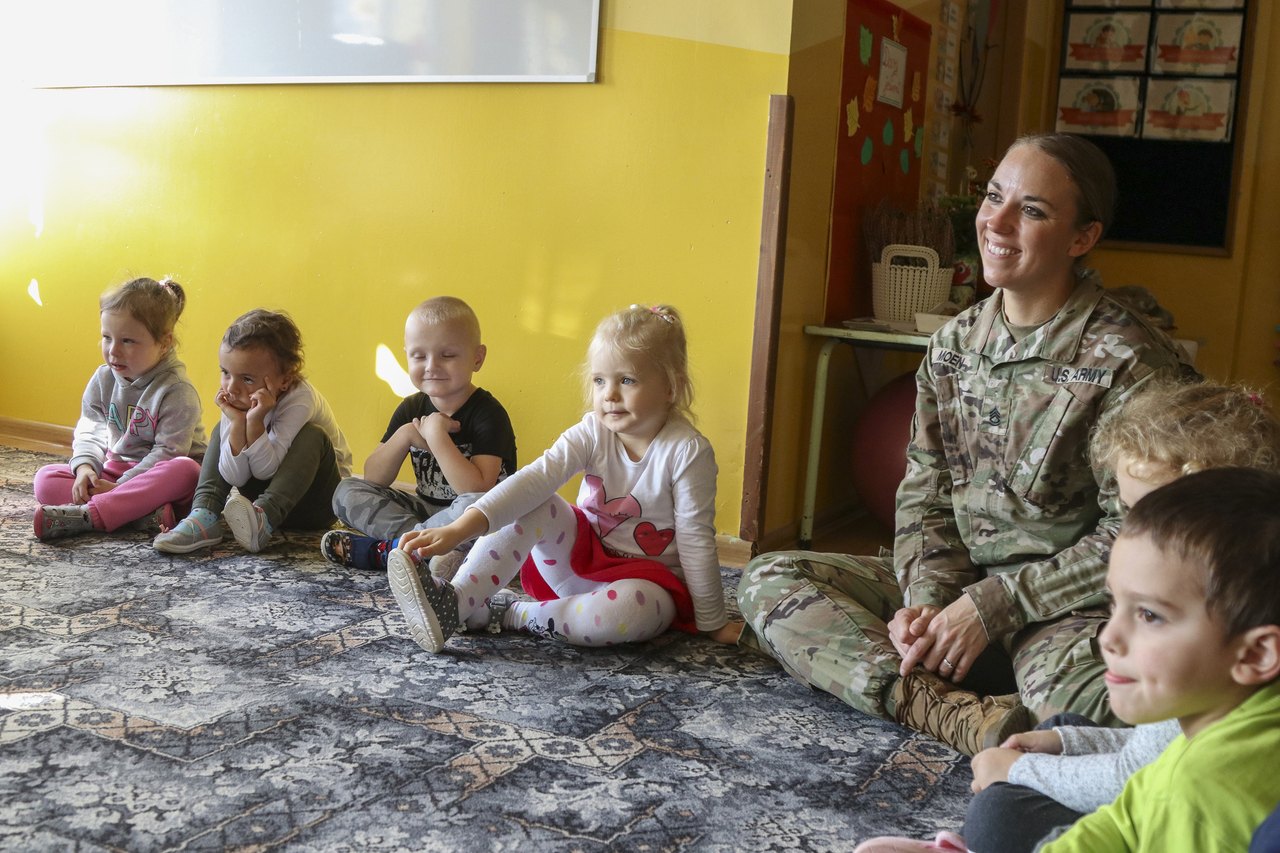
Visual AidA kindergarten class on the floor
Photograph taken in October 2018 of pre-kindergarten children sitting on the floor of their classroom while an adult talks with them. The Knowledge Bank explains that the word kindergarten means children’s garden, and that it was built on the gentle idea that five-year-olds learn best through play and doing rather than sitting still. It also says a young child takes words at their exact meaning. These are real children in a real classroom, not Miss Binney’s room, and Ramona is not among them. Notice that nobody is at a desk — at this age the floor is where the lesson happens.
Pre-kindergarten children in class, October 2018; photograph by Master Sgt. Ryan Matson, U.S. Army Reserve. Source: Wikimedia Commons, public domain.
kindergartenn.Ch.1
The first year of school for young children
“Ramona had waited her whole life to start kindergarten.”
presentn.Ch.1
A gift — OR the time right now
“Sit here for the present, said Miss Binney — and Ramona heard ‘gift.’”
patientadj.Ch.1
Able to wait calmly without complaining
“Ramona tried to be patient, but the present never came.”
temptingadj.Ch.1
So attractive you can hardly resist it
“Susan’s bouncy curls were terribly tempting.”
obeyv.Ch.1
To do what you are told
“Ramona meant to obey Miss Binney in everything.”
disappointedadj.Ch.1
Sad because a hope did not come true
“No gift by lunchtime — Ramona was deeply disappointed.”
imaginev.Ch.1
To picture something in your mind
“Ramona could imagine exactly what the present would be.”
curlsn.Ch.1
Hair that twists in springy rings
“Susan’s curls went boing when they bounced.”
chasev.Ch.1
To run after someone
“Ramona decided at once to chase Davy around the playground.”
misunderstandingn.Ch.1
Hearing or understanding something the wrong way
“One little misunderstanding kept Ramona glued to her seat.”
ⓘ The vocabulary words in this list are selected to help you understand and complete this workbook. Some may not appear verbatim in the original novel.
🧠Knowledge Bank question
1According to the Knowledge Bank, the word kindergarten was built on the idea that five-year-olds ___.Ch.1
2The word ‘present’ can mean a gift — or the time right now.Ch.1
3Something so attractive you can hardly resist it is ___.Ch.1
4If you are ‘patient,’ you complain loudly while you wait.Ch.1
5Fill in each blank with the correct word.Ch.1
Word choices:chaseobeyimaginecurls- some words will not be used
Ramona liked to Davy around the playground.
Susan’s springy bounced with every step.
6To do what you are told is to ___.Ch.1
7A ‘misunderstanding’ is hearing or understanding something the wrong way.Ch.1
8Sad because a hope did not come true is ___.Ch.1
9Fill in the blanks with the correct words.Ch.1
Word choices:presentpatienttemptingkindergarten- some words will not be used
Miss Binney said to sit here for the .
Ramona tried her best to be and wait.
10To picture something in your mind is to ___ it.Ch.1
Part 2
Comprehension
Show you understood what happens in Chapter 1.
🧠Knowledge Bank · Reading Between Ramona’s Lines
Narrative Logic · Reading Between Ramona’s Lines
Beverly Cleary shows you what Ramona does, but she rarely stops to explain what it means — that job is left to you. This is called making an inference: you gather the small clues an author gives and add them together, the way a detective studies a scene. When Ramona sits stiff and still, waiting and waiting, the book never says she misunderstood. You work it out, because you know the phrase means for now, while Ramona does not. That gap between what you know and what she knows is what makes the moment funny and warm. Reading the unspoken meaning behind a character’s actions is one of the most powerful habits you will ever build.
Visual AidThe book shows; the reader works out
Diagram for the Knowledge Bank on inference. The three numbered cards separate what the writing actually gives us from what it leaves the reader to supply: the sitting and waiting, the thing the book never says, and the conclusion you reach yourself. All three come from the Knowledge Bank’s own example. Notice that the last card is the only one the page never prints — that card is the reader’s work.
Making an inference from the clues, as set out in the Knowledge Bank. Drawn for Garden Heights Academy.
🧠Knowledge Bank question
1The Knowledge Bank says making an inference means ___.Ch.1
2What does Miss Binney say that Ramona misunderstands?Ch.1
3Ramona refuses to leave her seat because she is waiting for a gift.Ch.1
4What is special about Susan’s hair?Ch.1
5Write the numbers 1–5 in the boxes to show the correct order of events in Chapter 1. Number 1 = what happens first.Ch.1
Miss Binney tells Ramona to sit here for the present.
Miss Binney reads the class the steam-shovel story.
Ramona sets off for her first day of kindergarten.
Ramona’s great day ends with no gift after all.
Ramona notices Susan’s bouncy boing curls.
6Ramona thinks Miss Binney is a terrible teacher from the very first minute.Ch.1
7Which boy does Ramona decide to chase?Ch.1
8During story time, what does Ramona do?Ch.1
9Beezus walks with Ramona on her way to school.Ch.1
10Why does Ramona’s misunderstanding last so long?Ch.1
Part 3
Literary Elements
Understanding HOW and WHY Beverly Cleary tells the story across Chapter 1.
🧠Knowledge Bank · Seeing Through Ramona’s Eyes
Literary Technique · Seeing Through Ramona’s Eyes
This story is told in third-personlimited point of view. A narrator outside the story calls Ramona ‘she,’ yet the camera never leaves Ramona’s head — we see only what she notices, wants and feels. Because the viewpoint stays locked to a five-year-old, the world tilts to her scale: Susan’s bouncy curls become almost impossible to resist, and a simple rule can feel as large as a law. An older narrator might call Ramona naughty, but from inside her eyes every choice makes sense. Notice how much of your sympathy comes purely from whose eyes you are borrowing to look.
Third-person limited
The story says ‘she,’ but we only see what Ramona sees and feel what she feels.
Dramatic irony
Readers understand something a character doesn’t — we know what ‘for the present’ really means.
Character traits
The qualities that make a character themselves — Ramona’s curiosity, stubbornness, and big heart.
🧠Knowledge Bank question
1According to the Knowledge Bank, third-person limited point of view means the story ___.Ch.1
2Fill in the blank with the correct literary term.Ch.1
Word choices:ironytraitsrhymesetting- some words will not be used
When readers know what a character doesn’t, that is dramatic .
A character’s special qualities are their character .
3The ‘present’ mix-up is funny AND a little sad because readers ___.Ch.1
4Cleary needs many chapters before readers learn anything about Ramona’s personality.Ch.1
5Ramona staying glued to her seat all morning shows her trait of ___.Ch.1
6Cleary opens the book on the first day of kindergarten because it is ___.Ch.1
7In third-person limited, the narrator shares every character’s secret thoughts equally.Ch.1
8Fill in the blank with the correct literary term.Ch.1
Word choices:limitedomniscientfirstspoken- some words will not be used
A narrator who follows one character’s mind is third-person .
9The steam-shovel question shows that Ramona’s curiosity is ___.Ch.1
10By ending the great day with no gift, Cleary teaches readers to expect a book where ___.Ch.1
Part 4
Think Deeper
Four deeper challenges — no single-word recall. Read, weigh the evidence, and reason it out.
🧠Knowledge Bank · When Big Feelings Meet a Big New Place
Ethical Reasoning · When Big Feelings Meet a Big New Place
Starting school is one of the biggest days in a young child’s life, and Ramona arrives bursting with hope to be seen as grown-up and good. Yet a five-year-old feels emotions at full volume while still building the brakes to steer them. So when Susan’s spring-like curls are too tempting, Ramona reaches out and shouts, and a happy morning wobbles. She is not a bad child; her strong feelings have raced ahead of her self-control. This is the real work of the early school years — not sitting still, but learning to pause between a feeling and an action. Patience is a skill nobody is born with; it is grown through steady practice.
Think back over the chapter. A girl who has waited her whole life for this day sits down in her very own seat, in her very own classroom, beside a teacher she already loves. The teacher says one small sentence and walks away. And from that moment, while other children sing and play, the girl guards her chair like a treasure chest — because somewhere between her ears and her hopes, the words ‘for the present’ turned into a promise with a bow on it.
Original passage written for Garden Heights — not a quotation from the novel.
1Claim: “Ramona’s seat-guarding came from love and logic, not naughtiness.” — choose the two details that best prove it.Claim & Evidence
2What Miss Binney meant, or What Ramona heard? Tap each detail to sort it — tap again to switch sides. You can keep tapping to change your answer.Sort into two
◄ What Miss Binney meantWhat Ramona heard ►
3Match each cause to its result. For each cause, pick its result.Cause & Effect
Miss Binney says ‘sit here for the present’→
Susan’s curls bounce boing past Ramona→
Miss Binney reads the steam-shovel story→
No present has appeared by day’s end→
🧠Knowledge Bank question
4Fill both blanks to complete the reasoning.Build the Argument
The Knowledge Bank explains Ramona’s grab at Susan’s curls by saying a five-year-old , while still .
Part 5
Standardized Test
Reading passage · Why Words Can Trick You · SAT & TOEFL-style practice
Read the passage — the highlighted words are tested — then answer. Tap an answer, then tap it again to confirm.
SATCentral Ideas — the passage's main point
SATWords in Context — a word's meaning in this passage
SATInference — a conclusion the passage implies
SATText Connections — how two parts of the text relate
TOEFLFactual Information — a fact stated in the passage
TOEFLRhetorical Purpose — why the author included a detail
How Young Children Misread Words
English is full of little traps. Many ordinary words carry two meanings at once: a present can be a gift, or it can mean right now; a bat can fly through a cave or hit a baseball. Scientists who study language say listeners usually escape these traps without noticing, because we use context — the other words around a word — to pick the meaning that fits. Young children have a harder time. A five-year-old often knows only one meaning of a word, and so takes it literally, exactly as it sounds. That is not carelessness; it is a mind still collecting meanings, one by one. A grown-up who understands this can be patient instead of annoyed. Adults forget how strange their own sentences can be, and a cheerful phrase tossed over a shoulder can leave a child holding the wrong picture entirely. The result is a misunderstanding that belongs to nobody in particular. Picture a small girl sitting bolt upright in a classroom chair, refusing to move, waiting all morning for a gift that was never offered.
Original passage written for Garden Heights — not a quotation from the novel.
1What is the main idea of the passage?SAT · Central Ideas
2In the passage, a present is ___.SAT · Words in Context
3According to the passage, how do most listeners escape word traps?TOEFL · Factual Information
4In the passage, a patient grown-up is ___.SAT · Words in Context
5Why do young children often fall into word traps?TOEFL · Factual Information
6The passage says a child’s literal listening is ___.SAT · Inference
7In the passage, a misunderstanding is ___.SAT · Words in Context
8The passage uses the word ‘bat’ to show ___.TOEFL · Rhetorical Purpose
9The girl guarding the chair at the end of the passage is ___.SAT · Inference
10Which Chapter 1 moment does this passage BEST explain?SAT · Text Connections
Part 6 · Optional
Creative Writing
A bonus challenge to practice your English. Take your time and have fun with it.
About This Section
This writing task is optional and is not part of your auto-graded score. The feedback below checks only the basics — length, spelling, and grammar — not whether your ideas are right or wrong. It is meant for classroom discussion and creative practice, so feel free to use your imagination!
Writing Task — Part 1 “The Word That Tricked Me”
Ramona hears ‘present’ and waits all morning for a gift. Write about a time YOU misunderstood something — a word, a rule, a joke — and what happened because of it. Tell what you heard, what was really meant, and how you found out the truth, in 6–10 sentences. End with one line about how the mix-up felt once you could laugh at it.
You can start with: “I was absolutely sure I had heard it right, and that was the problem...”
0 / 40 words minimum
🗣 Teach It · Just for Fun (optional)
No right or wrong — close the screen and tell someone nearby what happened in this part. Can’t find anyone? Tell yourself out loud. The moment you teach it, you truly understand it.
Part 1 Complete!
You finished Chapter 1 of Ramona the Pest.
Here are your auto-graded results:
-
points out of 100
Teach it to someone
The best last step is to teach it. In your own words, explain what happened — retell a favorite scene, teach a character’s big choice, or sum up the main idea for a parent, friend, or classmate. When you can teach it clearly, you truly own it.
Independent study guide by Garden Heights. Not affiliated with or endorsed by Beverly Cleary. Contains original analysis only; no text from the novel is reproduced. Reference text: This workbook follows Beverly Cleary’s classic text (the standard Puffin edition sold worldwide). Revised 2023 UK editions change some wording and may not match the vocabulary studied here.
SAT® is a registered trademark of College Board, which is not affiliated with, and does not endorse, these materials. TOEFL® is a registered trademark of ETS. These materials are not endorsed or approved by ETS. Garden Heights is an independent provider of test-style reading practice.