New here? Just sign up with Google — your account includes Matilda, our gift book, forever.
Ramona the Pest · Garden Heights
Part 4
for Ramona the Pest · Part 4 · Chapter 4
8 Parts40 min
What Happens in Part 4
Disaster: Ramona arrives at school to find that Miss Binney is absent — and a stranger, a substitute teacher, will run kindergarten in her place. Ramona’s response is pure Ramona-logic: if Miss Binney is not at school, then Ramona will not be either. She hides behind the trash cans, with only Ribsy — Henry Huggins’s dog — for company, and refuses to go in. It is Henry Huggins himself, the big traffic boy who guards the school corner, who discovers the runaway and marches her back where she belongs. Inside, the principal, Miss Mullen, introduces the substitute, Mrs. Wilcox — who turns out to be perfectly nice, and even lets the class draw instead of doing regular seat work. Somewhere on Ramona’s paper, a row of whiskered Qs marches past, and Mrs. Wilcox, seeing only cats, has no idea she is looking at the finest last-name practice in the room. Kindergarten, it turns out, survives for one day without Miss Binney. Ramona is not so sure she does.
Ramona-logic, loyalty, and a point of view that misreads cats
Cross-Curricular
Why a favorite teacher’s absence feels enormous, and the hardest job in school
Chapter Summary
Ch.
What happens
4
The Substitute — Miss Binney is absent; Ramona hides behind the trash cans with Ribsy until traffic-boy Henry Huggins marches her in to meet Mrs. Wilcox — who lets the class draw, and mistakes Ramona’s Qs for cats.
Part 1
Vocabulary
Study 10 key words from Chapter 4, then answer each question.
🧠Knowledge Bank · The Traffic Boy on the Corner
Lexicology · The Traffic Boy on the Corner
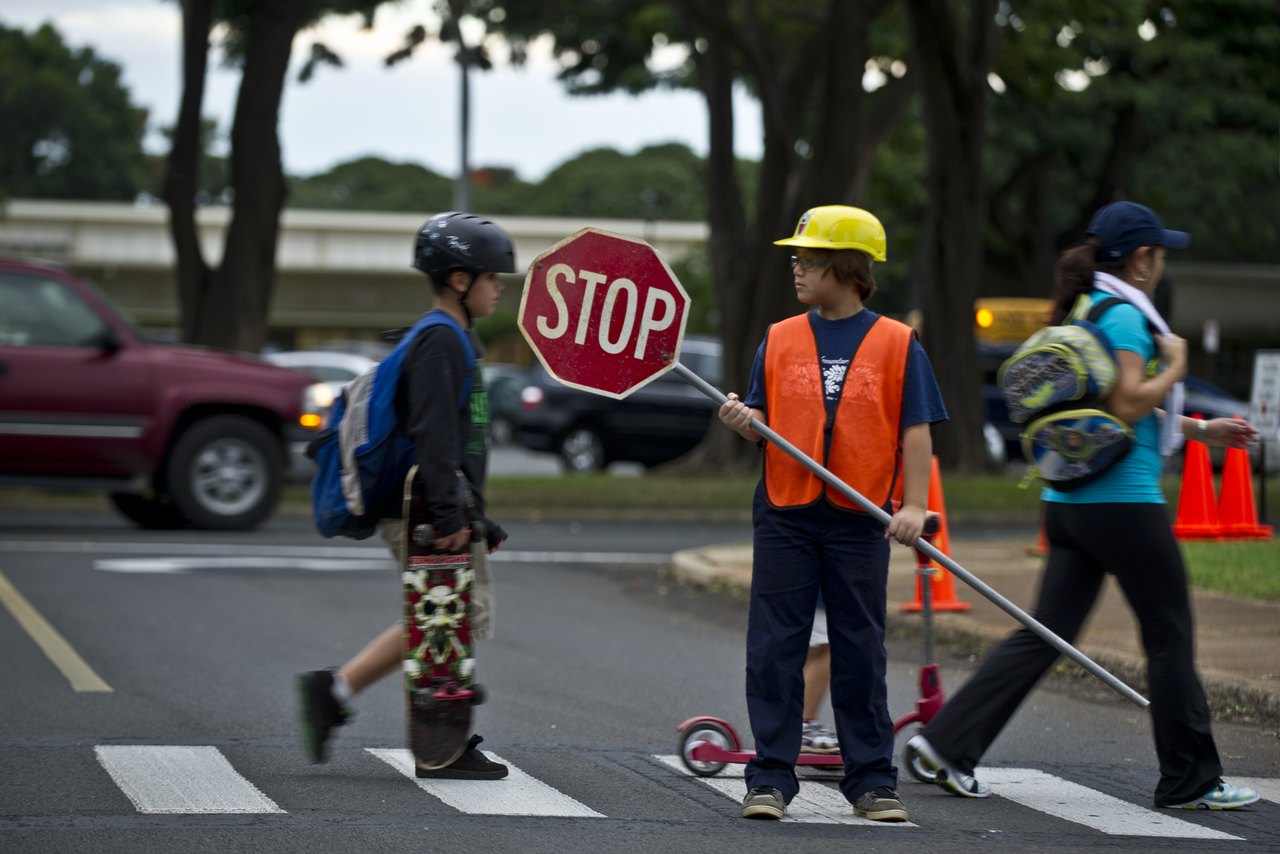
In the 1950s and 1960s, most children walked to their neighborhood school, and older students were given a proud, serious job: the school safetypatrol. A patrol boy wore a white belt across his chest and a shiny badge, and he stood at the busy corner helping the youngest children cross. Because towns were built to be walked and families lived close to the school, this everyday guardian was a familiar figure to little ones like Ramona. Being chosen for the patrol was an honor, a first taste of responsibility. Knowing this helps you see why the corner and the boy who guards it matter so much in a young walker’s world of trust.
Visual AidThe patrol on the corner
Photograph taken in January 2012 of an elementary school safety patrol holding a stop sign while classmates cross at a marked crossing. The Knowledge Bank explains that in the 1950s and 1960s most children walked to their neighborhood school, and that older students were given a proud, serious job on the school safety patrol: a white belt across the chest, a badge, and a post at the busy corner helping the youngest children across. The belt and badge have become a vest and a sign, but the job is the same one. This is a modern American school, not Ramona’s.
Elementary school junior police officers on crossing duty, January 2012; photograph by Tech. Sgt. Michael Holzworth, U.S. Air Force. Source: Wikimedia Commons, public domain.
absentadj.Ch.4
Not present; away
“Miss Binney was absent, and the day went wrong at once.”
substituten.Ch.4
A person who fills in for someone else
“Mrs. Wilcox was the substitute for Miss Binney.”
hidev.Ch.4
To keep out of sight
“Ramona chose to hide behind the trash cans.”
refusev.Ch.4
To say firmly that you will not
“She would refuse to go in without her teacher.”
discoverv.Ch.4
To find something or someone
“Henry was the one to discover the runaway.”
guardv.Ch.4
To watch over and keep safe
“The traffic boy’s job is to guard the crossing.”
principaln.Ch.4
The leader of a school
“Miss Mullen, the principal, introduced the substitute.”
loyaladj.Ch.4
Faithfully sticking by someone
“Ramona stayed loyal to Miss Binney all day.”
companyn.Ch.4
Someone who is with you
“Behind the trash cans, Ribsy was her only company.”
survivev.Ch.4
To get through something difficult
“Kindergarten managed to survive one day without Miss Binney.”
ⓘ The vocabulary words in this list are selected to help you understand and complete this workbook. Some may not appear verbatim in the original novel.
🧠Knowledge Bank question
1According to the Knowledge Bank, a school safety patrol boy in the 1950s ___.Ch.4
2A ‘substitute’ is a person who fills in for someone else.Ch.4
3To keep out of sight is to ___.Ch.4
4The ‘principal’ is the leader of a school.Ch.4
5Fill in each blank with the correct word.Ch.4
Word choices:guardcompanydiscoverrefuse- some words will not be used
Henry’s job was to the school crossing.
Ribsy the dog kept Ramona behind the cans.
6To find something or someone is to ___ them.Ch.4
7Someone ‘loyal’ quickly forgets the people they care about.Ch.4
8To get through something difficult is to ___ it.Ch.4
9Fill in the blanks with the correct words.Ch.4
Word choices:absentsubstituteloyalhide- some words will not be used
With Miss Binney , nothing felt right.
Mrs. Wilcox, the , turned out to be kind.
10To say firmly that you will not do something is to ___.Ch.4
Part 2
Comprehension
Show you understood what happens in Chapter 4.
🧠Knowledge Bank · Measuring One Against Another
Narrative Logic · Measuring One Against Another
A powerful reading skill is to compare and contrast — to hold two people or moments side by side and notice how they are alike and how they differ. This chapter almost begs you to use it, because an unfamiliar teacher stands where the beloved Miss Binney usually stands. Since you know Miss Binney’s warmth, you naturally measure the substitute against her, and every small difference stands out to you as it does to Ramona. Comparing this way reveals what a character truly values by showing, without explanation, what they miss. It works because the noticing is done by the reader rather than the author.
Visual AidMeasuring one against the other
Diagram for the Knowledge Bank on comparing and contrasting. Card 1 is the teacher Ramona knows and card 2 is the one actually standing there, with arrows running both ways because the Knowledge Bank says the reader measures each against the other. The words in the cards are the Knowledge Bank’s. Notice that neither card says the substitute is unkind — the strangeness comes from the comparison, not from her.
Comparing the familiar teacher with the substitute, as described in the Knowledge Bank. Drawn for Garden Heights Academy.
🧠Knowledge Bank question
1The Knowledge Bank says this chapter almost begs a reader to compare and contrast because ___.Ch.4
2What does Ramona decide when she learns about the substitute?Ch.4
3Ramona hides behind the trash cans with Ribsy the dog.Ch.4
4Who finds Ramona and brings her back to school?Ch.4
5Write the numbers 1–5 in the boxes to show the correct order of events in Chapter 4. Number 1 = what happens first.Ch.4
Miss Mullen introduces Mrs. Wilcox to the class.
Ramona learns that Miss Binney is absent.
The class draws, and Ramona’s Qs pass for cats.
She hides behind the trash cans with Ribsy.
Henry Huggins discovers her and walks her in.
6Mrs. Wilcox turns out to be cruel and strict with the class.Ch.4
7What does Mrs. Wilcox let the class do instead of regular seat work?Ch.4
8What does Mrs. Wilcox think Ramona’s Qs are?Ch.4
9Henry Huggins works as the traffic boy at the school corner.Ch.4
10What does Ramona’s trash-can protest REALLY show about her?Ch.4
Part 3
Literary Elements
Understanding HOW and WHY Beverly Cleary tells the story across Chapter 4.
🧠Knowledge Bank · Why the Substitute Seems So Strange
Literary Technique · Why the Substitute Seems So Strange
Remember that we see this whole story from inside Ramona’s head, through third-personlimited point of view. That single choice shapes how the substitute teacher appears to us. Because we are locked to Ramona’s young viewpoint, the new teacher feels strange and a little alarming — not because she is unkind, but because she is not Miss Binney. A grown-up in the same room would likely see an ordinary, friendly adult doing her best. The gap between those views is the point: point of view does not just report a scene, it colors it. Noticing whose eyes you are borrowing is the whole skill of reading a limited viewpoint.
Actions over words
Feelings shown through what characters DO — a hiding place can be a love letter.
Point of view
What you see depends on what you know — a stranger sees cats; readers see Quimby practice.
Gentle irony
The feared disaster turns out fine — the substitute is kind, and the boycott was for nothing.
🧠Knowledge Bank question
1According to the Knowledge Bank, the substitute seems strange to us because ___.Ch.4
2Fill in the blank with the correct literary term.Ch.4
Word choices:viewironysimilestanza- some words will not be used
What a character sees depends on their point of .
A feared disaster turning out fine is gentle .
3Mrs. Wilcox sees cats instead of Qs because ___.Ch.4
4The chapter’s irony is that the substitute Ramona feared turns out to be kind.Ch.4
5Henry marching Ramona back to school works in the story as ___.Ch.4
6The whiskered Qs returning in this chapter is an example of ___.Ch.4
7‘Actions over words’ means characters explain their feelings in long speeches.Ch.4
8Fill in the blank with the correct literary term.Ch.4
Word choices:actionswordstitlessounds- some words will not be used
Cleary shows feeling through instead of speeches.
9By making the substitute kind, Cleary teaches readers — and Ramona — that ___.Ch.4
10After this chapter, readers know that when Ramona seems naughtiest, they should look for ___.Ch.4
Part 4
Think Deeper
Four deeper challenges — no single-word recall. Read, weigh the evidence, and reason it out.
🧠Knowledge Bank · When Something Familiar Disappears
Ethical Reasoning · When Something Familiar Disappears
Young children lean on routine the way a climber leans on a rope. A familiar face, a known schedule, the same kind teacher each morning — these quietly tell a child that the world is safe and can be counted on. So when Miss Binney is suddenly gone and a stranger stands in her place, Ramona’s whole day tilts, and a change that seems tiny to an adult feels enormous to her. This is not weakness; it is how a small person’s sense of security works. Learning that the world can shift and then settle again is one of childhood’s hardest lessons, a quiet early practice in resilience.
Think back over the chapter. A girl arrives at school carrying her usual morning — and finds a stranger standing where her teacher belongs. So she takes her morning back outside and sets up her protest headquarters behind the trash cans, with a large friendly dog as her entire staff. It takes a traffic boy’s calm authority to march her indoors — where the feared stranger turns out to be kind, hands out drawing paper, and admires a row of whiskered cats that are not, in fact, cats at all.
Original passage written for Garden Heights — not a quotation from the novel.
1Claim: “Ramona’s hiding was an act of loyalty, not an escape from school.” — choose the two details that best prove it.Claim & Evidence
2What Ramona imagines, or What actually happens? Tap each detail to sort it — tap again to switch sides. You can keep tapping to change your answer.Sort into two
◄ What Ramona imaginesWhat actually happens ►
3Match each cause to its result. For each cause, pick its result.Cause & Effect
Miss Binney is absent without warning→
Ramona refuses to enter the school→
Henry spots the runaway from his corner→
Mrs. Wilcox swaps seat work for drawing→
🧠Knowledge Bank question
4Fill both blanks to complete the reasoning.Build the Argument
The Knowledge Bank compares a young child’s routine to , which is why a change that seems tiny to an adult .
Part 5
Standardized Test
Reading passage · The Hardest Job in School · SAT & TOEFL-style practice
Read the passage — the highlighted words are tested — then answer. Tap an answer, then tap it again to confirm.
SATCentral Ideas — the passage's main point
SATWords in Context — a word's meaning in this passage
SATInference — a conclusion the passage implies
SATText Connections — how two parts of the text relate
TOEFLFactual Information — a fact stated in the passage
TOEFLInsert Text — where a sentence best fits
A Substitute Teacher's Hard Job
Imagine starting a new job where you know nobody’s name, the plans on the desk were written by someone else, and your twenty-five bosses are all five years old. That is a substitute teacher’s morning. Substitutes step in when the regular teacher is absent, and their first battle is with the classroom’s routine — the familiar order of the day that makes children feel safe. Students notice instantly that the routine has a stranger in it, and some test the newcomer with wiggles, tricks, or — in rare, dramatic cases — a decision to hide behind the trash cans. Experienced substitutes come prepared. They choose simpler activities that any class can enjoy, such as drawing. They stay calm and friendly, because a temporary teacher — one there for just a day — cannot spend a week earning trust; kindness has to work fast. And they ask students to cooperate, to work together with them, rather than demanding instant obedience from strangers. Teachers say substituting is the hardest job in school, and the best proof is a quiet one: when a substitute’s day goes smoothly, hardly anyone notices how much skill that took.
Original passage written for Garden Heights — not a quotation from the novel.
1What is the main idea of the passage?SAT · Central Ideas
2In the passage, a substitute is ___.SAT · Words in Context
3Why do children feel unsettled when a substitute arrives?TOEFL · Factual Information
4According to the passage, how do some students ‘test’ a substitute?TOEFL · Factual Information
5In the passage, a teacher who is absent is ___.SAT · Words in Context
6Why do experienced substitutes choose simpler activities like drawing?TOEFL · Factual Information
7In the passage, to hide is to ___.SAT · Words in Context
8What is the ‘quiet proof’ that substituting takes skill?SAT · Inference
9The ‘protest behind the trash cans’ mentioned in the passage refers to ___.SAT · Text Connections
10Insert Text (TOEFL). Look at the four squares [1]–[4] in the excerpt below. They show where this sentence could be added: “That trust is the invisible tool the regular teacher has and the visitor must do without.”
A regular teacher spends all September learning names, habits, and worries. [1] By winter, the class trusts her so completely that a single look can settle a room. [2] A substitute arrives with none of this history and must borrow order from kindness instead. [3] That is why the wisest substitutes reach first for warmth, and only later for rules. [4]
Where would the sentence fit best?TOEFL · Insert Text
Part 6 · Optional
Creative Writing
A bonus challenge to practice your English. Take your time and have fun with it.
About This Section
This writing task is optional and is not part of your auto-graded score. The feedback below checks only the basics — length, spelling, and grammar — not whether your ideas are right or wrong. It is meant for classroom discussion and creative practice, so feel free to use your imagination!
Writing Task — Part 4 “The Day the Routine Broke”
Ramona’s day fell apart the moment her routine changed. Write about a day when YOUR routine broke — a different teacher, a moved classroom, a canceled plan. Tell what changed, how it felt at first, and how the day actually turned out, in 6–10 sentences. End with one line of advice for anyone facing a surprise substitute.
You can start with: “The moment I walked in, I knew something about the day was different...”
0 / 40 words minimum
🗣 Teach It · Just for Fun (optional)
No right or wrong — close the screen and tell someone nearby what happened in this part. Can’t find anyone? Tell yourself out loud. The moment you teach it, you truly understand it.
Part 4 Complete!
You finished Chapter 4 of Ramona the Pest.
Here are your auto-graded results:
-
points out of 100
Teach it to someone
The best last step is to teach it. In your own words, explain what happened — retell a favorite scene, teach a character’s big choice, or sum up the main idea for a parent, friend, or classmate. When you can teach it clearly, you truly own it.
Independent study guide by Garden Heights. Not affiliated with or endorsed by Beverly Cleary. Contains original analysis only; no text from the novel is reproduced. Reference text: This workbook follows Beverly Cleary’s classic text (the standard Puffin edition sold worldwide). Revised 2023 UK editions change some wording and may not match the vocabulary studied here.
SAT® is a registered trademark of College Board, which is not affiliated with, and does not endorse, these materials. TOEFL® is a registered trademark of ETS. These materials are not endorsed or approved by ETS. Garden Heights is an independent provider of test-style reading practice.