New here? Just sign up with Google — your account includes Matilda, our gift book, forever.
Ramona the Pest · Garden Heights
Part 7
for Ramona the Pest · Part 7 · Chapter 7
8 Parts40 min
What Happens in Part 7
Some days tip over one domino at a time. Ramona’s begins with a genuine wonder: her first loose tooth comes out at school — a badge of growing up! — and Miss Binney keeps it safely for her. Then comes Susan, and the boing curls, and one word too many: Susan calls Ramona a pest. A PEST! Ramona — who has battled that word all year — answers the only way her hands know how: she pulls those tempting curls. And this time everything is different. Miss Binney, patient Miss Binney, tells Ramona that she cannot come back to kindergarten until she can promise to leave Susan’s curls alone — and Ramona, heartbroken and stubborn in equal measure, cannot make herself promise. She walks home a kindergarten dropout, with no school, no Miss Binney — and, she suddenly remembers, no tooth: it is still at school, in the keeping of the teacher she is sure no longer likes her.
The climax of the curls, and a title that finally lands
Cross-Curricular
Why baby teeth fall out, and what the word ‘pest’ really does
Chapter Summary
Ch.
What happens
7
The Day Things Went Wrong — Ramona’s first tooth comes out (Miss Binney keeps it); Susan’s ‘pest’ sparks one curl-pull too many; and Miss Binney bars Ramona from kindergarten until she can promise to stop — a promise Ramona cannot make.
Part 1
Vocabulary
Study 10 key words from Chapter 7, then answer each question.
🧠Knowledge Bank · The Milestone of a Lost Tooth
Lexicology · The Milestone of a Lost Tooth
Somewhere around the ages of five and six, children begin to lose their baby teeth, and the first wobbly tooth to fall out is a genuine milestone. To a young child it is thrilling proof, right there in the palm of the hand, that she is truly growing bigger. Because so much of being little means waiting to be big, this small, visible sign matters enormously. Many families make it magical with the tooth fairy, who trades a coin for the tooth left under a pillow. Understanding how much a lost tooth means helps you feel Ramona’s pride, and see that her body is quietly carrying her forward into someone bigger.
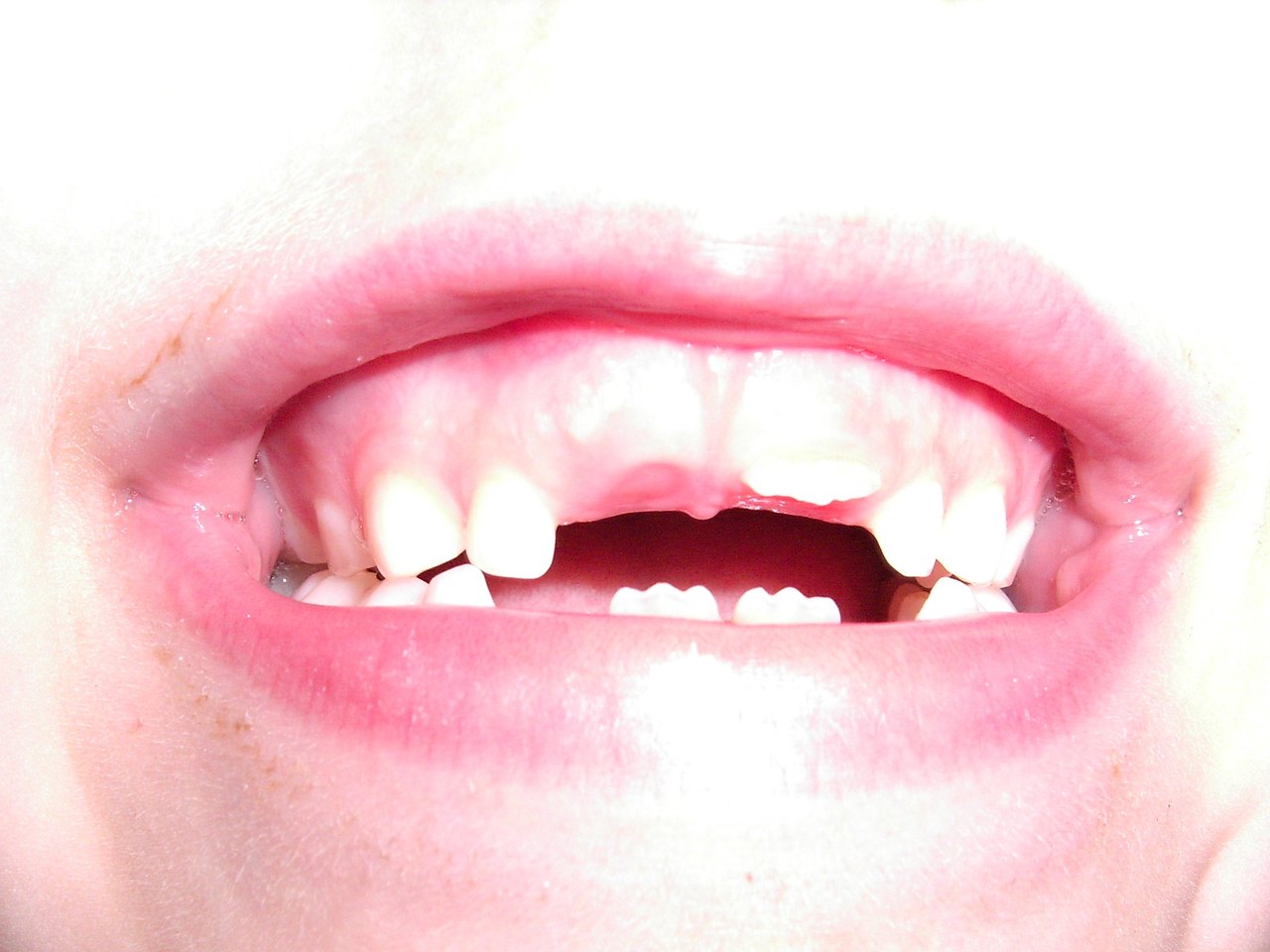
Visual AidBaby teeth giving way to adult ones
Photograph taken in 2009 of a child’s mouth during the changeover from baby teeth to adult ones. The Knowledge Bank explains that around the ages of five and six children begin to lose their primary teeth, and that the first wobbly tooth to fall out is a genuine milestone — thrilling proof, right there in the palm of the hand, that a child is truly growing bigger. Compare the sizes: the small teeth are the first set, and the larger one pushing up behind is the tooth that will stay. This is a medical photograph of a real child, not anyone in the book.
A child’s deciduous and erupting permanent teeth, 2009; photograph by Sebastian Wallroth. Source: Wikimedia Commons, public domain.
looseadj.Ch.7
Not firmly attached; wiggly
“Her first loose tooth finally came out at school.”
milestonen.Ch.7
An important marker of growing up
“A lost tooth is a true kindergarten milestone.”
tempern.Ch.7
The anger that rises when you are pushed too far
“Susan’s word lit Ramona’s temper like a match.”
insultn.Ch.7
A word meant to hurt someone
“To Ramona, ‘pest’ was the worst insult of all.”
promisev.Ch.7
To say truly that you will or will not do something
“Miss Binney asked Ramona to promise to stop.”
dropoutn.Ch.7
A person who leaves school
“Ramona walked home a kindergarten dropout.”
heartbrokenadj.Ch.7
Filled with deep sadness
“No school and no Miss Binney left Ramona heartbroken.”
stubbornadj.Ch.7
Refusing to change your mind
“Too stubborn to promise, too sad to stay.”
behavev.Ch.7
To act properly
“Kindergarten asks everyone to behave — even Ramona.”
banishv.Ch.7
To send someone away from a place
“One pulled curl was enough to banish her from class.”
ⓘ The vocabulary words in this list are selected to help you understand and complete this workbook. Some may not appear verbatim in the original novel.
🧠Knowledge Bank question
1According to the Knowledge Bank, a first lost tooth matters so much to a young child because ___.Ch.7
2A ‘milestone’ is an important marker of growing up.Ch.7
3A word meant to hurt someone is an ___.Ch.7
4A ‘dropout’ is a person who leaves school.Ch.7
5Fill in each blank with the correct word.Ch.7
Word choices:temperpromisebehaveloose- some words will not be used
Susan’s word set off Ramona’s .
Miss Binney asked her to to leave the curls alone.
6Refusing to change your mind is being ___.Ch.7
7Someone ‘heartbroken’ is filled with joy and excitement.Ch.7
8To send someone away from a place is to ___ them.Ch.7
9Fill in the blanks with the correct words.Ch.7
Word choices:heartbrokendropoutinsultmilestone- some words will not be used
Losing a first tooth is a childhood .
Ramona walked home a kindergarten .
10The anger that rises when you are pushed too far is your ___.Ch.7
Part 2
Comprehension
Show you understood what happens in Chapter 7.
🧠Knowledge Bank · Adding the Clues Together
Narrative Logic · Adding the Clues Together
To draw a conclusion is to take several clues from the page, mix them with what you know about life, and arrive at an understanding the author never states outright. It is close to inference but reaches further, forming a judgment about why things are as they are. On this difficult day, Ramona meets one small trouble after another, and no sentence announces why she feels miserable. Instead you gather the scattered moments and add them up yourself. Because the pieces point the same direction, you can tell how heavy her heart has grown. Careful readers do not wait to be told; they weigh the evidence and reach a thoughtful conclusion.
🧠Knowledge Bank question
1The Knowledge Bank says drawing a conclusion reaches further than an inference because it ___.Ch.7
2Who keeps Ramona’s tooth safe?Ch.7
3Susan calls Ramona a pest.Ch.7
4How does Ramona respond to Susan’s insult?Ch.7
5Write the numbers 1–5 in the boxes to show the correct order of events in Chapter 7. Number 1 = what happens first.Ch.7
Susan calls Ramona a pest.
Miss Binney puts the tooth away for safekeeping.
Miss Binney says Ramona may not return until she can stop.
Ramona pulls Susan’s curls.
Ramona loses a tooth in class.
6Miss Binney says Ramona may return to kindergarten whenever she feels ready, no conditions.Ch.7
7Why can’t Ramona simply promise to stop?Ch.7
8What does Ramona call herself as she walks home?Ch.7
9Ramona remembers that her tooth is still at school with Miss Binney.Ch.7
10Why does the ‘pest’ insult hit Ramona harder than any other word could?Ch.7
Part 3
Literary Elements
Understanding HOW and WHY Beverly Cleary tells the story across Chapter 7.
🧠Knowledge Bank · The Story’s Highest Point
Literary Technique · The Story’s Highest Point
Every well-shaped story rises toward a climax — the moment of highest tension, where feelings run strongest and something important finally turns. Think of a story as a hill: the early events climb steadily, and the climax is the very top, just before everything tips toward its ending. In this chapter, Ramona’s troubles have been stacking higher, and here they reach their peak. Because Cleary has patiently built the pressure across the whole book, this bad day lands with real force instead of feeling small. Learning to feel a story reach its boiling point helps you understand why a single scene can carry the heaviest weight.
Visual AidA story climbs to its highest point
Diagram for the Knowledge Bank on the climax. The numbered points follow the hill the Knowledge Bank describes: the early troubles climb steadily, point 4 is the top where feelings run strongest, and the line then tips toward the ending. The shape is the Knowledge Bank’s image, not a measurement of the chapter. Notice that the climb takes three points and the fall takes one — a story spends far longer rising than it does coming down.
Rising action and the climax as described in the Knowledge Bank. Drawn for Garden Heights Academy.
Climax
The story’s highest point of tension — one pulled curl, and kindergarten hangs in the balance.
Best-worst structure
Placing the day’s triumph and disaster side by side — a tooth gained, a school lost.
Title payoff
The book’s name finally lands with full weight — who decides whether Ramona is a pest?
🧠Knowledge Bank question
1According to the Knowledge Bank, the climax of a story is ___.Ch.7
2Fill in the blank with the correct literary term.Ch.7
Word choices:climaxpayoffprologuemeter- some words will not be used
The highest point of tension is the .
A planted detail landing at last is a .
3The curls Ramona finally pulls were planted in which chapter?Ch.7
4Putting the day’s best moment and worst moment side by side makes both feel stronger.Ch.7
5Miss Binney’s verdict lands so hard because she has been ___.Ch.7
6Ramona’s refusal to promise shows a surprising kind of ___.Ch.7
7The book’s title question — is Ramona really a pest? — comes to a head in this chapter.Ch.7
8Fill in the blank with the correct literary term.Ch.7
Word choices:structuredialoguecostumechorus- some words will not be used
The side-by-side placing of triumph and disaster is the chapter’s .
9Leaving the tooth in Miss Binney’s keeping is masterful plotting because it ___.Ch.7
10Cleary lets the day begin WONDERFULLY before it breaks in order to ___.Ch.7
Part 4
Think Deeper
Four deeper challenges — no single-word recall. Read, weigh the evidence, and reason it out.
🧠Knowledge Bank · The Weight of the Word ‘Pest’
Ethical Reasoning · The Weight of the Word ‘Pest’
Words can land on a child with surprising force, and the small word pest lands hard on Ramona. She almost never means to be a bother; her mishaps come from eagerness, curiosity and big feelings she cannot yet steer. But a five-year-old does not easily separate a careless label from a true statement about who she is, so being called a pest wounds her, because for a moment she fears it might be true. This is the quiet heartache of being misunderstood. Ramona reminds us to look past a child’s messy actions to the hopeful intentions underneath, and to choose our words with care.
Think back over the chapter. A tooth — a first tooth, a badge of bigness — comes out in the middle of a school morning and is handed, glowing, to the most trusted keeper in the room. Hours later, a word flies across the classroom, four letters long and aimed perfectly. Two hands answer it before their owner can vote. And by the walk home, a girl who owns a witch costume, a worm ring, and the finest cat-Qs in kindergarten owns one thing more: a title she never wanted, in a school she is no longer allowed to enter.
Original passage written for Garden Heights — not a quotation from the novel.
1Claim: “Ramona’s refusal to promise came from honesty, not defiance.” — choose the two details that best prove it.Claim & Evidence
2Accidents of the day, or Choices of the day? Tap each detail to sort it — tap again to switch sides. You can keep tapping to change your answer.Sort into two
◄ Accidents of the dayChoices of the day ►
3Match each cause to its result. For each cause, pick its result.Cause & Effect
Susan flings the word ‘pest’→
The curls are pulled one time too many→
Ramona cannot promise to stop→
The lost tooth stays in the teacher’s desk→
🧠Knowledge Bank question
4Fill both blanks to complete the reasoning.Build the Argument
The Knowledge Bank says the word pest wounds Ramona because a five-year-old , even though her mishaps really come from .
Part 5
Standardized Test
Reading passage · The Secret Life of Baby Teeth · SAT & TOEFL-style practice
Read the passage — the highlighted words are tested — then answer. Tap an answer, then tap it again to confirm.
SATCentral Ideas — the passage's main point
SATWords in Context — a word's meaning in this passage
SATText Connections — how two parts of the text relate
TOEFLFactual Information — a fact stated in the passage
The Secret Timeline of Baby Teeth
The tooth that wiggles loose in kindergarten has been working in secret for years. Humans grow two full sets of teeth: twenty small primary teeth, the baby teeth, that appear before age three, and thirty-two adult teeth waiting quietly in the jaw below. Around age five or six, the changeover begins. As an adult tooth rises, it presses on the baby tooth’s root, and the body slowly dissolves that root away until the little tooth is held by almost nothing. Then comes the famous wiggle, and one day, often mid-apple or mid-recess, the tooth simply lets go. A stubborn one may hang on for days, refusing to drop however much it is pushed. There is usually little blood and less pain, because the body planned this exit for years. Dentists say the timing is wonderfully predictable: the bottom front teeth almost always go first, right around the kindergarten year. Cultures everywhere celebrate the milestone: teeth left for fairies or mice, tossed on rooftops, or kept safe in tiny envelopes by teachers who know precious cargo when they see it. The tooth is small, but what it announces is not.
Original passage written for Garden Heights — not a quotation from the novel.
1What is the main idea of the passage?SAT · Central Ideas
2In the passage, a loose tooth is ___.SAT · Words in Context
3What makes a baby tooth finally come loose?TOEFL · Factual Information
4In the passage, a stubborn tooth is one that ___.SAT · Words in Context
5Why is there usually little pain when a baby tooth comes out?TOEFL · Factual Information
6In the passage, a milestone is ___.SAT · Words in Context
7Which teeth usually fall out first?TOEFL · Factual Information
8How many adult teeth wait in the jaw, according to the passage?TOEFL · Factual Information
9The ‘teachers who know precious cargo’ line is a wink at ___.SAT · Text Connections
10Which Chapter 7 detail does this passage BEST help explain?SAT · Text Connections
Part 6 · Optional
Creative Writing
A bonus challenge to practice your English. Take your time and have fun with it.
About This Section
This writing task is optional and is not part of your auto-graded score. The feedback below checks only the basics — length, spelling, and grammar — not whether your ideas are right or wrong. It is meant for classroom discussion and creative practice, so feel free to use your imagination!
Writing Task — Part 7 “The Promise I Couldn’t Make”
Ramona cannot promise to stop pulling the curls — because she isn’t sure her hands will obey. Write about a promise that was (or would be) HARD for you to make honestly: staying calm, sharing something, giving something up. Explain why keeping it would be hard, and what might make it possible, in 6–10 sentences. End with whether you think Ramona was right not to promise.
You can start with: “Everyone thought it was a simple promise, but I knew better...”
0 / 40 words minimum
🗣 Teach It · Just for Fun (optional)
No right or wrong — tell someone nearby what happened in this part. Can’t find anyone? Tell yourself out loud. The moment you teach it, you truly understand it.
Part 7 Complete!
You finished Chapter 7 of Ramona the Pest.
Here are your auto-graded results:
-
points out of 100
Teach it to someone
The best last step is to teach it. In your own words, explain what happened — retell a favorite scene, teach a character’s big choice, or sum up the main idea for a parent, friend, or classmate. When you can teach it clearly, you truly own it.
Independent study guide by Garden Heights. Not affiliated with or endorsed by Beverly Cleary. Contains original analysis only; no text from the novel is reproduced. Reference text: This workbook follows Beverly Cleary’s classic text (the standard Puffin edition sold worldwide). Revised 2023 UK editions change some wording and may not match the vocabulary studied here.
SAT® is a registered trademark of College Board, which is not affiliated with, and does not endorse, these materials. TOEFL® is a registered trademark of ETS. These materials are not endorsed or approved by ETS. Garden Heights is an independent provider of test-style reading practice.