New here? Just sign up with Google — your account includes Matilda, our gift book, forever.
Refugee · Garden Heights
Part 6
for Refugee · Part 6 · Chapters 36–42
8 Parts40 min
What Happens in Part 6
Baby Hana is handed to strangers, Miami's glow appears, and four countries divide the St. Louis passengers.
Hana handed overThe overloaded dinghy capsizes in rough night seas, and the counterfeit life vests from Izmir soak through. Treading water beside his mother, Mahmoud stops trying to be invisible — he shouts until a passing boat, too full for everyone, takes one small passenger: baby Hana, handed across to strangers. Near dawn the coast guard pulls the swimmers out; the family reunites on Lesbos, its beaches drifted with thousands of abandoned life vests, but none can say which boat took Hana.
Locked at the borderThere is nothing to do but move: a ferry to Athens, then buses and footpaths up the Balkan route through Macedonia and Serbia — until Hungary's new razor-wire fence stops them, tear gas answers the crowd at the border, and the Bisharas are locked in a Hungarian detention camp.
Miami in sightIn 1994, Isabel's little boat is failing in sight of its goal: the engine is dead, the hull rides lower every hour, and the group takes turns floating in the water beside it to lighten the load, bailing with whatever holds water. Then the horizon begins to glow — Miami, close enough to ache for, with the most dangerous stretch still to cross.
Divided at AntwerpIn 1939, the St. Louis steams back toward Europe while cables beg country after country for mercy, and the captain quietly prepares to run his own ship aground off England rather than return his passengers to Germany. At the last hour, word comes that Britain, France, Belgium, and Holland will divide the passengers among them; the ship docks at Antwerp, and Josef's family draws France — safe, they believe, on the wrong side of the map.
What We Will Learn
Section
What you will practice
Vocabulary
Words for the water and the wire: capsize, buoyant, sodden, refuge, detain…
Literary Elements
A parallel narrative braided from three timelines, cliffhangers that cut away at the worst possible moment, and water as a motif binding 1939, 1994, and 2015
Cross-Curricular
The 2015 Mediterranean crossing — smugglers’ economics, counterfeit life vests, the six-mile Turkey–Lesbos corridor, and the Balkan route north
Chapter Summary
Ch.
What happens
Chapter 36
Mahmoud — The Mediterranean Sea, 2015 — The overloaded dinghy capsizes in the night swells, and the family’s counterfeit vests soak up seawater. Mahmoud shouts a passing boat close, and baby Hana is handed across the water to strangers moments before the swimmers are left alone in the dark again.
Chapter 37
Josef — The Atlantic Ocean, 1939 — The St. Louis steams back toward Europe. While the passenger committee cables country after country pleading for a harbor, the captain quietly plans to run his ship aground off England rather than deliver his passengers back to Germany.
Chapter 38
Isabel — The Straits of Florida, 1994 — The engine is dead and the overloaded boat rides lower every hour. To lighten it, the group takes turns floating in the water alongside while the others bail, and Isabel refuses to be treated as too young to take her turn.
Chapter 39
Mahmoud — Lesbos, Greece, 2015 — Rescued near dawn, the family reunites on a beach drifted with abandoned life vests. Mom searches every boat and every face for word of Hana as they cross the island, board a ferry to Athens, and turn north.
Chapter 40
Josef — Antwerp, Belgium, 1939 — Word comes at last: Britain, France, Belgium, and Holland will divide the passengers among them. The ship docks at Antwerp, and Josef’s family is assigned to France — back in Europe, but not, they tell themselves, in Germany.
Chapter 41
Isabel — The Straits of Florida, 1994 — The glow of Miami rises on the horizon at last, so close it seems touchable. But the boat is sinking faster than it is sailing, and everyone aboard knows the final miles will cost more than all the miles before them.
Chapter 42
Mahmoud — Hungary, 2015 — Buses and footpaths carry the family up the Balkan route until Hungary’s new razor-wire fence stops them. Tear gas answers the crowd at the border crossing, soldiers treat the refugees like criminals, and the Bisharas are penned in a detention camp.
Part 1
Vocabulary
Study 10 key words from Chapters 36–42, then answer each question.
💰Knowledge Bank · The Price of a Seat
Economics · The Smuggling TradeIn 2015, moving refugees became one of the most lucrative criminal businesses on earth. Smugglers on Turkey’s coast charged roughly one thousand to two thousand American dollars for a single seat in an inflatable rubber boat — a craft built for perhaps fifteen people, loaded with forty or more, and bought cheaply because it was never meant to make a second trip. The smugglers themselves rarely came aboard; they handed the tiller to a passenger, sometimes for a discount, and kept their own feet dry on the beach. Around the trade grew a swarm of smaller cheats. Shops in the port city of Izmir sold life vests to families who could not swim, and many of the vests were counterfeit, stuffed with packing foam that soaked up seawater instead of shedding it. A family’s savings bought a seat, a vest, and a promise — and every piece of the bargain was priced for the seller’s profit.
Visual AidCapacity against cargo
Measure diagram of the two numbers the Knowledge Bank sets side by side: an inflatable built for perhaps fifteen people, and the forty or more actually loaded aboard. The circles stand for people and nothing else — no ages, no families, no luggage — and both boats are drawn the same size on purpose, because the boat did not grow when its cargo did. The diagram does not show any one launch; it shows the arithmetic every launch obeyed. Notice the notes beneath: the seat cost a family’s savings, the smuggler stayed ashore, and even the life vests could be counterfeit.
Boat capacities, prices, and counterfeit vests in the 2015 Aegean smuggling trade, as reported by the Knowledge Bank from UNHCR and press documentation. Drawn for Garden Heights Academy.
capsizev.Ch.36
To tip over in the water
“One steep wave was enough to capsize the overloaded dinghy.”
buoyantadj.Ch.36
Able to float
“A real life vest stays buoyant for hours; the fake ones only pretended.”
exhaustionn.Ch.36
The state of being completely worn out
“By dawn, exhaustion had turned his arms to stone.”
reluctantadj.Ch.38
Unwilling; hesitant to do something
“The adults were reluctant to let Isabel take her turn in the water.”
makeshiftadj.Ch.38
Put together quickly from whatever is at hand
“They bailed with a makeshift scoop cut from a plastic jug.”
soddenadj.Ch.39
Completely soaked through
“The family staggered ashore in sodden clothes that weighed like armor.”
throngn.Ch.39
A large, tightly packed crowd
“A throng of families filled the dock long before the ferry came.”
refugen.Ch.40
A place of safety and shelter
“Four different countries offered the passengers refuge at last.”
relentv.Ch.40
To finally give way after refusing
“After days of silence, the governments relented and opened their doors.”
detainv.Ch.42
To hold someone in custody
“The soldiers had orders to detain anyone who crossed the fence.”
ⓘ The vocabulary words in this list are selected to help you understand and complete this workbook. Some may not appear verbatim in the original novel.
🧠Knowledge Bank question
1The Knowledge Bank explains that many life vests sold in Izmir could not keep a swimmer buoyant because their stuffing ___.Ch.36
2‘Exhaustion’ is the state of being completely worn out.Ch.36
3Something ‘buoyant’ is able to ___.Ch.36
4‘Sodden’ clothing is ___.Ch.39
5Fill in each blank with the correct word.Ch.38–40
Word choices:refugemakeshiftcapsizedetain- some words will not be used
Four countries finally promised the passengers .
Isabel bailed with a scoop cut from a jug.
6A ‘throng’ is a small, quiet gathering of people.Ch.39
7To ‘detain’ someone is to ___.Ch.42
8A ‘reluctant’ person is eager to begin at once.Ch.38
9Fill in each blank with the correct word.Ch.36–39
Word choices:exhaustionthrongbuoyantrelent- some words will not be used
By morning, had turned his arms to stone.
A of families crowded the ferry dock.
10When officials ‘relent,’ they ___.Ch.40
Part 2
Comprehension
Show you understood what happens in Chapters 36–42.
🌊Knowledge Bank · Six Miles of Open Water
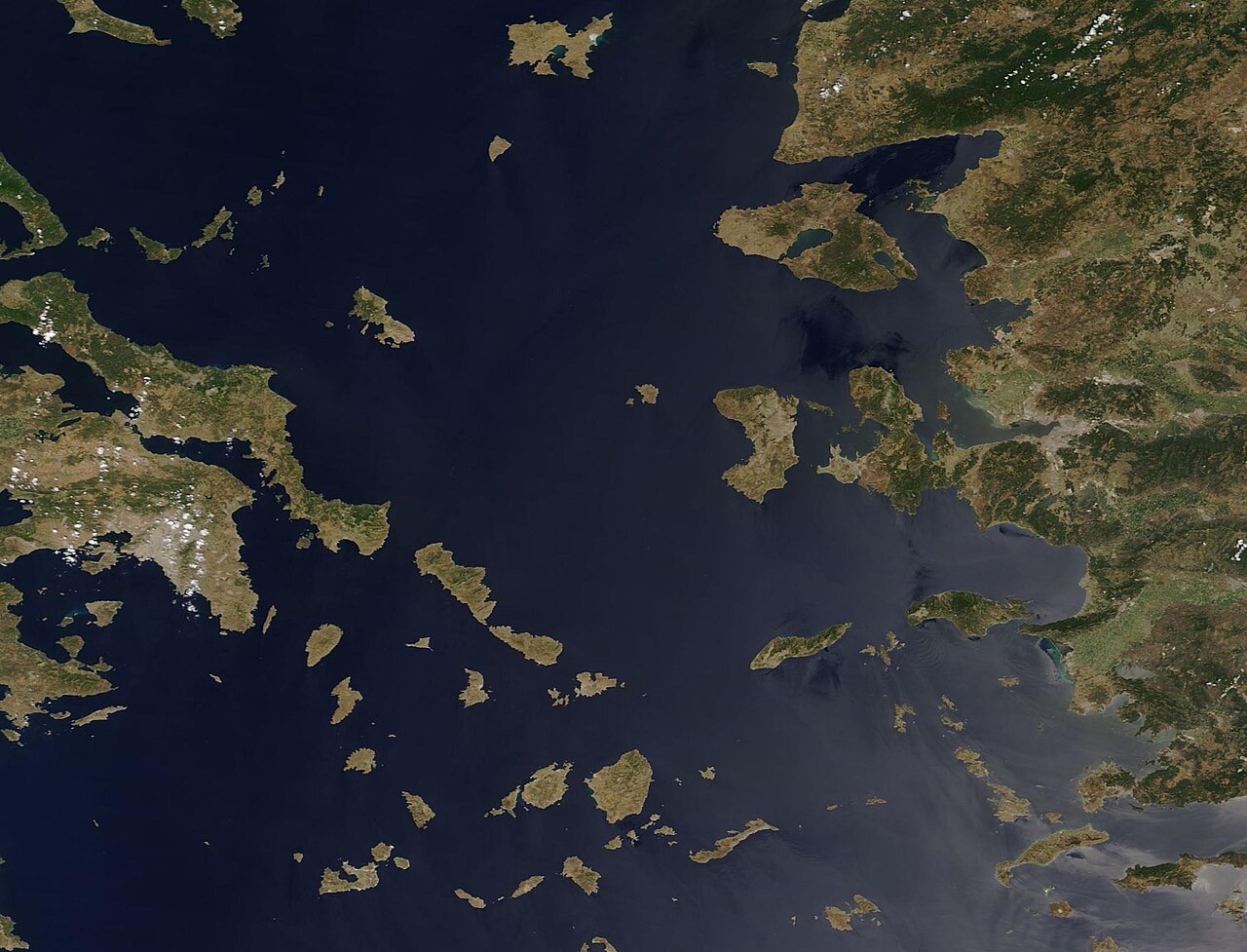
Geography · The Aegean CrossingFind Turkey on a map and look just offshore: the Greek island of Lesbos sits so close that at the narrowest point only about six miles (ten kilometers) of the Aegean Sea separate the two coasts. In 2015 that thin blue line became the busiest refugee corridor on the planet. More than 850,000 people reached the Greek islands that year — roughly half of them landing on Lesbos alone — most launching at night from beaches near the Turkish city of Izmir. The island’s northern shore changed color as tens of thousands of discarded vests piled into orange drifts, so many that trucks hauled them inland to a hill of foam and nylon locals called the life jacket graveyard. Fishermen pulled swimmers aboard; grandmothers on the beach bottle-fed arriving babies. But for the people wading ashore sodden and shaking, the island was never the destination. Lesbos was not an ending at all — it was a doorway.
Visual AidSix miles, seen from orbit
NASA satellite photograph of the Aegean Sea, taken by the MODIS instrument in July 2019 — Greece on the left, Turkey on the right, and the water between them that the Knowledge Bank measures. Find the large island lying close against the Turkish coast near the top: that is Lesbos, and at the narrowest point only about six miles separate it from the shore where the boats launched. From orbit the gap looks like nothing; every drowning of 2015 happened inside distances this picture makes small. The image was taken four years after the crossings it helps you measure, on a clear summer day, and shows no boats — at this scale, nothing so small could ever appear.
Greece, Turkey and the Aegean Sea, NASA MODIS Land Rapid Response Team, July 8, 2019. Source: Wikimedia Commons, File:Greece, Turkey and the Aegean Sea (MODIS 2019-07-08).jpg, public domain.
🧠Knowledge Bank question
1According to the Knowledge Bank, the northern shore of Lesbos changed color in 2015 because ___.Ch.36
2What does Mahmoud beg the people in the passing boat to do?Ch.36
3The captain quietly plans to run the St. Louis aground near England if no country will take the passengers.Ch.37
4What covers the beach where Mahmoud’s family lands on Lesbos?Ch.39
5Write the numbers 1–5 in the boxes to show the correct order of events. Number 1 = what happens first.Chapters 36–42
Isabel’s group begins taking turns floating beside the boat.
The overloaded dinghy flips in the night swells.
Soldiers stop Mahmoud’s family at Hungary’s razor-wire fence.
The St. Louis docks at Antwerp and the passengers are divided.
Baby Hana is handed across the water to a passing boat.
6To keep the sinking boat afloat, Isabel’s group takes turns floating in the water beside it.Ch.38
7Where does the St. Louis finally put its passengers ashore?Ch.40
8Which country is Josef’s family assigned to?Ch.40
9At the Hungarian border, the family is welcomed through and put on a train onward.Ch.42
10What tells Isabel how close her family is to Miami?Ch.41
Part 3
Literary Elements
Understanding HOW and WHY Alan Gratz tells the story across Chapters 36–42.
🎭Knowledge Bank · A Story Told in Braids
Authorial Craft · Parallel NarrationRefugee is built like a braid. Alan Gratz (author) rotates three viewpoints in a strict order — Josef, Isabel, Mahmoud — and ends nearly every chapter on a cliffhanger, cutting away at the exact moment of greatest danger. The rotation is not only for suspense. Gratz (author) lines the strands up so that they rhyme: in Part 6 all three families are on the water at once, separated by decades. While Mahmoud treads the dark Mediterranean, Isabel is bailing the Straits of Florida and Josef is steaming back across the Atlantic toward the continent he fled. Placing scenes side by side so readers compare them is called juxtaposition, and here it makes an argument no single story could make alone: the year changes, the flags change, and the sea does not. Notice what the structure does to you as you read — the forced wait to return to a stranded family becomes its own engine of suspense.
Parallel Narrative
Three protagonists in three eras take turns telling the story in a fixed rotation, so the strands move forward together like lanes of a single road.
Cliffhanger
Chapters break off at the moment of greatest danger — a wave, a fence, a glowing horizon — forcing the reader through two other timelines before any rescue can arrive.
Motif
Open water returns in every strand — the Atlantic, the Straits of Florida, the Mediterranean — until the sea feels like one recurring character wearing three disguises.
🧠Knowledge Bank question
1According to the Knowledge Bank, placing all three families on the water at once lets the structure argue that ___.Chapters 36–42
2Ending the chapter at the instant the dinghy overturns is ___.Ch.36
3Juxtaposition means placing two scenes or images side by side so readers compare them.Chapters 36–42
4Water returning in all three timelines — ocean, strait, and sea — works as ___.Chapters 36–42
5A cliffhanger resolves all of a chapter’s tension before the chapter ends.Ch.36
6Fill in each blank with the correct literary term.Chapters 36–42
Word choices:juxtapositioncliffhangermetaphorepilogue- some words will not be used
Setting Mahmoud’s night at sea beside Isabel’s creates .
Cutting away as the tear gas flies is a .
7Gratz (author) cuts from Mahmoud in the water to another timeline mainly to ___.Ch.36
8A motif is an image or idea that repeats through a story and gathers meaning.Chapters 36–42
9Which pairing is the clearest juxtaposition in Part 6?Chapters 36–42
10Fill in each blank with the correct literary term.Chapters 36–42
Word choices:motifparallelflashbackallusion- some words will not be used
Water returns in every timeline as a .
The three plotlines run on tracks.
Part 4
Think Deeper
Four deeper challenges — no single-word recall. Read, weigh the evidence, and reason it out.
🚧Knowledge Bank · A Border Made of Wire
History · Hungary’s 2015 Border FenceWhen Mahmoud’s family reaches Hungary in Part 6, they walk into brand-new architecture. In the summer of 2015, Hungary’s government built a razor-wire fence roughly 110 miles (175 kilometers) long across its entire southern border with Serbia — directly across the Balkan route that hundreds of thousands of people were walking toward Germany. In mid-September the crossing was declared closed, and climbing the wire became a crime. The next day, at the Röszke border point, crowds pressed against a locked gate, and riot police answered with tear gas and water cannons; families who got through were detained behind wire while officials decided what to do with them. The fence never stopped the movement of people — it bent the human river westward through Croatia and Slovenia within days. As you weigh the challenges below, ask what a border is actually for, and notice that each of the novel’s three timelines answers the question with a wall.
Picture the blackest water you will ever see. The dinghy is gone — one steep wave was all it took — and now a twelve-year-old boy is treading water somewhere between Turkey and Greece, in a life vest that is quietly soaking up the sea instead of floating on it. Somewhere in the dark his mother is holding his baby sister above the chop. When a boat finally passes, it is already full, and it will not stop for a family. It might make room for something smaller. Part 6 is the night everything is handed over — a baby passed across open water to strangers, a ship’s worth of passengers divided among four countries at a Belgian dock, a grandfather’s boat riding lower and lower while the glow of Miami hangs on the horizon like a promise nobody will confirm. Three families, three seas, one question: when you cannot save everything, what do you hold on to, and what do you trust to someone else’s hands?
Original passage written for Garden Heights — not a quotation from the novel.
1Claim: “Part 6 argues that a refugee’s fate hangs on whether strangers choose to help — not on effort alone.” — choose the two details that best prove it.Claim & Evidence
2The sea decides, or People decide? Tap each detail to send it left or right.Sort into two
◄ The sea decidesPeople decide ►
3Match each cause to its result. For each cause, pick its result.Cause & Effect
A boat built for fifteen carries more than forty→
A passing boat has room for one small child→
Hungary strings razor wire along its southern border→
Britain, France, Belgium, and Holland each take a share→
🧠Knowledge Bank question
4Fill both blanks to complete the reasoning.Build the Argument
The Knowledge Bank argues that Hungary's 2015 fence never stopped the movement of people because , which shows that .
Part 5
Standardized Test
A Million Crossings · Reading & Vocabulary · SAT & TOEFL-style practice
Read the passage — the highlighted words are tested — then answer. Tap an answer, then tap it again to confirm.
SATCentral Ideas — the passage's main point
SATInference — a conclusion the passage implies
SATAuthor’s Purpose — what the author wants to achieve
SATWords in Context — a word's meaning in this passage
TOEFLFactual Information — a fact stated in the passage
TOEFLVocabulary — a tested word's meaning here
TOEFLProse Summary — the three sentences that sum it up
A Million Crossings
In 2015 more than one million people crossed the Mediterranean Sea to Europe — the largest movement of refugees there since the Second World War. Most aimed at a narrow gap in the Aegean Sea, where the Greek island of Lesbos lies only about six miles off the Turkish coast. On a clear day, each shore can see the other. More than 850,000 people reached the Greek islands that year, roughly half of them landing on Lesbos alone.
The crossing was short, but it was never safe. Smugglers — criminals paid to move people across borders — charged a thousand American dollars or more for a seat in an inflatable boat built for perhaps fifteen passengers and loaded with forty, so overloaded that one wave could capsize it. The smugglers stayed ashore, handing the tiller to whichever passenger agreed to steer. Many of the life vests sold to families who could not swim were counterfeit, stuffed with packing foam that was not buoyant at all; it soaked up seawater, hung sodden and heavy, and dragged swimmers down. Nearly 3,800 people drowned or went missing in the Mediterranean that year alone.
A Greek beach, though, was only the middle of the journey. From the islands, ferries ran to Athens, and from there a makeshift highway of buses, trains, and footpaths — the Balkan route — carried people north through Macedonia and Serbia toward Germany. In September 2015, Hungary sealed its southern border with a razor-wire fence roughly 110 miles long, and travelers caught crossing were detained or turned back. The fence did not stop the river of people; it bent the route westward, and the hardest miles of a million journeys began on the far side of the sea.
Original passage written for Garden Heights — not a quotation from the novel.
1What is the main idea of the passage?SAT · Central Ideas
2According to the passage, about how many people landed on Lesbos in 2015?TOEFL · Factual Information
3It can be inferred that smugglers handed the tiller to a passenger because they ___.SAT · Inference
4The counterfeit vests were dangerous because their stuffing ___.TOEFL · Factual Information
5The author calls a Greek beach ‘the middle of the journey’ mainly to ___.SAT · Author’s Purpose
6The passage suggests that Hungary’s fence mainly ___.SAT · Inference
7In paragraph 2, buoyant most nearly means ___.SAT · Words in Context
8In the passage, capsize most nearly means ___.SAT · Words in Context
9In the passage, sodden most nearly means ___.TOEFL · Vocabulary
10Prose Summary (TOEFL).The passage explains why 2015 became the year a million people crossed the sea to Europe — and why arrival was only the middle of the journey. This TOEFL task lists six sentences; choose the THREE that best capture the passage’s main ideas. The other three do not belong — they state minor details or ideas the passage does not present.TOEFL · Prose Summary
Part 6 · Optional
Creative Writing
A bonus challenge to practice your English. Take your time and have fun with it.
About This Section
This writing task is optional and is not part of your auto-graded score. The feedback below checks only the basics — length, spelling, and grammar — not whether your ideas are right or wrong. It is meant for classroom discussion and creative practice, so feel free to use your imagination!
Writing Task — Part 6 “The Day You Chose to Be Seen”
In the water, Mahmoud stops trying to be invisible — he shouts, waves, and begs a passing boat to notice his family, and being noticed is what saves his sister. Write about a time you chose to speak up or ask for help instead of staying quiet — or a time you noticed someone else who needed to be seen. Describe what made it hard, what you decided, and what changed because of it. 6–10 sentences. End with what you would tell someone who is afraid to ask for help.
You can start with: “Staying quiet felt safer, but...”
0 / 40 words minimum
🗣 Teach It · Just for Fun (optional)
No right or wrong — close the screen and tell someone nearby what happened in this part. Can’t find anyone? Tell yourself out loud. The moment you teach it, you truly understand it.
Independent study guide by Garden Heights. Not affiliated with or endorsed by Alan Gratz. Contains original analysis only; no text from the novel is reproduced. Reference text: This workbook follows Alan Gratz’s classic text (the standard Puffin edition sold worldwide). Revised 2023 UK editions change some wording and may not match the vocabulary studied here.