New here? Just sign up with Google — your account includes Matilda, our gift book, forever.
What Happens in Part 6
The farm fills with neighbors. Matthew, Maggie, and their two children come to help Papa plow the field for corn, and they bring Sarah a gift of three chickens — which she loves at once (Anna knows they will never end up on the dinner table). While the men work the fields, Maggie and Sarah cook together and talk, and both admit how much they miss the homes they left behind. Maggie has also brought flowers, so the women and Anna plant a garden together. Maggie offers to teach Sarah to drive the wagon so she can visit — and Sarah, in overalls, boldly asks Papa to teach her to ride the horse Jack and drive the wagon herself. Papa hesitates, but a storm is gathering on the horizon, so he says the lesson must wait; first he has to mend the roof before the rain. Sarah, a skilled carpenter, insists on climbing up to help him.
What We Will Learn
Focus
What It Means
Foil (Character Parallel)
How Maggie mirrors Sarah’s own journey
Frontier Community
Neighbors sharing work, gifts, and company
Theme (Independence)
Sarah wanting to ride, build, and drive the wagon
Chapter Summary
Chapter
Key Events
Ch.7
Neighbors come to plow; the children give Sarah three chickens; Maggie and Sarah share their homesickness and plant a garden; Sarah asks to learn to ride and drive, but a coming storm sends Papa up to mend the roof, with Sarah helping
💭 Before You Read · Warm-Up (not scored)
There are no wrong answers here — just think, guess, and talk:
Maggie has also left a faraway home to live on the prairie. Why might it help Sarah to meet someone like her?
Sarah wants to learn to ride a horse and drive the wagon herself. Why might that independence matter so much to her?
Predict: a storm is gathering as the chapter ends. What might a big storm change for this family?
Copyright Notice
This is an independent study guide created by Garden Heights Academy to support reading comprehension and literary analysis. It contains original analysis questions and does not reproduce any text from the novel. Sarah, Plain and Tall is a work by Patricia MacLachlan. This guide is not affiliated with, authorized by, or endorsed by the author or any associated rights holder.
Part 1
Vocabulary
Study 10 key words from Chapter 7, then answer each question.
🧠Knowledge Bank · Breaking the Prairie Sod
Agricultural Technology · The Steel PlowPrairie grass grows a mat of roots so dense that early wooden plows simply jammed in it, and the first breaking teams needed several yoke of oxen to drag one furrow. The remedy arrived in 1837, when a blacksmith named John Deere shaped a plow from polished steel. Sticky black soil slid off its curved face instead of clinging, so a single farmer with a pair of horses could turn a field alone. Sod broken in spring was left to rot down before it would carry a crop. Only then could the ground be planted, tended, and at last brought to harvest.
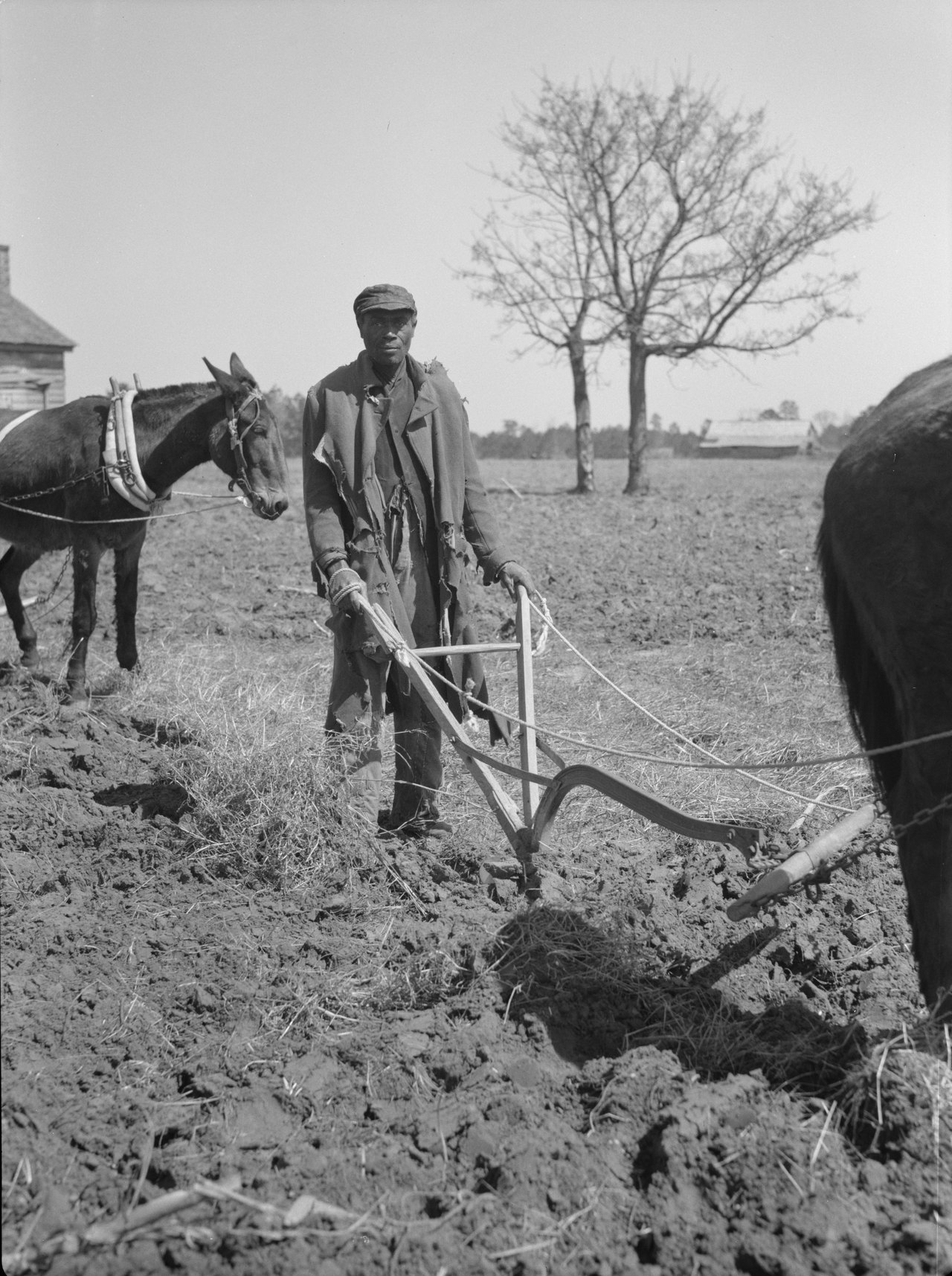
Visual AidOne man, one animal, one plow
Photograph by Arthur Rothstein, taken in April 1937 for a government program, of a sharecropper in Montgomery County, Alabama, guiding a walking plow behind a mule across a bare field. The Knowledge Bank explains that prairie roots once jammed wooden plows until John Deere shaped a plow from polished steel in 1837, so that sticky soil slid off its curved face and a single farmer with a pair of horses could turn a field alone. The curved steel blade turning the earth here is that invention, still at work a century later. This is Alabama cotton country, not the prairie, and one mule rather than two horses. Notice the furrow curling over behind the blade — the soil slides off instead of clinging.
Sharecropper plowing, Montgomery County, Alabama, April 1937; photograph by Arthur Rothstein, Farm Security Administration, Library of Congress. Source: Wikimedia Commons, public domain.
plowv.Ch.7
To cut and turn over soil to prepare it for planting
“The horses helped him plow the field before spring.”
harvestn.Ch.7
The crops gathered at the end of the season
“The whole family worked hard to bring in the harvest.”
neighborn.Ch.7
A person who lives near you
“Their nearest neighbor lived many miles away.”
seedlingn.Ch.7
A young plant just beginning to grow
“She watered each tiny seedling in the new garden.”
overallsn.Ch.7
Loose work trousers with a bib, worn over clothes
“Sarah pulled on overalls to work in the field.”
carpentern.Ch.7
A person skilled at building with wood
“As a carpenter, Sarah could mend the roof herself.”
insistv.Ch.7
To say firmly that something must happen
“She insisted on helping, no matter what.”
brewv.Ch.7
To build up and get ready to happen (a storm)
“Dark clouds meant a storm was brewing.”
mendv.Ch.7
To fix something that is broken or worn
“Papa hurried to mend the roof before the rain.”
sturdyadj.Ch.7
Strong and well built
“They needed a sturdy roof to keep out the storm.”
🧠Knowledge Bank question
1According to the Knowledge Bank, John Deere's polished steel plow succeeded because ___.Ch.7
2A “harvest” is ___.Ch.7
3A “neighbor” is ___.Ch.7
4Fill in each blank with the correct word.Ch.7
Word choices:seedlingoverallsharvestmend- some words will not be used
Each tiny must go into the ground before the rain.
Sarah pulls on a pair of for the day’s hard work.
5True or False: “Overalls” are loose work trousers with a bib, worn for hard jobs.Ch.7
6Fill in each blank with the correct word.Ch.7
Word choices:carpenterbrewingsturdyinsist- some words will not be used
Sarah is a skilled who can build with wood.
Dark clouds pile up — a storm is .
7To “insist” is to ___.Ch.7
8When a storm is “brewing,” it is ___.Ch.7
9To “mend” the roof is to ___.Ch.7
10True or False: Something “sturdy” is weak and easily broken.Ch.7
Part 2
Comprehension
How well do you understand Chapter 7?
🧠Knowledge Bank · Neighbors Who Trade Labor
Rural Sociology · Shared WorkCertain farm jobs are simply too large for one household. Plowing a field before the weather turns, raising a barn, threshing grain before it spoils — each carries a deadline, and missing one can cost a whole year. So plains families ran an unwritten system: you brought your team and your hands to a neighbor’s place, and when your own deadline came, everyone turned up at yours. No money changed hands, and the account was kept in memory and in food. Because farms sat miles apart, these gatherings supplied the month’s only company, which made a punishing day of labor feel oddly like a holiday.
Visual AidNeighbors who trade labor
Diagram for the Knowledge Bank on shared work. The three cards follow the unwritten system the Knowledge Bank describes, your team and hands at a neighbor’s deadline, everyone at yours when it comes, and an account kept in memory and in food, with a dashed arrow showing the cycle repeating. It does not name the neighbors in the book. Notice that no card mentions money — the Knowledge Bank says none ever changed hands.
The labor-trading cycle as described in the Knowledge Bank. Drawn for Garden Heights Academy.
🧠Knowledge Bank question
1The Knowledge Bank says plains families traded labor because certain jobs ___.Ch.7
2The neighbor children bring Sarah three chickens as a gift.Ch.7
3How does Sarah feel about the chickens?Ch.7
4What do Maggie and Sarah talk about while cooking?Ch.7
5Put these events from Part 6 in the correct order. Write 1–5 (1 = first).Ch.7
Sarah asks Papa to teach her to ride and drive the wagon.
Maggie and Sarah talk about the homes they each miss.
Maggie gives Sarah flowers to plant a garden.
The neighbor children give Sarah three chickens.
Matthew and Maggie arrive to help Papa plow.
6What does Maggie offer to teach Sarah?Ch.7
7What does Sarah boldly ask Papa to teach her?Ch.7
8Why must the riding lesson wait?Ch.7
9How does Sarah help with the roof?Ch.7
10True or False: Maggie is the only person Sarah has met who also came from far away to the prairie.Ch.7
Part 3
Literary Elements
Understanding HOW and WHY Patricia MacLachlan tells the story across Chapter 7.
🧠Knowledge Bank · A Character Held Up Beside Another
Literary Craft · The FoilA foil is a character a writer sets beside another so the first one becomes easier to see. The trick is contrast built on likeness: the two must share enough — an age, a job, a history — that whatever differs between them stands out sharply. Foils are also efficient. Rather than explaining a character’s fears at length, a writer introduces somebody who has already met those same fears, and the comparison does the explaining. Watch for a newcomer who resembles a main character but has traveled further along the same road, because such a person is never brought on stage by chance.
📚 Literary Devices in This Part · definitions & examples
A foil is a character who parallels or contrasts with another to reveal something about them. Maggie mirrors Sarah — both left faraway homes — so Maggie’s settled, happy life hints at what Sarah’s could become. An aphorism is a short saying that holds a big truth, like Maggie’s wisdom that ‘there are always things to miss.’
1Fill in each blank with the correct literary term.Ch.7
Word choices:foilforeshadowingrhymesetting- some words will not be used
A character whose story mirrors the hero’s — like Maggie for Sarah — is a .
The storm gathering at the chapter’s end is of trouble ahead.
🧠Knowledge Bank question
2According to the Knowledge Bank, a foil works through contrast built on ___.Ch.7
3What does Maggie’s happy, settled life suggest about Sarah’s future?Ch.7
4Fill in each blank with the correct literary term.Ch.7
Word choices:aphorismmotifnarratortitle- some words will not be used
‘There are always things to miss’ is an — a short, wise saying.
Missing home, which returns again and again in this book, is a .
5True or False: A foil can help readers understand a main character by comparison.Ch.7
6Sarah wearing overalls and demanding to ride and build mostly reveals her as ___.Ch.7
7The gathering storm at the chapter’s end is an example of ___.Ch.7
8Why might the author place Sarah’s bid for independence right before a storm?Ch.7
9True or False: Foreshadowing gives the reader a hint about what may happen later.Ch.7
10True or False: A foil is a character whose situation mirrors the main character’s, helping us understand them better.Ch.7
Part 4
Think Deeper
Four deeper challenges — no single-word recall. Read, weigh the evidence, and reason it through.
🧠Knowledge Bank · Roots Deeper Than a House
Botany · Prairie PlantsThe tall grasses and wildflowers of the plains survive by growing downward. One big bluestem plant can drive roots eight feet (2.4 m) or more beneath the surface, well past the reach of summer heat, and that buried mass regrows the whole plant after fire, drought, or grazing. Garden vegetables own no such armor. A bean or tomato seedling roots shallowly and must be watered, shaded, and coaxed, which is why a planted garden out here amounted to a promise of months of attention. Wild prairie endures on its own; a vegetable patch lives only as long as somebody keeps watering.
1Claim: “Maggie helps Sarah see she can love her new home while missing the old.” — choose the two details that best prove it.Claim & Evidence
2Shows the warmth of the community, or a worry Sarah still carries? Tap each item to sort it — tap again to switch sides. You can keep tapping to change your answer.Sort into two
◄ Warmth of the communityA worry Sarah carries ►
3Match each cause to its result. For each cause, pick its result.Cause & Effect
The neighbors come to plow→
They bring Sarah three chickens→
Sarah confides she misses home→
Maggie’s words sink in→
🧠Knowledge Bank question
4Fill both blanks to complete the reasoning.Build the Argument
The Knowledge Bank says wild prairie grass survives fire, drought, and grazing because , while a planted garden .
Part 5
Standardized Test
Key Details & Inference — SAT & TOEFL-style practice
Read the passage — the highlighted words are tested — then answer. Tap an answer, then tap it again to confirm.
SATWords in Context — a word's meaning in this passage
SATInference — a conclusion the passage implies
TOEFLFactual Information — a fact stated in the passage
TOEFLProse Summary — the three sentences that sum it up
TOEFLRhetorical Purpose — why the author included a detail
The Many Uses of a Hen
Long before shops sold eggs in cartons, almost every farm kept a small flock of hens, and a good hen was one of the most useful animals a family could own. Best of all, a healthy hen lays an egg nearly every day, giving the family fresh food that costs almost nothing. Hens also help in ways that are easy to miss. They peck up insects and weed seeds around the yard, keeping pests down, and their droppings make the garden soil richer. They need very little in return: some grain, clean water, and a safe, sturdy coop where they can roost at night, out of reach of foxes. Extra eggs could even be traded with a neighbor for flour or thread. A hen will also warn the farm of danger, setting up a loud alarm when a hawk's shadow crosses the yard. For all these reasons, three little hens were a thoughtful gift indeed. They were not a toy but a small, clucking source of food, help, and company that would earn its keep for years and quickly become cherished as part of the family.
Original passage written for Garden Heights — not a quotation from the novel.
1In the passage, a hen is called a “useful” animal because it —SAT · Words in Context
2How often does a healthy hen lay an egg?TOEFL · Factual Information
3In the passage, a neighbor is ___.SAT · Words in Context
4Where does a hen “roost” at night?TOEFL · Factual Information
5A sturdy coop is one that is ___.SAT · Words in Context
6Besides eggs, how do hens help the garden?TOEFL · Factual Information
7What can the reader infer about keeping hens?SAT · Inference
8The passage says the hens would become “cherished” as part of the family because they —SAT · Inference
9Prose Summary (TOEFL).The passage shows why hens were so valuable to a farm family. This TOEFL task lists six sentences; choose the THREE that best capture the passage’s main ideas. The other three do not belong — they state minor details or ideas the passage does not present.TOEFL · Prose Summary
10This passage helps us understand Chapter 7 because the three chickens are —TOEFL · Rhetorical Purpose
Part 6 · Optional
Creative Writing
A bonus challenge to practice your English. Take your time and have fun with it.
About This Section
This writing task is optional and is not part of your auto-graded score. The feedback below checks only the basics — length, spelling, and grammar — not whether your ideas are right or wrong. It is meant for classroom discussion and creative practice, so feel free to use your imagination!
Writing Task — Part 6 “A Neighbor’s Helping Hand”
In this chapter, neighbors arrive to share the hard work and swap gifts and stories. Write about a time neighbors, friends, or family came together to help with a big job or to celebrate something. What did everyone do, and how did working together feel? Write at least 40 words.
You can start with: “I remember a day when everyone came together to…”
0 / 40 words minimum
🗣 Teach It · Just for Fun (optional)
No right or wrong — close the screen and tell someone nearby what happened in this part. Can’t find anyone? Tell yourself out loud. The moment you teach it, you truly understand it.
Part 6 Complete!
You finished Chapter 7 of Sarah, Plain and Tall.
Here are your auto-graded results:
-
points out of 100
Teach it to someone
The best last step is to teach it. In your own words, explain what happened — retell a favorite scene, teach a character’s big choice, or sum up the main idea for a parent, friend, or classmate. When you can teach it clearly, you truly own it.
Independent study guide by Garden Heights Academy. Not affiliated with or endorsed by the author or any rights holders. Contains original analysis only; no text from the novel is reproduced.
SAT® is a registered trademark of College Board, which is not affiliated with, and does not endorse, these materials. TOEFL® is a registered trademark of ETS. These materials are not endorsed or approved by ETS. Garden Heights is an independent provider of test-style reading practice.