New here? Just sign up with Google — your account includes Matilda, our gift book, forever.
What Happens in Part 8
The story reaches its quiet, beautiful end. After the storm, the family replants the crops the hail had beaten down, and Papa keeps his promise to teach Sarah to ride the horse and drive the wagon. Then, the next day, Sarah drives off to town all alone. The children are gripped by a terrible fear: has Sarah decided to leave them and return to the sea? The hours crawl by. But by suppertime the wagon returns — and Sarah is in it. She has brought gifts for the children, and among them are three colored pencils: blue, gray, and green — the colors of the sea. She went to town not to leave, but to buy the sea’s own colors, so she can keep the ocean she loves and the prairie family she has come to love. Sarah is staying. And Papa tells the children the happiest news of all: he and Sarah will marry in the autumn.
What We Will Learn
Focus
What It Means
Symbol (the pencils)
How three colors can mean ‘I am staying’
Resolution & Theme
Belonging: keeping the old home while making a new one
Suspense
The fear that Sarah has left, and the joy of her return
Chapter Summary
Chapter
Key Events
Ch.9
After the storm the family replants; Papa teaches Sarah to ride and drive; Sarah goes to town alone and the children fear she has left for good, but she returns with three sea-colored pencils — she is staying, and she and Papa will marry in autumn
💭 Before You Read · Warm-Up (not scored)
There are no wrong answers here — just think, guess, and talk:
Sarah buys pencils in the sea’s colors instead of going back to the sea. What might those colors mean?
The children are terrified Sarah has left. Why is the fear of losing someone often strongest just before good news?
Looking back over the whole book: what small moments, from shells to haystacks to a squall, finally led Sarah to stay?
Copyright Notice
This is an independent study guide created by Garden Heights Academy to support reading comprehension and literary analysis. It contains original analysis questions and does not reproduce any text from the novel. Sarah, Plain and Tall is a work by Patricia MacLachlan. This guide is not affiliated with, authorized by, or endorsed by the author or any associated rights holder.
Part 1
Vocabulary
Study 10 key words from Chapter 9, then answer each question.
🧠Knowledge Bank · Planting a Field Twice
Crop Science · ReplantingA ruined field is not automatically a lost year. Farmers assess the damage, count the days remaining before the first frost, and work out whether time is left — a crop needing ninety days can be sown again in early summer and still ripen by autumn. Quick-growing plants are chosen for that second sowing, and a few crops surprise everybody by pushing fresh shoots from undamaged roots. This is what farmers mean by replanting: not stubbornness but arithmetic. Weather can destroy a season’s labor in an afternoon, and the ordinary answer is a calendar, saved seed, and a second start.
Visual AidReplanting is arithmetic
Chart for the Knowledge Bank on replanting. The long bar is the days left before the first frost and the shorter bar is the days a quick crop needs to ripen, the two numbers the Knowledge Bank says a farmer compares; the red card is the decision that comparison makes. The figures are an example, not a count from the book. Notice that the crop bar fits inside the frost bar — when it does not, no amount of stubbornness will ripen the field.
Days to frost against days to ripen, as described in the Knowledge Bank; example values. Drawn for Garden Heights Academy.
replantv.Ch.9
To plant crops again after a loss
“After the hail, they had to replant the ruined corn.”
belongv.Ch.9
To have a rightful, welcome place somewhere
“At last Sarah felt she truly belonged on the farm.”
marryv.Ch.9
To become husband and wife
“Papa said he and Sarah would marry in the autumn.”
autumnn.Ch.9
The season after summer, when crops are gathered
“The wedding would be held in the golden autumn.”
journeyn.Ch.9
A trip from one place to another
“Sarah’s long journey had led her to a new home.”
decidev.Ch.9
To make up your mind about something
“Sarah had to decide whether to stay or to go.”
promisen.Ch.9
Something you swear you will truly do
“Papa kept his promise to teach her to drive.”
contentadj.Ch.9
Quietly happy and satisfied
“Sarah felt content at last among her new family.”
foreveradv.Ch.9
For all time; without ending
“She would keep the sea in her heart forever.”
welcomeadj.Ch.9
Gladly received and wanted
“Sarah’s return was the most welcome sight of all.”
🧠Knowledge Bank question
1According to the Knowledge Bank, replanting is not stubbornness but ___.Ch.9
2To “belong” somewhere is to ___.Ch.9
3To “marry” is to ___.Ch.9
4Fill in each blank with the correct word.Ch.9
Word choices:autumnjourneypromiseforever- some words will not be used
The wedding will come in the , after the harvest.
Sarah’s trip to town is her first alone on the prairie.
5True or False: A “journey” is a trip from one place to another.Ch.9
6To “decide” is to ___.Ch.9
7A “promise” is ___.Ch.9
8Someone who is “content” feels ___.Ch.9
9Fill in each blank with the correct word.Ch.9
Word choices:forevercontentdecidebelong- some words will not be used
Sarah decides to stay — not for a month, but .
By supper, everyone is quietly at last.
10True or False: If something is “welcome,” it is gladly received and wanted.Ch.9
Part 2
Comprehension
How well do you understand Chapter 9?
🧠Knowledge Bank · Driving a Team to Town
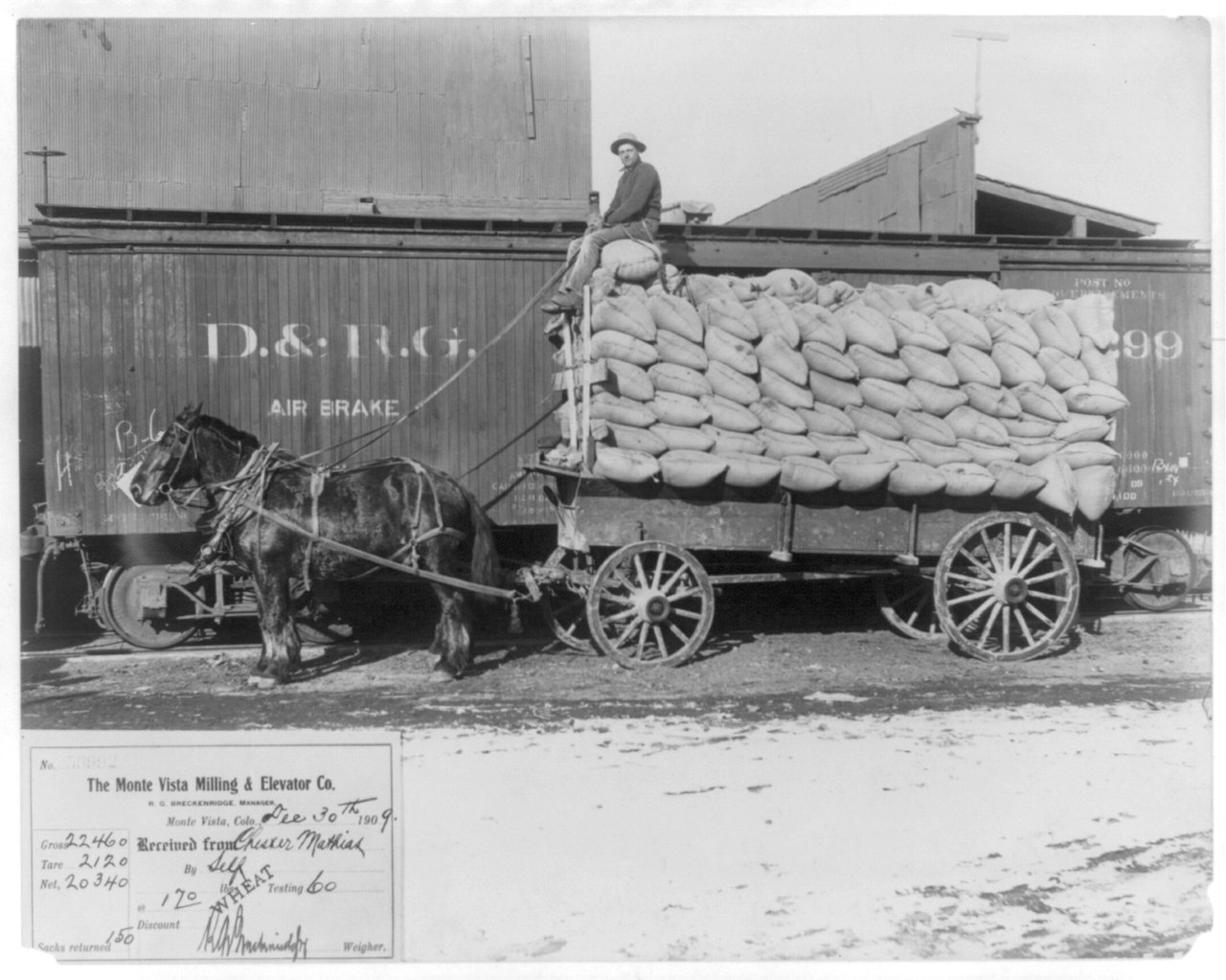
Frontier Skills · Horses and WagonsBefore automobiles, a farm’s transport was two horses and a wagon, and handling them was a skill nobody was born with. The driver holds four reins, one pair to each animal, and steers with small pulls and spoken words the team already knows; a steep grade, a hidden rut, or one startled horse can turn a trip dangerous. The nearest town might sit ten miles (16.1 km) off, which swallowed most of a day going and coming. Anybody who could not drive depended on somebody else for mail, flour, seed, and news. Learning to manage a team was really about being able to go somewhere alone.
Visual AidA team hauling a record load
Photograph taken in 1910 of two horses hitched to a wagon stacked high with sacks of wheat, a driver perched on top of the load beside a railroad freight car, labeled by its maker as a record load. The Knowledge Bank explains that a farm’s transport was two horses and a wagon, that the driver held four reins, one pair to each animal, and that a trip to town could swallow most of a day. Here is such a team at the end of that trip, delivering grain to the railroad. The load is far heavier than anything in the story, and the photograph was made to show off. Notice the driver’s seat on top of the sacks — from there he steers two animals with small pulls and spoken words.
Record load of wheat, 1910; Library of Congress. Source: Wikimedia Commons, public domain.
🧠Knowledge Bank question
1The Knowledge Bank says learning to manage a team was really about ___.Ch.9
2Papa teaches Sarah to ride the horse and drive the wagon.Ch.9
3What does Sarah do the next day that frightens the children?Ch.9
4What do the children fear Sarah has decided to do?Ch.9
5Put these events from Part 8 in the correct order. Write 1–5 (1 = first).Ch.9
Papa teaches Sarah to drive the wagon.
Sarah drives off to town alone.
Sarah returns by supper with three sea-colored pencils.
The family replants the crops the hail destroyed.
The children wait all day, afraid she has gone for good.
6What special gift does Sarah bring the children?Ch.9
7Why are those pencil colors so meaningful?Ch.9
8What happy news does Papa share?Ch.9
9True or False: Sarah went to town to buy a ticket back to Maine.Ch.9
10By the end, Sarah has decided to ___.Ch.9
Part 3
Literary Elements
Understanding HOW and WHY Patricia MacLachlan tells the story across Chapter 9.
🧠Knowledge Bank · How Stories Close a Circle
Literary Craft · Resolution and MotifThe resolution is the stretch after a story’s tension breaks, when the reader finally learns how matters settle. Skilled writers often close by bringing back an object introduced early; a returning image of that kind is called a motif. Its meaning has shifted in the meantime, and the shift is the whole point, because the very thing that once measured a loss can end up measuring a choice. Since the reader remembers the first appearance, the last one lands without a word of explanation. A quiet ending built this way answers the question the book has been asking since its opening page.
📚 Literary Devices in This Part · definitions & examples
The resolution is the part of a story where the main problem is solved and the ending becomes clear — here, Sarah decides to stay. A symbol is an object that stands for a bigger idea; the three sea-colored pencils stand for Sarah keeping both her old home (the sea) and her new one (the family). Together they give the book its quiet, powerful ending.
1Fill in each blank with the correct literary term.Ch.9
Word choices:resolutionthemerhymesetting- some words will not be used
The part where the story’s big question is answered is the .
The big idea the whole book explores is its .
🧠Knowledge Bank question
2According to the Knowledge Bank, a returning object's meaning ___.Ch.9
3What do the sea-colored pencils stand for?Ch.9
4True or False: A good ending can answer a story’s big question with a single image instead of a long explanation.Ch.9
5Sarah driving off alone builds a feeling of ___ before the happy ending.Ch.9
6Fill in each blank with the correct literary term.Ch.9
Word choices:motifsymbolnarratortitle- some words will not be used
The sea — shells, dunes, songs, colors — runs through the book as a .
One small object carrying a large meaning is a .
7The book’s central theme is best stated as ___.Ch.9
8True or False: A symbol lets one small object carry a story’s largest meaning.Ch.9
9Why is buying the sea’s COLORS a better ending than Sarah simply saying ‘I will stay’?Ch.9
10True or False: The resolution is where a story’s main question is finally answered — here, whether Sarah will stay.Ch.9
Part 4
Think Deeper
Four deeper challenges — no single-word recall. Read, weigh the evidence, and reason it through.
🧠Knowledge Bank · Carrying One Home Into Another
Cultural Psychology · Place AttachmentPeople who move a long way almost never swap one home for another cleanly. Researchers call the bond we form with a place attachment, and it behaves much like affection for a person: it fades slowly, comes flooding back with a smell or a tune, and need not be surrendered before a new bond can grow. Migrants everywhere manage it the same way, carrying old recipes, names, songs, and small objects into the new country and letting them go on working there. English even has a phrase for settling somewhere — putting down roots — and a plant rooted in fresh ground is still the same seed.
1Claim: “Sarah chooses to stay because the family has become her true home.” — choose the two details that best prove it.Claim & Evidence
2The family’s fear that Sarah will leave, or the signs she will stay? Tap each item to sort it — tap again to switch sides. You can keep tapping to change your answer.Sort into two
◄ Fear she will leaveSigns she will stay ►
3Match each cause to its result. For each cause, pick its result.Cause & Effect
Papa keeps his promise→
Sarah drives to town alone→
Sarah returns with colored pencils→
Sarah says she’d miss them most→
🧠Knowledge Bank question
4Fill both blanks to complete the reasoning.Build the Argument
The Knowledge Bank says place attachment behaves like affection for a person, so it , which is why migrants carry .
Part 5
Standardized Test
Main Idea & Theme — SAT & TOEFL-style practice
Read the passage — the highlighted words are tested — then answer. Tap an answer, then tap it again to confirm.
SATWords in Context — a word's meaning in this passage
SATInference — a conclusion the passage implies
SATAuthor’s Purpose — what the author wants to achieve
SATCentral Ideas — the passage's main point
TOEFLFactual Information — a fact stated in the passage
TOEFLInsert Text — where a sentence best fits
TOEFLRhetorical Purpose — why the author included a detail
How a New Place Becomes Home
What turns a strange new place into a real home? It almost never happens all at once. When people make a long journey to somewhere far away, a new town, a new country, a new family, they usually feel like a stranger at first, aching for the place they left. But home, it turns out, is something you slowly build, not something you simply find. Little by little, a new place fills with familiar things: a favorite window, the names of the neighbors, a path your own feet have worn. Most people also carry small pieces of their old home with them, a photograph, a recipe, a few treasured objects, and keeping these does not hold them back; it helps them feel whole while they put down new roots. In time, the heart makes room for two places at once: the one you came from, which you never stop loving, and the one you are becoming part of. To truly belong somewhere new, then, is not to forget where you began; it is to love a second place without letting go of the first.
Original passage written for Garden Heights — not a quotation from the novel.
1In the passage, a journey is ___.SAT · Words in Context
2According to the passage, home is something you —TOEFL · Factual Information
3To “build” a home, in this passage, means to —SAT · Words in Context
4Why do people keep “treasured” objects from their old home?TOEFL · Factual Information
5To belong somewhere is to ___.SAT · Words in Context
6What can the reader infer about feeling at home?SAT · Inference
7The author defines what it means to “belong” somewhere new at the very end mainly to —SAT · Author’s Purpose
8Insert Text (TOEFL). Look at the four squares [1]–[4] in the passage excerpt below. They show where the following sentence could be added: “The old keepsakes are not chains; they are roots carried in the hand.”
[1] Little by little, a new place fills with familiar things: a favorite window, the names of the neighbors, a path your own feet have worn. [2] Most people also carry small pieces of their old home with them — a photograph, a recipe, a few treasured objects — and keeping these does not hold them back; it helps them feel whole while they put down new roots. [3] In time, the heart makes room for two places at once: the one you came from, which you never stop loving, and the one you are becoming part of. [4]
Where would the sentence fit best?TOEFL · Insert Text
9Which sentence best states the main idea?SAT · Central Ideas
10This passage connects to the end of the book because Sarah —TOEFL · Rhetorical Purpose
Part 6 · Optional
Creative Writing
A bonus challenge to practice your English. Take your time and have fun with it.
About This Section
This writing task is optional and is not part of your auto-graded score. The feedback below checks only the basics — length, spelling, and grammar — not whether your ideas are right or wrong. It is meant for classroom discussion and creative practice, so feel free to use your imagination!
Writing Task — Part 8 “What Makes a Home”
Sarah keeps the sea she loves and still makes the prairie her home. What makes a place feel like home to you? Is it people, places, objects, or feelings? Could you love a new home without forgetting an old one, the way Sarah does? Write at least 40 words.
You can start with: “To me, home is not just a place — it is…”
0 / 40 words minimum
🗣 Teach It · Just for Fun (optional)
No right or wrong — close the screen and tell someone nearby how Sarah’s story ends, and why she chose to stay. Can’t find anyone? Tell yourself out loud. The moment you teach it, you truly understand it.
🎉 You Finished Sarah, Plain and Tall! 🎉
Mini Report Card · the whole journey, part by part
Part
What Happened
Big Idea
1
Papa’s advertisement; Sarah’s letters from Maine
Honest hope
2
Sarah arrives with sea shells and her cat, Seal
Bringing your true self
3
Shells on the sill, dried flowers, hair for the birds
Small acts of belonging
4
The sheep, and Papa’s haystack ‘dunes’
Kindness as a gift
5
Swimming and pretend waves in the cow pond
Joy builds hope
6
Neighbors plow; three chickens; a garden; a storm brews
Community & independence
7
The hailstorm; the night in the barn draws Papa and Sarah close
Danger that unites
8
Sarah stays — three sea-colored pencils; an autumn wedding
Belonging to two homes
Sarah journeyed far from the sea — and found a home without ever letting the sea go. Now you know her whole story. Well done, reader.
Part 8 Complete!
You finished Chapter 9 of Sarah, Plain and Tall.
Here are your auto-graded results:
-
points out of 100
Teach it to someone
The best last step is to teach it. In your own words, explain what happened — retell a favorite scene, teach a character’s big choice, or sum up the main idea for a parent, friend, or classmate. When you can teach it clearly, you truly own it.
Independent study guide by Garden Heights Academy. Not affiliated with or endorsed by the author or any rights holders. Contains original analysis only; no text from the novel is reproduced.
SAT® is a registered trademark of College Board, which is not affiliated with, and does not endorse, these materials. TOEFL® is a registered trademark of ETS. These materials are not endorsed or approved by ETS. Garden Heights is an independent provider of test-style reading practice.